
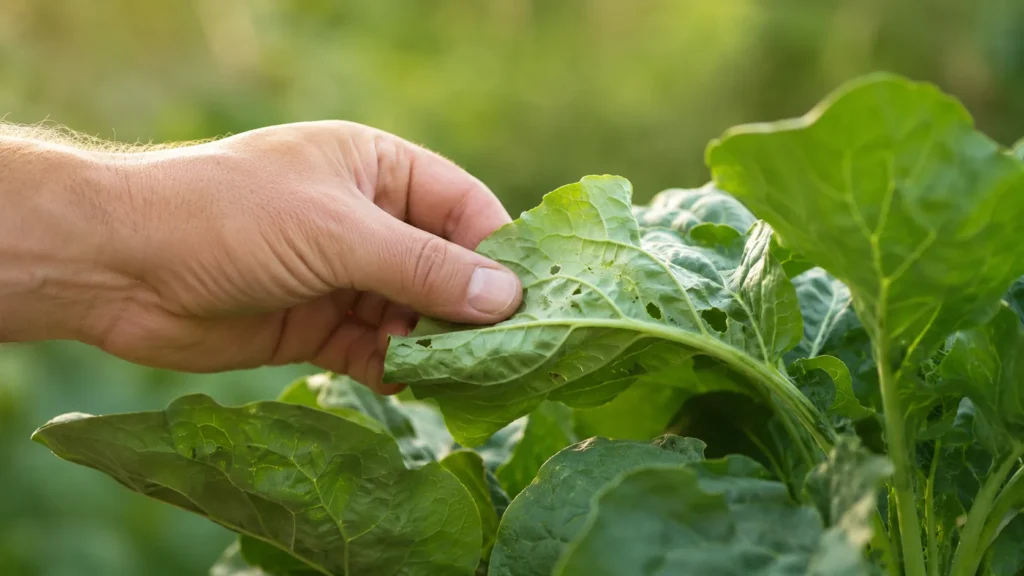
Something is eating your plants and you cannot see what. Start with the damage, not the insect. The pest is usually gone by the time you look, but the marks it leaves behind are still there, and different pests leave different marks. Holes are not just holes. A chewed leaf, a curled leaf and a skeletonized leaf point at three different culprits.
This guide works backward from what you can actually see. Every identification and every control step below is attributed to a university extension service, and the sources are listed at the end.
One Link for Your Whole Garden
A short address you control, pointing to your growing notes, your pages and everything else you share.
How to Read the Damage
Three questions narrow the field fast, before you identify anything.
What kind of damage is it? Insects with chewing mouthparts remove tissue and leave holes or missing edges. Insects with piercing and sucking mouthparts drink sap and leave no holes at all, only discoloration, curling and wilting. That single distinction cuts the suspect list roughly in half.
Where on the plant? New growth, undersides of leaves and unopened buds attract different feeders than mature outer leaves. University of Minnesota Extension notes that aphids "gather where they can feed on new succulent growth on unopened flower buds, the underside of young leaves and developing stems." Tomato hornworms do the opposite: they "start feeding on the leaves on the upper parts of the plants."
What else did it leave behind? Droppings, cast skins, egg clusters, slime trails and sticky residue are often easier to find than the pest itself, and several are diagnostic on their own.
Check the undersides of leaves. Most of the evidence in this guide is on the side you do not normally look at.
Damage to Pest, at a Glance
Use this to narrow down, then read the full section before acting.
| What you see | Likely cause | Confirm by looking for |
|---|---|---|
| Twisted, curled, yellowing leaves; sticky shine | Aphids | Clusters on new growth, two tail pipes, white cast skins |
| Whole leaves gone, bare stems, fast | Tomato hornworm | Dark green or black droppings below the damage |
| Leaf tissue eaten between the veins, lace-like | Japanese beetle | Metallic green and copper beetles, active in daylight |
| Irregular holes in leaves, flowers, fruit | Slugs | Dried slime trails, damage worst in shade and damp |
| Yellow spots turning brown, then wilting | Squash bugs | Bronze egg clusters on leaf undersides, in a V between veins |

Curled, Twisted, Sticky Leaves
No holes anywhere, but leaves are deformed and something is sticky. This is sap feeding, and aphids are the most common cause in a home garden.
Identification. University of Minnesota Extension describes aphids as "small, 1/16- to 1/8-inch-long (2-4 mm), pear-shaped, soft-bodied insects" that "can range in color from green, black, red, yellow, brown or gray." Color is unreliable for identification, so use the structure instead: "The best way to identify aphids is to check for two tail pipes (cornicles) found at the end of the abdomen. All aphids have cornicles, but some are smaller and less obvious."
Another clue stays behind after the aphids leave. They shed their skins as they grow, and "these white cast skins can be found on leaves or stuck in honeydew secretions of the aphid."
The damage. Minnesota lists the symptoms of severe feeding as "twisted and curled leaves," "yellowed foliage," "stunted or dead shoots" and "poor plant growth." The sticky residue has a name: "After feeding, they secrete a sticky, shiny waste product called honeydew," which "attracts ants, yellowjackets (especially during late summer and fall) and other insects that feed on it."
What to do, and what not to. This is the part gardeners most often get wrong. Minnesota is explicit that "in most cases they cause little or no damage to the health of plants" and that "treating aphids for the health of plants is usually unnecessary."
Start by monitoring, since "aphid populations can explode." Remove weeds that host them, because weeds "such as sowthistle and mustard can support large numbers of aphids." Then let the garden work: natural enemies including "lady beetles, lacewings, syrphid fly larvae and parasitic wasps" reduce aphid numbers, though "because aphids can multiply very fast, it will likely take some time for the predator insects to catch up."
Clemson Cooperative Extension adds two physical methods and one warning worth repeating: "Aphids can be removed with a strong stream of water if applied regularly," and "when population numbers are low, insecticidal soap can effectively control aphids," spraying "both leaf surfaces." The warning: insecticides "also kill the aphids' natural enemies, often making the problem more severe."
Leaves Stripped to the Stem
Yesterday the plant had leaves. Today there are bare stems, and the damage is concentrated near the top. On tomatoes, this is almost always the tomato hornworm.
Identification. Minnesota Extension: hornworms "are among the largest caterpillars" and "can measure up to four inches in length." Size alone gives it away, once you find it. "Large caterpillars develop eight white, V-shaped marks on each side," and they have "a black projection or 'horn' on the last abdominal segment." Small ones look different, "yellow to white in color with no markings."
Why you cannot find it. "The caterpillars blend in with the leaves and might not be noticed until most of the damage is done." So look for the droppings instead: "As they feed, they create dark green or black droppings that are clearly visible." Find the droppings on a leaf or on the ground, then search the stems directly above that spot.
The damage escalates. "Large numbers of caterpillars can occur in home gardens and can quickly defoliate plants." And the timing is not linear: "The last caterpillar stage consumes nearly as much as all the younger stages combined." Catching them small matters.
Control, with one important exception. "Physical removal is usually the only necessary management." Pesticides "are generally not necessary."
The exception is worth learning to recognize. Hornworms are parasitized by a small braconid wasp, and Minnesota describes what that looks like: "The cocoons look like white rice protruding from the hornworm's body. If you see this happening, leave the hornworms in the garden to allow the adult wasps to emerge. These wasps kill the hornworms when they emerge from the cocoons. Then the wasps look for other hornworms to parasitize."
A hornworm covered in what looks like grains of white rice is already losing. Removing it removes the next generation of wasps that would have hunted the others.
Leaves Turned to Lace
The veins are intact but the tissue between them is gone, leaving a lace-like skeleton. That pattern is specific.
Identification. Minnesota Extension describes the adult Japanese beetle as "approximately 1/3 to 1/2 inch long," with a "metallic green head and thorax (the area behind the head) with copper-brown wing covers." The detail that separates it from lookalike beetles: "The sides of the abdomen have five white patches of hair, and the tip of the abdomen has two patches of white hair."
The damage. "They skeletonize leaves by feeding on tissue between the major veins giving them a lace-like appearance. Damaged leaves turn brown and may fall off." In the garden they favor "rose, grape, linden, apple, crabapple, cherry, plum and related trees, birch, elm, raspberry, currant, basil, Virginia creeper, hollyhock, marigold, corn silks and soybean."
Control. Handpicking works at garden scale: "Handpick or knock the beetles into a bucket of soapy water to kill them." Timing helps, since "the best time to remove Japanese beetles is in the evening or in the morning when beetles on the plants are still cool and sluggish."
There is a feedback loop worth knowing: "beetle-damaged leaves emit airborne chemicals that attract more beetles," so removing them early reduces what arrives later.
Do not buy the traps. Minnesota is unambiguous: "Don't use Japanese beetle traps. Hanging a trap in a home garden is not an effective way to protect plants. And they may attract more insects to your yard." The reason is measured, not theoretical: "research at the University of Kentucky has demonstrated that more beetles fly toward the traps than are caught. This usually results in more damage to nearby gardens and landscape plants than if no traps were present."
Also worth keeping in perspective: "In most cases, Japanese beetle damage is cosmetic only and will not kill plants."
Keep the Garden Notes in One Link
What you found, what you tried and what worked, all behind a single address you can share.
Irregular Holes and Slime Trails
Ragged holes in the middle of leaves, worst on seedlings, worst in the shady damp corner of the garden, and no insect in sight during the day.
Identification. Minnesota Extension: slugs "can be described as snails without shells," are "slimy and soft-bodied, without any legs," "generally brownish or grayish," and "can range in size from 1/4 inch to two inches or longer." The giveaway does not require finding one: "Slugs produce slime and use it to move. A dried slime trail indicates slugs are active in your garden."
The damage. "Slugs use file-like mouthparts (called radula) to rasp and chew plant tissue. Because of their mouthparts, they create irregularly shaped holes in leaves, flowers and fruit." Severity depends on plant age: "Severe slug feeding can injure plants, especially seedlings," while "older plants are more tolerant of defoliation."
Where they are. Slugs are "generally active at night when it's cool and damp," and "warm, dry conditions are less favorable to them." Minnesota notes that "generally, slugs do not bother plants that grow in full sun," and that ground covers such as spotted dead nettle "create an inviting slug habitat by shading soil and keeping it cool and moist." If the damage tracks the shade, that is a strong signal.
Control. Two trap methods are documented. Boards: "Set out several flat boards, shingles or damp newspapers," then "check under these traps the next morning and kill any slugs that are hiding," repeating "every night until the slug damage is no longer present." Beer traps: bury containers "so the top of the container is level with the ground," fill with "beer or a water and yeast mixture (one teaspoon of yeast to three ounces of warm water)," and "check traps at least several times a week."

Yellow Spots Then Sudden Wilting
On squash, pumpkin and cucumber, yellow spots that turn brown, followed by wilting, suggest squash bugs.
Identification. Minnesota Extension: adults "measure 5/8 inch long," are "usually dark gray to dark brown," and "their abdomens have alternating orange and brown stripes." The eggs are the most reliable early evidence: "oval-shaped, 1/16 inch long, and yellowish to bronze."
Where to find those eggs is oddly specific and very useful: females "lay small clusters of eggs (about 20) on the undersides of the leaves, especially between the veins where they form a V."
The damage. "They suck the sap out of leaves with their piercing-sucking mouthparts. Their feeding causes yellow spots that eventually turn brown. The feeding also affects the flow of water and nutrients, and, when severe, can cause wilting." Plant age decides the outcome: "Larger, sturdier plants are more tolerant of feeding damage, while young plants may die because of feeding."
Control. "Crush eggs that are attached to the undersides and stems of leaves." For nymphs and adults, "remove and kill nymphs and adults by dropping them into a pail of soapy water," which "is practical only if a few plants are affected." Minnesota is honest that this is fiddly: "Removing squash bugs can be challenging because squash bugs hide under leaves and move quickly when disturbed." The board trick works here too: "Trap squash bugs by laying out boards or pieces of newspaper. Squash bugs will group under the boards at night; you can then collect and destroy them in the morning."
Where You Garden Changes the Answer
This matters more than most pest guides admit, so it gets its own section.
Every source cited here is a United States extension service, and the pest list reflects United States gardens. One of these five is explicitly regional. The Japanese beetle is an invasive species in North America: Minnesota Extension notes it was "first found in the United States in 1916, after being accidentally introduced into New Jersey," and is "now found throughout the eastern U.S., except for Florida." Even within Minnesota it "has been found in many counties but is only known to be abundant in some."
So if you are not gardening in that range, the beetle section may simply not apply to you, and a beetle on your roses is something else entirely.
What transfers across regions is the method, not the species list. Chewing damage versus sap-feeding damage, checking leaf undersides, reading droppings and egg clusters, matching damage to plant age: those hold anywhere. The specific insect behind a given mark depends on where you live.
For a local answer, a local source beats a general one. Outside the United States, look to your national or state agricultural research service for the species where you live.
Five Ways to Misread the Evidence
Treating damage that already stopped. Chewing damage stays visible for the life of the leaf. A hole is a record of something that happened, not proof it is still happening. Look for fresh droppings, live insects or new damage on new growth before you act.
Spraying by default. Minnesota says plainly that aphid treatment "is usually unnecessary," hornworm pesticides are "generally not necessary," and Japanese beetle damage is "cosmetic only" in most cases. Broad sprays also remove the predators that were working for free.
Removing a parasitized hornworm. The white rice grains are braconid wasp cocoons. Minnesota's instruction is to "leave the hornworms in the garden to allow the adult wasps to emerge."
Hanging a Japanese beetle trap. The research finding is that traps draw in more beetles than they catch, producing more damage nearby than no trap at all.
Blaming an insect for a growing problem. Yellowing, wilting and poor growth also come from water, drainage, root damage and disease. Sap feeders leave insects or eggs behind. If repeated inspection of leaf undersides finds nothing at all, look at the growing conditions instead.
FAQ
How do I tell insect damage from disease?
Chewing insects remove tissue, leaving holes and missing edges. Sap-sucking insects leave no holes, only curling, spotting and wilting, but they leave the insects or their eggs behind. Damage with no insect present after repeated checks, especially spreading spots or coatings, points toward disease or a growing problem.
What is eating holes in my leaves overnight?
If the holes are irregular and there are dried slime trails, slugs are likely, and they are active at night in cool damp shade. If leaf tissue is gone between the veins in a lace pattern, that is daytime beetle feeding, not a night pest.
Why are my leaves sticky?
That is honeydew, the waste product of sap-feeding insects such as aphids. Minnesota Extension describes it as "a sticky, shiny waste product" that also attracts ants and wasps.
Should I use a Japanese beetle trap?
No. Minnesota Extension advises against it, citing University of Kentucky research showing more beetles fly toward traps than are caught, which usually causes more damage nearby than no trap at all.
My caterpillar is covered in small white growths. What are they?
Those are braconid wasp cocoons on a parasitized hornworm. Leave it in place so the wasps emerge and parasitize other hornworms.
Do these pests apply to my country?
Not necessarily. These sources describe United States gardens, and Japanese beetle in particular is a regional invasive species there. The reading method transfers everywhere, but check a local agricultural service for the species where you live.
When should I actually spray something?
Only after identification, and only when damage threatens the plant rather than its appearance. The extension sources cited here lead with monitoring and physical removal, and treat pesticides as a fallback.
References
- University of Minnesota Extension, Aphids in home yards and gardens. Identification, cornicles, honeydew, damage symptoms and non-chemical management.
- University of Minnesota Extension, Tomato hornworms in home gardens. Size and markings, droppings, defoliation, braconid wasp parasitism.
- University of Minnesota Extension, Japanese beetles in yards and gardens. Adult identification, skeletonizing damage, handpicking, trap research and regional distribution.
- University of Minnesota Extension, Slugs in home gardens. Identification, slime trails, irregular holes, board and beer traps.
- University of Minnesota Extension, Squash bugs. Adult and egg identification, V-shaped egg placement, wilting damage, physical controls.
- Clemson Cooperative Extension, Flowering Bulb Insect Pests. Aphid water spray, insecticidal soap and the effect of insecticides on natural enemies.
Show the Garden You Grew
One link for your plant list, your photos and the notes you want to pass on.