

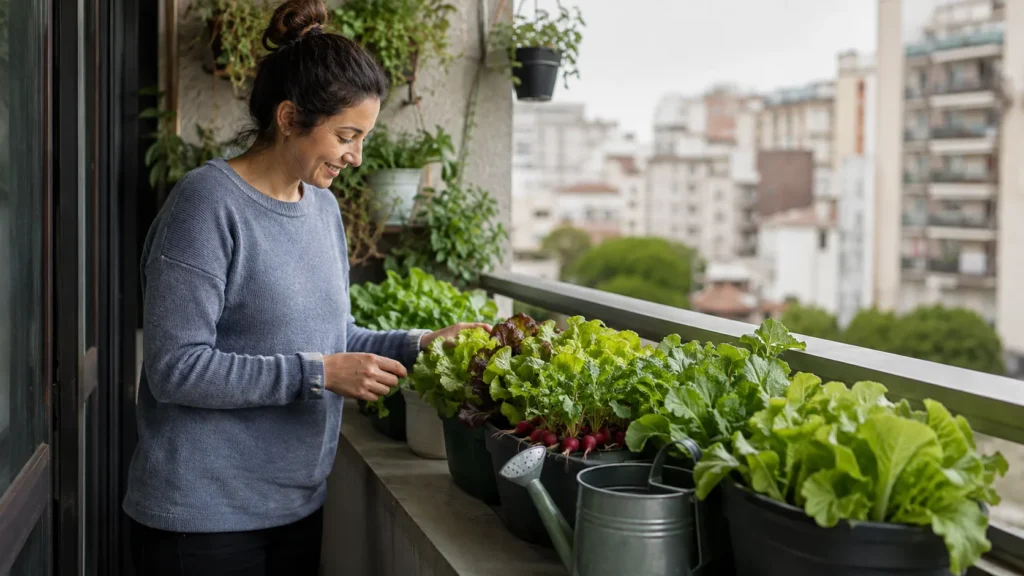
Almost every "shade plants" guide on the internet is about flowers. This one is about food. If your balcony or patio gets three or four hours of sun, you cannot grow a tomato, and no trick will change that. But a real, sourced list of vegetables will grow there happily, most of them in surprisingly small pots, and this guide walks through exactly which ones, what containers they need, and how watering changes when the sun is scarce.
The container fundamentals, pot choice, potting mix, drainage, live in our container gardening guide for beginners; this page assumes them and answers the question that guide leaves open: with limited light, what do you actually plant?
One Link for Your Whole Garden Journey
A short address you control, pointing to your harvest photos, garden notes and pages wherever they live.
How Many Hours of Sun Does Your Balcony Really Get?
Do not estimate; observe. Check the spot at three moments, mid-morning, midday and mid-afternoon, on one clear day, and count only direct sun: light bounced off a neighboring wall and the bright-but-sunless glow of open shade do not count the same. Note which corner gets the most, because you will assign it deliberately later. And remember the answer is seasonal: the sun rides lower in the cool months, so a balcony that clears six hours in summer may clear three in winter.
Direction matters too. In the northern hemisphere the sun tracks across the southern sky, so a north-facing balcony is the shadiest one and a south-facing wall is the hot one. Where your pots sit relative to that arc is the single fact this whole page turns on.
The Rule That Decides Everything: Leaf, Root or Fruit
Extension services do not publish sun-hours crop by crop, and any chart claiming "lettuce: 4 hours" is invented. What they publish is better: a classification by the part you harvest.
Fruiting vegetables (tomatoes, peppers, eggplant, cucumbers, zucchini, melons) are non-negotiable sun eaters. Clemson's container guide puts the absolute floor at 5 hours of direct sun, with real production arriving at 8 to 10 hours; most extensions work with 6 hours as the floor and 8 or more as the target. Below 5, do not try. Leafy vegetables (lettuce, spinach, chard, kale, cabbage, herbs) are the generous group: the sources say they tolerate partial shade and need less light than fruiting crops, and deliberately publish no numeric floor for them, because it varies with latitude, season and variety. Root vegetables (radishes, beets, carrots) sit with the leaves in the partial-shade-tolerant group.
So the honest translation of "my balcony gets 3 to 4 hours": fruit is out, leaves and roots are in. That single sentence eliminates half the disappointments in container gardening.
The Vegetables Extension Services Actually Name for Low Sun
The University of Minnesota's extension names names for beds getting less than a few hours of sun, partial to full shade, and the list transfers directly to pots: lettuce, baby kale, scallions, microgreens, radishes and beet greens. Three precisions worth keeping. It is baby kale, harvested young, not a full mature plant. It is beet greens, the leaves; in the shade you harvest the tops and do not expect the root to fatten. And "less than a few hours" is deliberately vague in the source, so we will not pretend it means a specific number.
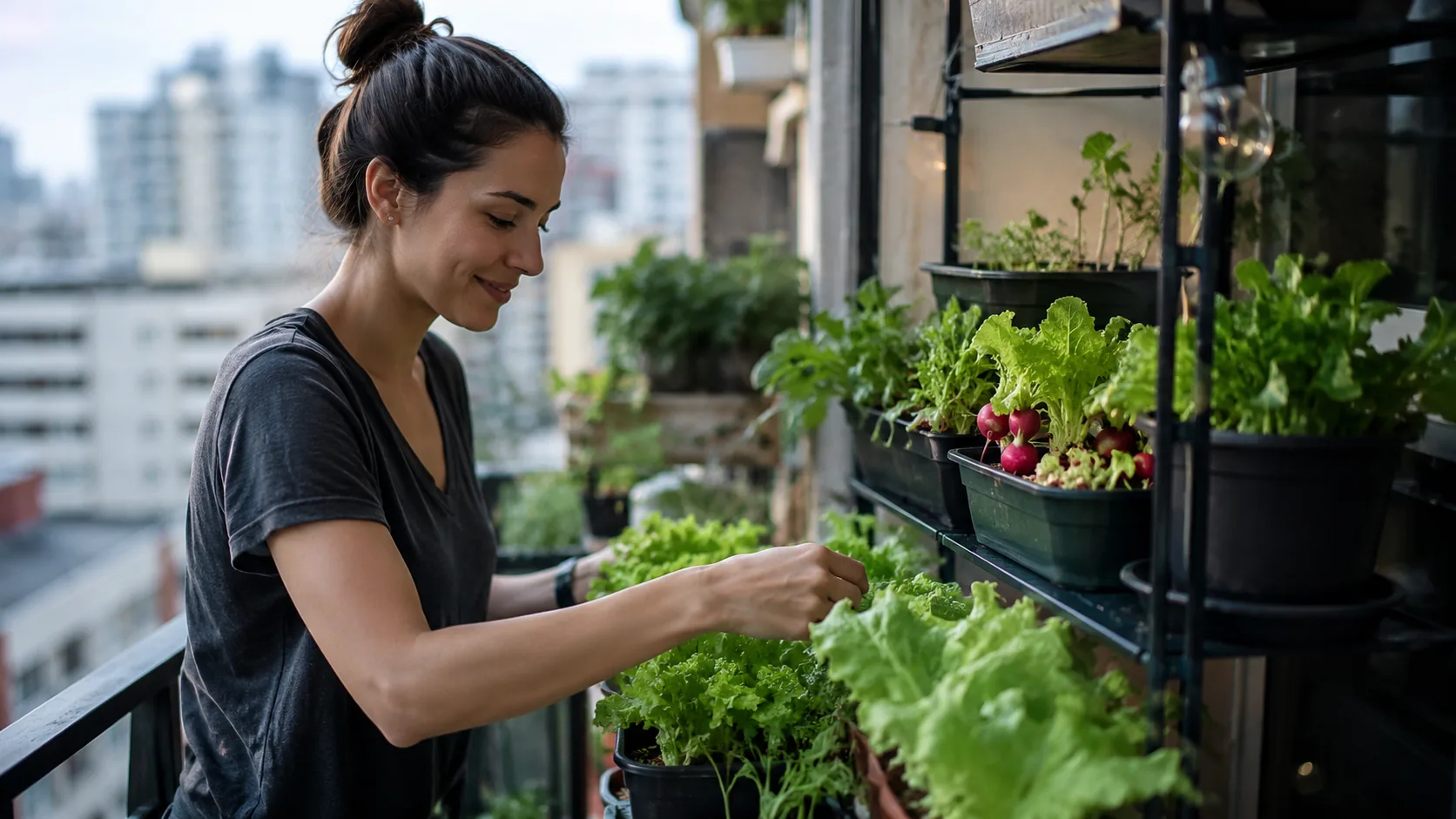
Around that core, the partial-shade group by classification: Clemson puts leaf and root crops in general there, and New Hampshire's extension names herbs, lettuce, spinach, chard and cabbage as the group that tolerates less light. Clemson also singles out carrots, radishes and lettuce as small-space container crops, which is exactly the profile of a shaded balcony.
Keep Your Garden Notes in One Place
Link your pot lineup, harvest photos and favorite guides from one short address.
What Size Pot Each One Needs
Here is the pleasant surprise: the shade list is almost entirely shallow-rooted, so a shaded balcony needs smaller pots, not bigger ones. From the University of California's container guidance, by soil depth: the 6 to 9 inch (15 to 23 cm) group covers lettuce, radishes, spinach, green onions and chives, essentially the whole shade core; the 12 to 18 inch (30 to 45 cm) group adds kale, chard, beets and short-variety carrots; the 18 to 24 inch (45 to 60 cm) group, tomatoes, squash, cucumbers, beans, potatoes, is precisely the group the shade rules out anyway. (Potatoes deserve their own pot and their own guide: our growing potatoes in containers post covers them.)
Two sourced rules complete the sizing. Clemson's floor: most plants want a pot at least 6 to 8 inches (15 to 20 cm) deep. And a deeper pot generally beats a wider one, giving roots room to chase moisture and cooler temperatures. For everything else about containers, drainage holes included, the beginner pillar has it covered.
What Not to Attempt in the Shade
Tomatoes, peppers, eggplant, cucumbers, zucchini and melons. Below Clemson's 5-hour floor these plants grow tall, pale and fruitless: the plant stretches for light and never banks enough energy to set and ripen fruit. You get a healthy-looking disappointment. Strawberries carry the same sun appetite, our strawberry container guide assumes a sunny spot for a reason.
What about the one sunny corner almost every balcony has? Clemson's planning guidance answers it directly: reserve the sunniest spot for the fruiting crops. One tomato in a big pot on the bright corner, at 4 to 5 gallons (15 to 19 liters) per plant, and the shade list everywhere else, is the rational allocation of a mostly shaded space.
Three Tricks That Buy You Light
Reflect it. Clemson notes that available light can be increased somewhat with reflective materials around the plants, aluminum foil, white-painted surfaces, even marble chips. "Somewhat" is the source's word and ours: it helps, it does not manufacture a new sun.
Move it. Pots on wheeled platforms or casters can follow the light across the day and the seasons, which both Clemson and the University of California recommend specifically for balcony and apartment growers. The shade map of a balcony is not fixed; a pot on wheels turns one hour of sun in two places into two hours.
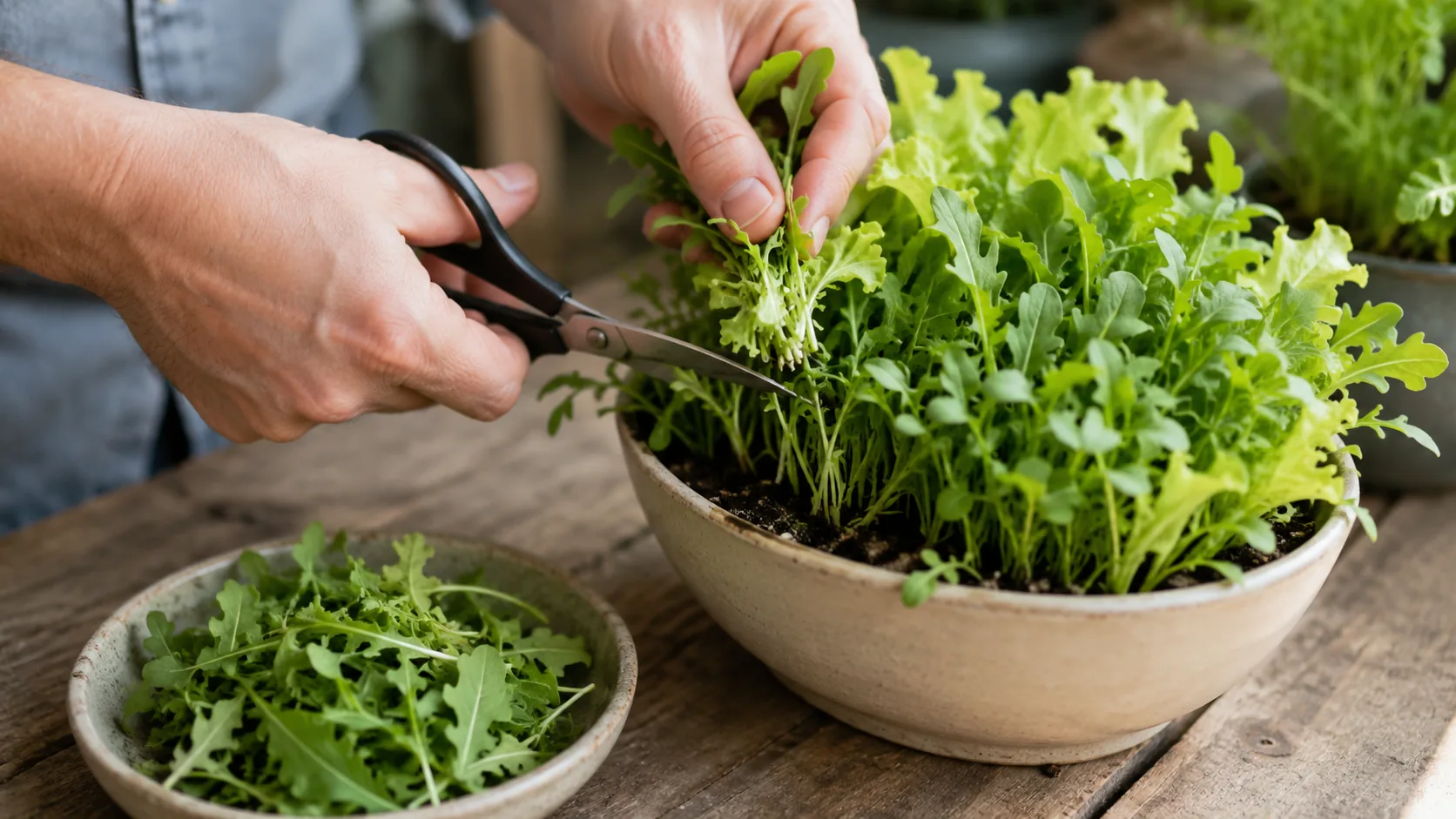
Harvest younger. The cut-and-come-again technique is the shade grower's best friend: sow mesclun, spinach, chard or arugula densely, about 2 inches (5 cm) apart, and harvest individual leaves as soon as they reach eating size, resowing every 3 to 4 weeks. You skip the part of the plant's life that demands the most light, the formation of a full head, and eat continuously instead.
Watering and Feeding Change in the Shade
Every watering warning you have read, daily watering, twice a day in heat, assumes a pot in full sun on hot pavement. In the shade the same physics run in reverse: less evaporation, mix that stays moist longer, and the relevant Clemson warning flips to the other one: in cool conditions, container plants kept too wet can develop root rot. Copy the tomato-guide watering routine onto a shaded lettuce pot and you drown it.
So test instead of scheduling: the finger test, checking the first inch (2.5 cm) of mix and watering only when it is dry, does the calibrating for you, and when you do water, water until it runs from the drainage holes. Feeding still matters, shade or not: a mix with incorporated fertilizer feeds for roughly 8 to 10 weeks, after which Clemson recommends a soluble fertilizer at label rate every 2 to 3 weeks, and containers lack the buffering of ground soil, so more is not safer. The rest of the watering-and-mix story lives in the container fundamentals guide.
Share Your Balcony Harvest, Not Ten Links
One VisuLink holds your garden photos, your notes and everything else you share.
FAQ
What vegetables can I grow in pots in the shade?
The extension-named list for partial to full shade: lettuce, baby kale, scallions, microgreens, radishes and beet greens, plus the broader partial-shade group of herbs, spinach, chard and cabbage. Leaves and shallow roots, not fruit.
How many hours of sun do vegetables in containers need?
It depends on what you harvest. Fruiting crops need a published floor of 5 hours (Clemson, for containers) with 8 to 10 for real production; most extensions use 6 as the general floor. Leaf and root crops tolerate partial shade, and no extension publishes a per-crop hour count for them, so distrust any chart that does.
Can I grow tomatoes on a shady balcony?
Not in real shade. Below about 5 hours of direct sun a tomato grows tall and pale and sets little or no fruit. If your balcony has one sunny corner, reserve it for a single tomato in a 4-to-5-gallon (15 to 19 liter) pot and give the shade to the leafy crops.
Do shade vegetables need big pots?
Mostly no, and that is the good news. The shade list is nearly all shallow-rooted: lettuce, radishes, spinach and scallions are happy in 6 to 9 inches (15 to 23 cm) of soil depth, with kale, chard and beets at 12 to 18 inches (30 to 45 cm).
Why are my shaded pots staying wet so long?
Less sun means less evaporation, so the mix holds moisture far longer than sun-drenched guides assume. That is normal; the risk flips from drying out to root rot. Water by the finger test, not by the calendar.