

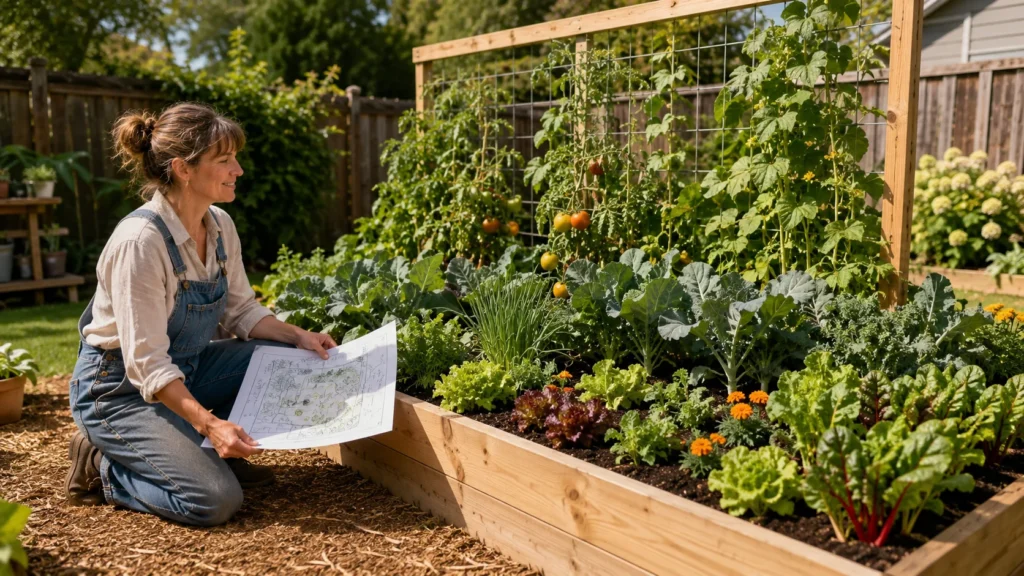
A 4x8 raised bed is small enough to plan in an afternoon and big enough to feed a family salad all season, if the layout is right. This guide walks through where the bed should sit, which side is north and why that decides half your plan, how much space each crop truly needs, and four ready layouts you can copy straight into the soil.
One honest note before the drawings: the 4-foot width is what university extension services actually recommend, because you can reach the middle from either side. The 8-foot length is a lumber-aisle convention, boards come in 8-foot cuts, and the sources are fine with that: Utah State's extension notes bed length can vary, typically 4 feet or more. If you are still choosing between a bed and pots, our container gardening guide for beginners covers that fork first.
One Link for Your Whole Garden Journey
A short address you control, pointing to your harvest photos, garden notes and pages wherever they live.
Why 4x8 and Not Some Other Size?
The width is the load-bearing number. Both Utah State and Clemson extension services recommend beds 3 to 4 feet (90 to 120 cm) wide, for one physical reason: that is as far as most people can comfortably reach from either side to the middle without stepping in. The length is genuinely flexible; USU puts it as "typically 4 or more feet," and 8 feet (2.4 m) simply matches the standard board you will find at any lumber yard. One caveat worth knowing: Minnesota's extension notes that boards of 6 feet (1.8 m) or less warp and break less than longer ones, and recommends turning boards heartwood-in so any warp bows outward. If that worries you, two 4x4 modules do the same job as one 4x8.
Depth: the box should be at least 6 to 12 inches (15 to 30 cm) high to accommodate the rooting depth of most vegetables. A bed shallower than 12 inches (30 cm) should be built without a bottom, so roots can reach the soil below, and it pays to loosen that ground soil 6 to 12 inches (15 to 30 cm) deep before filling. Fill with a mix of roughly half to two thirds topsoil and the rest plant-based compost; straight potting soil dries out far too fast for a bed, it belongs in containers and seed trays.
Where to Put the Bed Before You Draw Anything
The most common planning mistake is designing the layout before choosing the spot. Sun decides everything: 6 hours of direct sun a day is the functional floor, 8 or more is the target, and hotter southern-latitude sources like the University of Georgia ask for 8 to 10. Fruiting crops, tomatoes, peppers, eggplant, demand the full-sun end of that range; leafy greens and roots tolerate partial shade.
Beyond sun: pick a well-drained spot, close to a water source, and away from trees, which cast shade and compete for water and nutrients. Leave 3 to 4 feet (90 to 120 cm) of path around a framed bed, wide enough for a wheelbarrow, and mulch the paths with bark or straw to keep weeds and mud down. Remember that raised beds drain and dry faster than ground-level soil, so plan for more frequent watering in dry spells.
Which Side Is North? The Rule That Decides Half the Layout
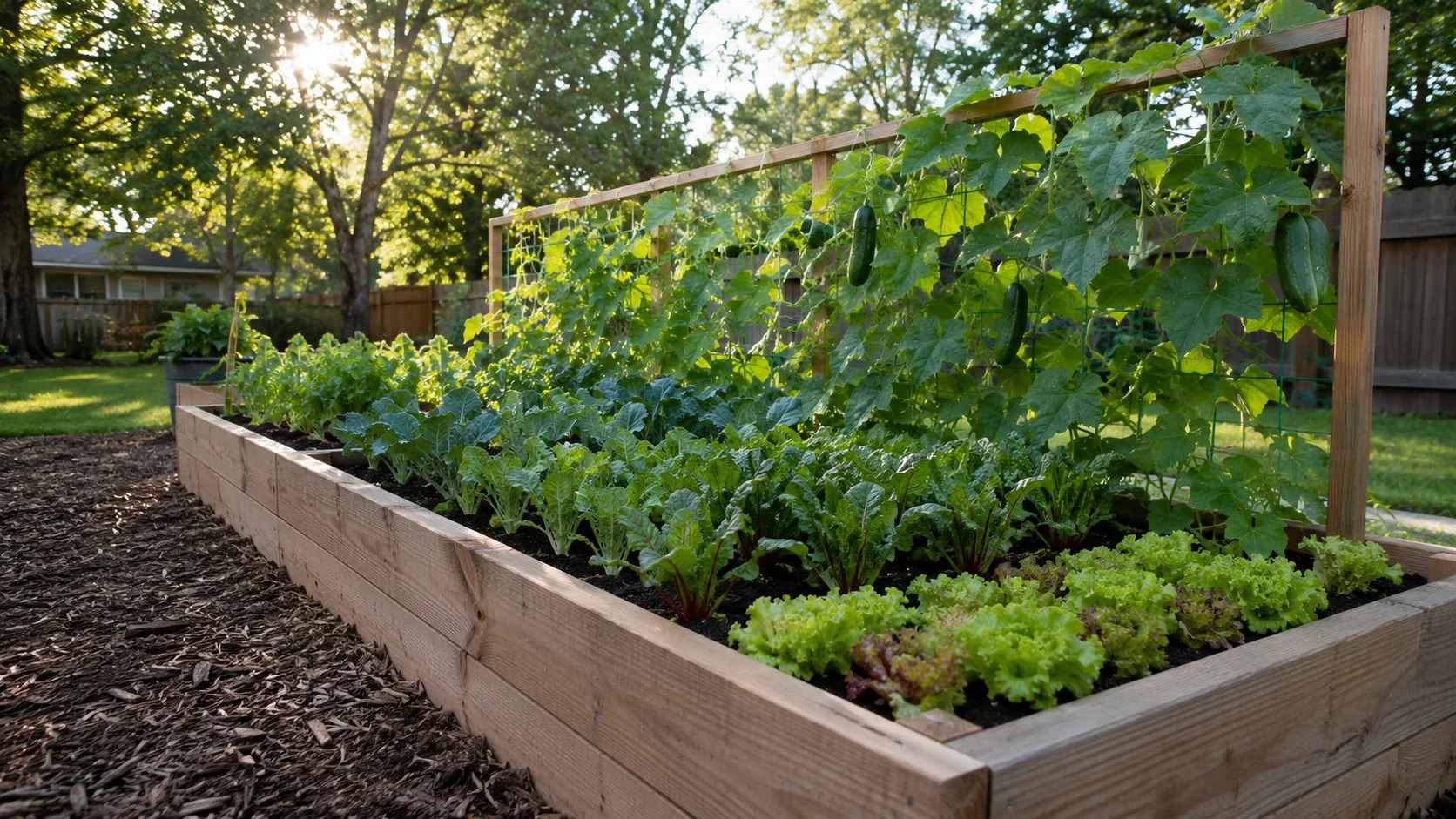
Both Clemson and UGA give the same placement rule: tall and trellised crops go on the north side (UGA allows north or west), so they never shade the shorter plants. The sun tracks across the southern sky in the northern hemisphere, which means shadows fall northward; put the tall stuff where its shadow lands outside the bed, and step the heights down toward the south.
In practice, for a 4x8 bed with the long sides facing east-west: the trellis line, caged tomatoes, pole beans and cucumbers on a trellis, hugs the north long side; mid-height crops like eggplant and broccoli take the center band; low growers, lettuce, carrots, beets, fill the south edge. If your bed sits north-south instead, apply the same logic to whichever end points away from the sun's path. Watch where shadows fall at midday and mid-afternoon for one day before planting; it settles every argument the compass starts.
How Much Space Each Crop Really Needs
Seed packets list two numbers: space between rows and space between plants in the row. In a raised bed you never walk on, the between-row number mostly disappears, it exists to give your boots a corridor in a field garden. What governs a raised bed is the in-row spacing, applied in blocks: Clemson's raised-bed guidance says it plainly, plant vegetables in blocks instead of rows.
From Clemson's planting chart, the in-row numbers that matter most in a 4x8 bed: carrots 1 inch (2.5 cm), leaf lettuce and beets 2 inches (5 cm), bush beans 2 inches (5 cm), pole beans 4 inches (10 cm), collards 8 inches (20 cm), head lettuce and cabbage 12 inches (30 cm), cucumber 12 inches (30 cm) on a trellis, broccoli, cauliflower and eggplant 18 inches (45 cm). Tomatoes, staked or caged, want 18 to 24 inches (45 to 60 cm) between plants. The arithmetic gets vivid fast: a single 4-foot (1.2 m) row fits dozens of carrots, but only two to three eggplants depending on the edge gap you leave. For when to actually put tomatoes in, our tomato planting calendar covers timing by region; this page only handles the real estate.
Planting depth is on the same chart, from a quarter inch (0.6 cm) for carrots to 3 inches (7.5 cm) for transplanted cabbage and eggplant, so keep the packet handy at sowing time even after the map is drawn.
Four Ready Layouts for a 4x8 Bed
1. The salad-and-roots bed. No trellis needed. North long side: two rows of collards at 8 inches (20 cm) and a row of kale. Center band: head lettuce at 12 inches (30 cm), about 12 heads in two staggered rows. South edge: alternating blocks of leaf lettuce and beets at 2 inches (5 cm) and carrots at 1 inch (2.5 cm). Everything here tolerates a little shade, so this is also the layout for a spot that only clears 6 hours of sun.
2. The summer fruit bed. Trellis on the north long side carrying cucumbers at 12 inches (30 cm). Next band: two caged tomatoes at 24 inches (60 cm) plus two to three eggplants at 18 inches (45 cm). South half: bush beans in a block at 2 inches (5 cm), refilling nitrogen-hungry soil as they go. This bed wants the full 8-plus hours of sun.
3. The three sisters, adapted. The oldest companion layout there is, corn as the pole, beans climbing it and feeding nitrogen back, squash sprawling below as a living deterrent, comes from Mesoamerica and has been used by many Indigenous communities including the Pueblo, Mandan and Iroquois for centuries. In a 4x8 frame the honest version is partial: give the north half to a block of corn with pole beans on the stalks, and let a squash spill over the south edge and out of the bed. It is a generous, sprawling system squeezed into a small frame; expect it to look wild, that is the design.
4. The continuous-harvest bed. Clemson's raised-bed advice is to alternate crops that mature at different times and sow in intervals. Split the bed into four 2-foot (60 cm) bands and stagger: a band of quick leaf lettuce and beets, a band of bush beans, a band of head lettuce or cabbage, a band of carrots, then resow each band as it empties. Group plantings by how long each crop holds its ground, so late starters inherit the space of early finishers.
Keep Your Garden Notes in One Place
Link your bed maps, harvest photos and favorite guides from one short address.
Companion Planting: What Research Supports and What Is Folklore
Here is the part most layout guides get wrong. The University of Minnesota's extension states it bluntly: popular companion pairings claimed to repel flea beetles, marigolds and green onions among them, appear on gardening sites and even some extension websites, yet there is little research to support them and some research contradicts them. A layout built on a friends-and-enemies chart is built on folklore.
What the research does support is narrower and more useful. Pungent brassicas, arugula, mustard, rapeseed and napa cabbage, are well documented as trap crops that draw flea beetles away from your main planting, and mixes of three or more companion species reduce damage better than any single trap crop. Field work in Iowa found thyme, onion and nasturtium reduced caterpillar damage on broccoli, and marigold, onion and nasturtium did the same on cabbage. Legumes, beans and peas, fix atmospheric nitrogen and cut the bed's fertilizer appetite, and mixing rooting depths, taproots like carrots alongside shallow feeders, loosens soil and draws nutrients from different layers. Plant diversity, not magic pairings, is the defensible core of the idea.
The Five Mistakes That Ruin a 4x8 Bed
Overcrowding. The in-row numbers above are minimums for full-grown plants, not suggestions. Stepping in the bed. All planting, tending and harvesting happens from the paths; one footprint compacts what the raised structure exists to keep loose. Tall plants on the sun side. One misplaced tomato cage shades a quarter of the bed all season. The same family in the same soil year after year. More on that below. Filling with potting soil. It drains too fast for a bed; use the topsoil-plus-compost mix, and go easy on manure, which loads the soil with more phosphorus than most beds need.
What About Next Year? Rotating Families in the Same Bed
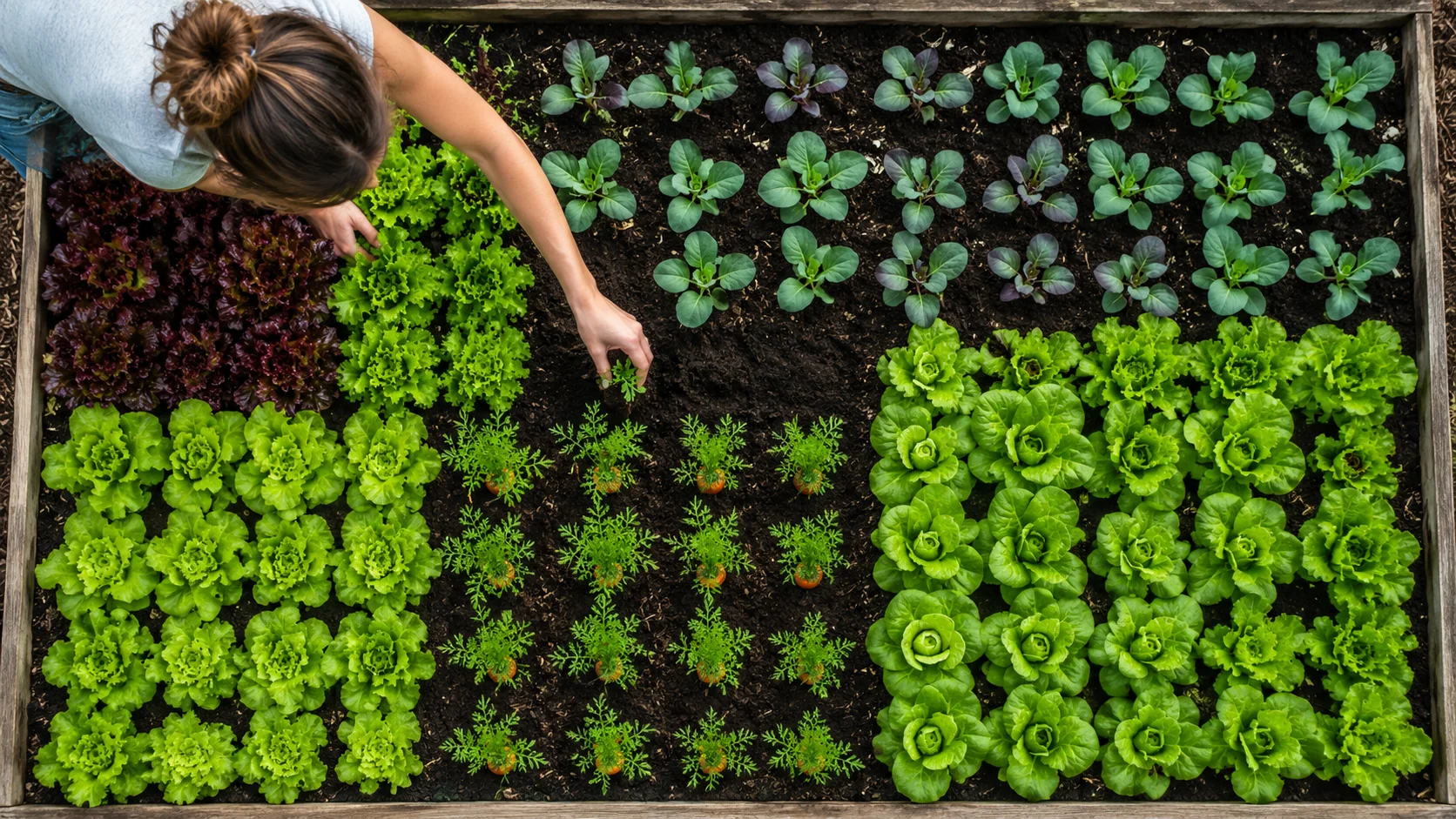
Minnesota's rule is clear: avoid planting the same family in the same bed for 3 to 4 years. Grow a tomato this year and the whole nightshade family sits out that spot, peppers, eggplant, potatoes, tomatillos. The extension's preferred fix is several smaller beds rotated against each other, which is worth saying honestly: one 4x8 bed cannot fully deliver a 3-to-4-year rotation. The workable approximation is to treat the bed as four quadrants on your map and march the families around them year by year, accepting that the buffer is thinner than the rule wants. Keep the map, both Clemson and UGA say to plan on paper, and next spring's version of you will be grateful.
Rotation is also where alliums earn their place: garlic and onions belong to a different family from both nightshades and brassicas, which makes them ideal tenants for a quadrant coming off tomatoes. Our garlic planting guide covers the timing, which conveniently runs opposite to the summer crops.
Share Your Garden, Not Ten Links
One VisuLink holds your bed plans, your harvest clips and everything else you share.
FAQ
How many plants fit in a 4x8 raised bed?
It depends entirely on the crop: at Clemson's in-row spacings, a 4x8 bed could hold hundreds of carrots at 1 inch (2.5 cm) apart, or roughly a dozen head lettuces at 12 inches (30 cm), but only a handful of 18-inch (45 cm) crops like eggplant or caged tomatoes. Mixed layouts like the four above land somewhere between.
Is a 4x8 raised bed a recommended size?
The 4-foot (1.2 m) width is the sourced recommendation, both USU and Clemson give 3 to 4 feet so you can reach the middle from either side. The 8-foot (2.4 m) length is a lumber convention that falls within USU's "4 feet or more"; Minnesota notes shorter boards warp less, so two 4x4 modules are a fine substitute.
How deep should a 4x8 raised bed be?
At least 6 to 12 inches (15 to 30 cm) to cover the rooting depth of most vegetables. Anything shallower than 12 inches (30 cm) should have no bottom, so roots continue into loosened ground soil below the frame.
Which vegetables should go on the north side of the bed?
The tall and trellised ones: caged tomatoes, pole beans, cucumbers on a trellis. In the northern hemisphere the sun crosses the southern sky, so shadows fall north; tall crops on the north edge shade the path instead of the lettuce.
Does companion planting actually work?
Parts of it. Trap crops like arugula and mustard for flea beetles are well documented, legumes really do fix nitrogen, and multi-species mixes reduce pest damage in field studies. But many popular pairings, marigolds repelling everything, have little research behind them, and Minnesota's extension says some evidence contradicts them.