
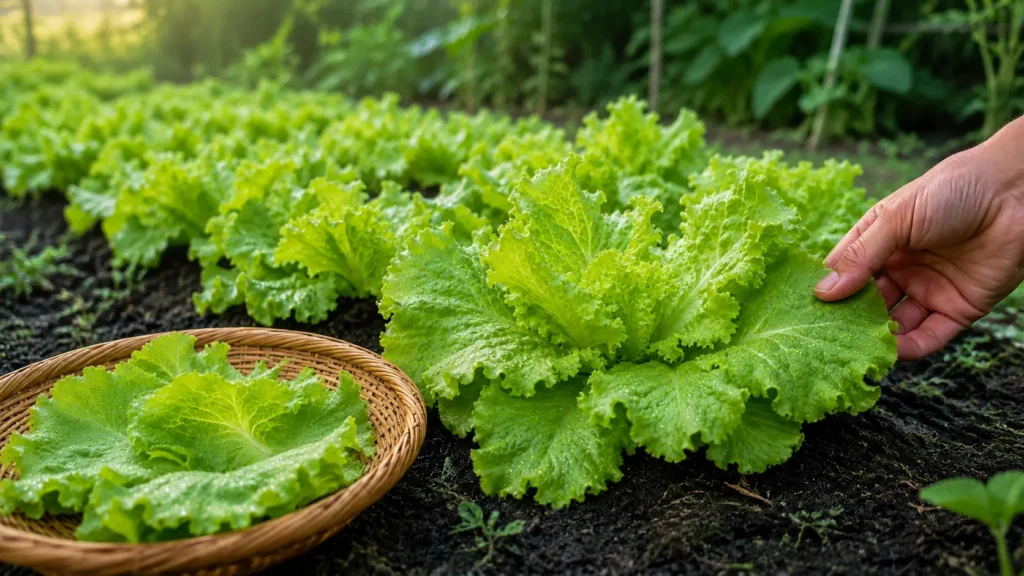
You can harvest the same lettuce plant many times, or once. The choice happens at the moment you cut, and it is easy to make it without realising. Pull the whole plant and you get one salad. Take the outer leaves and leave the centre growing and you get salads for weeks from the same plant.
This covers both methods, when each one is right, what to do when the leaves turn bitter, and the one step that decides whether your lettuce is crisp or limp.
One Link for Your Whole Garden
A short address you control, pointing to your growing notes, your pages and everything else you share.
Two Ways to Harvest, One Decision
University of Minnesota Extension lays out both options plainly.
Repeat harvest: "Harvest single leaves as soon as they reach a usable size. If you harvest individual leaves at the 'baby' stage, leaving most of the small leaves on the plant, multiple harvests are possible."
Single harvest: "You can also remove the whole plant by cutting it off at or just above the soil surface."
Both are correct. Which one to use depends on what you want.
| Leaf by leaf | Whole plant | |
|---|---|---|
| You get | Small amounts, repeatedly | One full head at once |
| Best for | Loose-leaf types | Heading types, or clearing the bed |
| Plant after | Keeps growing | Finished |
| Suits | Daily salads for one or two people | Cooking for several, or a plant about to bolt |
Worth knowing before you choose: not all lettuce suits repeat harvesting. Clemson Cooperative Extension notes that loose-leaf is the type most gardeners grow, "a fast-growing, long-lasting lettuce" where "leaf lettuce needs only to be planted and harvested." Heading types build a single structure and are harvested once.
When It Is Ready
Days to maturity gives you a rough window, but the plant tells you more than the seed packet does.
Clemson gives specific readiness signals by type:
- Leaf lettuce: "ready to harvest about 75 days after planting. It can be used as soon as plants are 5 to 6 inches tall."
- Bibb or butterhead: "mature when leaves begin to cup inward to form a loose head."
- Romaine or cos: "ready to use when the leaves have elongated and overlap to form a partially tight head about 6 to 8 inches tall."
- Head lettuce: "can be harvested as early as 55 days, depending on the variety. It is mature when leaves overlap to form a head similar to those available in the stores."
Note the phrase in the leaf lettuce entry: as soon as. There is no requirement to wait for full size. Minnesota puts it as harvesting "single leaves as soon as they reach a usable size," where usable is defined by you rather than by the plant.
Earlier is often better. Minnesota advises harvesting before the weather turns hot and dry; heat slows growth, and leaves become tough and bitter as the plant bolts.
Cut and Come Again, Step by Step
This is the method that turns one planting into a long supply.
1. Take from the outside. The outer leaves are the oldest and largest. The growing point sits at the centre of the plant, so removing outer leaves takes the mature growth while leaving the engine intact.
2. Leave the small central leaves alone. Minnesota is specific that multiple harvests depend on "leaving most of the small leaves on the plant." Strip a plant bare and it has nothing to regrow from.
3. Cut rather than tear. A clean cut with scissors or a knife leaves a smaller wound than pulling, which can loosen the whole plant in the soil.
4. Come back in a few days. The plant replaces what you took from the centre outward. Harvesting little and often is what keeps the plant producing.
Washington State University Extension describes the same approach as a way of getting several stages of harvest from one sowing: "broadcast lettuce seed and when plants have 4-6 leaves, harvest every other plant as baby leaf lettuce. Once plants have 8-10 leaves, harvest 2-4 outer leaves per plant every week for salad. When plants become crowded or lettuce heads begin to form, harvest every other plant. Harvest remaining plants before they bolt."
That sequence is worth reading twice. It thins the bed and feeds you at the same time, and every stage of thinning produces food rather than compost.

Harvesting the Whole Plant
Sometimes one cut is the right call: heading types, a plant about to bolt, or clearing space for the next crop.
Minnesota's instruction is to remove "the whole plant by cutting it off at or just above the soil surface."
Cutting rather than pulling matters here for two reasons. It leaves the roots in the soil rather than disturbing neighbouring plants, and it keeps soil off the leaves, which saves washing.
Cut just above the soil surface rather than below it. Cutting into the crown means every leaf falls apart separately, and the base carries the most grit.
Keep the Garden Notes in One Link
What you sowed, what you cut and when it bolted, all behind a single address you can share.
The Step That Decides Crisp or Limp
This is the detail that separates garden lettuce that snaps from garden lettuce that droops, and it happens before you cut anything.
Minnesota: "Lettuce, endive and radicchio will be crisper if you water them often in the days prior to harvesting."
Lettuce is mostly water, and a plant harvested from dry soil is already partly wilted when it reaches the kitchen. Watering in the days before harvest fills the leaves out.
There is a limit to that, and Minnesota flags it: "When rainfall or watering follows a dry spell, the plants will suddenly resume growth. This leads to 'tipburn,' or the browning of the leaves."
So the useful pattern is consistent moisture rather than drought followed by a heavy soak. Steady watering gives crisp leaves. Feast and famine gives browned edges.
When Lettuce Turns Bitter
If lettuce turns bitter, check for bolting and hot conditions.
Clemson: "High summer temperatures usually cause seed stalk formation (bolting) and bitter flavor."
Minnesota explains what triggers it: "These plants may bolt in response to long days, high light intensity, and heat. Bolting causes extreme bitter flavor."
How to recognise it. The plant starts to stretch upward, the centre elongates, and a stalk begins to rise from the middle. Leaves often become coarser at the same time. That stalk is the plant switching from making leaves to making seed.
The hard part, stated honestly. Minnesota does not soften it: "Bolting ends the possibility of harvest."
Minnesota states that bolting ends the possibility of harvest. What you can do is harvest everything usable the moment you see a stalk forming, and treat the rest as finished.
Preventing it next time. Clemson gives the conditions lettuce actually wants: "a cool-season crop that prefers temperatures of 55 to 65 °F for optimum growth." Minnesota puts the ideal as "a nighttime low temperature of 50°F, and up to a 68°F daytime high temperature."
Two practical levers follow. First, variety: Clemson notes that "slow-bolting or heat-resistant varieties are available and are recommended for extending the lettuce-growing season." Second, timing: grow lettuce in the cooler parts of your year rather than fighting the hot part. Minnesota is blunt about its own state, saying that for most of Minnesota, "June, July and August conditions are too hot for these crops."
One variety-specific note from Clemson, useful if you grow butterhead: "Bibb lettuce will develop bitterness readily if temperatures go above 75 °F." Some types give up earlier than others.

Keeping It After Harvest
Clemson: "Store in the refrigerator in the coolest area. Crisphead lettuce can be stored for two weeks under optimal conditions. Leaf and Bibb will store as long as four weeks if the leaves are dry when bagged."
The conditional at the end carries the whole instruction. Leaves bagged wet rot at the edges. Dry them properly before they go into a bag and loose-leaf types can keep up to four weeks.
Common Mistakes
Taking the whole plant when you wanted repeat harvests. One cut at the base ends the plant. Outer leaves only, and it keeps producing.
Stripping a plant down to nothing. Multiple harvests depend on leaving most of the small central leaves in place.
Waiting for supermarket size. Leaf lettuce is usable well before full size. Waiting into hot weather increases the chance of bolting and bitterness.
Harvesting from dry soil. Water in the days before cutting. Lettuce harvested thirsty is limp before it reaches the kitchen.
Soaking after a drought. Sudden growth after dry conditions causes tipburn, the browning of leaf edges.
Trying to save a bolted plant. Bolting ends the harvest. Take what is still usable and start again.
Bagging wet leaves. Dry them first; Clemson's four weeks depends on it.
FAQ
How do I harvest lettuce so it keeps growing?
Take outer leaves only and leave most of the small central leaves on the plant. Minnesota Extension notes that multiple harvests are possible when you harvest individual leaves and leave the small ones in place.
Should I cut lettuce or pull it?
Cut. For a whole plant, Minnesota advises cutting it off at or just above the soil surface. Pulling disturbs neighbouring plants and brings soil onto the leaves.
How big should lettuce be before harvesting?
Clemson says leaf lettuce can be used once plants are 5 to 6 inches tall, and Romaine when leaves form a partially tight head about 6 to 8 inches tall. For individual leaves, usable size is your call.
Why is my lettuce bitter?
Look for bolting first. It is triggered by heat, long days and high light. Clemson links high summer temperatures directly to seed stalk formation and bitter flavour.
Can I fix bitter lettuce?
No. Minnesota states that bolting ends the possibility of harvest. Harvest anything still usable and replant when conditions cool.
How do I stop lettuce bolting?
Grow it in cool conditions and choose slow-bolting or heat-resistant varieties, which Clemson recommends for extending the season. Lettuce prefers 55 to 65 °F for optimum growth.
How long does harvested lettuce keep?
Clemson reports up to two weeks for crisphead and as long as four weeks for leaf and Bibb, provided the leaves are dry when bagged and stored in the coolest part of the refrigerator.
Why are the edges of my leaves brown?
That is tipburn. Minnesota attributes it to plants suddenly resuming growth when rain or watering follows a dry spell.
References
- University of Minnesota Extension, Growing lettuce, endive and radicchio in home gardens. Harvest methods, watering before harvest, tipburn, bolting triggers and temperature range.
- Clemson Cooperative Extension, Lettuce (HGIC 1312). Readiness by type, days to maturity, bolting and bitterness, slow-bolting varieties and storage.
- Washington State University Extension, Home Vegetable Gardening in Washington. Staged harvesting from a single sowing and harvesting before bolting.
Show the Garden You Grew
One link for your plant list, your photos and the notes you want to pass on.