
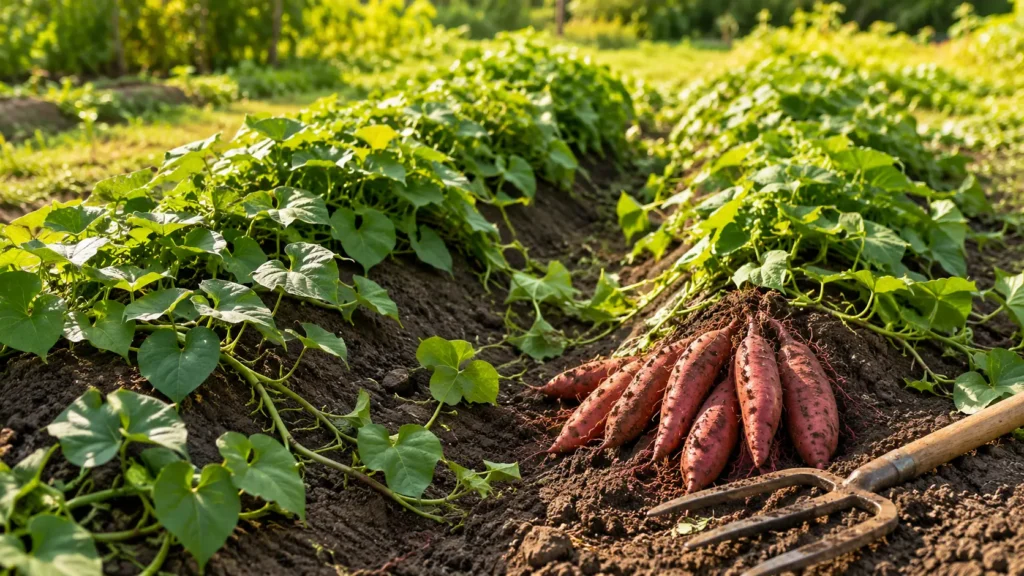
Sweet potatoes are not potatoes, and almost every mistake people make with them comes from treating them like potatoes. They are not planted from seed pieces, they are not tubers, and they are not ready to eat the day you dig them up. Grow them on their own terms and they are one of the least demanding crops in the garden.
This is the full cycle: starting slips, planting, care, harvest, and the curing step that decides whether they taste sweet or bland.
One Link for Your Whole Garden
A short address you control, pointing to your growing notes, your pages and everything else you share.
Not a Potato, Not a Yam
Start here, because the name causes real confusion in the garden.
Iowa State University Extension places the sweet potato (Ipomoea batatas) in "the family Convolvulaceae (morning glory family)." That is not the potato family. The plant grows as a trailing vine, and what you harvest is not a tuber.
Clemson Cooperative Extension is precise about that distinction: sweetpotatoes "do not produce tubers but produce an edible storage root that is developmentally a true root derived from root tissue." A potato is a swollen stem. A sweet potato is a swollen root. That single difference explains why they are planted differently, why they are harvested differently, and why they store differently.
Yams are a third thing entirely. Iowa State separates them cleanly: "Yam is a monocot (single cotyledon), dry and starchy, rough-skinned, grown for its tuber, originated from West Africa, and belongs to the Dioscoreaceae family (yam family). Sweet potato on the other hand is a dicot (two cotyledons), moist and sweet, smooth-skinned, grown for its roots, originated from Central/South America, and belongs to the Convolvulaceae family."
Slips: What They Are and How to Get Them
You do not plant a sweet potato the way you plant a potato. There are no seed pieces and no eyes to cut. You plant rooted sprouts called slips.
Iowa State: sweet potatoes "are started from a vegetative stem tip cutting, also known as 'slip,' which is propagated from the roots of the previous season's crop." What a good one looks like: "A good sweet potato slip should be firm, green, and 8 to 12 inches long, preferably with one or two leaves. Slips may or may not have roots when they are cut."
Buying is the simpler route, and both sources recommend it for most gardeners. Iowa State advises that slips "should be disease and insect free and bought from reputable vendors." University of Georgia Extension gives the reasoning: "Most gardeners prefer to plant slips bought from garden centers because they are most likely to be disease resistant and because sweet potato seeds can be difficult to obtain and get started."
Growing Your Own Slips
If you want to produce your own, Clemson gives a method you can follow on a windowsill.
Start with the right roots. Clemson notes that "roots from last year's home harvest or those that were organically grown are more apt to sprout and make slips as compared with most grocery store sweetpotatoes, which were chemically treated to not sprout during storage." That detail matters: a supermarket sweet potato may simply refuse to sprout.
The method, from Clemson: "Start with healthy, medium-sized sweetpotato roots and regular or wide-mouthed quart jars. Insert 3 or 4 toothpicks into each root halfway between its two ends. Place a root into each jar allowing the toothpicks to rest on the rim of the jar. Add water to each jar until the bottom half of each root is submerged. Place the jars in a warm location with indirect sunlight."
Then maintain it: "Watch the water levels and add water as needed to keep the lower halves submerged. Change the water weekly to reduce problems with bacterial growth in the water, which will appear as cloudiness. Sprouts will appear in about 2 weeks."
Separating the slips is the step people get wrong by being gentle at the wrong moment: "Once the sprouts are six or more inches long, grasp each sprout near its base and pull or twist the sprout free from the mother sweetpotato root. Place these sprouts into another jar with enough fresh water to cover their bottom ends. This will allow them to produce their own roots, which takes about 10 days."
Count backward from your planting date. Two weeks to sprout plus about ten days to root is roughly three and a half weeks of minimum lead time. Starting a week or two earlier than that is worth doing, not because the process takes longer, but because sprouting is uneven and some roots are slower than others.

Soil and Site
Sweet potatoes are relaxed about fertility and fussy about drainage. Get the soil texture right and most of the work is done.
Iowa State: "Well-drained, sandy, or loamy soils are the best for sweet potatoes. Heavy clay or rocky soils will result in misshapen sweet potato roots. Soil that does not drain well may result in lower yields or root rot." Clemson agrees that those grown in heavy clay "may be smaller and misshapen," and recommends tilling "organic matter into the garden to loosen and improve the aeration and drainage of heavy clay soils."
Georgia gives the same fix in different words: "If your soil contains clay, add some aged compost or other organic amendment to the planting bed to improve drainage. Sweet potatoes grown in unamended clay soils are usually small."
Clemson adds a structural option for wet ground: "Plant sweetpotatoes on ridges in the Coastal and Piedmont areas to provide better drainage." A raised ridge or mound is the low-effort answer to soil that stays soggy.
Sun. Iowa State: plants "require full sunlight and should receive at least six to eight hours of full sun each day." Georgia sets the bar slightly higher at "8 to 10 hours of sunlight per day."
pH. Iowa State reports tolerance across a wide range, growing "best in soils with a pH of 6.0 to 7.0." Georgia narrows it to "a slightly acidic soil with a pH range of 6.0-6.5."
Keep the Garden Notes in One Link
Planting dates, cultivars and what your soil actually did, all behind a single address you can share.
When and How to Plant
Soil temperature decides the date, not the calendar. This is a warm-season crop with no tolerance for cold ground.
Clemson: the sweetpotato "is a warm-season crop that is not planted until well after the last chance of frost in the spring. The soil temperature should be above 65 °F before planting this crop." Georgia sets a warmer threshold: "The soil temperature should reach 70 °F before they can be planted in the garden."
Iowa State translates that into local timing for its own state, which is a useful illustration of how much this shifts by region: "Plant in mid-to-late May or early June after the danger of frost has passed." Georgia notes planting "can occur in mid-April in south Georgia and the first part of May in the mid- to northern part of the state." Two states, two different months, same rule underneath.
Spacing. Iowa State is specific and explains the consequence in both directions: "plant slips in rows that are 36-48 inches apart. Plant spacing within the row should be 12 inches. More than 12-inch in-row spacing will lead to a higher proportion of jumbo-sized roots at harvest that are difficult to handle and process. Less than 12-inch in-row spacing will lead to a higher proportion of smaller and slender roots, which are also undesirable."
Clemson gives slightly tighter numbers and a planting depth: "Plant the transplants (called slips) in rows 3 feet apart with 8 to 12 inches between plants in the row at a depth of 3 to 4 inches." Georgia keeps it simple: "Space the slips 3 ft apart to allow room for the vines to expand."
| Decision | What the sources say | Source |
|---|---|---|
| Soil temperature to plant | Above 65 °F, or reaching 70 °F | Clemson, Georgia |
| Row spacing | 36 to 48 in, or about 3 ft | Iowa State, Clemson, Georgia |
| In-row spacing | 12 in, or 8 to 12 in | Iowa State, Clemson |
| Planting depth | 3 to 4 in | Clemson |
| Sunlight | 6 to 8 h, or 8 to 10 h | Iowa State, Georgia |
| Days to maturity | 90 to 120, varies by cultivar | Iowa State |
Care Through the Season
The main risk during the season is kindness. Sweet potatoes reward being left alone.
Georgia states the failure mode directly: "Be careful with fertilization. Overfertilized sweet potato plants produce just foliage." A heavily fed sweet potato patch makes a beautiful vine and disappointing roots.
The recommendation is to test rather than guess: "Base the fertilizer application on the results of a soil test." Georgia gives a fallback rate for when no test is available, but a soil test costs little and removes the guesswork entirely.
The vines take care of most weed pressure themselves once they run. Iowa State describes the plant as one that "vine out and trail along the ground," which is why row spacing is generous: you are leaving room for a ground cover, not a bush.
Harvesting
Two signals tell you when: the cultivar's maturity window, and soil temperature.
Iowa State: "Sweet potato cultivars vary in days to maturity, but most range between 90 and 120 days. Typically, they are harvested in late summer/early fall before soil temperatures drop below 60°F."
On the frost question, which causes a lot of unnecessary panic: "One can wait until the maturity date of the cultivar (90-120 days) or harvest immediately after the first frost. There is no rush to harvest before the first frost, but it is not recommended to expose the root to colder soils for long periods. Cool soil reduces root quality and storage life."
Read that carefully, because it reverses the usual panic. The source does not treat the first frost as a deadline to beat. What it warns against is what comes after: roots left sitting in cold soil, which reduces both quality and storage life.
How to dig. Iowa State: "Harvest by digging, using a spading fork or shovel, carefully around the plants without damaging the roots." Storage roots grow wider than the crown suggests, and they bruise easily. Start the fork well outside the plant and lift, rather than driving it in close.
Curing: The Step That Makes Them Sweet
This is the step most home gardeners skip, and it is the one that changes the flavor. A sweet potato eaten straight from the ground has not gone through the starch conversion described below, so it is less sweet than the same root will be after curing. That is not a bad harvest. It is an uncured one.
Iowa State explains what curing does: sweet potato roots "require curing to heal cuts, bruises and reduce rots, and convert some of the starch in the roots to sugar."
The commercial conditions are demanding: growers "cure their sweet potatoes in special rooms at 85°F and 80% to 90% relative humidity for seven to 10 days." Iowa State is realistic that this is out of reach at home, noting that "duplicating this process would be very difficult for home gardeners."
The home version, in their words: "A middle ground approach would be to air dry sweet potatoes for 10-14 days in a warm and shady location like a garage."
Then store them properly, and not in the refrigerator. Iowa State: "After curing, the roots should be stored in a dark, cool place with temperatures between 50 to 55°F. Sweet potatoes can be stored under good conditions for four to six months."
Note that storage temperature is cool, not cold. A household refrigerator runs well below that range.

Common Mistakes
Planting cut pieces of root, like seed potatoes. Sweet potatoes grow from slips, which are rooted sprouts, not from cut sections with eyes.
Planting into cold soil. Both Clemson and Georgia key planting to soil temperature, above 65 °F or reaching 70 °F, not to a date on the calendar.
Feeding heavily for a bigger crop. Georgia is explicit that overfertilized plants "produce just foliage."
Eating them immediately. Uncured roots have not converted starch to sugar yet. Ten to fourteen days of curing is what produces the flavor people expect.
Refrigerating the harvest. Storage is dark and cool at 50 to 55 °F, which is warmer than a refrigerator.
Digging too close to the crown. Storage roots spread wider than the plant looks. Dig from outside the plant and lift.
FAQ
Can I plant a sweet potato from the grocery store?
Sometimes, but it may not sprout. Clemson notes that most grocery store sweetpotatoes "were chemically treated to not sprout during storage," and that home-harvested or organically grown roots sprout more readily.
How long do sweet potatoes take to grow?
Most cultivars run 90 to 120 days to maturity, according to Iowa State, though the exact window varies by cultivar.
Do I have to harvest before frost?
No. Iowa State states there is "no rush to harvest before the first frost," and that harvesting immediately after the first frost is an option. What matters is not leaving roots in cold soil for long, since cool soil reduces quality and storage life.
Why do my sweet potatoes taste bland?
They were probably eaten before curing. Curing converts some of the starch in the roots to sugar, and takes ten to fourteen days at home.
Why did I get huge vines and tiny roots?
Too much fertilizer. Georgia Extension notes that overfertilized sweet potato plants produce just foliage. Base feeding on a soil test.
Is a sweet potato the same as a yam?
No. Iowa State separates them by family, origin and structure: yams are monocots from the Dioscoreaceae family grown for tubers, while sweet potatoes are dicots from the Convolvulaceae family grown for storage roots.
Can I grow them in heavy clay?
You can, but expect small or misshapen roots unless you amend it. Clemson and Georgia recommend loosening clay with organic matter, and Clemson suggests planting on ridges where drainage is poor.
References
- Iowa State University Extension, Growing Sweet Potatoes in Iowa. Botany, slips, spacing, harvest timing, curing and storage.
- Clemson Cooperative Extension, Sweetpotato (HGIC 1322). Storage root versus tuber, soil temperature, ridges, planting depth and the jar method for producing slips.
- University of Georgia Extension, Home Garden Sweet Potatoes (Circular 1014). Soil temperature, sunlight, pH, spacing and the effect of overfertilization.
Show the Garden You Grew
One link for your plant list, your photos and the notes you want to pass on.