

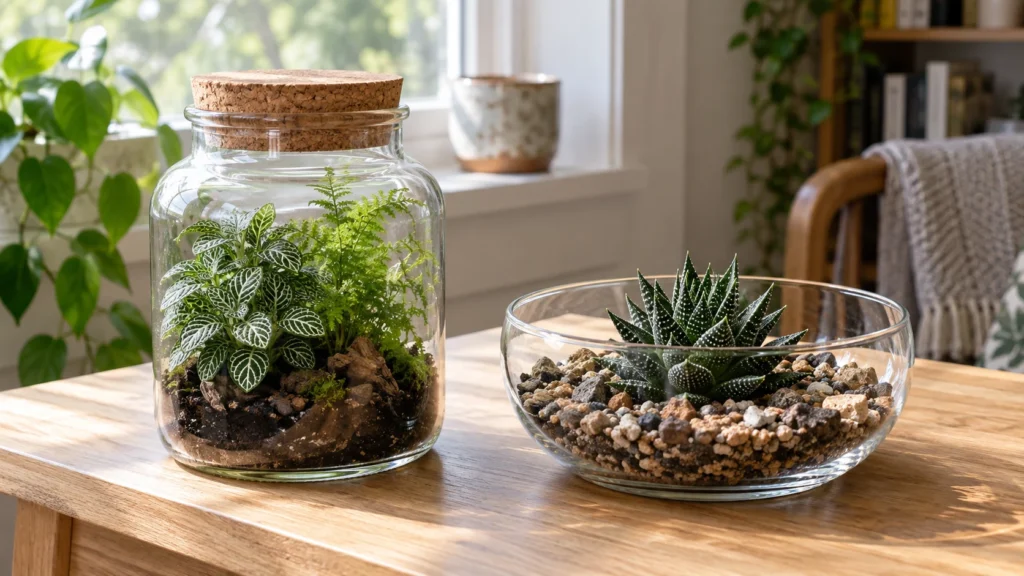
A successful terrarium starts with a climate decision, not a shopping list. A lidded jar holds humidity and slows water loss. An open bowl exchanges air with the room and dries faster. The plants must suit that environment and one another after they grow, not only look good together on the day you buy them. This guide helps you choose a vessel, compare six useful plants by verified mature habit, build compatible groups and correct the first warning signs without pretending that one recipe fits every home.
Keep Your Plant Resources in One Place
A VISU Link can collect links to your plant list, care notes and trusted guides behind one short address.
Choose the Vessel Before the Plants
Closed terrarium: choose this for plants that prefer steady moisture, higher humidity and indirect light. The lid slows water loss and keeps water cycling inside the system, so excess water is harder to correct than in a pot that drains. University of Minnesota Extension recommends matching plants by water and light requirements and considering mature size before choosing the container. That mature-size check prevents a common mistake: buying three tiny nursery plants that become one crowded mass.
Open terrarium: choose this when the plants need stronger air exchange and a drier root zone. Succulents such as Haworthiopsis attenuata and Echeveria elegans belong on this side of the decision. An opening does not make a bowl drain, however. If the vessel has no drainage hole, added water still has nowhere to leave. Treat it as a display container that receives measured water, not as a normal flowerpot.
Glass in direct sun can heat quickly. Institutional terrarium guides from the RHS and university extension services recommend bright or filtered indirect light rather than a hot windowsill. Observe the actual spot at different hours. A shelf that is shaded in the morning can receive a hard beam in late afternoon.
Terrarium Plant Selection Table
The dimensions below come from the cited institutional plant profiles. They describe mature habit under suitable conditions, not the size of the specimen at the shop. Spread matters as much as height. A low creeper can fill the entire floor while remaining only a few centimeters tall.
Plants for closed terrariums
| Plant | Best vessel | Verified mature habit or size | Light and moisture | Selection note |
|---|---|---|---|---|
| Nerve plant Fittonia albivenis | Closed | About 8 to 20 cm tall and 15 to 45 cm wide; slow, creeping spread | Bright to medium indirect light; moist, well-drained mix | Useful color at the middle or front. Pinch stems if they shade neighbors. |
| Friendship plant Pilea involucrata | Closed | About 8 to 30 cm tall and wide; dense, creeping habit | Bright indirect light; humid air and moist, well-drained mix | Choose a small cutting for a short jar. Tip pruning keeps it compact. |
| Krauss spikemoss Selaginella kraussiana | Closed | About 5 to 10 cm tall but 30 to 45 cm wide; rapid mat-forming growth | Shade to partial shade; rich mix kept moist | A ground layer, not a quiet filler. Use a small division and expect to trim it. |
Plants for open or strongly ventilated terrariums
| Plant | Best vessel | Verified mature habit or size | Light and moisture | Selection note |
|---|---|---|---|---|
| Zebra haworthia Haworthiopsis attenuata | Open | About 10 to 30 cm tall; offsets can form a much wider clump over time | Bright indirect light; gritty drainage; let the mix dry between waterings | Begin with one rosette and leave room to remove offsets. |
| Mexican snowball Echeveria elegans | Open | Low rosette; the RHS places its eventual spread in a broad 10 to 50 cm band | Bright indirect light; sharply drained mix; water as the compost approaches dry | Needs more light than the closed-jar group. Offsets enlarge the clump. |
| Ripple peperomia Peperomia caperata | Open or strongly ventilated | About 15 to 20 cm tall and 15 to 60 cm wide; upright, bushy habit | Filtered medium light; well-drained mix that partly dries between waterings | Not a sealed-jar substitute for fittonia. It does not tolerate persistently wet soil. |
Do not read the table as six plants that belong together. It is a sorting tool. Choose one moisture group, then narrow again by light, growth rate and available width. Common names vary across shops and countries, so confirm the Latin name on the label before using a care profile.
Build a Compatible Group
Start with one anchor plant, one lower layer and empty space. In a closed jar, that might mean a small Fittonia albivenis cutting plus a limited patch of Selaginella kraussiana. The fittonia supplies upright color while the spikemoss covers soil. Their habits differ, but both suit moist, indirect-light conditions. The empty area is part of the design because it gives each plant somewhere to grow.
For a taller closed vessel, use Pilea involucrata as the anchor and skip the fast ground layer. Its institutional profile puts mature growth as high as 30 cm, enough to press against a short lid. A tiny plant is not proof of a tiny adult. If the available jar is only decorative-candy-jar size, a rooted cutting is easier to manage than a full nursery pot.
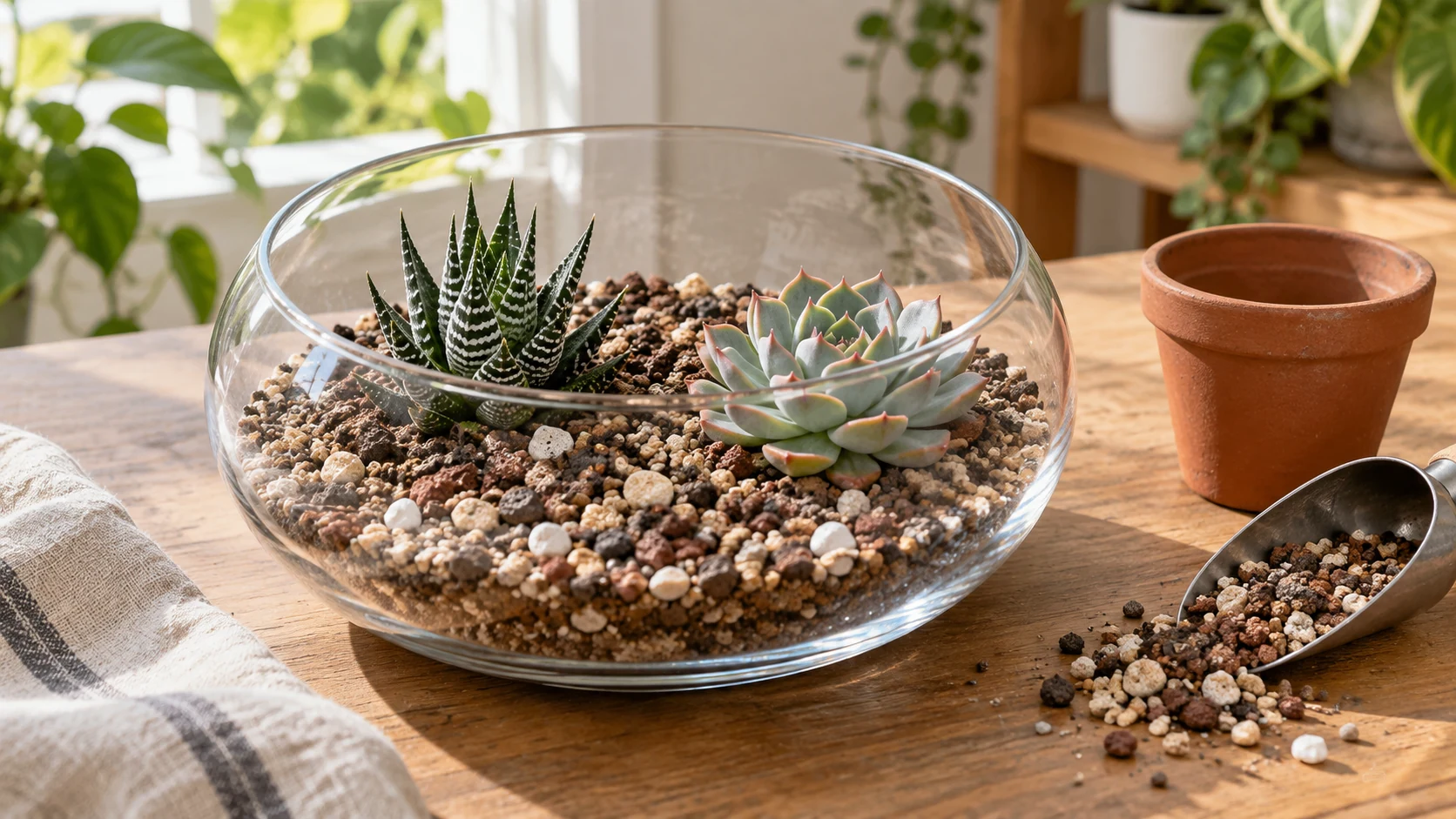
For an open, dry-side bowl, use one young Haworthiopsis attenuata or Echeveria elegans as the anchor. Both produce offsets, so a packed three-rosette arrangement can become crowded even when each plant grows slowly. Combining them is possible only where their light and drying pattern truly match. The safest small plan uses one species, repeats its form with stones and leaves the second species for another pot.
- Same moisture pattern: plants should want water at roughly the same stage of dryness.
- Same usable light: a plant that tolerates shade is not automatically a match for a light-hungry succulent.
- Compatible pace: a rapid mat former can overrun a slow rosette.
- Room at maturity: compare width, not only height.
- Reachable for care: every plant should be removable or trimmable without dismantling the whole scene.
Plan and Plant Without Trapping Excess Water
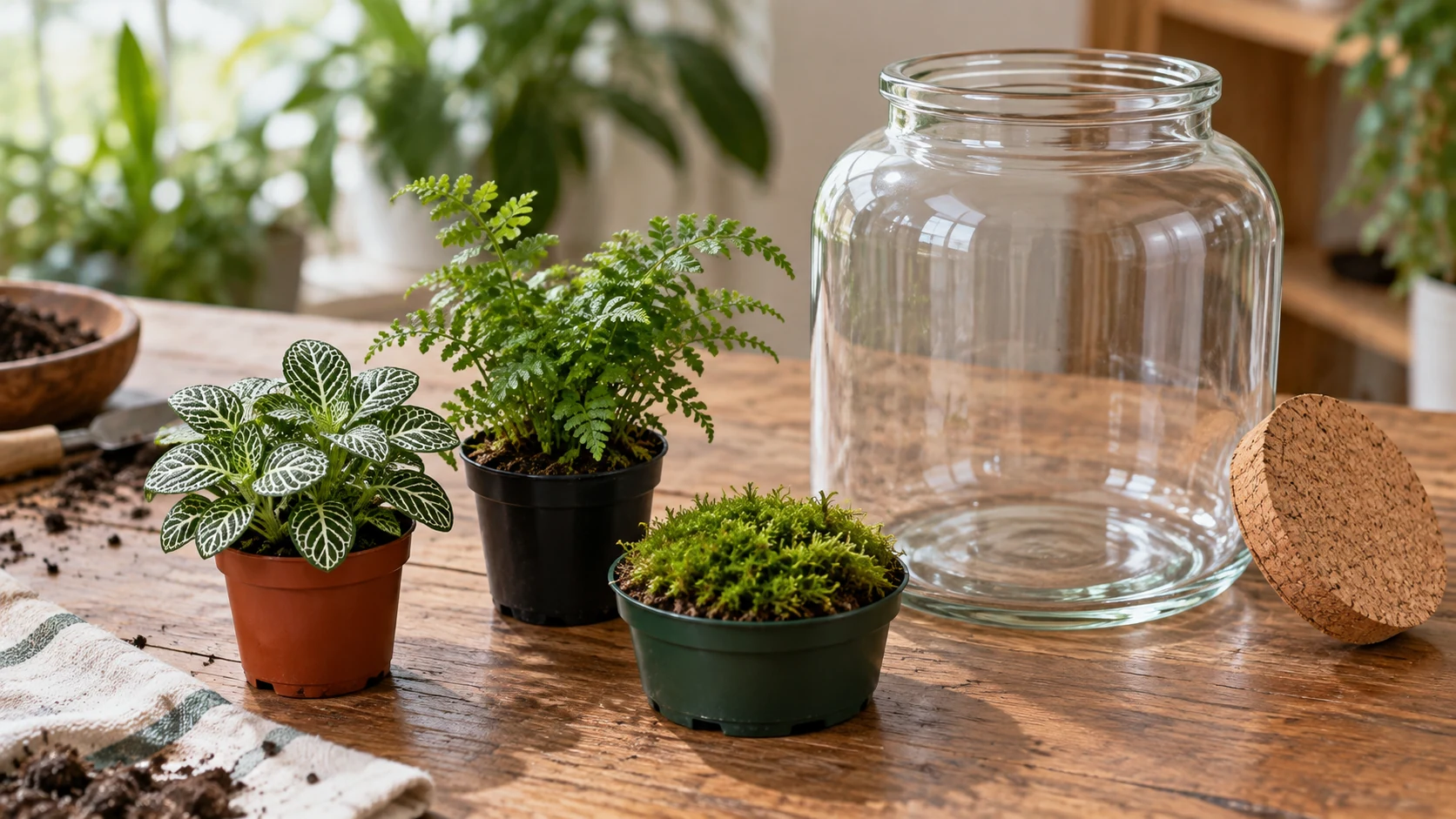
Wash and dry the vessel first. Set the nursery pots beside it and move them around before removing any plant. Look from the side that will face the room. Mark the eventual spread from the table with loose paper circles on the work surface. This simple rehearsal often shows that the original list contains one plant too many.
Use a potting mix that matches the group. A closed tropical group needs a moisture-retentive but well-drained medium. An open succulent group needs a gritty, sharply drained medium. A decorative pebble layer at the bottom is not an exit for water. Because most glass vessels lack a drainage hole, the useful control is restraint: begin with slightly moist mix for tropicals or dry mix for succulents, then add only what the plant zone needs.
- Add enough mix for the roots without burying the plant crown.
- Place the anchor first and keep foliage away from the glass where possible.
- Add the lower layer in a small patch instead of carpeting every open centimeter.
- Firm the mix gently around roots. Do not compress it into a solid block.
- Remove soil from leaves and glass so later changes are easy to see.
- Wait before decorating. Stones and figures can hide wet soil and dead foliage.
If you need a refresher on roots, container depth and potting media, the container gardening basics explain those decisions in a larger-pot context. A terrarium is less forgiving because there is much less soil and often no drainage hole.
Share the Plant List Without Rewriting It
Put links to your species list, source notes and care references on one VISU Link, then share that address with anyone helping with the terrarium.
Use the First Month as a Feedback Loop
The first month is for observation, not constant adjustment. Record the starting date, vessel type, plant names, light location and how damp the mix was at planting. Check at the same time of day so condensation and light are easier to compare.
In a closed jar, occasional condensation can be expected, but glass that stays heavily fogged and soil that remains saturated are reasons to pause watering and increase ventilation. Remove fallen leaves before they decompose. If one plant grows across another, prune early rather than waiting until both are tangled.
In an open bowl, check the mix below the surface rather than watering because the top looks pale. For Haworthiopsis attenuata, NC State Extension advises letting the soil dry between waterings. The RHS likewise recommends watering echeverias as the compost approaches dryness and never leaving them sitting in water. A fixed weekly schedule ignores differences in season, room temperature, vessel size and light.
Take one photo from the same angle each week. The purpose is not to claim a test result. It is to notice direction: a rosette leaning toward light, a creeping stem reaching a neighbor, or a wet zone that never changes. One clear trend is more useful than five unrelated daily interventions.
Read the Symptom Before You Change Everything
Stretched or leaning growth: the plant may be reaching for light, but confirm the species and inspect the whole plant before moving it. Increase light gradually and keep glass out of direct hot sun.
Soft, translucent or collapsing tissue: wet roots or stagnant conditions are possible. Stop adding water, remove failing material and check whether the plant belongs in that vessel type. A closed succulent display is usually a compatibility problem, not a shortage of care.
Crisp edges or a sudden fittonia wilt: the root zone may have become too dry, or the plant may be receiving hot direct light. Check the mix with a clean tool before adding water. A wilted leaf alone does not tell you how much to add.
Mold on dead material: remove the dead leaf or stem, improve air exchange and reassess how wet the system remains. Do not cover the symptom with more decorative moss.
Marks, webbing or repeated leaf damage: isolate the vessel from other plants and inspect closely. The guide to reading plant damage before guessing at a pest gives you a disciplined next step. Do not spray an unidentified product into a closed glass system.
Change one variable at a time when the plant is stable enough to wait. If you simultaneously move the jar, water it, prune it and replace the lid, you lose the chance to learn which condition mattered.
Three Small Plans You Can Adapt
Closed jar with controlled spread
Use one small Fittonia albivenis cutting as the focal plant and a small division of Selaginella kraussiana on only one side. Leave at least half the visible soil unplanted. This plan needs indirect light, conservative water and early trimming of the ground layer.
Tall humid jar with one species
Use a single Pilea involucrata cutting and let its textured foliage provide the whole composition. A one-species plan removes the hardest compatibility question. It still needs space because the verified mature range reaches roughly 30 cm in height and width.
Open dry bowl with room for offsets
Use one young Haworthiopsis attenuata rosette in gritty mix. Place inert stones far enough away that you can see and remove new offsets. If you prefer Echeveria elegans, use it instead rather than crowding both into a very small bowl.
Keep the Finished Guide Easy to Find
A VISU Link can hold links to your terrarium notes, plant sources and the photos you choose to share.
Frequently Asked Questions
Should a terrarium be open or closed?
Choose closed for plants that suit higher humidity, steady moisture and indirect light. Choose open for plants that need stronger air exchange and a drier root zone. The plant requirements decide the vessel, not the decorative style alone.
Can succulents live in a closed terrarium?
A sealed humid jar conflicts with the dry root zone and air exchange preferred by common succulents such as zebra haworthia and echeveria. Use an open vessel with sharply drained mix, or keep the succulent in a pot with a drainage hole.
How many plants fit in a small terrarium?
Start with one anchor plant and, if conditions match, one small lower layer. Compare mature spread with the vessel and leave visible empty soil. Nursery size is not mature size.
Do pebbles at the bottom give a terrarium drainage?
Pebbles can hold space below the mix, but they do not create an outlet from a vessel with no drainage hole. Control the amount of water you add and use a potting mix suited to the selected plants.
How often should I water a terrarium?
There is no reliable universal schedule. Check the vessel type, plant species, mix and actual moisture. Closed terrariums lose water slowly, while open vessels dry faster. Add water in small measured amounts only when the selected plants need it.
References
- RHS, Terrariums and Bottle Gardens
- University of Minnesota Extension, Terrarium Gardening
- NC State Extension, Fittonia albivenis
- NC State Extension, Pilea involucrata
- NC State Extension, Selaginella kraussiana
- NC State Extension, Haworthiopsis attenuata
- RHS, Echeveria Growing Guide
- NC State Extension, Peperomia caperata