

The best camera to record soccer games is decided by who has to hold it and where it can sit, not by megapixels. A phone in a parent's hand, an action cam on the fence, a camcorder on a tripod and a camera fixed above the pitch all record football. They fail in completely different ways, and the failure you can live with depends on your Saturday, not on a spec sheet.
This guide compares the five kinds of camera people actually use for amateur and youth soccer by the things that decide the result: who operates it, how high it can go, whether it keeps the whole pitch or follows the ball, how it copes with a full match of light and battery, and what you are left with afterward. It names no brands. If you want the framing and the light once you have picked a camera, how to record your soccer game covers that.
The Play Is Already Recorded
At a pitch with VISU Replay, the cameras run continuously. You press the button after the goal and the clip is already there, cut and ready, without anyone leaving the game to film.
Start With Who Is Holding the Camera
Every camera question about soccer hides a people question. There are only three situations, and each one points to a different kind of equipment.
Someone films and does not play. A parent on the touchline, a coach, a friend who came to watch. That person can hold a phone, follow the ball, zoom when play moves to the far end and stop when nothing is happening. The camera can be simple because the operator is doing the hard part. The cost is that the operator watches the match through a screen and misses it in person.
Nobody can sit out. Five-a-side, a Sunday kickabout, futsal with exactly ten players. Whoever films is not playing, so the camera has to work unattended: on a tripod, clipped to a fence, or fixed somewhere high. Now the camera has to be good at things a human would normally do, which is why this scenario is where most footage goes wrong.
The pitch already has a camera. Some venues have a fixed camera installed above the field that records every session. Nobody brings anything, nobody operates anything, and the question changes from "which camera" to "how do I get my clip". If that is your situation, most of this article is background reading.
Decide which of the three you are in before reading on. The right camera for a touchline parent is a poor camera for a group of ten, and the reverse is also true.
The Five Types of Camera for Soccer
Each type below is described by what it does well, where it fails and who it suits. No brands, because within each type the differences that matter for soccer are the ones listed here, not the model name.
1. A Phone in Someone's Hand
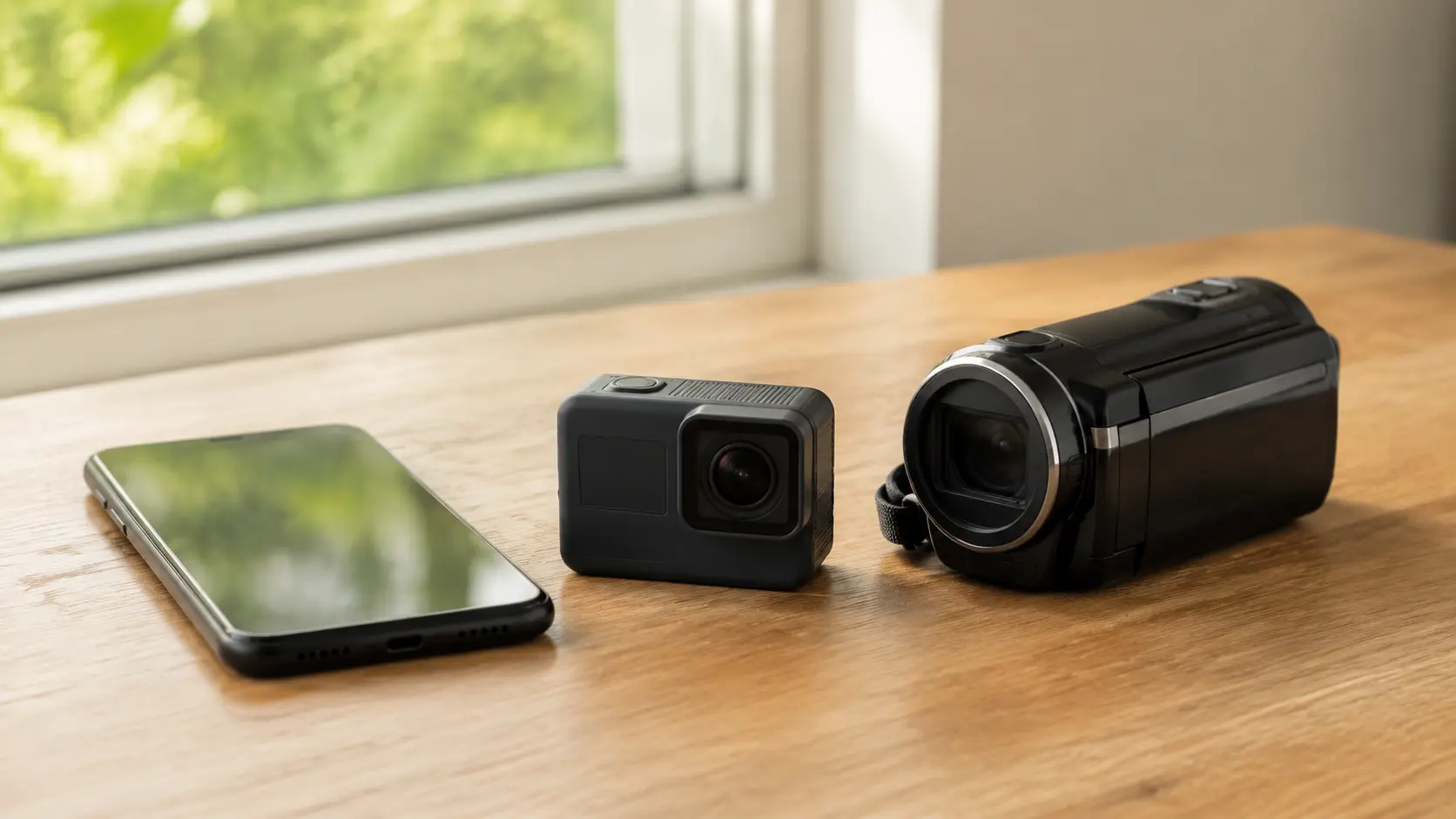
Good at: being there. It is charged, it is in your pocket and it can follow the ball, zoom and stop. Modern phones handle daylight well and the file lands where you already share things. Fails at: everything that needs height and stillness. From touchline height the far side of the pitch is a row of small figures, handheld zoom shakes, and a full match of continuous recording heats the phone and drains it. Suits: a parent or coach who wants specific moments, not the whole game, and is willing to trade watching for filming.
2. A Phone on a Tripod
Good at: removing the shake and freeing the person. Set it high, frame wide, press record and go. Fails at: following the play. A fixed wide frame from touchline height keeps the whole pitch and loses the player: the ball is a dot and faces are unreadable. Raise it and you need a taller, heavier tripod that wind will test. The phone still overheats and still runs out of storage on a long match. The full trade-off is in tripod versus fixed camera. Suits: small pitches where wide is close enough, and groups where nobody can sit out.
3. An Action Cam
Good at: surviving. Weather, knocks, a fence clip, a pole mount, long recording without heat problems. The wide lens keeps the whole small pitch in frame. Fails at: distance. The same wide lens that captures everything makes a full-size pitch look far away, and there is no meaningful zoom. Fixed exposure decisions in changing evening light are also a known weakness. Suits: futsal courts and five-a-side cages, mounted high on the fence, when nobody can operate a camera.
4. A Camcorder or Zoom Camera on a Tripod
Good at: reach. Optical zoom pulls the far penalty area back to a usable size, batteries last, and storage is designed for hours of footage. On a tall tripod behind the halfway line it produces the classic amateur match video. Fails at: being left alone. Zoomed in, it needs someone panning; zoomed out, it is a tripod phone with better optics. It is also more to carry, set up and charge. Suits: clubs and teams with a designated person filming full-size matches for analysis.
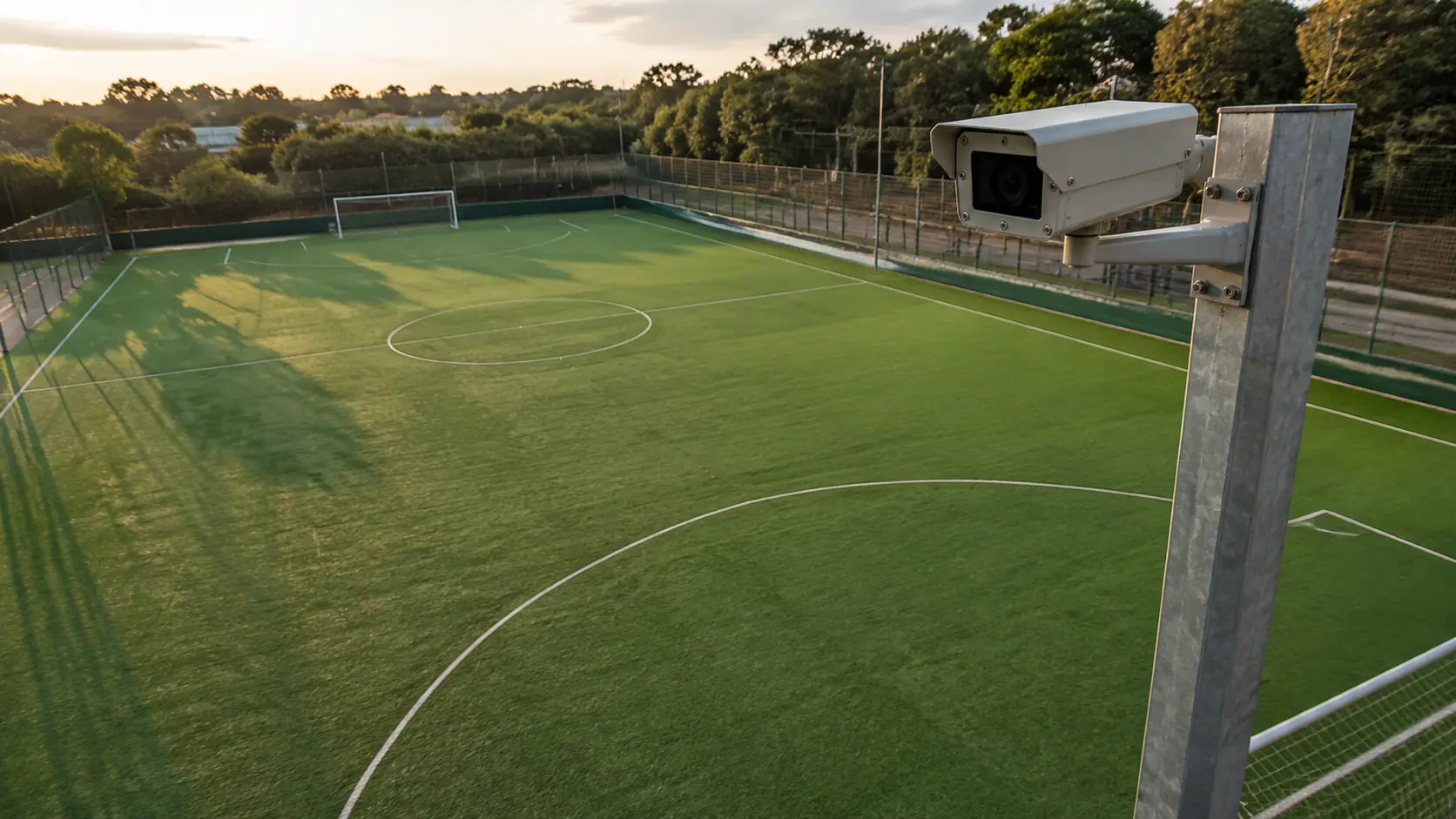
5. A Camera Fixed Above the Pitch
Good at: the things nobody wants to do. It is already high, already aimed, already powered, and it records every session without anyone remembering. Where it is a replay camera, players trigger a short clip after a play and receive it on their phone, cut and named, with no editing step. What a replay camera is explains the difference from a security camera or a broadcast setup. Fails at: being yours. It exists only where a venue has installed it, and the angle is fixed by the installer. Suits: anyone who plays at a venue that has one, and venue owners who want every booking to leave with footage.
Field Size Changes the Answer
The single biggest reason soccer footage disappoints is distance, and distance is set by the pitch, not the camera. A five-a-side cage is roughly the size of a basketball court. A full-size pitch is more than a hundred metres long. The same phone that produces perfectly watchable futsal from the fence produces unrecognisable specks from the halfway line of a full pitch.
For small pitches, futsal courts and five-a-side cages, a wide fixed camera works: a phone on a tall tripod, an action cam clipped high on the fence, or a venue camera. Height matters more than zoom here. Get the lens above head height and slightly behind the halfway line and you keep the whole game and still see who scored.
For full-size pitches, nothing wide from ground level is enough. You need either optical zoom with a person panning, or a camera that is genuinely high and permanently placed, which in practice means a venue installation. A phone on a tripod at the corner flag is the most common mistake and the least watchable result.
Where the camera goes matters as much as what it is. The best camera angle for soccer covers height and side of the pitch in detail, and the conclusions there apply to every type on this list.
Find Out If Your Pitch Has It
VISU Replay only exists where it has been installed, so the useful first question is whether the place you already play has cameras. If it does, the camera decision is already made.
Light, Battery and Storage for a Full Match
A soccer match is long for a camera. Ninety minutes plus warm-up is well beyond what most phones are comfortable recording continuously, and the failure is rarely dramatic: the phone gets hot, drops resolution or stops with a warning while the second half is still going. If you record with a phone, expect to manage it at half-time: check heat, storage and battery, and restart the recording.
Light changes across a match more than people expect. A late-afternoon kick-off starts in sun and ends under floodlights, and any camera with a wide dynamic range and automatic exposure handles the transition better than one locked to a single setting. Action cams and phones do this reasonably in daylight; under floodlights every consumer camera struggles with noise and motion blur, and the fix is higher frame rate and a lens that gathers more light, not more resolution. For covered pitches and sports halls, filming indoor courts under artificial lighting goes through what actually helps.
Storage is the quiet problem. A full match at high resolution is a large file, and the file has to go somewhere before the next game. Camcorders and action cams accept memory cards you can swap. Phones fill up. Fixed venue cameras handle storage on their side, which is one of the less obvious reasons people who play at venues with a camera stop carrying anything.
A practical rule: if you cannot name who will charge it, empty it and restart it at half-time, choose a type that does not need any of those three.
What You Get Afterward: Raw File or Ready Clip
This is the part of the decision most camera guides skip, and it is the part that decides whether the footage is ever watched. Four of the five types give you a raw file: sixty to ninety minutes of continuous video that contains, somewhere, the two goals and the save people actually want to see. Someone has to find them, trim them and send them, and that someone is usually nobody.
The fixed venue camera with a replay button is the exception, and the reason it belongs in a camera comparison at all. The camera records continuously, a player presses a button after a play, and the system cuts a short clip around that moment and delivers it to the player's phone. The replay button keeps a window of about twenty-five seconds before the press and five after, which is why the clip starts before the goal rather than after it. There is no raw file to search and nothing to edit.
If you choose any of the other four types, plan the afterward step before the match: who will pull the clips, on what device, and how long that takes. Two goals from a ninety-minute file is a real hour of someone's evening. If the honest answer is that nobody will do it, a camera that produces a raw file is a camera that produces nothing.
A Decision Table
Match your situation to a row. The recommendation is a type, not a model, and the reason is the thing that would otherwise go wrong.
| Your situation | Best type | Because |
|---|---|---|
| Parent filming a child's match, willing to follow the ball | Phone in hand, or camcorder with zoom on a full pitch | An operator solves distance; the phone solves sharing |
| Five-a-side or futsal, nobody can sit out | Action cam or phone on a tall tripod, mounted high behind halfway | Small pitch makes wide good enough; height keeps faces readable |
| Full-size pitch, nobody to operate | Fixed venue camera if the ground has one; otherwise accept a wide overview only | No unattended ground-level camera reaches the far end |
| Club filming for analysis | Camcorder or zoom camera on a tall tripod with a designated operator | Reach, battery and storage built for full matches |
| You mainly want the goals, not the match | Replay camera at the venue | The clip is cut at the moment it happens; no file to search |
| Evening matches under floodlights | Whichever type has the largest sensor and a higher frame rate; avoid the phone if you can | Low light punishes small sensors before it punishes resolution |
| You own or run the venue | Fixed installed camera | Every booking gets footage; every clip carries your name |
If You Run the Pitch
A fixed camera means every group that books leaves with the clip without bringing equipment, and every clip goes out carrying the name of your venue.
FAQ
Can I record a soccer game with my phone?
Yes, and for small pitches from a high, fixed position it is often enough. Plan for heat, storage and battery at half-time, and accept that from ground level a full-size pitch will look far away.
What camera do parents use to record soccer?
Most use the phone they already have, held or on a tripod. Parents who film full-size matches regularly tend to move to a camcorder with optical zoom on a tall tripod because reach is the problem a phone cannot solve.
How do I record a whole soccer field?
Height first, width second. Get the camera well above head height behind the halfway line. On a small pitch a wide lens from there keeps everything. On a full-size pitch no single ground-level camera keeps both the whole field and readable players; that is what fixed high installations are for.
Action cam or camcorder for soccer?
Action cam for small pitches and unattended mounting; camcorder for full pitches with someone operating the zoom. They solve opposite problems.
Do I need 4K to record soccer?
Resolution helps if you plan to crop into a wide shot afterwards. It does not fix distance, shake, low light or a bad angle, and higher resolution makes the heat and storage problems on a phone worse. Position and height matter more.
How do venues record games?
With cameras fixed high above the pitch that record every session. Where the venue uses a replay system, players trigger short clips with a button and receive them on their phone, so nobody films and nobody edits.