

A tryout video is not judged like a highlight clip, because it has one reader instead of an audience. The person watching is deciding something, and they are watching under time pressure, which changes what belongs in the video and what has to go.
Most tryout footage fails for reasons that have nothing to do with talent. The viewer cannot tell which player is you, the clip starts after the decision that mattered, the camera loses the run that created the space, or the file is long and arrives with no order. None of that is fixed by better editing.
Find Out If Your Court Has It
VISU Replay only exists where it has been installed, so the useful first question is whether the place where you already play has fixed cameras and a replay button.
Why a Tryout Video Is Judged Differently
A clip made for a group chat and a clip made to be evaluated look similar and work in opposite ways. The group already knows who you are, already watched the game, and is enjoying a moment it remembers. The person evaluating knows none of that. Every piece of context that friends supply from memory has to be supplied by the video itself.
That single difference reorganises the whole checklist. The general criteria in what makes a good sports clip still hold, but they assume a viewer who is watching for pleasure and will give the clip the benefit of the doubt. Here the viewer is resolving a question, and anything ambiguous is not resolved generously. It is simply skipped.
The practical consequence is that a spectacular moment can be worth less than an ordinary one. A goal filmed from behind a fence, where the scorer is one of four bodies in a blur, proves nothing to a stranger. A simple pass, filmed so the reader sees you check your shoulder and move the ball first time, proves something specific.
So the test for every candidate clip is not whether it looks good. It is whether a stranger watching once, without pausing, could say what you did and why it was a decision rather than an accident.
The Most Common Mistake: Nobody Can Tell Which One You Are
This is the failure that wastes the most usable footage. The play is fine, the framing is fine, and the video is unusable because the reader spends the whole clip trying to work out which player to follow, and by the time they have decided, the action is over.
Football is built to make players hard to separate at a distance. The Laws of the Game state that the two teams must wear colours that distinguish them from each other and the match officials, which solves the team problem and not the individual one. Within your own team you are wearing the same shirt as everyone else, and at a wide framing that is the only information the camera captured.
The Laws also note that a player’s number and name are usually permitted on the shirt, and that is the identifier most tryout footage never actually shows. A number only helps if the camera sees the back at a readable size, which a wide clip from the far touchline rarely does. Assume it will not be legible.
The reliable methods are boring and they work. Something visually distinct that stays consistent across every clip, boots or sleeves, so the reader learns you once. A still frame opening the reel that shows you clearly. And your starting position stated in one line, so the reader knows where to look before the play develops.
The Play Starts Before the Touch
Almost every tryout clip starts too late. The instinct is to begin where the visible action begins, at the moment the ball arrives, because that is the part that looks like something. But the part that looks like something is usually the least informative part of the sequence.
What the reader wants to see is whether the touch was a decision or a reaction, and that is only visible before the ball arrives. Where were you standing, did you look before receiving, did you move to create the angle, had you already chosen the next pass. A clip starting at the touch deleted all of it and kept the outcome.
This is why general advice on clip length behaves differently here. General guidance on clip length is about holding attention. Here the constraint is the opposite: the clip needs enough room at the front to contain the reasoning.
A useful test is to watch a candidate clip with the sound off and stop it the instant before the ball reaches you. If nothing in what you just watched explains why the next thing works, the clip needs more room at the start, not a tighter cut.
The Play Is Already Recorded
At a court with VISU Replay, the cameras run continuously. You press the button after the play and the clip is already there, cut and ready, without anyone leaving the game to film.
The Camera That Loses the Movement Off the Ball
A person holding a phone follows the ball, because that is what watching football feels like. But a tryout video often needs to show what you did while the ball was elsewhere, and a ball-following camera is pointing away at exactly that moment.
The scale of the pitch is why this is not a small framing error. Under Law 1, the touchline runs from a minimum of 90 m to a maximum of 120 m, and the goal line from 45 m to 90 m. A camera panning across that distance to stay with the ball is travelling a long way, and every degree it turns toward the ball is a degree turned away from the run that is about to matter.
A fixed wide frame is the more reliable tool. It looks less exciting and captures more evidence, because the player and the space are in the picture together and the reader sees the relationship. The trade-off is size: you will be smaller, which pushes the identification problem back onto the methods above.
If someone is operating the camera, the instruction that helps most is to resist the ball. Frame the area you are playing in and hold it, letting the ball enter and leave. The angle choices in the best camera angle for soccer apply, with one adjustment: pick the angle that keeps you in frame continuously.
Mark the Play During the Game, Not Afterward
The most expensive part of making a tryout video is not filming or editing. It is finding the moments afterward inside a long recording with nothing to navigate by. An hour of unmarked footage has to be watched at least once, and this is where most tryout videos quietly die.
Marking live removes that cost. If somebody notes the clock time right after a play worth keeping, even roughly, the search collapses to a handful of positions. A note on a phone works, as long as it happens while the memory is still attached to the number.
There is a second reason to mark live, which is that judgement changes. Watching an hour of your own footage afterward, you start grading plays against each other and drifting toward the ones that look impressive. In the moment you know which were good decisions, because you remember what you could see.
A retroactive replay button is the same principle built into the venue. Instead of noting a time to search for later, the moment is saved as a clip when you press, and the search never has to happen.
How Many Plays and In What Order
Fewer than feels right, and ordered on purpose. The reason is not that the reader has a rule about length. It is that they will stop when they have formed an opinion, and everything after that point is either unwatched or actively working against you by diluting what they already saw.
The order that survives that puts your clearest play first, not your most spectacular. Clearest means the reader sees who you are, what the situation was, and what you chose, with the least effort. If the first clip needs explaining, it is the wrong first clip.
After that, show range rather than repetition. Three variations on the same action tell the reader one thing three times. Three different situations, receiving under pressure, a defensive recovery, a decision with your back to goal, describe a player instead of a moment.
Group by type rather than by chronology. Nobody watching cares which game came first, and grouping similar situations lets the reader compare like with like instead of resetting their attention on every cut.
Cutting: What Goes First
The first things to cut are the plays you keep for reasons that are not about the reader. The goal from a game your team won, the moment your friends still talk about. Sentiment is invisible in the footage, and a play that needs your memory to be impressive will not impress someone who was not there.
Cut anything ambiguous next. If you are fairly sure the reader can identify you but not certain, remove it. An ambiguous clip does not score zero, it scores negative: the reader spends attention and gets nothing back, and that attention was going to the next clip.
Then cut everything where the useful part is missing at the front. A clip that begins at the touch, as covered above, cannot be repaired in editing. If the seconds before the ball arrived were not recorded, the evidence does not exist and the clip is a highlight, not a piece of a tryout video.
What survives that process is usually a short reel, and short is correct. A tryout video is not a record of a season. It is an argument, and every clip that does not carry the argument is weakening it.
Raw and Well Cut Against Heavily Edited
Raw footage cut at the right moments outperforms polished footage almost every time, and the reason is credibility. Every effect that draws attention to the edit raises the question of what the edit is doing. Slow motion on an ordinary pass, music timed to the touch: each tells the reader someone worked to make this look better than it was.
An unedited clip makes the opposite offer. It says here is what happened, at normal speed, from a distance where you can see the whole situation, judge it yourself. That is a stronger position to argue from, and it is also less work.
The editing that helps is invisible: the right start point, the right end point, and a deliberate order. A single quiet marker identifying you in the first seconds is worth more than every transition effect combined, because it solves a real problem instead of decorating one.
This is a different job from building a highlight reel as a format, where production value is part of the point. Here the video exists to be assessed, and assessment rewards footage that is easy to trust.
If the Tryout Pitch Already Has VISU Replay
The real bottleneck is not skill, camera or editing. It is that almost nobody has a person available to film an entire tryout. Parents watch, friends play, and the phone that was going to record ends up in a pocket. A pitch that already records removes that dependency.
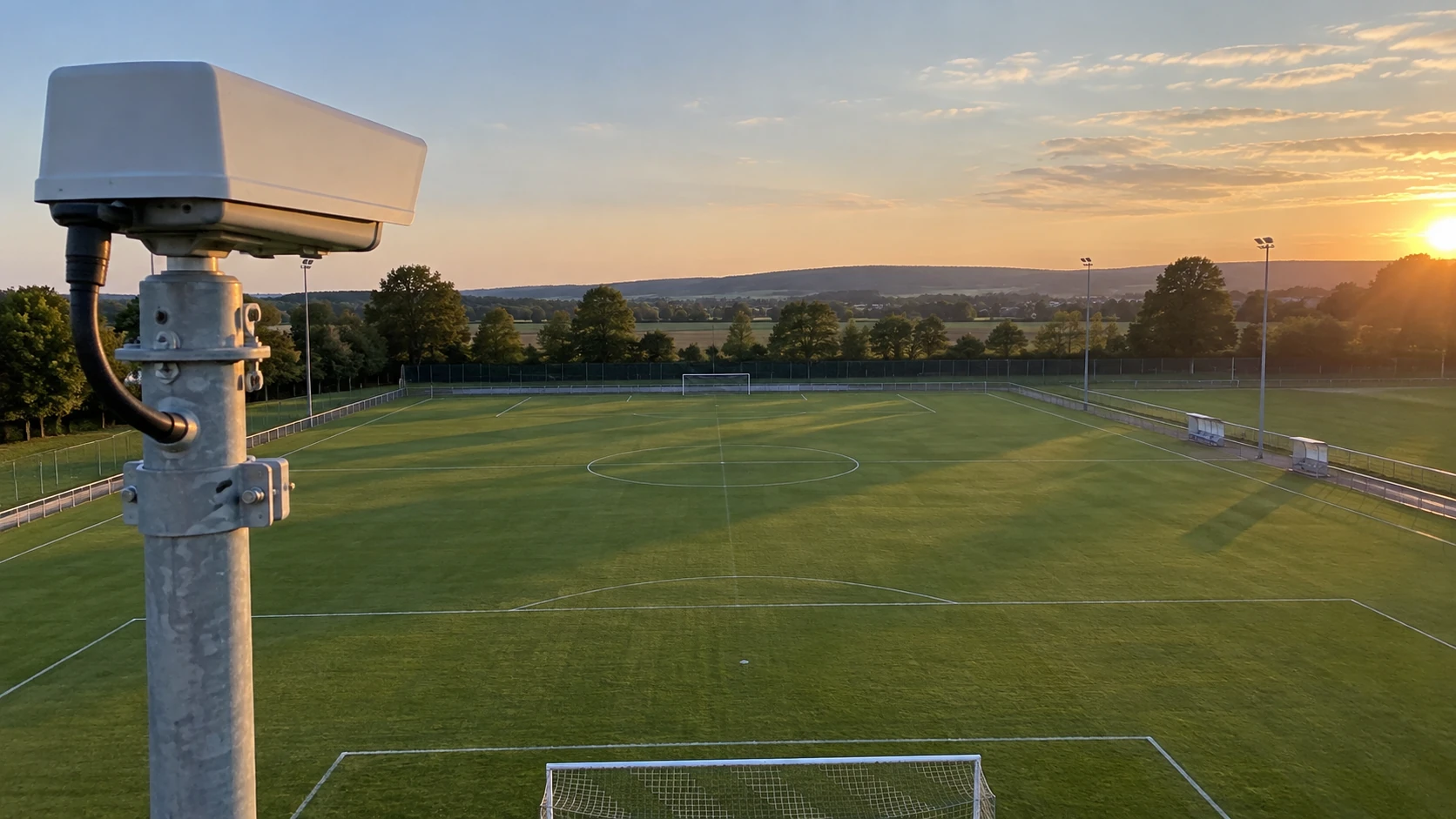
At a venue with VISU Replay, a fixed camera records the session from its installed position. After a play, a player presses the button and the system saves a clip that is already cut, using a window of 25 seconds back and 5 seconds forward. That window is why it works here: it keeps the build-up, not just the finish.
It is worth being precise about what this does. The camera records and the button saves a clip. It does not decide which plays are good, rank them, label who is in them, or send anything to anyone. Selecting and ordering the reel remains your work.
VISU Replay only exists where it has been installed, so do not assume a pitch has it because another one does. Ask the place where you already play, and if it is there, learn the button position before the session. The mechanics are in how the replay button works.
If You Run the Venue
A fixed camera means every group that books gets the clip without bringing equipment, and every clip leaves carrying the name of your court.
FAQ
How long should a tryout video be?
Short enough that the reader watches all of it, which means fewer clips than you want to include. Length is set by how many plays carry the argument, not by a target duration.
How do I make sure they know which player I am?
Do not rely on the shirt number, because a wide frame rarely renders it legibly. Use something visually consistent across every clip, open with a still frame showing you clearly, and state your starting position in one line.
Should I include full matches or only clips?
Clips. A full match asks the reader to do the selection work themselves, and the selection work is the part of the video you control. Keep the full recording for your own reference, but send the reel.
Is it better to film from the sideline or from high up?
Higher is generally better, because it keeps you and the space in the same frame and shows movement off the ball. A sideline phone at ground level exaggerates near players and hides what is happening behind them, which is often exactly what needs to be visible.
What if nobody can film the whole session?
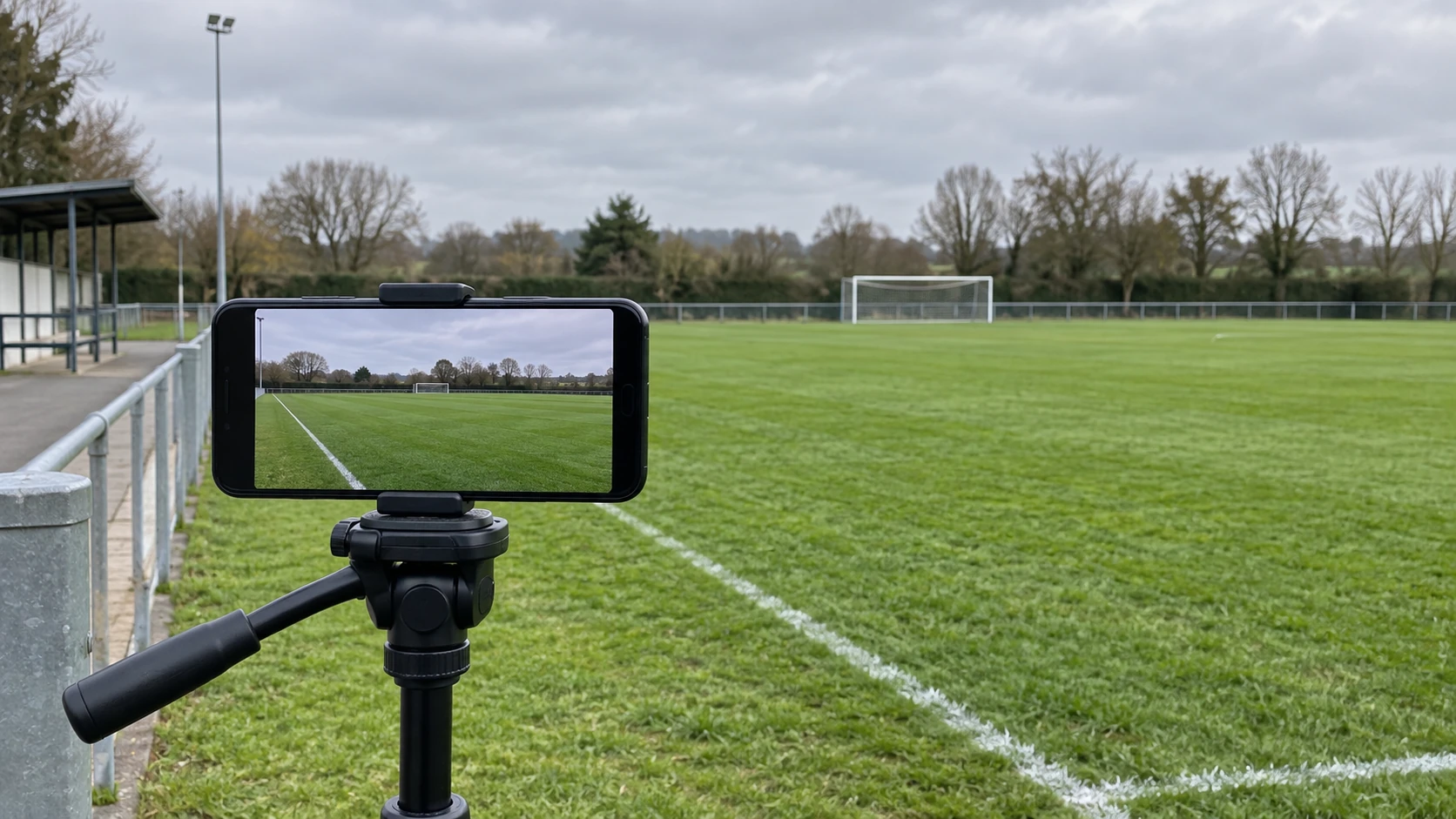
This is the normal situation, and it is why fixed recording matters. If the pitch has cameras and a replay button, plays are saved as you press without anyone stepping out of the game. If not, a phone on a tripod holding a wide frame beats an occasional person following the ball.
Should I show mistakes?
Not as filler, but do not cut a clip only because the outcome was imperfect. A good decision where the pass was slightly overhit still shows the decision, and that can be worth more than a clean touch that required nothing.
References
- IFAB Laws of the Game: The Field of Play. Pitch dimensions, used to explain the distance a camera has to cover when it follows the ball.
- IFAB Laws of the Game: The Players' Equipment. Team colours distinguish teams from each other, and shirt numbers and names are usually permitted, which is why individual identification is a separate problem from team identification.
- IFAB Laws of the Game: The Players. Team composition on the field, relevant to how many similar shirts appear in a wide frame.