

Family Feud questions work differently from trivia. Nobody asks for the right answer; players try to guess what most people would say. That is why the format suits a living room full of mixed ages: a ten-year-old can beat a professor at "name something you take to the beach". Below you will find original survey-style questions with ranked answers, a Christmas round and a Fast Money round, plus everything you need to host: the board, a buzzer you already own, a timer, the scoring and fair teams. When it is time to split the room, our free random team generator balances players by level and shows the seed of every draw.
Put Your Game Night on One Page
A free VISU Link page keeps the date, the address, the teams and your group chat link in one place, so every guest finds the details without scrolling back through messages.
How a Survey Game Works, and Why It Is Not Trivia
Family Feud is an American game show created by Mark Goodson that first aired in 1976 and is now hosted by Steve Harvey. Two families compete to name the most popular answers to survey questions. On the show, each question was first put to a group of 100 people, and every answer on the board is worth one point for each person who gave it. An answer needs at least two people to make the board, so the points often add up to less than 100.
That changes what a good question looks like. A trivia question has one correct answer and rewards knowledge; if that is what your group wants, our fun trivia questions for adults are built for it. A survey question has many acceptable answers and rewards empathy: you win by thinking like everyone else, not by knowing more than everyone else. The best ones start with "Name something..." and have five or six answers that most people would think of within a few seconds.
A note on the answers below: these questions are ours, written for party play. The ranked answers and points are our estimates of what a typical group would say, not results from a real survey, and not answers from the TV show. Treat them as a starting point. If your family insists that "flip-flops" belongs on the beach board, the host can add it. For answers that come from real people, see the last section on running your own survey with your guests.
The format travels well. In the United Kingdom it ran as Family Fortunes, Mexico had 100 mexicanos dijeron and Brazil had versions such as Jogo das Famílias. Whatever name your guests grew up with, the rules below will feel familiar.
Warm-Up Questions for All Ages
Start with questions that everyone from eight to eighty can answer. The top answer should feel obvious, so the first face-off ends with a laugh rather than a long silence.
- Name something you take to the beach. Towel 30, sunscreen 24, umbrella 14, cooler 11, swimsuit 8, beach chair 6.
- Name an animal you might see on a farm. Cow 36, pig 22, chicken 18, horse 12, sheep 7.
- Name something people do right after they wake up. Check their phone 31, go to the bathroom 24, brush their teeth 16, make coffee 14, take a shower 8.
- Name a fruit that is yellow. Banana 52, lemon 21, pineapple 12, mango 6, pear 4.
- Name something kids take to school. Backpack 33, lunch 25, pencil 15, books 12, water bottle 7.
- Name a reason someone is late for work. Traffic 40, overslept 28, car trouble 12, the kids 8, bad weather 5.
- Name something that has wheels. Car 38, bike 24, skateboard 11, shopping cart 9, stroller 6, suitcase 4.
- Name a pet that lives in a cage or a tank. Fish 34, hamster 26, bird 19, guinea pig 9, snake 5, turtle 4.

Questions About Home, Food and Everyday Life
Everyday questions are where families argue the most, because every household is sure its own habit is the normal one. That is exactly the fun.
- Name a topping people put on pizza. Pepperoni 41, extra cheese 18, mushrooms 13, sausage 10, onions 6, pineapple 5.
- Name something people put in their coffee. Milk or cream 46, sugar 30, sweetener 8, cinnamon 5, ice 4.
- Name a room where you would find a mirror. Bathroom 55, bedroom 26, hallway 7, closet 5, living room 4.
- Name a chore nobody likes doing. Dishes 33, laundry 22, cleaning the bathroom 19, vacuuming 10, taking out the trash 8.
- Name something you keep in the fridge door. Ketchup 30, milk 21, eggs 15, juice 12, butter 8.
- Name a food people eat with their hands. Pizza 30, burger 24, fries 15, chicken wings 13, tacos 9.
- Name something you find in a junk drawer. Batteries 26, rubber bands 18, pens 17, takeout menus 10, keys 9, tape 7.
- Name something people lose all the time. Keys 44, phone 21, glasses 12, the TV remote 10, socks 6.
Questions for Teens and Adults
These still work with kids in the room, but the answers come from adult life: dates, budgets and the group chat. Read the room before you ask anything more personal than this.
- Name something people do during a boring meeting. Check their phone 39, doodle 18, zone out 15, look at the clock 11, yawn 9.
- Name something you need for a road trip. Snacks 33, gas 21, a playlist 16, a phone charger 13, a map or GPS 9.
- Name something people do on their phone in bed. Scroll social media 41, watch videos 22, text 15, set an alarm 11, play games 6.
- Name a place to go on a first date. Restaurant 38, movie theater 25, coffee shop 15, bar 9, park 6.
- Name something people do to save money. Cook at home 32, use coupons 22, cancel subscriptions 14, buy store brands 11, drive less 7.
- Name something people bring to a potluck. Salad 27, chips and dip 22, dessert 20, a casserole 15, drinks 9.
- Name an excuse for not answering a text. My phone died 34, I was busy 28, I didn't see it 20, I was asleep 10, I was driving 5.
- Name a job that comes with a uniform. Police officer 30, nurse 22, firefighter 17, chef 10, pilot 8, soldier 7.
Christmas Family Feud Questions
For a holiday party, swap one regular round for this one. These questions ask what people do and think at Christmas, not facts about it. If you want a fact-checked holiday quiz for the same night, our Christmas trivia questions come with answers and sources.
- Name something you hang on a Christmas tree. Ornaments 40, lights 28, tinsel 12, a star 10, candy canes 6.
- Name a Christmas song everybody knows. "Jingle Bells" 38, "Silent Night" 18, "Rudolph the Red-Nosed Reindeer" 16, "Deck the Halls" 10, "All I Want for Christmas Is You" 9.
- Name something people leave out for Santa. Cookies 55, milk 32, carrots for the reindeer 9.
- Name a gift nobody really wants. Socks 36, fruitcake 18, an ugly sweater 17, a gift card to a store you never visit 10, a lump of coal 8.
- Name something people do the day after Christmas. Return gifts 34, eat leftovers 27, sleep in 15, shop the sales 13, clean up 6.
- Name a reason a holiday dinner runs late. The turkey isn't done 35, guests arrive late 30, someone forgot an ingredient 12, too many cooks in the kitchen 9, the oven is too small 6.
A Fast Money Round to Finish
On the show, the winning family sends two players to Fast Money. The first answers five quick survey questions against the clock while the second waits out of earshot. Then the second player answers the same five questions with five extra seconds; if they repeat an answer the first player already gave, the host asks them to try again. Since 1994 the clock has given the first player 20 seconds and the second 25, and the pair needs 200 points combined to win the cash prize.
At home, send the second player to the kitchen with headphones on and use the timer on your phone. Here are five questions to use:
- Name something you drink in the morning. Coffee 62, water 14, orange juice 12, tea 8.
- Name a color for a car. White 30, black 28, silver 16, red 12, blue 9.
- Name a holiday people decorate their homes for. Christmas 60, Halloween 24, Easter 7, the Fourth of July 5.
- Name something you take on a picnic. A blanket 34, a basket 24, sandwiches 20, drinks 10, fruit 7.
- Name a vegetable kids refuse to eat. Broccoli 41, Brussels sprouts 24, spinach 13, peas 10, carrots 5.
With these numbers, 200 is reachable but not easy, which is the point. For younger players, lower the target to 150.
Share the Rules Before Anyone Arrives
A VISU Link page can hold the house rules, the team list and the address, so guests show up knowing how the game works and which side they are on.
How to Host: Board, Buzzer and Timer
The host makes or breaks this game. Pick someone who enjoys reading out loud, can keep a straight face and is happy not to play. The host holds the answer sheet, reads each question, judges close answers and keeps things moving.
The Board
- Whiteboard and sticky notes. Write the answers in ranked order with their points, cover each line with a numbered sticky note and peel it off when someone finds that answer.
- Paper on the wall. The same idea with a large sheet and folded cards taped over each answer.
- Slides on the TV. One slide per answer, revealed in order. It looks great but takes more preparation, and the host has to click to the right answer, not the next one.
The Buzzer
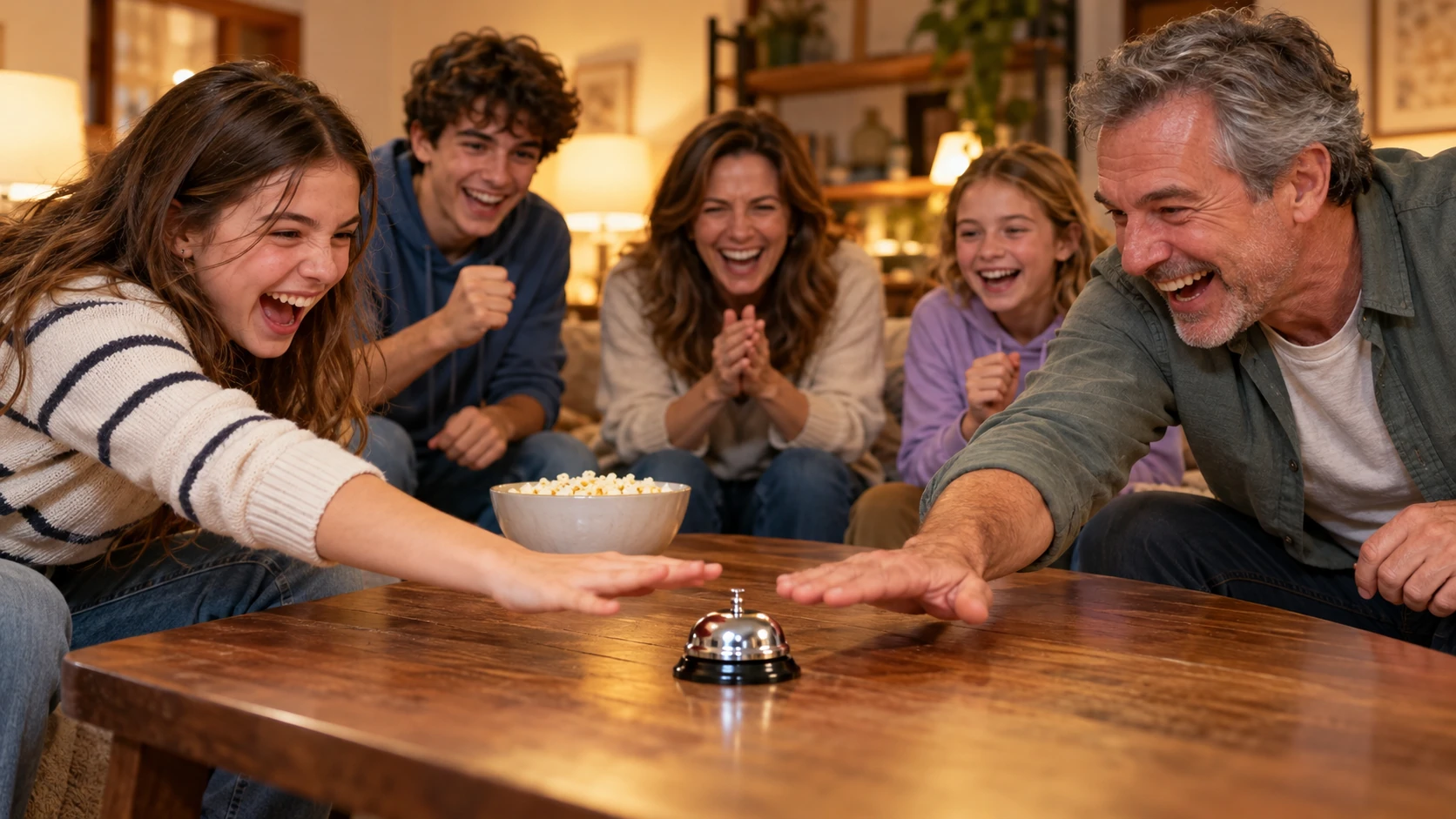
You do not need to buy anything. A desk bell, a squeaky toy or a cushion in the middle of the table that both players slap all work. The rule that matters: hands stay behind backs until the host finishes reading the question. On the show, if neither player in the face-off answers within three seconds, the question opens up to the rest of the teams.
The Timer and the Close Calls
A phone timer covers Fast Money and any round that drags. For close answers, agree on one rule before the first question: if an answer means the same thing as the one on the board, it counts. "Cell phone" matches "phone"; "eating" does not match "pizza". The host's call is final, and arguing costs a strike.
To decide who goes first in each face-off, the random name picker spins a wheel of player names on the big screen. Remove each name after it comes out, so everyone gets a turn at the bell before anyone goes twice.
Rules and Scoring for Two Teams
These are the show's core rules, trimmed for a living room:
- Face-off. One player from each team faces the host. The first to buzz answers. A top answer wins control at once; otherwise the other player gets a chance, and the higher-ranked answer wins.
- Play or pass. The team that wins the face-off chooses to play the question or pass it to the other team.
- Three strikes. The team in control answers one player at a time. A wrong answer, or no answer, is a strike. The round ends when every answer is found or after three strikes.
- The steal. After three strikes, the other team huddles and gets one answer. If it is on the board, they steal all the points banked in that round.
- Points. The team that wins the round scores the points of every answer revealed. On the show, values are doubled and then tripled in later rounds, and the current version plays to 300 points.
For a game of about an hour, play four rounds: single points in rounds one and two, double in round three, triple in round four. The first team to 300 wins, and if nobody gets there, the highest score after four rounds wins. Keep the point totals on the board.
For a big, visible tally of rounds won, open the simple counter on our free online scoreboard, type the two team names and tap the side that wins each round. It goes full screen on a phone or tablet, keeps the score on the device if the page reloads and makes a result card you can post in the group chat at the end.
Fair Teams for Mixed Ages
The classic setup is one family against another, five players each. At a party, that rarely matches who actually showed up. Mixed teams are usually more fun, as long as they are even.
- Avoid captains picking sides. It ranks people out loud. Our guide on how to make fair random teams explains why the first pick gets an edge and what to do instead.
- Spread the generations. Survey games reward life experience and pop culture at the same time. Put grandparents and teenagers on both sides.
- Separate the loudest players. Two people who always answer first should not share a team.
- Rotate the face-off. Everyone takes a turn at the bell, including the shy cousin.
The random team generator handles this in seconds: it balances teams by level, keeps two people together or apart and posts the result with the seed and the time of the draw. The levels stay on your own device, so the shared teams show names only. Give each team a name too; a family surname or a silly name both work.
Run Your Own Survey With Your Guests
The best version of this game uses real answers from people the players know. It takes a week of preparation:
- Write ten questions in the same "Name something..." style. Avoid questions with one obvious answer and questions that could embarrass anyone.
- Send them a week ahead to friends, coworkers or the extended family group chat. Ask for the first answer that comes to mind, one per question. People who will play on the night should not answer.
- Count the answers. Group answers that mean the same thing ("cell" and "phone"). Like the show, leave out answers that only one person gave.
- Scale to 100. If 25 people answered, multiply each count by four. Now your board looks like the real thing.
A survey of 20 or 30 people is not scientific, and that is fine. The fun is hearing that 12 of Grandma's friends said the same thing.
Looking for more ideas for the same evening? Our games to play with friends without anything need no board at all.
Make Next Game Night Easier to Join
Create a free VISU Link page for your group's game nights and share it by link or QR code, so the next invite starts from the same page.
Frequently Asked Questions
What makes a good Family Feud question?
An open question, usually starting with "Name something...", that has five or six answers most people would think of quickly and no single correct answer. "Name something you take to the beach" works; "What is the capital of France?" is trivia.
Are the answers in this list real survey results?
No. The questions are original and the ranked answers and points are our estimates for party play, not results from a survey or from the TV show. For real answers, survey your guests a week before the game and scale the counts to 100.
How do you play Family Feud at home?
Split into two teams and pick a host. Each round starts with a face-off at the buzzer; the winning team plays or passes, answers one player at a time, and loses control after three strikes, when the other team can steal the points with one correct answer.
How many people do you need to play?
Five people is the minimum that works well: a host and two teams of two. The show uses five players per family, so two teams of four or five plus a host is the classic size. Larger groups can rotate players between rounds.
How does Fast Money work?
Two players from the winning team answer the same five questions against the clock, the second without hearing the first. On the show the times have been 20 and 25 seconds since 1994, and the pair needs 200 points combined to win.