
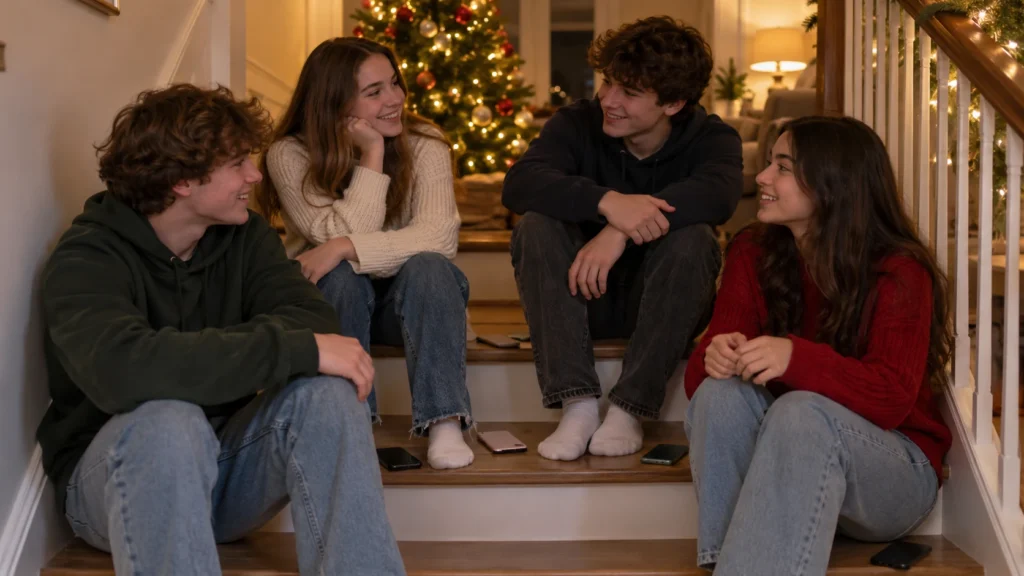
Christmas games for teenagers work best when nobody has to be told a game is starting. These twenty games are written for whoever is organising the room, a parent, a teacher or an older sibling, and they use paper, pens, phones and whatever the house already has. Nothing depends on gifts, on buying a kit or on anyone performing for the group.
The Party Happens Somewhere
When the group moves to an ice cream shop or a snack place that is a VISU partner location, being there can earn a reward. Scan the code on site, with no purchase required.
Why Most Christmas Games Fail With Teenagers
The usual failure is not the game. It is the announcement. Saying out loud that everyone is going to play something forces each guest to decide publicly whether to be enthusiastic, and the safest answer is no. The second failure is scale: a game written for eight year olds asks for a visible silliness a fifteen year old reads as being handled like a child.
What survives is a game with a real problem in it. So the design rules below are simple. Set the material out before anyone is asked anything. Give each game a visible finish line. Make joining and leaving equally invisible. Never make appearance, body, family or romantic status part of a rule, and never require touching anyone.
Times and player counts here are rule parameters and planning estimates for the organiser, not measurements of how any group behaves.
Games That Start Without an Announcement
1. The Wall That Fills Itself. People: any number. Time: runs all evening. Materials: a large sheet of paper on a wall, markers. How to play: before anyone arrives, write one open line at the top, such as the worst possible Christmas song title, leave the markers beneath it and say nothing. People add lines as they pass, and halfway through the evening you read the five best out loud. Comfort rule: anything about a person in the room gets erased, with no discussion.
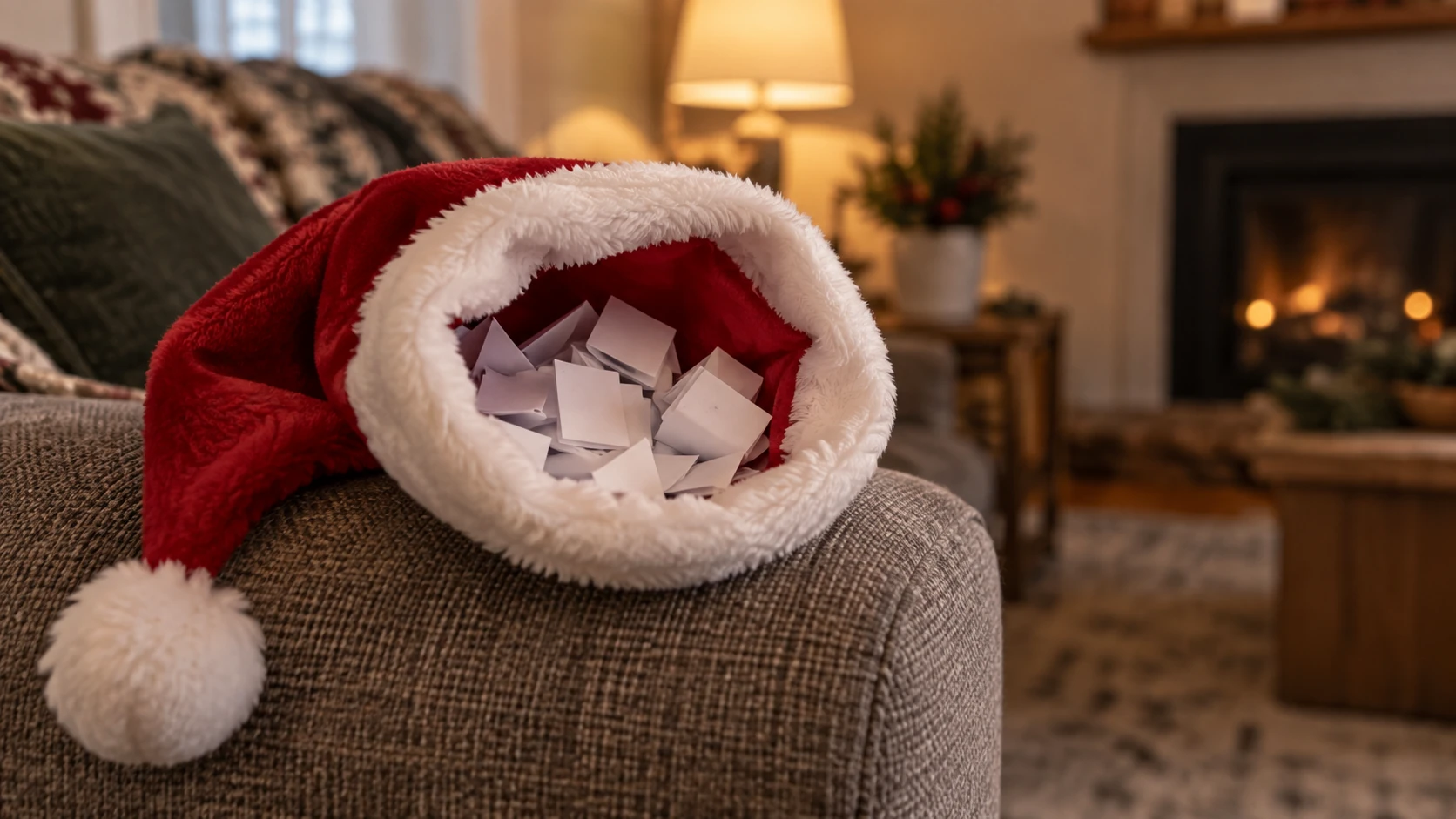
2. Slips in the Hat. People: five to twenty. Time: ten minutes. Materials: folded paper slips in a hat. How to play: each slip carries one harmless instruction, such as get three people to agree on the best film ending. Guests draw as they pass, with no scoring. When enough slips are gone, ask what people got and let the answers become the conversation. Comfort rule: a slip can be put back.
3. The Playlist Argument. People: four to fifteen. Time: fifteen minutes. Materials: a shared playlist and paper. How to play: announce only that anyone may add one song. Once six or seven are queued, put up a sheet with two columns, keep and cut. Every cut needs a written reason. The song with the most keeps wins its owner the next track. Comfort rule: reasons are about the song, never the person who added it.
4. Table Sabotage. People: six to sixteen. Time: a whole meal. Materials: nothing. How to play: quietly hand three people the same ordinary secret word, such as ladder or envelope, to say during the meal without being noticed. At dessert, the table names who it suspects. Each undetected carrier scores a point, and each correct accusation scores one. Comfort rule: no word may be about someone at the table.
Team Games With Real Stakes
Stakes here mean a symbolic prize that costs nothing: choosing the next playlist, skipping the washing up, deciding the film. No money and no purchased prize appears in any version.
5. Two Teams, One Rule. People: eight to twenty. Time: twenty minutes. Materials: paper and pens. How to play: each team invents a secret rule governing how its members answer, such as always mention a colour. Teams interview each other, four questions per round, and try to state the opposing rule exactly. Two rounds decides it. Stake: the winners pick the next music. Comfort rule: a rule cannot require lying about a real fact.
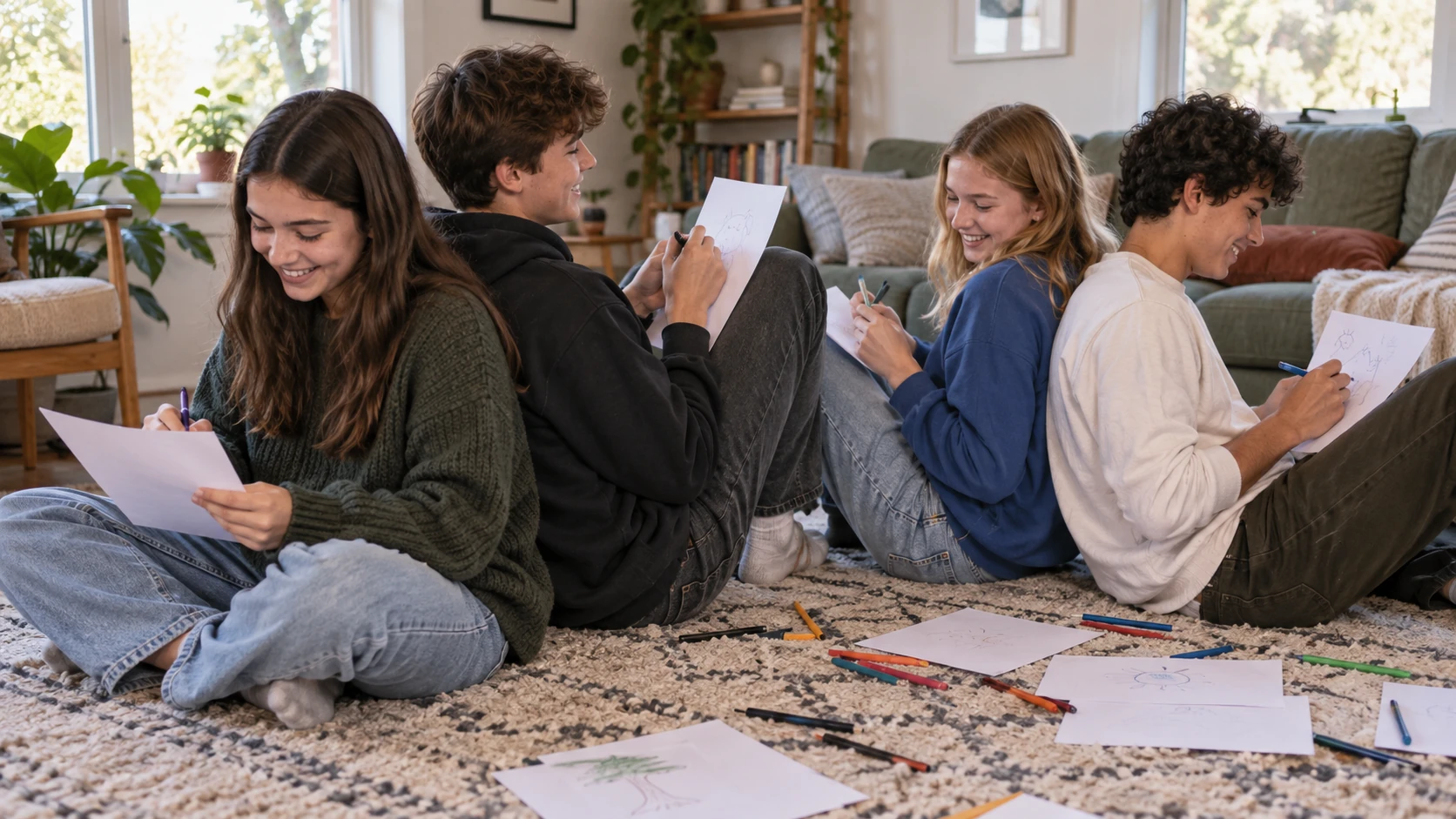
6. Back to Back Drawing. People: six to twenty. Time: fifteen minutes. Materials: paper, pens, one written description per round. How to play: pairs sit back to back. One reads a written scene, the other draws it from spoken description alone, never naming objects. Three rounds, swapping roles, then the room votes on the closest drawing. Stake: the winning pair chooses dessert order. Comfort rule: nobody is paired without choosing the partner.
7. The Auction of Bad Ideas. People: six to eighteen. Time: twenty minutes. Materials: paper slips, a hundred fictional points per team. How to play: read out ten deliberately terrible holiday plans and let teams bid fictional points for one. After all ten are sold, each team defends one as secretly brilliant and the room votes. A winning plan returns triple the bid. Stake: the top team names the next game. Comfort rule: points never convert to anything real.
8. The Expert Panel. People: eight to twenty. Time: fifteen minutes. Materials: slips with invented fields of study. How to play: three players sit as a panel of authorities on something absurd, such as the correct temperature of a living room in December. The other team asks questions and the panel must answer without contradicting each other. One contradiction ends the sitting and the teams swap. The panel that survives more questions wins. Stake: the winners choose the next game. Comfort rule: a panellist may defer any question to the person beside them.
A Reward Tied to the Visit
VISU rewards a verified visit at a partner location. The scan confirms that the group is there, without asking anyone to buy something or fill in a profile.
Games That Use Phones On Purpose
Asking a room of teenagers to put phones away is a rule most organisers lose. Using the phone as the equipment is easier.
9. Screenshot Evidence. People: four to sixteen. Time: ten minutes. Materials: phones. How to play: the organiser calls a category provable on a screen, such as the oldest photo of a Christmas tree in your camera roll. Anyone with a match holds the phone up briefly, and the first valid match scores. Five categories decides it. Comfort rule: the owner holds the phone and may skip any category.
10. Search Term Charades. People: six to eighteen. Time: fifteen minutes. Materials: phones, paper for scores. How to play: one player types a short phrase into a search bar without pressing enter, then reads out only the suggested completions. The room guesses the original phrase, scoring a point for the guesser and the reader. One turn each. Comfort rule: the reader chooses the phrase, and never types anyone's name.
11. The Group Photo Brief. People: eight to twenty four. Time: twenty minutes. Materials: phones. How to play: teams receive a written brief for one photo, such as the cover of an album called Winter Admin. Ten minutes to plan and shoot, then the room votes on one screen. Comfort rule: nobody appears in a photo who has not agreed, and photos stay on the phone that took them.
12. Two Tabs. People: four to twelve. Time: twelve minutes. Materials: phones. How to play: a player opens two unrelated pages and reads one sentence from each aloud. The room invents in writing the single article that could contain both, and picks the most convincing. Six rounds. Comfort rule: pages come from the reader's own screen and are never social profiles.
Games That Work Without Phones
13. The Straight Face Interview. People: five to fourteen. Time: fifteen minutes. Materials: paper slips. How to play: each player draws a slip with an invented job title, such as inspector of wrapping paper corners. In pairs, one interviews the other for ninety seconds without the other breaking the premise. Longest straight face wins. Comfort rule: jobs never mock a real person or role in the room.
14. Room Cartography. People: four to twelve. Time: fifteen minutes. Materials: paper and pens. How to play: everyone leaves the room and draws it from memory, marking eight objects. Return and score a point per object in the correct half, two if the position is right. Comfort rule: objects only; nothing belonging visibly to a guest is scored.
15. Sixty Seconds of Paper. People: six to twenty. Time: ten minutes. Materials: old paper, tape. How to play: teams get one minute to build the tallest free standing structure from paper alone, then one minute to defend why theirs deserves to win anyway. Height and defence are scored separately and added. Comfort rule: a timed round is announced with the finish, and this is one of only two timed games here.
16. The Chain Story With a Ban. People: five to sixteen. Time: fifteen minutes. Materials: nothing. How to play: the group builds a story one sentence at a time, with three ordinary words banned on a visible sheet. Using one ends your turn, and the group wins if the story reaches a real ending in twenty sentences. Comfort rule: a player may pass twice with no explanation.
17. The Buried Lie. People: five to sixteen. Time: twelve minutes. Materials: paper and pens. How to play: one player writes a short paragraph about an ordinary subject, such as how a postal sorting office handles December, planting exactly one false sentence. It is read aloud twice and everyone writes down which sentence they think is planted. The writer scores a point per person fooled, and each correct reader scores two. Four paragraphs decides it. Comfort rule: subjects are things and places, never a person in the room.
Quiet Games for the Ones Who Do Not Want to Play
There is always someone who will not stand up, and the way to include them is not persuasion. It is a game that runs sitting down, on paper.
18. The Corner Puzzle. People: one to four. Time: open ended. Materials: paper, pens, one written riddle set left on a side table. How to play: leave five written puzzles face down in a corner with an answer sheet. Anyone can sit, solve one and add an initial. Late in the evening, read the answers out and name whoever solved the most. Comfort rule: initials are optional and unsigned answers still count.
19. Silent Categories. People: two to eight. Time: ten minutes. Materials: paper. How to play: a category is written on a shared sheet left on the table. Players add one item each without speaking, whenever they pass. Repeats get crossed out and the longest unbroken run is read at the end. Comfort rule: no turn order, so nobody is waited on.
20. One Card Each. People: three to ten. Time: eight minutes. Materials: index cards. How to play: everyone writes one question about anything except a person in the room, such as how a shop chooses what plays in December. Shuffle, deal one each, answer someone else's card in writing, and read the answers anonymously. Comfort rule: any card can be swapped once, silently.
Games for a Mixed Group of Teens and Adults
When the room holds both, the risk is that the adults run everything and the teenagers become an audience. Two fixes do most of the work: split roles rather than teams, so each team holds a reader, a writer and a runner regardless of age, and give the teenagers the jobs with authority.
The games that survive a mixed room unchanged are The Wall That Fills Itself, Table Sabotage, Two Teams One Rule, The Expert Panel and The Buried Lie, because none depends on references from a single generation.
Where a game does need adjusting, change the input rather than the rules. In The Buried Lie, let each half of the room write two of the paragraphs. If a question round comes up, build it from what the room wrote rather than from a list one person brought, which is why collections such as general trivia questions, music trivia and film trivia work better as raw material than as a script.
Rules That Keep It Comfortable
Joining is opt in and leaving is silent. Say once, at the start of the evening, that anyone can step out of a round without giving a reason, then honour it without comment. Someone who has to explain why they are stopping will not start at all.
Nothing touches anyone. No game here requires physical contact, and none should be modified to add it. Relays pass paper and pens, never hands.
Nothing is about a body, a family or a relationship. Appearance, clothing, who likes whom and what happens at home all stay outside the rules. Where a game invites writing, the organiser reads first and quietly removes anything aimed at a person in the room.
No confession formats. Games that invite a disclosure in exchange for points do not belong at a mixed age party. Every game here can be played truthfully by someone who reveals nothing.
Score for the team, name the finish, and stop early. Individual elimination leaves someone standing alone at the edge of the room. Convert it into a change of role: the eliminated player becomes judge or reader. Announce the number of rounds before the first one, and end while people still want another.
Let the Place Count
If the evening ends somewhere that partners with VISU, scanning a code there can connect the visit to a reward. It comes from verified presence, not from spending.
FAQ
What Christmas Games Work for Teenagers Who Say They Do Not Want to Play?
Use the ones that need no announcement: The Wall That Fills Itself, Slips in the Hat and Silent Categories run without anyone agreeing to join. Set the materials out and let participation start by accident.
How Many Games Should I Prepare for a Teen Christmas Party?
Prepare more than you will use and plan to cut. Six prepared games is a comfortable figure for an evening. Cutting silently is easier than filling a gap.
Do I Need to Buy Anything?
No. Everything above uses paper, pens, cards, tape, a hat or bowl, chairs and phones that people already have.
How Do I Stop the Games Feeling Childish?
Keep a real problem in every game, avoid mandatory performance, and let stakes be symbolic rather than sweet.
What Do I Do About Phones?
Either use them as the equipment or run a game that gives hands something else to hold. Asking for them to be put away turns the organiser into an enforcer.
Can These Games Work With Both Teenagers and Adults in the Room?
Yes. Split roles instead of teams, give teenagers the scoring and timing jobs, and build any question round from what the room writes.
How Long Should Each Game Last?
Ten to twenty minutes is a workable planning window, and the length matters less than announcing the finish line before the first turn.