
Christmas youth group games have a logistics problem before they have a fun problem. Fifteen to forty teenagers, a borrowed room, ninety minutes, two volunteers, half the group arriving late. Every game below states its people, time, materials from an ordinary cupboard, space, rule, and what to do with whoever walks in during it.
The Night Happens Somewhere
If the hall where the group meets is a VISU partner location, being there can earn a reward. You scan a code at the place, and nothing has to be bought.
What a Youth Group Night Actually Needs
A youth group night is not a party. It is a recurring meeting with a room that has to be handed back, a start time nobody respects, and people who did not choose each other. Most game lists assume everyone is present and seated at the start, and that is the assumption that breaks first.
Arrival is staggered. The first game must absorb someone arriving twelve minutes late, with no rule explanation and nobody stopping.
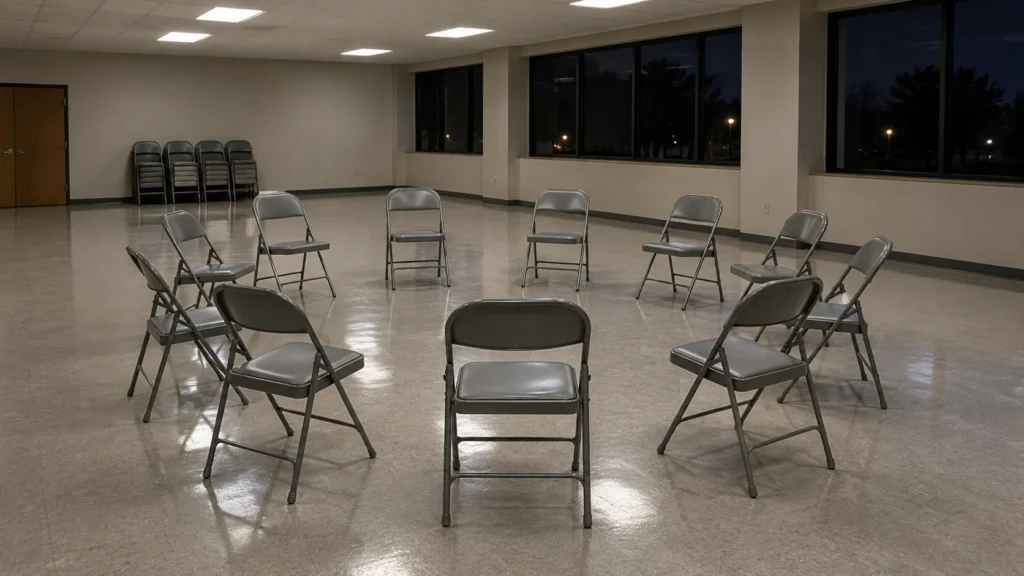
The room is borrowed and the volunteers are two. Games needing furniture moved cost time twice, so keep at most one per night. One adult runs the game and one watches the room, which means nobody is free to fetch supplies: everything is on the table before the first person arrives.
Participation is opt-in. Say once that sitting out needs no explanation, then give that person a job so not playing is not the same as not belonging. No game here requires touching anyone, and none asks anyone to reveal appearance, body, family, or who they like.
This is logistics for a large group of teenagers meeting regularly in a community space, so a student council, scout troop, or neighbourhood project runs it unchanged. Counts and durations below are planning estimates, not measurements from real meetings.
Games for the First Fifteen Minutes
These run while people are still arriving. None has a start you can miss.
1. The Rolling Category. People: six or more. Time: open-ended. Materials: a sheet taped to the wall, a marker. Space: a wall. Write a broad seasonal category at the top: things that appear in December and disappear in January. Whoever arrives adds an item and passes the marker on. When the list stops growing, read it aloud and vote on the strangest entry. A latecomer just adds an item.
2. Tape Line Opinions. People: ten or more. Time: ten minutes. Materials: masking tape. Space: a clear lane about five metres long. The tape is a scale from completely agree to completely disagree. Read a light statement: decorations should go up in November, and everyone stands at their point. Ask two people for a sentence each. Run nine or ten. A latecomer walks on and picks a spot.
3. Twelve Squares. People: twelve to forty. Time: twelve minutes. Materials: a hand-drawn grid of twelve squares per person, a pen each. Space: room to walk. Each square holds a neutral prompt about experience, not identity: has been in a choir, can name four reindeer, has wrapped a present in newspaper. Collect a signature per square from a different person. Nothing touches appearance, family, or money.
4. The Two-Minute Handover. People: eight or more. Time: eight minutes. Materials: none. Space: standing room. Pair people by whoever is nearest. Each pair has two minutes to agree on one thing both would put in a shared December playlist and one neither would. Pairs merge into fours, fours into eights, repeating the question. Final groups read their answers. Latecomers join the smallest group.
Games for a Room With No Furniture to Spare
A borrowed hall usually has chairs stacked against a wall and nothing else. These need only the floor.
5. The Standing Alphabet. People: fifteen to forty. Time: ten minutes. Materials: none. Space: open floor. The group forms one line ordered by the first letter of a chosen word: last film watched, street lived on, favourite December food. Speaking is allowed on the first attempt, banned on the second. Walk the line, count errors, let the room beat its count.
6. Floor Zones. People: fifteen or more. Time: twelve minutes. Materials: four sheets of paper and tape. Space: four reachable corners. Label the corners one to four, read a question with four answers, and everyone walks to their answer. Whoever is in the smallest corner sets the next question, which hands the room to quiet people without singling them out.
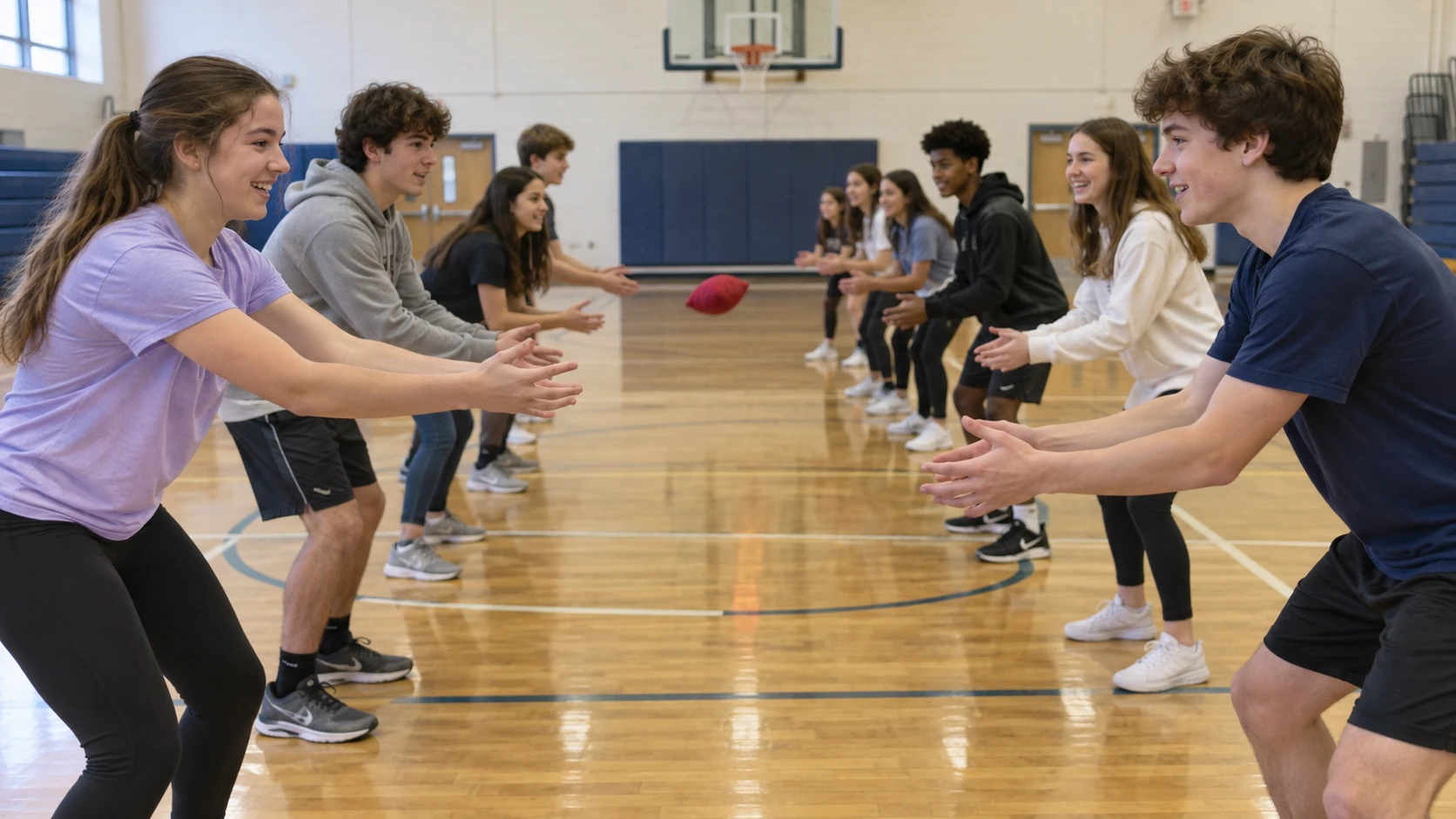
7. Pass the Weight. People: sixteen to forty. Time: ten minutes. Materials: two soft objects, a rolled sock or a cushion. Space: a circle or two lines. Two objects travel round the circle in opposite directions, one per pair of hands. When both meet in the same hands, the round ends and the room resets from a new start point. Objects pass, not people, so nobody is touched or chased.
8. The Wall Countdown. People: ten to thirty. Time: six minutes. Materials: a timer. Space: a wall. Facing the wall, the group counts one to thirty as a whole, one voice per number, no fixed order, no planned sequence. Two voices at once resets to one. The attempts are the game, and this is one of two timed challenges.
A Reward Tied to Being There
VISU rewards a verified visit at a partner location. The scan confirms you are at the place, without asking anyone to buy something or fill in a profile.
Team Games for 15 to 40
Teams turn a queue into parallel play. Split mechanically and announce the method before you announce teams: counting off, birth month, numbered slips. Never ask captains to pick.
9. The Shared Drawing Board. People: sixteen to forty, teams of four to six. Time: fifteen minutes. Materials: a large sheet and a marker per team. Space: table or floor per team. Every team draws the same seasonal scene, one person at a time for twenty seconds before passing the marker, and the drawer may not speak. Sheets stay hidden until the end, then go on the wall for the room to guess the briefs.
10. Written Relay. People: twenty to forty, teams of five. Time: twelve minutes. Materials: a sheet and a pen per team. Space: teams in short lines. Read a category: things that are red in December. The sheet travels down the line, each person adding an item. A team repeating its own item loses the round. Run six categories. All teams write at once.
11. The Blueprint Build. People: sixteen to thirty-six, teams of four. Time: fifteen minutes. Materials: scrap paper, tape, one drawn plan per team. Space: a table or floor patch per team. One member looks at a simple structure taped to the far wall, walks back, and describes it. Only the other three touch materials, and the describer touches nothing. Swap describer every three minutes.
12. Same Answer, Different Table. People: twenty to forty, teams of five. Time: ten minutes. Materials: a sheet and a pen per team. Space: tables or floor clusters. The goal is not the best answer but the same one as other teams. Ask an open question: name a December sound, and each team writes a word. A team scores a point for every other team with that word, which rewards guessing what the room thinks.
13. The Ordered Story. People: eighteen to thirty-six, teams of six. Time: twelve minutes. Materials: six paper strips per team, each with one sentence of a scrambled seasonal story. Space: floor space. Every member holds one strip and may read it aloud but never show it or hand it over. The team arranges itself in story order, then reads it out standing.
Games That Include the New Person
A first-time visitor knows nobody, and any game built on shared history locks them out. None of these puts a newcomer on the spot alone.
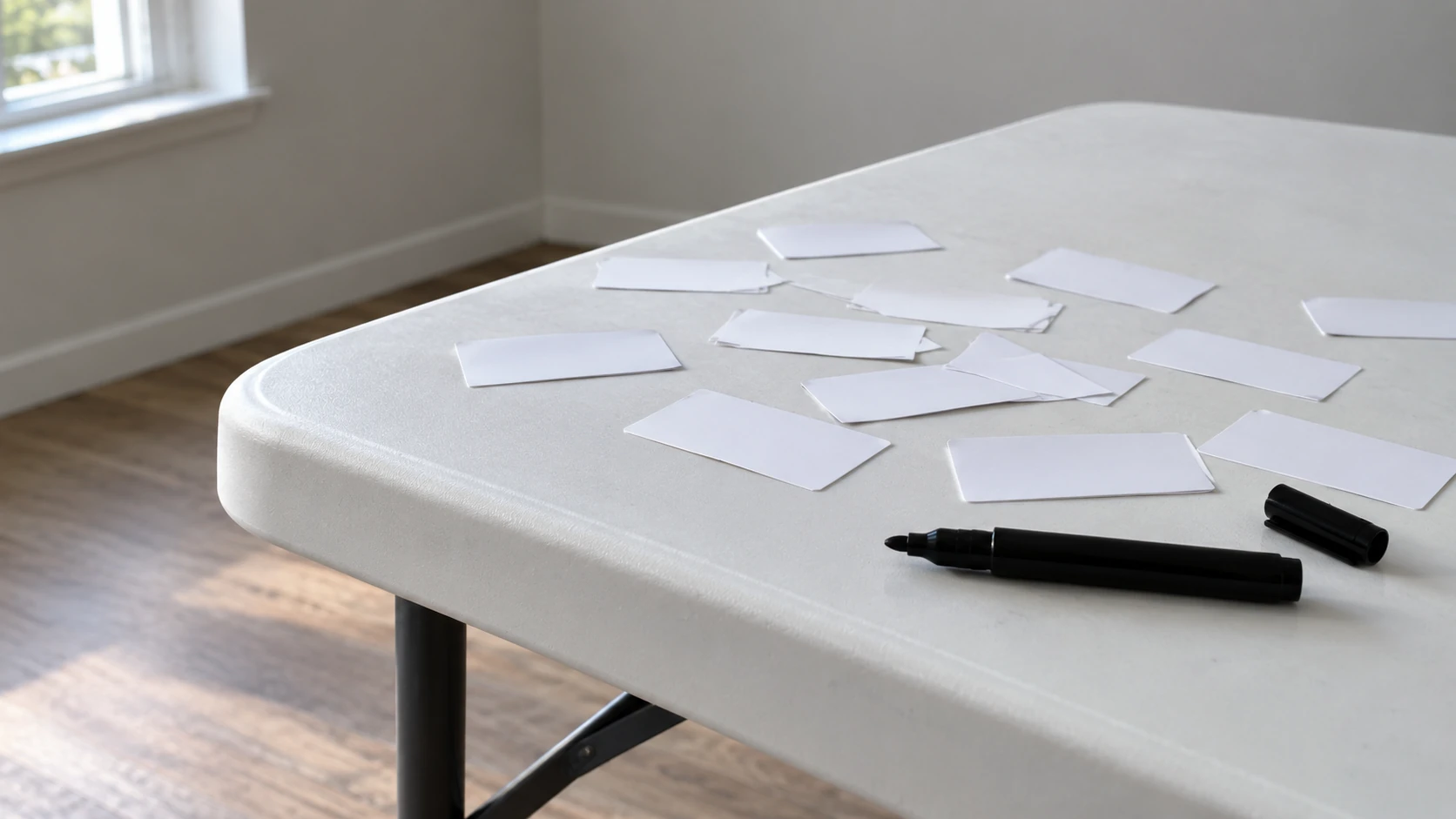
14. Name Tags With a Second Line. People: any number. Time: five minutes plus the rest of the night. Materials: paper tags and markers. Space: a table by the door. Every tag carries a name and one neutral answer to a question you set: the last thing you learned to cook. Later games reference that second line, giving newcomers something to be asked about that is unrelated to attendance.
15. The Group Invention. People: fifteen to forty, teams of five. Time: fifteen minutes. Materials: paper and pens. Space: clusters. Each team invents a December tradition that does not exist, with a name, one rule, and one object, then presents it in sixty seconds. The room votes on which it would adopt. Nobody needs prior knowledge, so a first-timer contributes like a regular.
16. Three Rooms of Questions. People: fifteen to thirty-six. Time: eighteen minutes. Materials: three lists of neutral questions. Space: three areas. Split into three groups, each with a list, six minutes, then rotate. Every group meets every list and mixes twice. Questions stay neutral: best way to spend a free Saturday, best film you were made to watch.
17. The Anonymous Wall. People: fifteen or more. Time: twelve minutes. Materials: slips, pens, a bowl, tape. Space: a wall. Everyone writes an unusual but harmless fact about their week on an unsigned slip. Slips go into the bowl, then onto the wall, and the room reads them. Nobody guesses who wrote what and nobody claims a slip. Say that rule before writing starts.
Low-Energy Games for the End of the Night
The last twenty minutes bring the room down, not up, so people leave calm and the space gets cleared.
18. The Long Word. People: ten to forty. Time: eight minutes. Materials: none. Space: seated. Someone says a word connected to December. The next says a word connected to that word, not to December. The room judges each link in a second, and a challenged link is replaced, not penalised. The aim is a long chain.
19. Quietest Instructions. People: twelve to thirty. Time: eight minutes. Materials: paper and pens. Space: seated. Each person writes instructions for an ordinary December task: putting up a string of lights, with one step deliberately impossible. Sheets are swapped and read aloud, and the room spots the impossible step. Quiet enough to run while chairs are stacked.
Games That Work Outdoors or in a Parking Lot
If the room is booked or too small, a lit parking area works on two conditions: nothing thrown can clear a wall, and the boundary is walked and named first.
20. The Marked Zone Sort. People: fifteen to forty. Time: fifteen minutes. Materials: chalk or four cones, a stack of paper cards. Space: a flat lit outdoor area. Mark four zones. Cards carry seasonal items, each with a correct zone under a rule you announce: goes on a tree, on a table, in a box, outside. Hand out five at a time, everyone walks a card to a zone. The round ends when all cards are placed, then the room argues the disputed ones, which outdoors costs nothing.
Outdoors needs one extra check. Name a meeting point, state the finish time twice, and keep the second volunteer at the edge of the lit area watching the boundary rather than the play. Anyone who wants to stop walks there without explaining.
Running the Night With Two Volunteers
Two adults is enough, provided roles are fixed before the door opens.
One runs, one watches. The runner explains rules, calls time, and never leaves the front. The watcher stays at the back, sees who drifted out, handles the door. Swap between games, or not at all.
Explain in two sentences, then start. A rule taking ninety seconds to explain has lost half the group. Say what to do and what ends the round, then correct in play.
Announce the shape once, plan six, run four. Four games, a break, two games, finish on time. A group that knows the shape stops asking what is next, and the spares let you drop one without a visible gap. Keep the low-energy pair as reserve.
Finish while the room is still full. Announce the last game as the last. An evening that trails off leaves the volunteers stacking chairs alone.
Adapting Any Game to Your Group
None of the twenty was designed for your room, and some will not fit. The method matters more than the list.
Change the parallel units, not the rule. A game for sixteen usually works for forty as four groups of ten running it at once. If not, the constraint is a single central object or speaking role, not the headcount.
Cut whatever needs a turn. If the rule creates a queue, either everyone acts at once or the room splits. A queue past about six people is where the group goes back to its phones.
Replace any prompt that touches identity. Swap appearance, family, money, or romance questions for experience or preference ones. The mechanic is untouched, the risk disappears.
Check a latecomer can join, and give the non-player a job. Ask where a person entering at minute twelve stands; no answer means that game belongs mid-night. Timekeeper, scorekeeper, and judge are genuine roles, rotated so holding one never reads as consolation.
A written question bank helps the games needing prompts. Ready-made sets of would you rather questions and music trivia questions adapt straight into the corner and category games. Note the boundary: raising money for the institution is a separate exercise from a games night, and mixing the two in one evening usually costs you both.
Let the Place Count
When the group goes somewhere together after the meeting and the place is a VISU partner, a code scan can connect the visit to a reward. The reward is for verified presence, not a purchase.
FAQ
What Are the Best Christmas Youth Group Games for a Large Group?
The ones with no queue: Floor Zones, Tape Line Opinions, and Written Relay have everyone acting at once, which stops forty people drifting.
How Many Games Do I Need for a Ninety-Minute Meeting?
Plan six and expect to run four. The spares cover the game that falls flat and the one that runs short.
What Do I Do With Someone Who Arrives Twenty Minutes Late?
Start with a game that has no start, such as The Rolling Category. Mid-game, hand them the scorekeeper job until the round ends.
How Do I Handle Someone Who Will Not Play?
Say at the start that sitting out needs no explanation, then offer a job rather than a turn.
What Do I Need to Buy?
Nothing. Every game runs on paper, pens, tape, a bowl, a timer, socks or cushions, and chalk if you go outside.
Do These Work for Groups Other Than a Youth Group?
Yes. The structure assumes teenagers meeting regularly in a borrowed space, so a student council or scout troop runs them unchanged.
How Do I Split a Big Group Into Teams Without Anyone Feeling Left Out?
Split mechanically and announce the method before the teams: counting off, birth month, numbered slips. Never let two people pick.