
A standard deck of playing cards has 52 cards, or 54 if you count the two jokers that most packs include. The 52 are four suits of 13 cards each: an ace, the numbers 2 to 10, and three face cards, the jack, the queen and the king. That is the deck behind most card games in English-speaking countries, but it is not the only one: a Spanish deck has 40 or 48 cards, pinochle uses 48, Skat 32, tarot 78 and Uno 108 or 112. This guide gives the full breakdown, a quick way to check that a deck is complete, the decks that break the 52 rule, and the basic odds with the math shown. When the game starts, our free online scoreboard keeps the running count on your phone.
Give Your Card Night a Page of Its Own
A free VISU Link page holds your group's house rules, the date of the next game night and the link to the scoreboard, behind one link you can drop in the group chat.
The Standard Deck at a Glance
The deck most people mean when they say "a deck of cards" is the French-suited 52-card pack. Every count in it comes from one multiplication: four suits times thirteen ranks.
| What you are counting | How many |
|---|---|
| Cards, without jokers | 52 |
| Jokers | Usually 2 (packs can include from one to six) |
| Suits | 4: clubs ♣, diamonds ♦, hearts ♥, spades ♠ |
| Cards per suit | 13 |
| Ranks | 13: ace, 2, 3, 4, 5, 6, 7, 8, 9, 10, jack, queen, king |
| Aces | 4, one per suit |
| Face cards (jack, queen, king) | 12, three per suit |
| Number cards 2 to 10 | 36, nine per suit |
| Red cards (hearts and diamonds) | 26 |
| Black cards (clubs and spades) | 26 |
Each suit adds up the same way: one ace, nine number cards and three face cards make 13, and four suits of 13 make 52.
The ace is the card with a single pip, so some descriptions count ten numeral cards per suit, from the ace to the 10, while the glossary term "pip cards" usually means 2 to 10 only. Either way, the total is 52.
Suits, Colors and Ranks
The four French suits are clubs, diamonds, hearts and spades. In the standard pack, spades and clubs are printed in black and hearts and diamonds in red, which is why a deck splits evenly into 26 red cards and 26 black cards. Some packs use four colors so the suits are easier to tell apart; one common scheme keeps spades black and hearts red and prints diamonds in blue and clubs in green. The number of cards does not change.
The face cards are also called court cards. In a modern deck they are double-headed: the picture is printed twice, upside down to itself, so the card reads the same from either end of the table. Wikipedia dates double-headed cards to around 1860; earlier cards of this type showed a single figure.
The letters in the corners depend on the country. English-speaking decks use A, K, Q and J for ace, king, queen and jack. French decks use 1, R, D and V (as, roi, dame, valet), and German decks use A, K, D and B. The English pattern itself goes back to Britain, which was importing French playing cards from Rouen and Antwerp by 1480.
Which rank is highest is up to the game, not the deck. In many games the ace ranks above the king; in others it counts as one. Pinochle, covered below, even ranks the 10 just under the ace.
How Many Jokers Come in a Deck
Jokers are not part of the 52. They come as extras, and how many you get depends on the maker: Wikipedia notes that commercial decks often include from one to six jokers, and that there are usually two per deck, often noticeably different from each other. The United States Playing Card Company, for example, prints one in a single color and the other in full color.
Most classic games are played without them, so the jokers go back in the box before the deal. A few games put them to work. In canasta, the twos and the jokers are wild cards, and canasta is played with two full decks and their jokers, as the next sections explain.
That is why both answers you see online are right: a deck has 52 playing cards, and the box usually holds 54.
Decks That Don't Have 52 Cards
The 52-card pack is the most common deck in the world, but many countries and games use smaller or larger packs. Wikipedia notes that the traditional pack is 36 cards in Russia and Bavaria and 32 in north and central Germany and Austria. The decks people ask about most often:
| Deck | Cards | What is in it |
|---|---|---|
| Spanish deck (baraja española) | 40 or 48 (50 with two jokers) | Suits of coins, cups, swords and clubs; 1 to 7 plus the sota, caballo and rey in the 40-card version; the 48-card version adds the 8s and 9s |
| Brazilian truco | 40 | A standard deck with the 8s, 9s and 10s removed |
| Pinochle | 48 | Two copies each of the 9, 10, jack, queen, king and ace in all four suits |
| Euchre | 24 | Half a pinochle deck: the 9 to the ace once in each suit |
| Skat | 32 | The pack for Skat, a German three-player game |
| Tarot (French Tarot) | 78 | 21 numbered trumps, the Excuse and 56 suit cards |
| Uno | 108 classic, 112 in sets made since 2015 | Four colors of 25 cards plus wild cards; not a standard deck at all |
The Spanish deck. Spanish-suited packs usually have 40 or 48 cards, or 50 when two jokers are included. In the 40-card version each suit runs from 1 to 7 and then the three figures, the sota, the caballo and the rey, numbered 10 to 12, so there are no 8s or 9s.
Truco. Pagat, a long-running card game rules site, describes Brazilian truco as a game for four players in fixed partnerships, played with 40 cards: a standard deck without the 8s, 9s and 10s. In the south of Brazil, the Portuguese Wikipedia notes, truco is played with Spanish cards instead.
Uno. The classic Uno deck has 108 cards: 25 in each of four colors (one 0, two each of 1 to 9, and two each of Skip, Draw Two and Reverse), plus four Wild and four Wild Draw Four cards. Mattel's instruction sheet lists 112 cards, the same 108 plus four extra wild-type cards. Which four depends on the edition: the sheet lists them as blank cards, and Wikipedia records a Wild Shuffle Hands card and three customizable wilds in sets made since 2017. Count your own box against its leaflet.
Keep the Season's Standings Where Everyone Can See Them
Create a free VISU account and post the standings of your card league or family tournament on your own page, updated after every game night.
Games Played With Two Decks
Some of the most popular family games need more than 52 cards, so they shuffle two standard decks together.
- Canasta. Two complete 52-card decks plus two or three jokers per deck, for 108 or 110 cards, depending on how many jokers the decks carry. Modern American canasta, the variation most commonly played in clubs and tournaments in the United States and Canada, fixes it at two decks plus four jokers, 108 cards.
- Buraco. The Brazilian member of the family, also called canastra, uses two complete 52-card decks, 104 cards, with the jokers optional. The twos also work as wild cards, so the game is playable with or without the jokers; with four jokers in, the count is 108.
A practical tip for two-deck games: use two decks with different back designs or colors. Shuffling them together does not matter during the game, and after the game you can split them back into two complete decks in a minute.
How to Check That a Deck Is Complete
A deck that has lived in a kitchen drawer for a few years can end up one card short, and nobody notices until a game goes wrong. Checking takes about two minutes:
- Set the jokers aside. You are counting the 52.
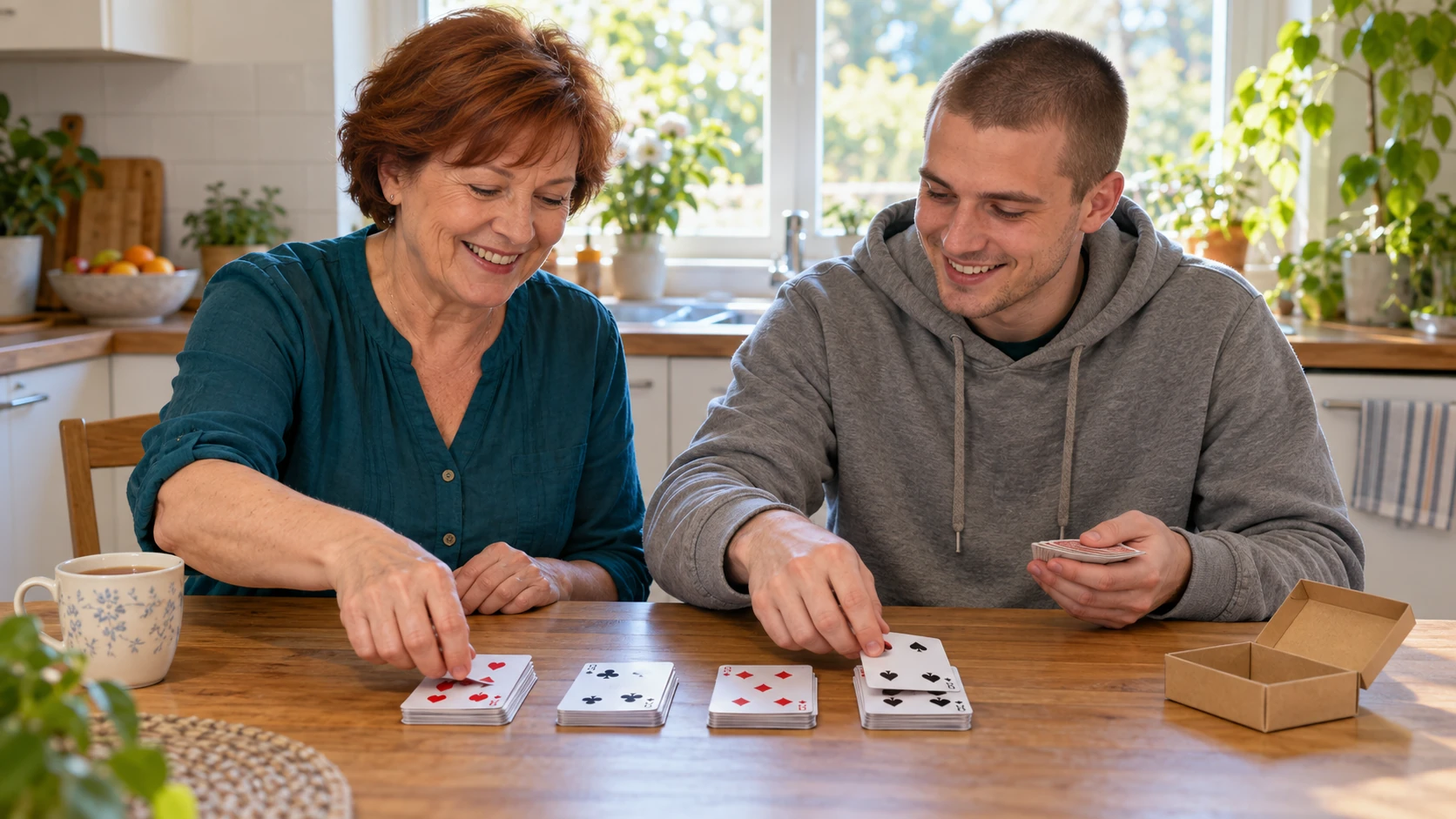
- Deal the cards face up into four piles, one per suit. Each pile should end with 13 cards.
- Put each pile in order, from the ace to the king. A missing card shows up as a gap, and a duplicate from another deck shows up as two of the same card.
- For a faster rough check, deal by rank instead. Thirteen piles of four, one pile per rank, tells you at a glance which rank is short, and you only need to look at the suits in that pile.
If a card is missing and the game needs it, a spare joker with the missing card written on it in marker keeps the deck playable until you buy a new one.
Card Odds in a 52-Card Deck, With the Math
Because every count in the deck is fixed, the basic odds follow directly from it. All draws below come from a full, well-shuffled 52-card deck without jokers, and "in a row" means the first card is not put back.
| Drawing | The math | Result |
|---|---|---|
| One specific card, such as the ace of spades | 1 / 52 | about 1.9% |
| Any ace | 4 / 52 = 1 / 13 | about 7.7% |
| Any heart | 13 / 52 = 1 / 4 | 25% |
| Any face card | 12 / 52 = 3 / 13 | about 23.1% |
| Any red card | 26 / 52 = 1 / 2 | 50% |
| Two aces in a row | 4/52 × 3/51 = 12 / 2,652 = 1 / 221 | about 0.45% |
| A pair with the first two cards | any first card, then 3 / 51 = 1 / 17 | about 5.9% |
| At least one ace in five cards | 1 − (48 choose 5) / (52 choose 5) = 1 − 1,712,304 / 2,598,960 | about 34.1% |
Three more numbers that come up at the table:
- Different five-card hands: 52 choose 5 = (52 × 51 × 50 × 49 × 48) / (5 × 4 × 3 × 2 × 1) = 2,598,960.
- Different 13-card hands, the size of a hand when the whole deck is dealt to four players: 52 choose 13 = 635,013,559,600.
- Different orders of a shuffled deck: 52 × 51 × 50 × ... × 1, written 52!, which is about 8.07 × 1067, a number with 68 digits.
Jokers and smaller decks change the math in the obvious way. With both jokers left in, the chance that the first card is a joker is 2/54 = 1/27, about 3.7%. In a 40-card Spanish or truco deck, any ace is 4/40 = 10%, and a three-card truco hand can be dealt in 40 choose 3 = 9,880 different ways.
Keeping Score on Game Night
Counting the cards is the easy part. Keeping a score nobody argues about at midnight is harder, and the right tool depends on how the game counts.
- Games scored a few points at a time. In Brazilian truco, Pagat describes the game as a race to 12 tentos won over a series of deals. The simple counter on our online scoreboard lets you tap the side that scored, so the score sits on a phone in the middle of the table instead of on a napkin. It also works for counting rounds won over a night of any game.
- Games scored in hundreds. Canasta and buraco add up melds and canastas in the hundreds, so a pen and a score sheet, or a shared note, is still the fastest way to add each hand.
- Partnership games. Classic canasta and Brazilian truco are usually played by four people in two partnerships, partners sitting opposite, and buraco is often played in pairs too. If the group cannot agree on the pairs, the random team generator splits the names for you.
- The final result. When the night ends, the score card maker turns the result into an image for the group chat. It is built for sports played in sets, but any single-score game works: type the final score as one set, such as 12 to 9 in truco or 3 to 2 in rounds won.
If your group meets every week, put the house rules on a VISU Link page: which deck you use, whether jokers are in, and what counts as a win. It settles most arguments before the first deal.
Bring the House Rules to the Table
A free VISU Link page keeps the deck you play with, the house rules and the season's leader in one place, so nobody has to ask which version you are playing.
Frequently Asked Questions
How many cards are in a deck without jokers?
52. A standard deck has four suits of 13 cards each. The jokers, usually two, come as extras on top of the 52 and are left out of most games.
How many face cards are in a deck of cards?
12. Each of the four suits has three face cards, the jack, the queen and the king. Aces are not face cards, so a deck has 12 face cards and 4 aces.
How many cards are in a Spanish deck?
Usually 40 or 48. The 40-card version runs from 1 to 7 plus the sota, caballo and rey in each of the four suits, with no 8s or 9s; the 48-card version adds them. Some packs add two jokers for 50.
How many cards are in an Uno deck?
The classic count is 108: 25 cards in each of four colors plus eight wild cards. Sets made since 2015 have 112, the same 108 plus four extra wild-type cards that vary by edition.
How many ways can a deck of cards be shuffled?
52!, which is 52 × 51 × 50 and so on down to 1. That is about 8.07 × 10 to the 67th power, a number with 68 digits.
References
- Wikipedia: Standard 52-card deck
- Wikipedia: Joker (playing card)
- Wikipedia: Spanish-suited playing cards
- Pagat: Brazilian Truco
- Wikipedia: Truco (in Portuguese)
- Wikipedia: Pinochle
- Wikipedia: Skat (card game)
- Wikipedia: French Tarot
- Wikipedia: Uno (card game)
- Mattel: UNO instruction sheet (PDF)
- Wikipedia: Canasta
- Wikipedia: Buraco (in Portuguese)