


Symmetry is the one time centering wins. A mirrored frame asks to be split down the middle, and the craft is in the alignment: a symmetrical photo taken slightly off axis reads as a mistake, not a style.
Most composition advice pushes the subject away from the center, and most of the time that advice is right. Symmetry is the standing exception. When the two halves of a scene answer each other, the balanced version is the strong version, and moving off center breaks exactly the thing that made the scene worth shooting.
This page covers where symmetry hides, how to shoot it so it actually reads as deliberate, and when to break it on purpose.
One Link for Everything You Shoot
A short address you control, pointing wherever your photos already live.
What Symmetry Does to a Picture
A symmetrical frame gives the eye a rule it can verify. One half predicts the other, the prediction comes true, and the picture reads as ordered, calm and intentional. That sense of order is the entire effect, which is why symmetry suits subjects that are themselves about order: architecture, formal portraits, reflections, ritual.
The cost is tension. A perfectly balanced frame has nowhere for the eye to travel and nothing unresolved, so it holds attention through precision rather than movement. Whether that is right depends on what the photo is about, which is the same question every compositional choice comes back to.
Symmetry sits inside the broader toolkit of photographic composition, and it directly overrides one of its most quoted guidelines: this is the case where the rule of thirds steps aside and dead center is the better answer.
Mirror Symmetry: Left Meets Right
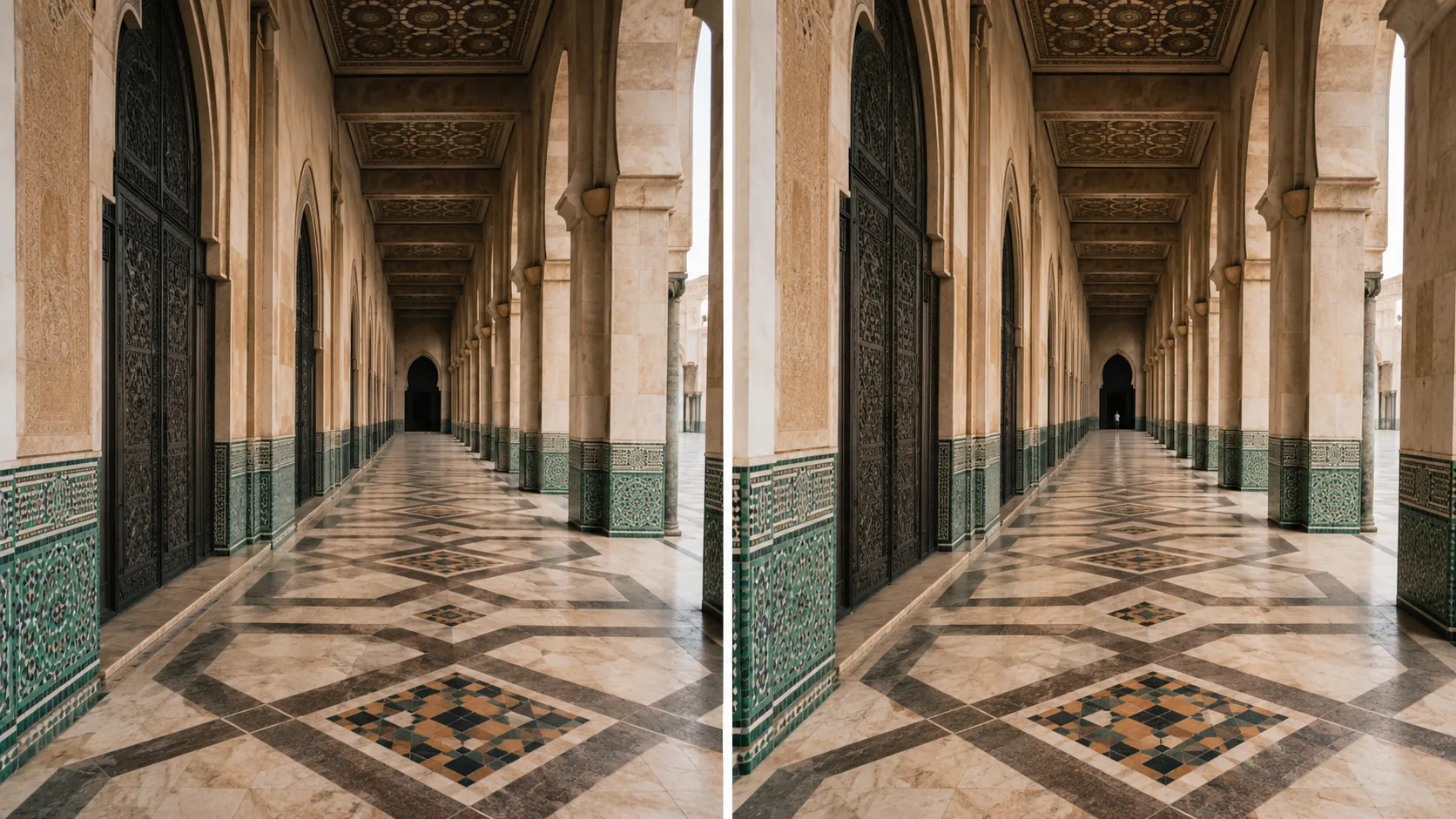
The most common kind: the left half of the frame mirrors the right across a vertical line. Corridors, facades, bridges, aligned trees, a face photographed straight on. The world builds a lot of it, because buildings and bodies are roughly symmetrical to begin with.
Two things decide whether it works.
The axis has to sit in the center. Mirror symmetry framed off center is neither one thing nor the other: too balanced to feel dynamic, too shifted to feel ordered. Put the line of symmetry in the middle of the frame and let the halves do the talking.
The halves have to actually match. A parked car on one side, an open window, a person mid-step: any one-sided element is instantly visible precisely because the rest of the frame is mirrored. Symmetry amplifies whatever refuses to obey it, which can ruin the shot or make it, as covered below.

Reflections: Water, Glass and Wet Ground
Reflections hand you symmetry that architecture cannot: horizontal symmetry, with the world above the line answered by its double below. Still water is the classic source, and it is more available than it sounds. Lakes at dawn before wind picks up, puddles after rain, harbor water between boat wakes, even a wet pavement after cleaning.
The working rules are the same as for mirror symmetry, rotated: the waterline is your axis, and it wants to sit close to the middle of the frame for the doubling to read as the subject. That contradicts the usual advice for horizons, and deliberately so. A horizon through the center divides a landscape; a reflection through the center completes one.
Glass adds a variation. Windows and polished surfaces reflect at an angle, which lets you compose the scene and its double side by side rather than stacked. The reflected half is always slightly darker, and that difference is information: viewers read which half is real without being told.
Share the Set, Not Fifteen Links
Point one short address at your gallery, your socials, wherever the work already sits.
Radial and Pattern Symmetry
Radial symmetry repeats around a point instead of across a line: spiral staircases shot from below, dome ceilings, flowers, bicycle wheels. The center of rotation is the natural place for the lens, and these shots reward looking straight up or straight down, angles most people never point a camera at.
Pattern symmetry is repetition: tiles, windows on a facade, rows of seats, columns. A pattern filling the whole frame has no single subject, and that is the point. The picture is about the rhythm, and the edges should cut the pattern cleanly, mid-element crops along the border read as sloppy rather than abundant.
Both kinds get stronger the tighter the frame excludes everything else. Sky above the facade, floor below the staircase: anything outside the system of repetition dilutes it. This is a framing decision as much as a compositional one, and the two pages make a natural pair.
Shooting It Straight
Symmetry is unforgiving of approximation, and the difference between striking and sloppy is usually a few degrees.
Center yourself physically. The camera has to sit on the axis of symmetry, not near it. In a corridor that means standing in the middle of the corridor. Half a step sideways skews every parallel line in the frame, and no crop fixes perspective taken from the wrong spot.
Square the camera. Point the lens level and straight at the subject, not tilted up or down, or vertical lines start leaning toward each other. The grid overlay in your camera app is the tool here, the same one covered in the rule of thirds guide, used for the opposite purpose: this time the subject goes on the center line.
Then check the details. With the geometry locked, one-sided intruders become the last problem: a bin, a shadow, a person about to walk through one half. Wait them out or reframe. In a symmetrical shot there is no busy corner to hide them in.
Breaking Symmetry on Purpose
A symmetrical frame with one deliberate exception is often stronger than the pure version. The mirrored scene sets the rule, the single red umbrella, lone figure or open window breaks it, and attention goes straight to the break. The symmetry does the pointing.
The break works when it is single and obviously intentional. One person in the empty mirrored plaza is a statement; three people scattered through it are just a plaza with people in it. If the breaking element can sit exactly on the axis, even better: the frame stays balanced while the exception owns the center.
This is the same logic as every rule in composition: the guideline creates the expectation, and the controlled exception spends it. Knowing why symmetry works is what tells you when the broken version says more.
Keep Your Photos in One Place
One address, updated whenever the work changes, with analytics on how often it gets opened.
Making It a Habit
Walk one street hunting axes. Corridors, doorways, facades, lines of trees. Count the symmetries you pass without shooting. The reflex you are building is spotting the axis, and it transfers to every camera you will ever hold.
Shoot one symmetry three ways. Perfectly centered, deliberately off axis, and centered with one breaking element. Comparing the three teaches you more about what alignment buys than any description, because the subject is constant and only the geometry moved.
Revisit after rain. The same locations you know produce new symmetries when the ground turns reflective. It is the cheapest way to double your local inventory of axes.
If the foundations underneath are still settling, our photography guide for beginners covers the order that makes this easier: light first, then framing, then settings.
FAQ
Is symmetry against the rule of thirds?
It is the recognized exception to it. The rule of thirds moves subjects off center to create balance between unequal areas; symmetry creates balance between equal ones. When a scene is genuinely mirrored, centering it is the choice that reads as deliberate.
Does symmetry have to be perfect?
The alignment does; the scene does not. A camera that sits off the axis looks like a mistake, but small real-world differences between the halves, worn stone, uneven foliage, read as texture. Precision in geometry, tolerance in content.
Where do I find reflections without a lake?
Puddles after rain, wet pavement, shop windows, polished tables, car roofs. Small reflective surfaces work when you bring the camera close to them, low over a puddle the doubling can fill most of the frame.
Why do my symmetrical photos look tilted?
Almost always because the camera was near the axis instead of on it, or tilted slightly up or down. Stand on the center line, level the camera, and use the grid overlay to check that verticals stay vertical at the edges of the frame.
Can I fix symmetry by cropping later?
You can re-center the axis, but you cannot repair perspective. If the camera stood off the line, the two halves converge differently and no crop makes them match. Symmetry is one of the cases where getting it right in the frame is genuinely the only way.
Is a phone enough for symmetry?
Entirely. Alignment and position matter far more than the camera, and phone grid overlays make squaring the shot easy. Ultra-wide lenses exaggerate any misalignment, so with those the on-axis discipline matters even more.