
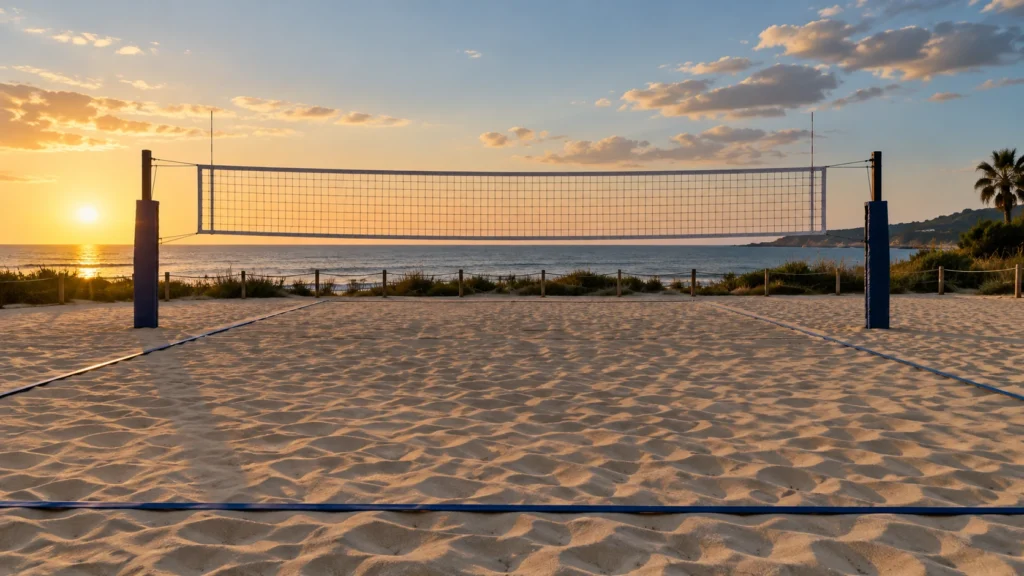
Almost all of footvolley happens above the players, and that is exactly the part a phone resting on the sand never captures. The ball rises on the touch, crosses a high net and drops somewhere else on the court while the pair crosses underneath it looking for the angle of the attack.
Footvolley is a Brazilian beach sport played on a sand court with a net, using the rules of beach volleyball with one change: the hands are out. If you have never seen it, picture a two versus two volleyball rally played entirely with feet, chest and head. The goal of a recording is not broadcast coverage. It is the whole rally, from serve to the ball landing, with both sides in frame and nobody leaving the pair to hold a phone.
The Play Is Already Recorded
At a court with VISU Replay, the cameras run continuously. You press the button after the play and the clip is already there, cut and ready, without anyone leaving the game to film.
Why Footvolley Is Hard to Film
Footvolley combines court rules based on beach volleyball with ball-touch rules taken from association football. Think of it as beach volleyball where players cannot use their hands and a football replaces the volleyball. The court is about 9 by 18 metres and the net sits around 2.2 metres high in men's play and 2 metres in women's play (see References). Those numbers explain the filming problem before any conversation about equipment.
A net above two metres on a narrow sand court puts most of the game above the eye line of anyone sitting on the beach. The set rises, the attack comes down, and a low camera sees a band of mesh with legs behind it. The frame that looks correct on the screen, with four players neatly centred, usually cuts off the exact height the ball travels through.
The format also shapes the setting. Footvolley was born on the beaches of Rio de Janeiro and settled on two versus two, which is still the standard today. Two players a side means fewer bodies blocking the view than in indoor volleyball, but it also means each player covers far more ground, so the action spreads across the whole court rather than staying in lanes.
Then there is the environment. Sand is bright and bounces light upward, the open sky behind the court is the brightest surface in the frame, and people walk between the camera and the sideline because a beach court rarely has a barrier. Each of these is manageable alone, but they always arrive together.
Finally, rallies end abruptly. Nobody knows in advance which dig will become the point worth keeping. The reliable unit of recording is therefore not the isolated finish, it is the rally. Everything that follows is built on that decision.
Where to Put the Camera on Sand
The strongest position is behind the baseline, elevated, and slightly off the central axis. Behind the baseline because the net becomes a horizontal line you look over, instead of a wall you try to look through. Elevated because the ball spends its time above the top of the net and has to fit inside the frame. Off axis because directly in line, the front player covers the partner at the moment of the serve.
Height is the variable that changes the result the most, and the one people ignore. If the camera sits below the top of the net, the set leaves through the top of the frame and the defence on the far side happens behind a band of mesh. If it sits above, the same scene becomes a clear read of both halves. A safe stairway at the venue, a deck, a balcony or a tall tripod solves that better than any change of phone.
The sideline works as a second option, and it charges a specific price. It reads the attack and the block well, but the net post cuts through the centre and the near pair hides the far pair. If it is the only position available, move far enough that the post does not sit on top of the main action, then check both back corners before leaving the camera alone.
Avoid ground level even when it is the most convenient. Propping the phone against a bag puts the lens at sand height: the nearest player becomes huge, the opposite half becomes tiny, and the ball exits the frame on the first high touch. Raising the camera half a metre usually helps more than moving it two metres closer.
Safety and venue rules come before framing. No tripod inside the playing area, nothing on an unstable fence, nothing blocking the walkway.
Phone on a Tripod: What You Get and What You Lose
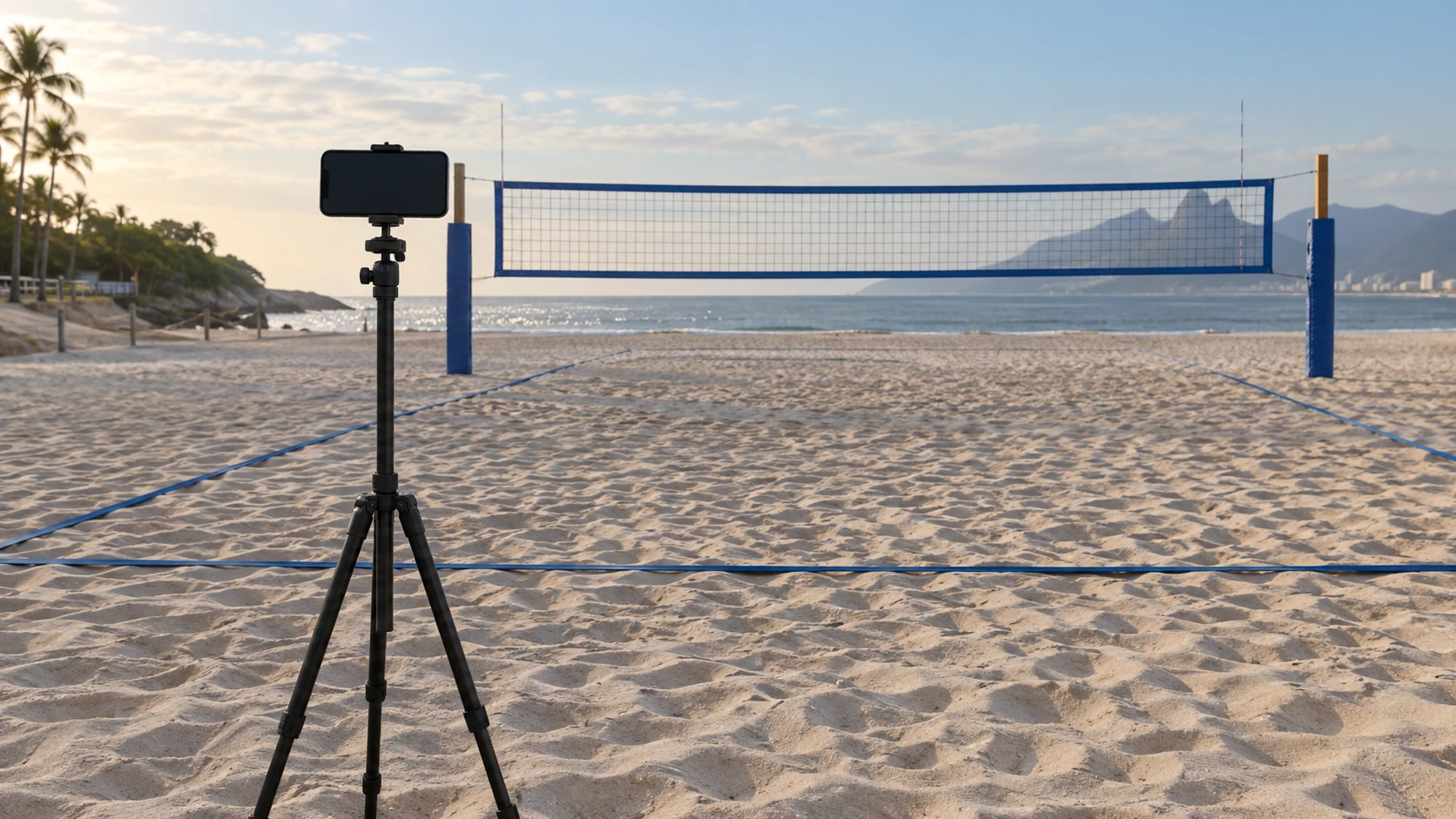
A phone on a tall tripod is the simplest arrangement you control by yourself. It holds a wide frame for the whole rally, the screen lets you confirm that both sidelines and the space above the net are inside the shot, and you can adjust between games. Set it up before play starts, record a short trial with the pair moving through both halves, and check the saved file rather than the preview.
What you lose is attention. Somebody has to start it, confirm that it is still recording, protect the tripod from people walking past and stop the file afterward. Battery, storage, notifications and heat stay the group's problem. The recording can be technically perfect and still fail because a tripod leg sank into the sand and the framing drifted mid match.
A frame wide enough for the whole court also makes each player small. With nobody operating it, a phone cannot follow the attacker and hold the full court at the same time. Decide which of the two you want before the game. Setup flexibility and unattended coverage are two different things, and a tripod only gives you the first.
Find Out If Your Court Has It
VISU Replay only exists where it has been installed, so the useful first question is whether the place where you already play has cameras and a replay button.
Sun, Backlight and Sand
Bright sand and open sky form the combination that ruins most beach court video. A camera meters light from the largest bright area in the frame, and in this setting that area is the ground or the sky, never the players. The default result is a well exposed court with four dark silhouettes standing on it.
The correction starts with orientation, not with settings. If there is a safe position where the sun sits behind the camera instead of behind the court, use it. Filming into the sun guarantees backlight, lens flare and faces without detail, even on a new phone. A ninety degree move around the court usually solves more than any menu.
When you cannot choose, tilt the camera slightly down so the frame holds more sand and less sky. That reduces the bright area dominating the meter and improves player exposure before you lock anything. After that, if the phone allows it, lock exposure and focus so the image does not pulse every time somebody crosses in front.
Light also changes during the game. Late in the afternoon the sun drops and rakes across the court, so re-check the frame between sets.
Sand is the physical half of the story. It gets into charging ports, tripod threads and the lens assembly, and it does not come back out. Set up outside the sliding zone, keep the equipment off the ground whenever possible, and never rest the phone directly on the sand. The general causes of poor sports footage are covered in why your phone films sports badly, and sand amplifies every one of them.
Fixed Camera and Button: Nobody Leaves the Game
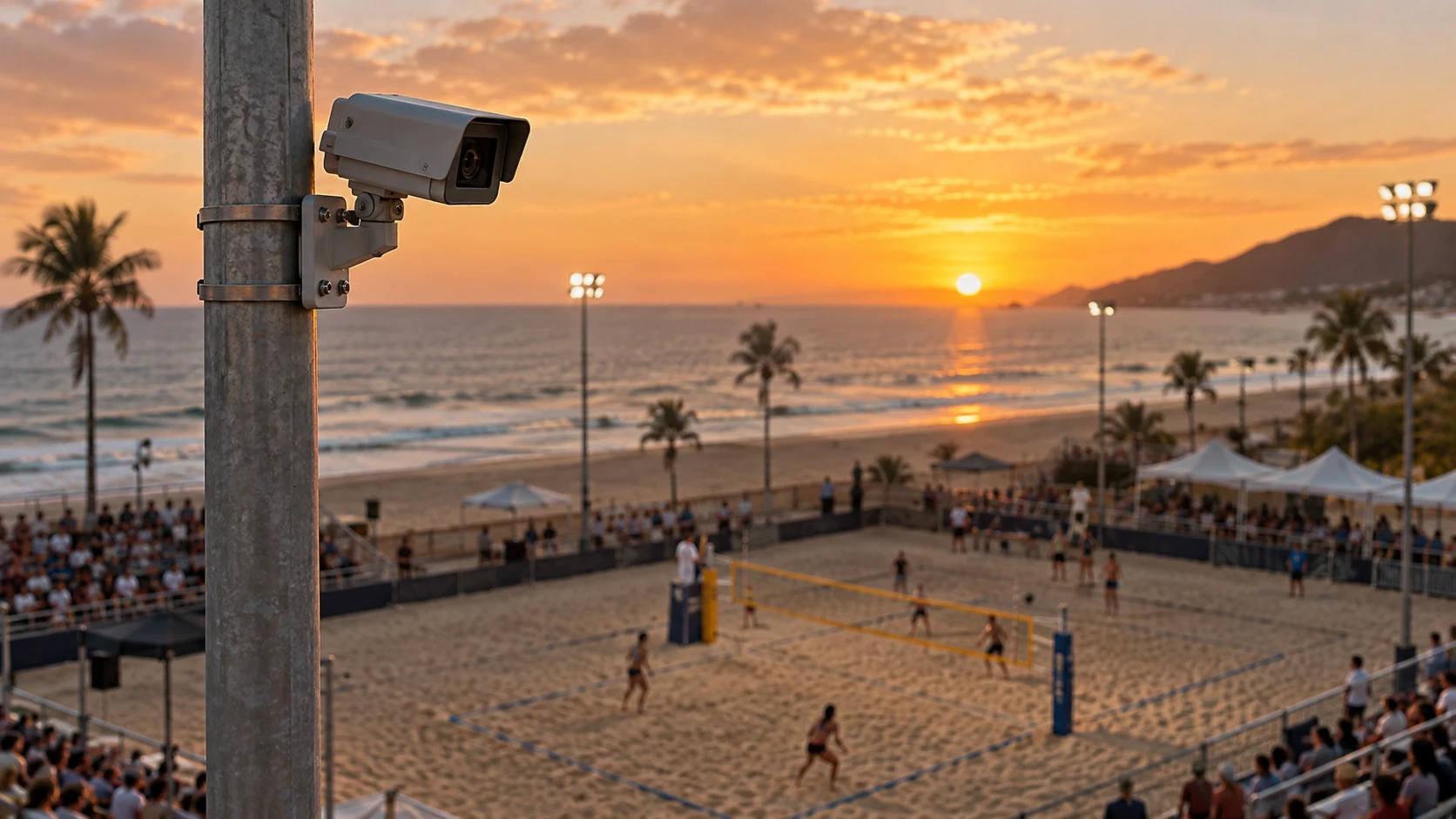
A fixed camera changes the nature of the problem, because the group stops building a new filming position for every match. At a venue with VISU Replay, the camera records the session from the view where it was installed. After a play, a player presses the replay button and the system saves a clip that is already cut.
The order matters. The button does not ask the camera to start recording after the point. It saves the action that has just happened, so the player can wait for the rally to finish before deciding whether that play is worth keeping. The guide to how the replay button works explains that retroactive window in detail.
This solves the participation problem, not every visual trade-off. A fixed position still needs enough height for the set and enough width for both halves. It cannot turn a single angle into a close-up of every player. What it removes is the teammate assigned to film, the repeated tripod setup and the long file somebody later has to search through.
The saved clip carries the court name. That matters when it leaves the player's phone and enters a group conversation, because the place stays attached to the moment without anyone editing a title into the video.
How Much to Keep: The Whole Rally
Keep from the serve to the ball landing. That boundary is understood by anyone who played the rally and does not require an editor to guess later where the story began. Cutting only the finish preserves the attack and removes the receive and the set that made the attack possible.
Leave a little room around the action when cutting from a continuous recording. The viewer should see the server prepare and should see the point resolve. Do not force every clip into the same duration: an ace is short, while a rally with two consecutive digs needs its whole sequence to make sense.
With a replay button, press after the point rather than during the attack. Retroactive capture is designed around action that has already occurred, so waiting for the ball to land keeps the press from becoming part of the play. Anyone who tries to anticipate ends up saving the start of the next rally instead.
Keep the whole match only when there is a reason to review the whole match. For sharing, rally-sized clips are easier to identify, name and send. The same sand and the same high net shape the setup described in how to record your beach tennis match.
Naming and Sharing the Play
A good filename answers what happened without opening the video. Use the venue or group name, the outcome of the play and a short player reference the group already uses. A name that depends only on download order disappears at the first backup.
Share the play, not the whole recording, when the purpose is a group conversation. A one rally file arrives, opens and gets watched. A full session file gets opened once and never again.
Before posting outside the pair, ask the venue and the visible players what they allow. A court can have its own filming policy, and agreeing with the people in frame is a practical part of responsible sharing, not legal advice.
Keep the original clip if you plan to crop vertical later. Every new export removes context or quality, while the original preserves the court view and the sequence around the point.
If Your Court Already Has VISU Replay
Start by separating the roles. The venue owner decides whether the fixed system is installed and how the court presents it. The player only finishes the rally, presses the button and opens the clip. Sharing happens afterward, from the clip, not from the installation.
VISU Replay only exists where it has been installed. Do not assume a beach arena has it because a neighbouring one does. Ask the place where you already play whether there is a replay camera and where the button is.
If it is there, learn the button position before the game so nobody is searching during the next serve. Press after the play you want, confirm the clip in the venue flow, and give it a useful name before it disappears into a folder of similar points.
If it is not there, the guide above still holds: height, a position behind the baseline, sun behind the camera where possible, and the whole rally.
If You Run the Venue
A fixed camera means every group that books gets the clip without bringing equipment, and every clip leaves carrying the name of your court.
FAQ
What is footvolley?
It is a Brazilian beach sport that combines beach volleyball court rules with football ball-touch rules. Picture beach volleyball where players cannot use their hands and a football replaces the volleyball, most commonly played two versus two.
Where should I put my phone to record footvolley?
Behind the baseline, raised above the top of the net and slightly off the central axis. That position shows both halves, turns the net into a reference line and stops the front player from covering the partner on the serve.
How high does the camera need to be?
High enough to sit above the top of the net, which is around 2.2 metres in men's play. Below that, the ball leaves through the top of the frame on the set. Use a safe support, never an unstable fence or anything in a player's run-off area.
Can I record footvolley alone, with nobody holding the phone?
Yes, with a tall tripod and a wide frame set up before play. Record a short trial with the pair moving, check the saved file, and place the equipment where nobody has to touch it during the game.
How do I avoid backlight on a sand court?
Choose, where there is a safe option, the side with the sun behind the camera. If you cannot, tilt slightly down so the frame holds more sand and less sky, then lock exposure and focus before the serve.
How long should a footvolley clip be?
The length of the rally, from serve to the ball landing, with a little room at each end. Do not standardise the duration, since an ace and a long rally do not fit the same cut.
Do I need permission to film at a beach court?
Ask the venue before setting up and agree with the people in frame before posting outside the group. Every place has its own policy, and this is practical courtesy rather than legal guidance.
References
- Wikipedia: Footvolley. Court of 9 by 18 metres, net height of 2.2 metres for men and 2 metres for women, hands not allowed, origin in Rio de Janeiro and the two versus two format.
- Wikipedia in Portuguese: Futevôlei. Sand court dimensions, net at 2.20 metres, three touches per side and the ban on arms, forearms and hands.
- Wikipedia in Spanish: Futvóley. Play predominantly on beach sand courts and the ban on touching the ball with the hand or arm.