

Most Halloween planning assumes a house full of children, and the adult version of the night has almost nothing to do with that. No costume contest, no sugar, no schedule built around bedtime. What is left is an evening you get to design from scratch, and that turns out to be the hard part.
What follows is a set of activities that are not games. No rules, no teams, no scoring. Decoration, food, films, going out, dressing up and one slow project, arranged so you can pick two or three and have a night that feels deliberate instead of improvised.
The Evening Happens Somewhere
If that place is a VISU partner location, your verified presence can earn a reward. Scan the code there, with no purchase required.
Why the Adult Version Is a Different Problem
Halloween is described as a celebration observed in many countries on 31 October, the eve of the Western Christian feast of All Hallows' Day, at the beginning of the observance of Allhallowtide, the period in the Christian liturgical year dedicated to remembering the dead. That origin is worth knowing because it explains the vocabulary you inherit: candles, quiet, the turn of the season, the dark half of the year. None of that requires a party.
The same source lists the popular activities of the date as trick-or-treating, attending costume parties, carving pumpkins or turnips into jack-o'-lanterns, lighting bonfires, apple bobbing, playing pranks, visiting haunted attractions, telling frightening stories, and watching horror or Halloween themed films. Read that list as an adult and roughly half of it is aimed at children, while the other half, the carving, the fire, the stories, the films, works better without them.
So the planning question is not what to organise. It is what to remove. An adult Halloween goes wrong in two predictable ways: it becomes a children's party with taller guests, or it becomes nothing at all because nobody wanted to be the person who suggested something. The fix is to commit to one anchor activity and let everything else be optional around it.
If what you actually want is a game with rules, teams and a score, that belongs elsewhere and it is a genuinely different article. Everything below is deliberately the other thing.
Turning the Room Dark on Purpose
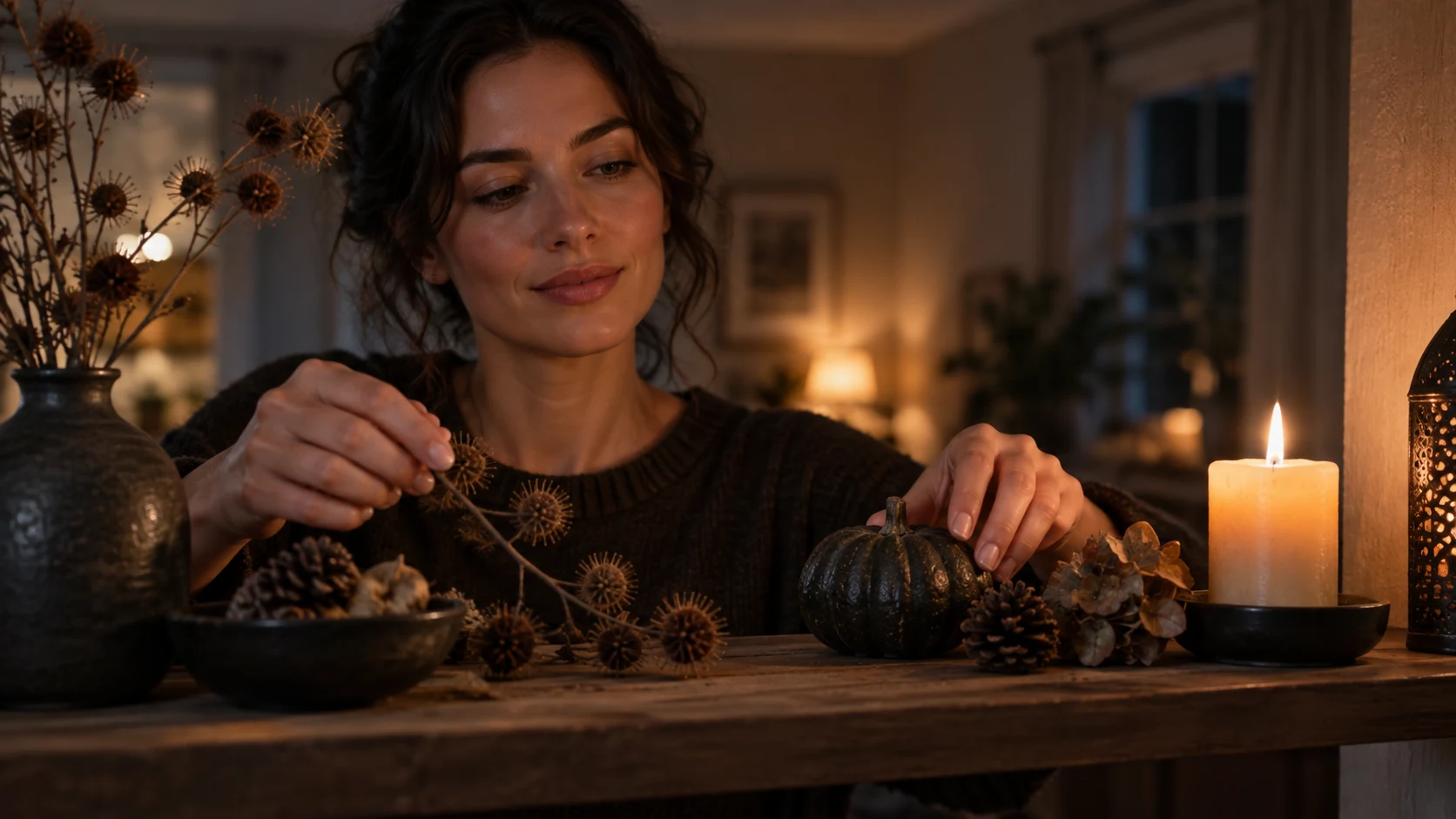
Adult decoration for this date is subtractive. You are not adding orange plastic to a room, you are removing light from it and letting what remains do the work. The single highest impact change is switching off overhead lighting entirely for the evening and lighting the room from below and from the sides.
Rebuild the light before anything else. Put every light source at or below table height: lamps on the floor, candles on shelves, a lamp turned to face a wall so the room is lit by reflection. Faces lit from below read differently, which is the whole visual grammar of the season. It costs nothing and changes a living room more than any object you could buy.
Work in one colour family. Choose two colours and refuse the rest. Black and deep red, or black and dull gold, or black and nothing at all. The failure mode of seasonal decorating is quantity, and the constraint of two colours removes the decision fatigue entirely.
Take things away. Clear the shelf down to bare wood, then put back three objects instead of eleven. Empty space around an object is what makes it look intentional rather than accumulated.
Use what the season already provides. Bare branches in a tall vessel, dried seed heads, a bowl of unpolished gourds, dark ivy. This is the one place where the decoration is free, seasonally accurate, and impossible to make look cheap.
Carve, but carve for shape. Pumpkin carving is on the list of traditional practices, and the adult version is simply a stricter one. One large pumpkin instead of five small ones. A single silhouette or a pattern of drilled holes rather than a face. Scrape the inner wall thin where the light passes through and the glow becomes even instead of patchy.
The Film Evening, Built Properly
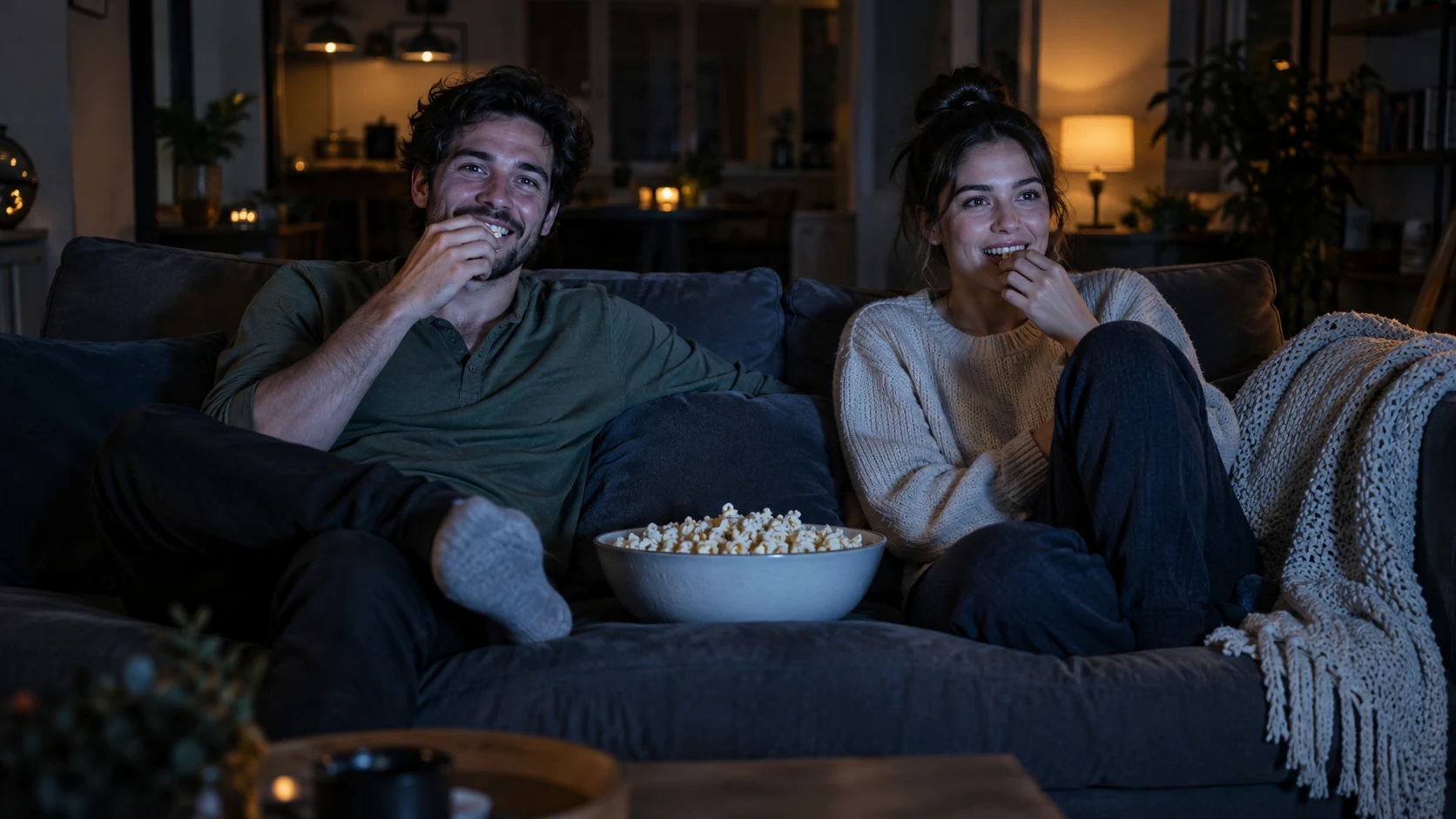
Watching horror or Halloween themed films appears in the traditional practices of the date, and it is the most common adult plan for the night. It is also the one most often ruined at the last minute, because two people spend forty minutes scrolling and then watch nothing.
Decide before the day. Pick the titles at least a day in advance, confirm they are actually available wherever you watch, and write them down. Catalogues shift constantly, so verify rather than assume. That advance decision is the difference between a plan and a wasted evening.
Programme it, do not just pick. A double feature with a shape is better than two unrelated films. Pair a slow, quiet film with a loud one. Or run a decade: two films from the same era so the second one is read through the first. Or choose one film everyone has seen and one nobody has, in that order, because the familiar one lowers the stakes.
Build in the interval. Twenty minutes between films, lights partly up, something to eat. Without it the second film is watched by people who stopped paying attention halfway through.
Match the intensity to the room. One person quietly enduring an evening is not a successful evening. Atmospheric older horror, gothic period pieces, supernatural mystery and comic horror all sit below the threshold where somebody leaves. Ask before, not during.
Have the alternative ready. Anthology episodes work when attention is short and people are arriving at different times. So does an unusual documentary about folklore or old buildings. If you would rather answer questions than watch anything, the site already has a set of movie trivia questions you can read straight from the page.
A Reward Tied to the Visit
VISU rewards a verified visit at a partner location. The scan confirms that you are there, without asking you to buy something or complete a profile.
Cooking as the Main Event
Making the food is an activity, not preparation for one. Treat the cooking as the thing you are doing together and the evening has a structure without anyone having to organise anything.
Cook the season instead of the theme. Late October produces squash, pumpkin, root vegetables, apples, nuts, dark greens. A slow roasted squash, a heavy soup, an apple dessert, bread. This tastes better than anything shaped like a bat and it is genuinely appropriate to the date rather than decorated to look like it.
Use the pumpkin you carved. Carving produces a large volume of flesh and seeds that mostly gets thrown away. Roast the seeds with salt. Use the flesh for soup or a purée. The activity and the meal become one thing.
Let colour do the theming. Blackened garlic, squid ink pasta, dark cherries, blackberries, purple cabbage, charred onion. Darkness on a plate is elegant, where plastic spiders on a plate are not.
Run it as stations. If more than two people are cooking, assign one dish each rather than having everyone circle the same pan. Arriving guests get a task instead of standing in a doorway.
Keep drinks out of the mechanics. Whatever anyone is drinking stays a drink. It is not a forfeit, a prize or part of any activity described here, and a good evening does not depend on it.
Leaving the House on the Night
Staying in is a choice, not a default. The date supports a surprising number of things that only work in late October.
Walk somewhere at night on purpose. A cemetery with public hours, an old quarter, a river path, a hill above the city. Cold air, early darkness and no particular destination is a genuinely good evening, and it is the closest modern equivalent to the seasonal walk the date came from.
Take the guided version. Many towns run history walks, folklore tours or evening museum openings in the last week of October. Book in advance, because the ones worth doing sell out for that specific week.
Visit a haunted attraction as an adult. Visiting haunted attractions is listed among the traditional practices, and going as an adult is different from going as a teenager. Check what the experience actually involves before booking, since the range runs from theatrical to physically intense.
Go to the themed venue rather than hosting. A bar, cinema or venue running something for the date removes all the work. Somebody else did the decoration and the programming, and you leave when you want to.
Choose the seasonal daytime version. A farm, an orchard, a forest walk in full autumn colour, a market. If nights out are not what you want, the last weekend of October outdoors is the better half of the season.
Let the Place Count
When an evening out happens at a VISU partner location, a code scan can connect the visit to a reward. The reward is for verified presence, not a purchase.
Dressing Up When There Is No Contest
Attending costume parties is among the practices associated with the date, but the adult version usually happens without a party attached, and that changes what a costume is for. Nobody is being judged, so the costume only has to work for you.
One decision, not a whole outfit. A single strong element carried by ordinary clothes is more effective than a full construction. A colour worn head to toe. One unusual object. A single deliberate detail. This survives a whole evening, where an elaborate build is abandoned by ten o'clock.
Choose by comfort first. If you are going out, you will be standing, walking, sitting on public transport and probably outdoors in the cold. Anything that restricts sight, hearing or movement gets removed within an hour, so decide against it now rather than later.
Concept over character. An idea, a mood, a period, a texture. This avoids depending on any specific character and generally looks better, because it is not competing with an image everyone already has in their head.
Assemble from what exists. Your own wardrobe, second hand shops, borrowed items. Using only what is already available produces better results than an unlimited budget, because it forces a simpler idea.
Give everyone permission not to. Say clearly whether costume is expected. A guest who guessed wrong in either direction spends the evening self conscious, and that is entirely avoidable with one sentence sent in advance.
One Slow Project Before the 31st
Some of the best of this happens in the weeks before, alone or with one other person, without an occasion attached. Keep it to a single project so it stays restful.
Candle making. Dyeing fabric black for a hanging or a tablecloth. Drying flowers and seed heads collected on a walk. Making a wreath from bare branches instead of evergreen. Restoring or repainting a found object in the two colours you chose for the room. Any of these is one evening's work and produces something the room actually uses on the night. If this is the part that appeals to you most, there is a fuller set of easy crafts for adults to work through, and the detailed instructions live there rather than here.
The point of the slow project is that the season lasts longer than one evening. Making something in mid October means the 31st arrives already furnished, and you spend the night itself with people instead of with a glue gun.
Assembling the Evening From Blocks
Pick one anchor and two optional extras. That is the whole method.
A quiet night for two. Rebuild the light in the afternoon, cook one seasonal dish together, watch a programmed double feature. Nothing else.
Four to six people at home. Cooking stations as the anchor, dark room set up in advance, one film after eating for whoever stays. Costume optional and clearly stated as optional.
Out for the night. A booked walk or tour as the anchor, a themed venue afterwards, one costume detail each. No hosting at all.
Alone and pleased about it. The slow project through October, then a walk at dusk on the night and a film chosen a week earlier. This is a legitimate plan and not a consolation prize.
Somebody who dislikes the season. Seasonal cooking and an autumn daytime outing, with none of the horror vocabulary. The date is a marker in the calendar, and you are allowed to use only the part of it you like.
Announce the anchor to whoever is coming, in one sentence, several days ahead. That single message is the difference between an evening people arrive prepared for and one that dissolves into everyone asking what the plan is.
FAQ
What Can Adults Do on Halloween Without a Party?
Rebuild the lighting and decorate subtractively, cook a seasonal meal as the shared activity, run a programmed double feature, walk somewhere at night, or take a booked history or folklore tour. Choose one as the anchor.
What Is Halloween Actually Celebrating?
It is observed on 31 October, the eve of the Western Christian feast of All Hallows' Day, and opens Allhallowtide, the part of the liturgical year dedicated to remembering the dead.
How Do I Decorate for Adults Without It Looking Like a Children's Party?
Limit yourself to two colours, remove light rather than adding objects, clear a surface completely before placing three things on it, and use bare branches, gourds and dried seed heads.
What If Nobody Wants to Watch Horror?
Ask before the night, not during. Gothic period pieces, supernatural mystery, comic horror, folklore documentaries and anthology episodes all fit the date without the intensity.
Do I Need a Costume If There Is No Contest?
No. If you want one, use a single strong element over ordinary clothes and choose it for comfort, since you will be wearing it for hours.
What Can I Do on Halloween Alone?
Take a slow project through October, walk at dusk on the night, cook one seasonal dish and watch something you chose a week earlier.
Where Do Games With Rules Fit In?
They are a separate plan. Everything here is chosen to work without rules, teams or scoring, so a rules based evening is organised differently from the start.
References
- Halloween, Wikipedia. Supports the date of 31 October, its position as the eve of All Hallows' Day and the opening of Allhallowtide, and the list of practices traditionally associated with the observance, including costume parties, carving pumpkins or turnips into jack-o'-lanterns, visiting haunted attractions, telling frightening stories and watching horror or Halloween themed films.
The planning methods, decoration approaches, cooking suggestions and evening structures above are editorial recommendations rather than measured claims, and no outcome, benefit or result is asserted for any of them.