

Futsal punishes a bad camera angle faster than any other football format. The court is small, the ball stays on the floor, ten players share a sports hall and the play turns around in a couple of touches. A position that works for an eleven-a-side match can leave you with a futsal video made of backs, legs and one distant goal.
This guide is only about the angle: where the camera goes, how high, which side of the hall, and how each position treats the plays that define futsal. The full setup, including flicker, exposure and focus, is in how to record your futsal game. This page is the decision that comes before all of it.
The Angle Is Decided Before Kick-Off
At a court with VISU Replay, the camera is already fixed high on the side of the hall, so nobody has to find a spot, hold a phone or sit out a shift to film the game.
The Short Answer
On the long side of the court, level with the halfway line, above head height, on the side opposite the team benches, tilted slightly down and filming horizontally. If the hall has bleachers along the long side, the first rows are already that position.
Each part does a job. The long side shows the width where futsal builds its attacks. The halfway line keeps both goals at a similar distance. Height separates players who overlap at floor level. The side opposite the benches keeps substitutes out of the foreground, and the downward tilt fills the frame with floor instead of ceiling lights.
It is the same logic as the best camera angle for soccer, compressed into a smaller space where every mistake costs more.
What the Futsal Court Imposes on the Camera
Futsal is not football on a small pitch. The FIFA Futsal Laws of the Game set a different court, ball and restarts, and each one changes where a camera needs to be.
A court that varies between halls. For international matches the Laws set the touchline between 38 and 42 metres and the end line between 20 and 25 metres. For non-international matches the touchline can be as short as 25 metres and the end line as narrow as 16. That spread is why this guide describes positions as proportions of the court rather than distances.
A small goal. The goal is 3 metres wide and 2 metres high, measured on the inside. Shots and saves happen inside a target that is easy to lose in a wide frame from far away.
A ball that stays low. The Laws require the ball to bounce no lower than 50 cm and no higher than 65 cm on the first rebound when dropped from 2 metres. The game is played on the floor. The camera does not need the headroom that padel or basketball demand. It needs the floor.
A ceiling that is part of the rules. The ball is out of play when it hits the ceiling, and play restarts with a kick-in. Nothing worth filming happens up there, which is one more reason to tilt down and leave the lamps out of the frame.
Five players a side and constant changes. Each team has a maximum of five players, one of them the goalkeeper, and the Laws allow unlimited substitutions through zones on the touchline in front of the team benches. On the bench side, the foreground never stops moving.
Restarts from the touchline. When the ball goes out along the side, play restarts with a kick-in from the line, taken within four seconds. For a camera on the side, those restarts begin right at the edge of the frame.
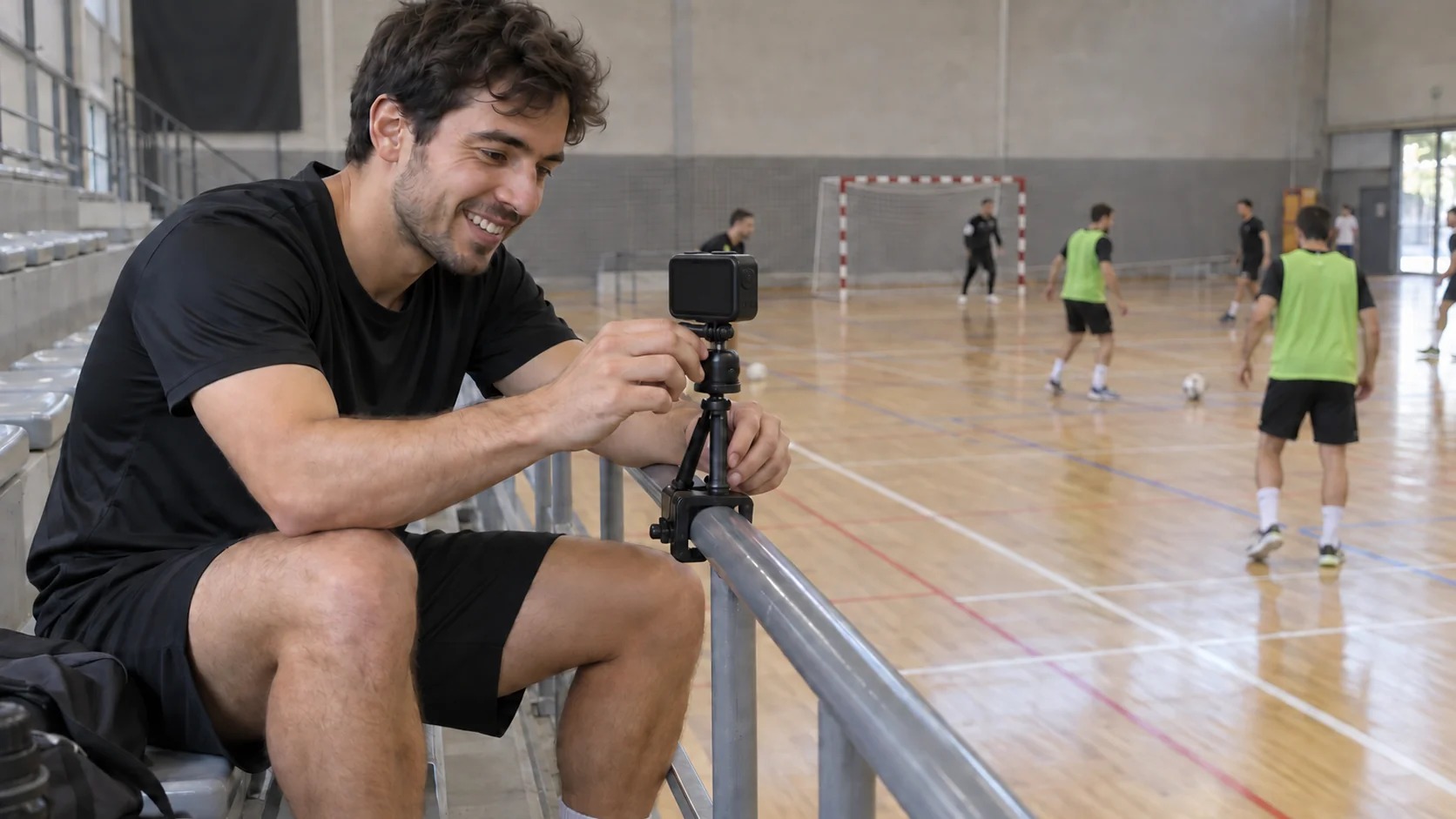
Height Separates the Players
Height does the most work in futsal. At player height, the camera spends the match looking at whoever is nearest. The pass that unlocked the defence happens behind someone's back, and the ball vanishes into a cluster of legs whenever the play comes toward you.
Above head height is the threshold that matters. Once the camera looks down on the players instead of across them, they separate. Gaps between defenders become visible, which is what explains why a pass worked. The bright floor also fills more of the frame, which helps the exposure, as the recording guide explains.
The bleachers are the easy win. A few rows of seating along one long side give height, stability and a view over the substitutes. A balcony or raised walkway works the same way. A bench at floor level does not, however convenient it is.
Too high has a cost too. From very high up, the court turns into a tactics board: good for shape, weak for faces, celebrations and the feel of a close duel. The footage people rewatch usually comes from a position clearly above the players but close enough to see who they are.
The Positions, Compared
Every position in a futsal hall is a trade.
| Position | What It Captures Well | What It Loses | Use When |
|---|---|---|---|
| Long side, halfway, raised, opposite the benches | The whole court, width, movement off the ball | Close detail at either goal | The default for a full game |
| Long side, halfway, bench side | The same view on paper | A foreground of substitutes and coaches | Only if it is the only raised spot |
| Long side at floor level | Whatever is nearest | Depth, the far side, the ball in traffic | Avoid |
| Behind the goal, raised | Finishing, saves, the goalkeeper | The other half of the court | Goalkeeper footage, kicks from the marks |
| Corner, raised | Depth on one half | The far goal, small and dark | A fallback when the side is blocked |
| High balcony at one end | Shape and spacing | Faces, the near goal area | Reviewing tactics rather than sharing |
The bench side is the quiet mistake. It looks identical to the good position until the game starts. Then unlimited substitutions put a moving layer of people between the camera and the court, and the best move of the night happens behind someone pulling off a bib.
Behind the goal is tempting because shots come often and from close range. It is right when the goalkeeper is the subject and wrong for a normal game, because the other half of the court becomes a blur. If your hall has a net close behind the goal, filming through it makes the camera focus on the mesh. Lock focus on the court or raise the camera above the net.
A Fixed Camera Above the Bench Traffic
A VISU Replay camera is mounted once, high on the side of the hall, so rotations, substitutes and the bench never cross the frame, and every goal stays in view.
Pivot Play, Flying Goalkeeper and Close-Range Saves
The default position covers a full game. The plays that define futsal each ask something specific of it.
The pivot turning on the edge of the area. The pivot receives with their back to goal, holds off the marker and either turns or lays the ball off. From the side and above, you see the pivot, the marker and the space they are fighting for. From floor level, the two bodies merge and the turn is invisible. From behind the goal, you see the finish but not the hold-up play that created it.
Passing sequences and rotations. Futsal attacks are built from quick passes and players swapping positions across the court. Only the raised long side keeps all the attacking outfield players in view at once. A tighter frame loses the player about to receive.
The flying goalkeeper. The Laws allow any player to change places with the goalkeeper, and a team chasing the score often attacks with an extra outfield player and an empty goal behind them. The FIFA guidelines even assign a referee to watch that empty goal line. The goal that decides the game may be scored from long range into the empty net at the far end, so keep the whole court in shot during those minutes.
Close-range saves. Saves in futsal are fast and dramatic, and from halfway they look small. If the goalkeeper is the subject, go behind the goal, slightly off centre and raised, so the dive reads as a diagonal instead of flattening toward the lens.
Kicks from the marks. The Laws place the penalty mark 6 metres from the goal and a second mark 10 metres out, used for the direct free kick a team concedes from its sixth accumulated foul in each period. These are the only moments where you know where the ball will go. Behind the goal and slightly to one side catches the strike and the goalkeeper.
Hall Light and Which Side to Choose
Outdoors, the sun decides which side you film from. Indoors, the hall decides.
Keep the lamps out of the frame. A ceiling lamp in the shot makes the camera expose for the lamp, and the players fall into shadow. A camera looking down at the court naturally leaves the lamps above the frame. A camera at floor level has them in shot all night.
Watch for windows and open doors. Daylight coming through a window on the far side acts like the sun in an outdoor match: the players in front of it become silhouettes. If one long side has windows, film from that side, with the daylight behind or beside the camera.
Then choose the side without benches. The order indoors is: the side with height, then the side without benches, then the side that keeps windows behind you. When height and benches conflict, height usually wins, because a raised camera looks over the bench traffic anyway.
Flicker from hall lighting is a separate problem that no position solves. The fix is a setting, explained in the recording guide linked at the top of this page.
Phone, Tripod or Fixed Camera
A phone in the bleachers. The simplest setup that works: a phone wedged in the first rows, filming horizontally, gets height, stability and distance from the ball. Horizontal matters because futsal develops across the width of the court, and a vertical frame cuts off the player the pass is going to. Crop a vertical version later if you need one.
A tripod on the floor. A floor tripod tops out at roughly the height of the person who set it up, which is where futsal players overlap, and it stands in the path of a fast, low ball. A tripod helps when it gets you onto something raised: a small one on a bleacher step or a clamp on a balcony rail.
Frame rate and resolution. The futsal recording guide is clear on frame rate: stay at 30fps unless the hall is genuinely well lit, because a higher rate means less light per frame and darker, noisier footage indoors. Resolution is a trade-off rather than a rule: more of it gives room to crop into a wide side angle later, and it costs storage and heat on a phone recording a whole game.
No zoom. Frame wide and crop afterwards. A tight frame loses the far post, the flying goalkeeper's empty goal and the player arriving late.
Someone always sits out. Every setup above needs a person to bring the camera, find the height and not play, and with rotations every few minutes, whoever films is missing shifts. A fixed camera removes that trade: the angle is chosen once for that court, and everybody plays.
The complete guide to filming amateur sports covers the principles shared by every sport in this series. The series also has the angle for soccer and padel, and a basketball version deals with a game played above head height, around the rim, instead of along the floor.
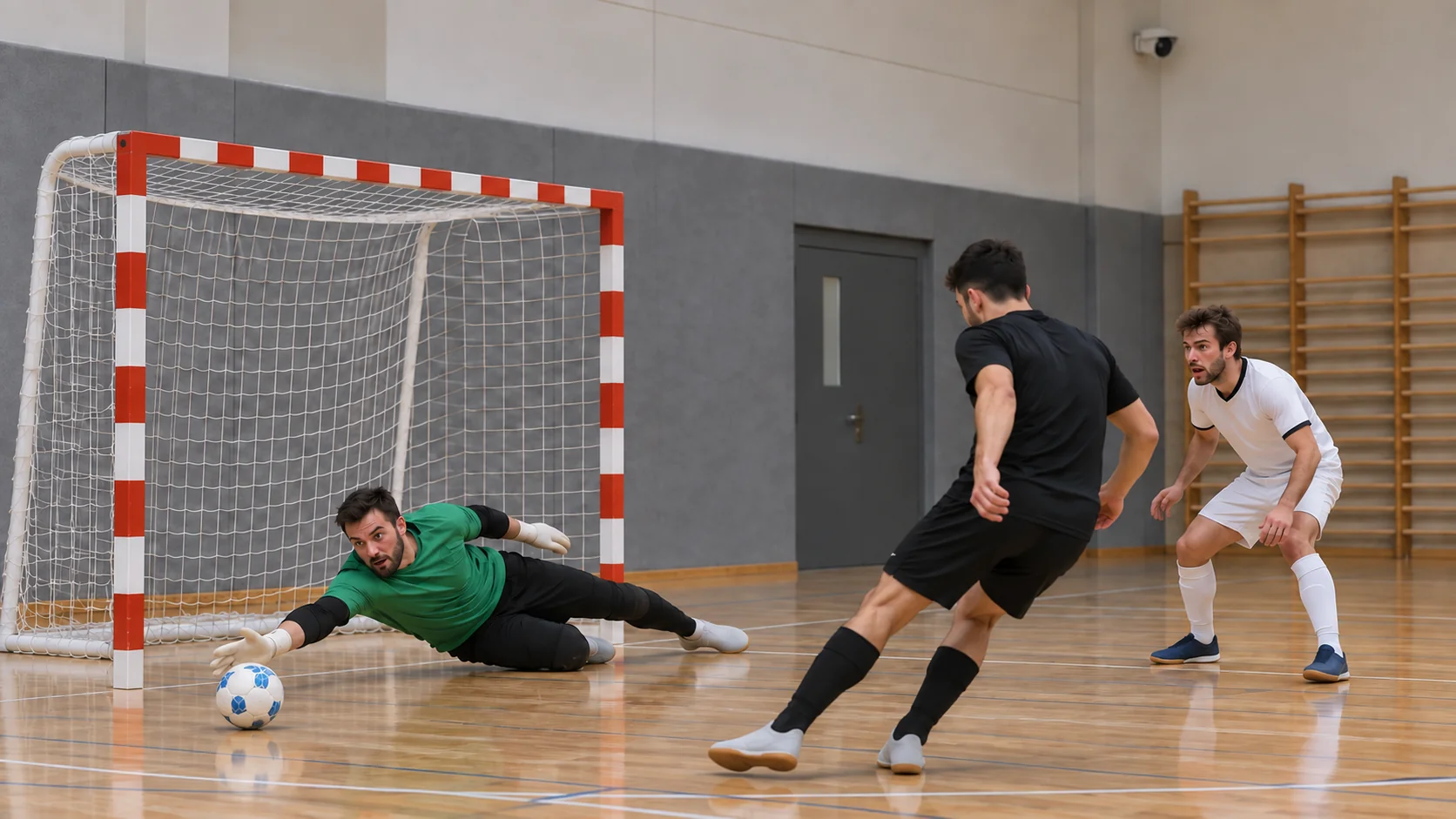
Everyone Plays, the Camera Stays Put
At a court with VISU Replay, the angle this guide describes is already set. Press the button after the goal or the save you want to keep, and the clip is there when you walk off.
FAQ
What Is the Best Camera Angle for Futsal?
The long side of the court, level with the halfway line, above head height, opposite the team benches, tilted slightly down and filming horizontally. It keeps both goals at a similar distance, shows the width where attacks are built and separates players who overlap at floor level.
Should I Film Futsal From Behind the Goal or From the Side?
From the side for a normal game. Behind the goal shows finishes and saves well and loses the other half of the court. Use it when the goalkeeper is the subject or for kicks from the marks.
How High Should the Camera Be for Futsal?
Clearly above head height, so the camera looks down on the players instead of across them. The first rows of the bleachers or a balcony along the long side usually do it. Very high positions show shape but lose faces, so they suit review more than sharing.
Which Side of the Hall Should I Film From?
The side where you can get height, then the side without the team benches, then the side that keeps windows behind the camera. Substitutions cross the frame all game on the bench side, and daylight from the far side turns players into silhouettes.
Is a Tripod Worth It for Futsal?
Only if it gets the camera onto something raised. A floor tripod stops at roughly the height of the person who set it up, where players overlap, and it stands in the path of the ball. A small tripod on a bleacher step or a clamp on a rail gives the height that matters.
Should I Raise the Frame Rate or the Resolution for Futsal?
Frame rate, usually not: stay at 30fps unless the hall is genuinely well lit, because a higher rate means less light per frame and darker footage indoors. Resolution is a trade-off: more of it leaves room to crop later, and it costs storage and heat on a phone recording a full game.