

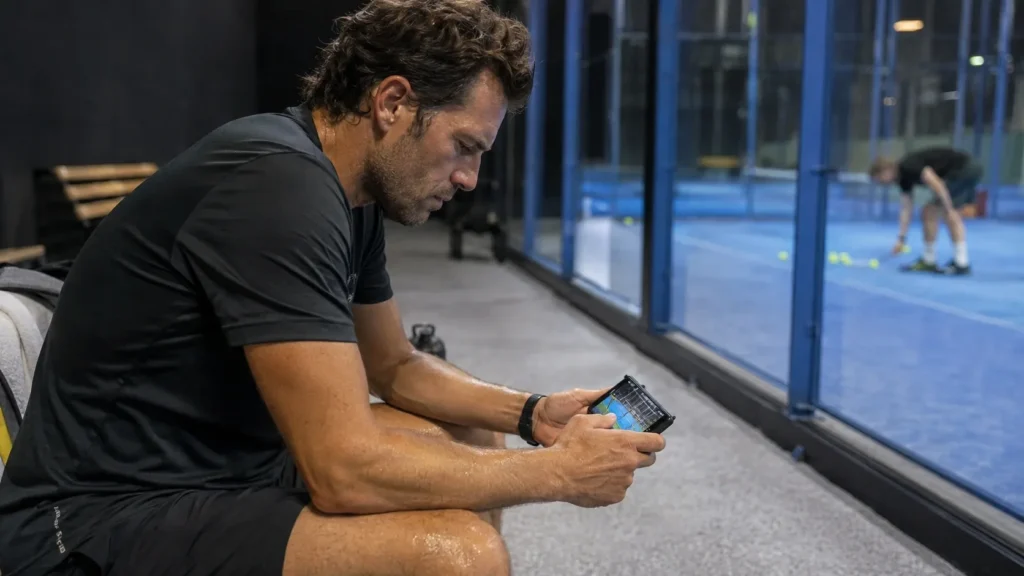
Watching your own padel match is not the same as watching padel. The professional match teaches you what the sport looks like at its ceiling. Your own match teaches you what your partner does when the ball goes behind them, and whether you actually moved after that drive or just watched it. Those are different lessons, and only one of them changes what you do on Thursday.
This page is about the second kind: how to review a match you played, what to look for in a court where two people share four walls, and how to stop after twenty minutes with something you can practice instead of a vague sense that you should have been better.
The Footage Has to Exist Before You Can Review It
At a court with VISU Replay, the cameras run through the whole match and the clip is waiting when you sit down. Nobody has to stand behind the glass holding a phone.
What You Are Actually Watching For
The first time most players watch themselves, they watch the ball. It is the moving thing, it is what the eye follows during the point, and it is almost the least useful thing on the screen. You already know where the ball went. You were there.
What you do not know is where you were standing when it got there. Padel punishes position more than it punishes technique, and position is exactly the thing your memory of the match does not contain. You remember hitting the ball. You do not remember that you were a meter inside the service line with your partner three meters behind you, which is why the lob that followed was unplayable.
So the review has a different subject than the match did. During the point you track the ball. During the review you track the two players on your side of the net, and you let the ball leave the frame.
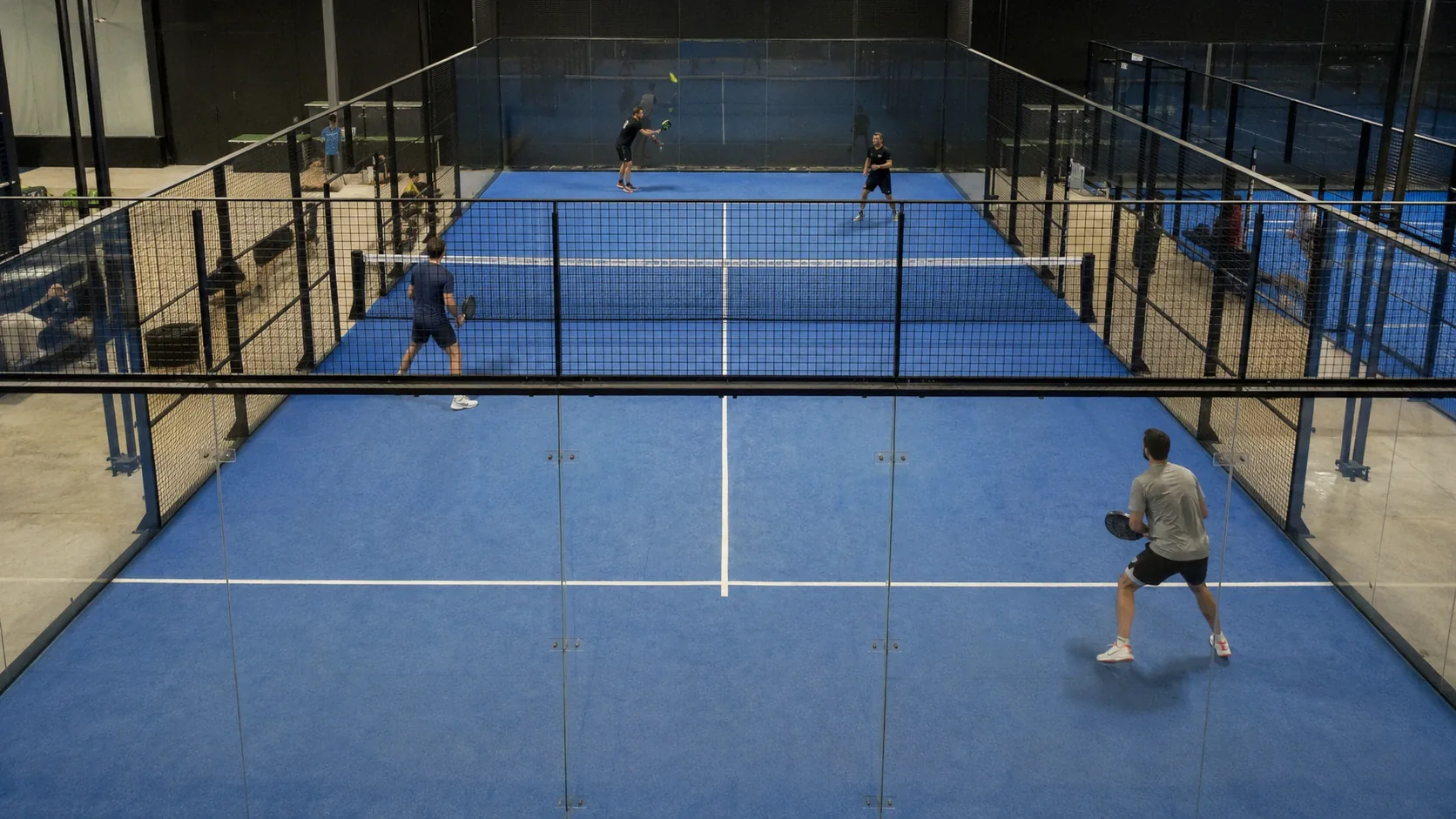
There is a practical consequence of this: the camera angle matters more for review than it does for highlights. A clip filmed from the side of the court looks fine and tells you almost nothing about depth. The angle that shows position is the one from behind the back glass, centered, high enough to see both pairs. The camera angle for padel covers why that position wins, and it is the same reason it is the angle worth reviewing from.
Court Position: The Thing the Camera Shows and You Cannot Feel
Watch a rally with the sound off and your eyes on the space between you and your partner. Three questions answer themselves in about four rallies.
Are you moving up together? Padel is a game of two players advancing as a unit. On video, a pair that arrives at the net together looks like a line moving forward. A pair that does not looks like one player at the net and one stranded in the middle of the court, which is where the ball is about to land.
Do you retreat after the smash? Most amateur pairs hit a smash and stay where they are, because the smash felt good. The video shows the lob coming back over the top of both of you a second and a half later. You cannot feel that happening. You can see it every time.
Where do you stand when your partner hits? This is the one nobody watches for and the one that changes the most points. If both players drift towards the same side, the court opens. The video makes the open half obvious because it is the empty part of the frame.
Four subjects, one stretch. In the focused part of the review, watch the same rally with your eyes on a different thing each time: you, your partner, the gap between you, the opponents. Ninety seconds, four times, beats twelve rallies watched once each with your eyes following the ball.
The Wall Is Where Reviews Get Useful
Every padel player has a wall problem, and almost nobody knows which one theirs is. The ball comes off the glass differently depending on how it arrived, and the difference between a player who reads it and one who does not is entirely about the half second before the bounce.
On video, wall errors have a signature you can spot without knowing anything technical. The player turns to face the wall. That is it. If you are turning your body towards the glass to wait for the ball, you have already lost the point most of the time, because you are now facing away from the net with your weight going backwards.
The players who handle the wall well do the opposite, and it looks strange in slow motion: they move away from where the ball is going to be, open their body towards the net, and let the ball come to them. Watch four wall balls in your own match and count how many times you turned to face the glass. That number is a training plan by itself.
You Cannot Review What Nobody Filmed
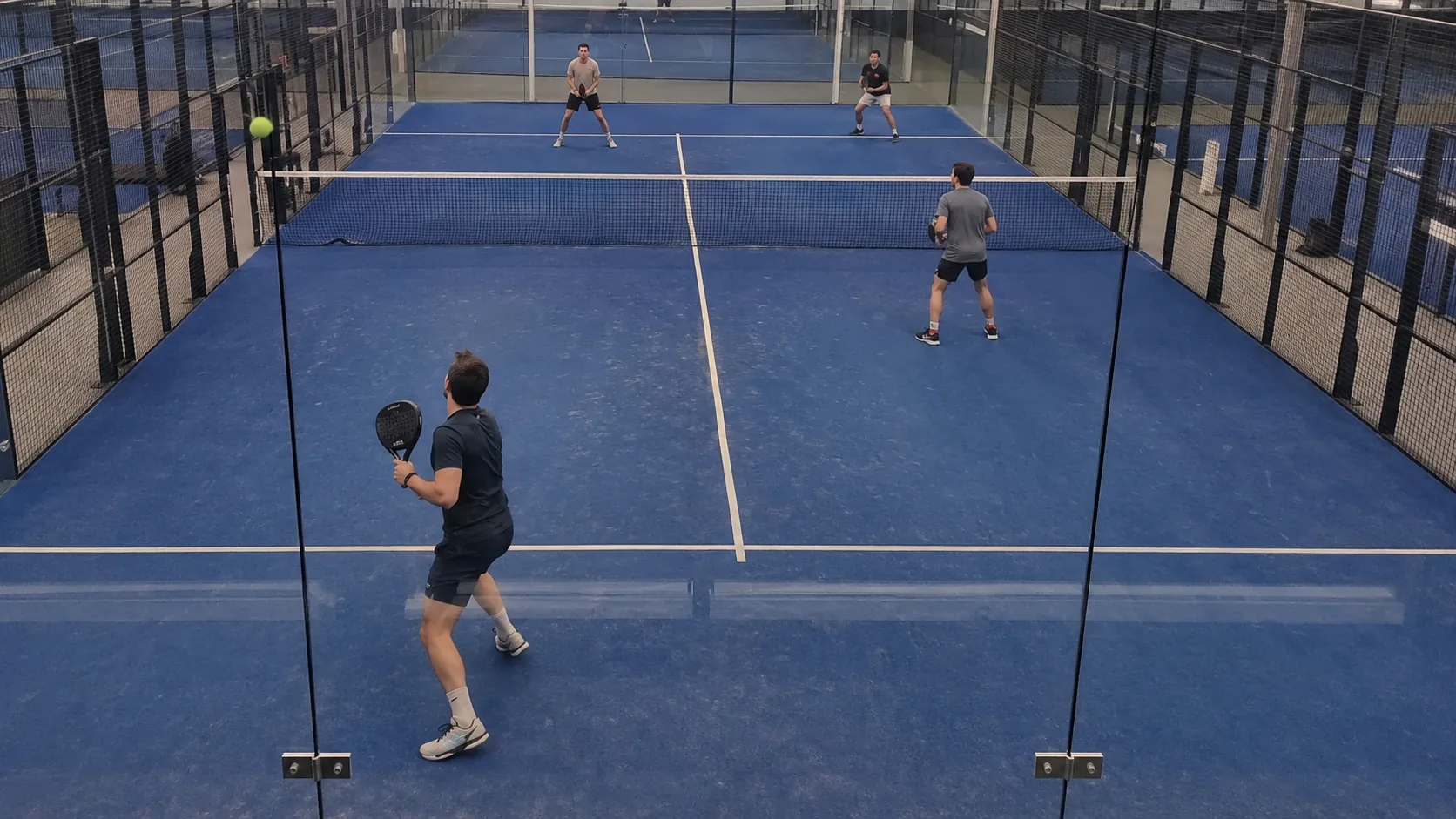
The reason most amateur review never happens is that somebody has to give up playing to hold the phone. VISU Replay records the court itself, so the match is already there when it ends.
Watching the Player You Are Not
Padel is the only racket sport most amateurs play where half the review is about somebody else. Your partner's position determines what shots are available to you, and their recovery determines whether the next ball is a problem.
The useful frame here is not judgment, it is prediction. Watch four or five points and ask what your partner does by default: do they lob under pressure or drive? Do they cover the middle or the line? Do they step back when the ball goes over their head, or turn and chase it?
Once you know the default, you can position for it instead of reacting to it. That is a review outcome that costs your partner nothing and requires no conversation about who made which mistake.
Three Times Is a Pattern, Once Is a Story
The single most common review mistake is fixing the memorable point instead of the frequent one. You will remember the smash you put into the bottom of the net at 4-4. It was one point. Meanwhile you lost the middle of the court eleven times and never noticed, because none of those moments felt like anything.
So the rule is a counting rule. Something that happens once is a story you will tell at the bar. Something that happens three times in a match is a pattern, and patterns are the only thing worth taking to the next session.
This is also why a review of a full match beats a review of highlights. A highlight reel is a collection of the memorable, which is by definition the unusual. The repeated error never makes the highlight reel, because nothing about it stands out. What makes a clip worth keeping is a different question from what makes footage worth reviewing, and it is worth not confusing the two.
How Long a Review Should Take
Twenty minutes, within about two days of playing, split the same way every time. This is the same structure that works for reviewing a football match, and it holds for padel because the failure it prevents is identical.
First pass, about eight minutes, without pausing. Watch at speed and resist the urge to stop. You are looking for rhythm and for the moments where the point went wrong before the error, not for a frame to freeze. Flag one stretch to come back to.
Focused rewatch, about eight minutes. This is where padel differs from football, because there are only two of you and the useful lens is the pair. Take the stretch you flagged and watch it more than once with a different subject each time: you, your partner, the space between you, then the opposing pair. Four viewings of ninety seconds is faster than twelve rallies watched once each with your eyes on the ball.
Write down two or three things, in the same format every week. Where you were standing when the ball arrived, the option you did not see, and the mistake that appeared more than once. The writing is not ceremony: an unwritten finding is one you will not remember on Thursday, and the repeated format is what lets you notice that the same line keeps appearing.
Longer does not work, for a reason that has nothing to do with discipline. After about twenty minutes you stop looking for patterns and start collecting grievances, and the review turns into a list of everything you did badly. That list is too long to act on, so it produces no change and a worse mood.
The timing matters as much as the length. Review the same evening and you are still inside the emotion of the match, which makes you generous about the points you won and brutal about the ones you lost. Wait a week and you no longer remember what you were trying to do, so the footage is just video of two people you half recognize.
Twenty Minutes, Two Days Later
Clips from a VISU Replay court are on your phone when you leave, so the review happens while the match is still fresh instead of never.
Reviewing With Your Partner Without Starting a Fight
Reviewing with your partner is better than reviewing alone, and that is not just a preference. The research on video feedback in sport was largely conducted with the video paired with conversation rather than watched in silence, which is one reason the same recommendation appears for football. In padel it applies with more force, because your positioning is only meaningful relative to the person next to you. Half of what you need to see is a two-player shape, and one player looking at it alone is guessing at the other half.
What it needs is a rule, because two people watching a match they lost together goes wrong in a predictable way: both players watch for evidence about whose fault it was. Everybody finds their evidence, because in a four-player sport there is always a second cause.
The rule that works is narrow. Each player talks about their own position, not the other one's shot. You are allowed to say where you were standing and what you should have done. You are not allowed to narrate what your partner should have hit. It sounds artificial for about five minutes and then it becomes the reason the review is still happening in a month.
If you share clips in a group, the same rule applies with more force, because tone does not survive a group chat. A clip posted with "look at this" reads differently to the person in it than it did in your head. Sharing clips in your team group covers the etiquette of that in more detail.
FAQ: Reviewing Your Padel Match
How much of the match should I watch?
About twenty minutes, split into three parts: roughly eight minutes of a first pass without pausing, eight minutes rewatching the one stretch you flagged, and a few minutes writing down two or three findings. Twenty minutes is roughly the point where attention stops finding patterns and starts collecting complaints, which is why the limit matters as much as the structure.
What should I be watching if not the ball?
The position of the two players on your side of the net. Padel punishes position more than technique at amateur level, and position is the part your memory of the match does not contain. Watch whether you and your partner move up together, whether you retreat after a smash, and where you stand while your partner is hitting.
Should I review a match I won?
Yes, and it is often more useful. A win hides its own errors, because the scoreline suggests everything worked. The repeated positional mistake that cost you four points is still there in a match you won 6-3, and it will cost you the match against a pair that punishes it.
Is the camera angle important for reviewing?
More than for highlights. A side angle looks fine and hides depth, which is the thing you are trying to see. The angle from behind the back glass, centered and high enough to show both pairs, is the one that makes court position readable. That is the same angle that works for clips, for the same underlying reason.
How soon after the match should I do it?
Within about two days. Review immediately and you are still inside the emotions of the match, which distorts what you notice. Wait a week and you no longer remember what you were trying to do on each point, so the footage loses the context that makes it useful.
Should I review alone or with my partner?
With your partner, and in padel more than in most sports, because your positioning only means anything relative to the person next to you. The rule that keeps it useful is narrow: each player talks about their own position rather than the other player's shots. You describe where you were standing and what you should have done differently; you do not narrate what your partner should have hit. It feels artificial for a few minutes and it is the reason the habit survives past the first session.