
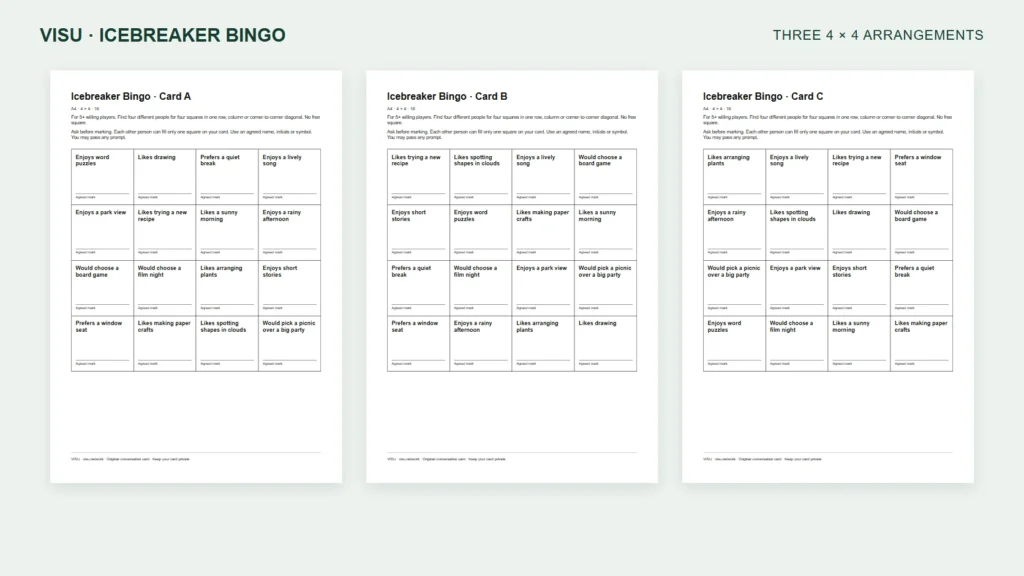
Print a card, ask a light question and look for a shared interest. These three icebreaker bingo cards use the same 16 optional prompts in different positions. A complete line needs four different people, so the game is about conversations rather than guessing facts about someone.
Share the Gathering Details
Use VISU Link to collect your public meeting details and the activity pages you want participants to find.
Download Cards A, B and C
Choose A4 or US Letter to match your paper. Each download is a one-page static PDF with a 4×4 grid, the rules and space for agreed marks. There is no registration step. Cards A, B and C contain the same prompts, rearranged; they are not three different question banks.
Mix the card letters when distributing copies. It is fine to print more than one copy of each arrangement for a larger group. Check your printer preview and make sure the text and marking lines remain readable before printing the whole set.
| Arrangement | A4 PDF | US Letter PDF |
|---|---|---|
| Card A | Download A4 | Download US Letter |
| Card B | Download A4 | Download US Letter |
| Card C | Download A4 | Download US Letter |
Explain the Rules Before Handing Out Cards
Use the line game with at least five willing players: each player needs four other people for a winning line. This is a requirement of the one-person-per-card rule below, not a claim about the ideal group size. With fewer people, use the prompts for an unscored conversation instead.
- Give each player one card and a pencil.
- Ask another willing player about a prompt before marking it.
- Each other person may fill only one square on your entire card; you cannot fill your own squares.
- Use an agreed name, initials or symbol, and allow anyone to pass.
- Call bingo after four confirmed squares form a row, column or full diagonal; pause for the host check.
Use the 16 Light Prompts
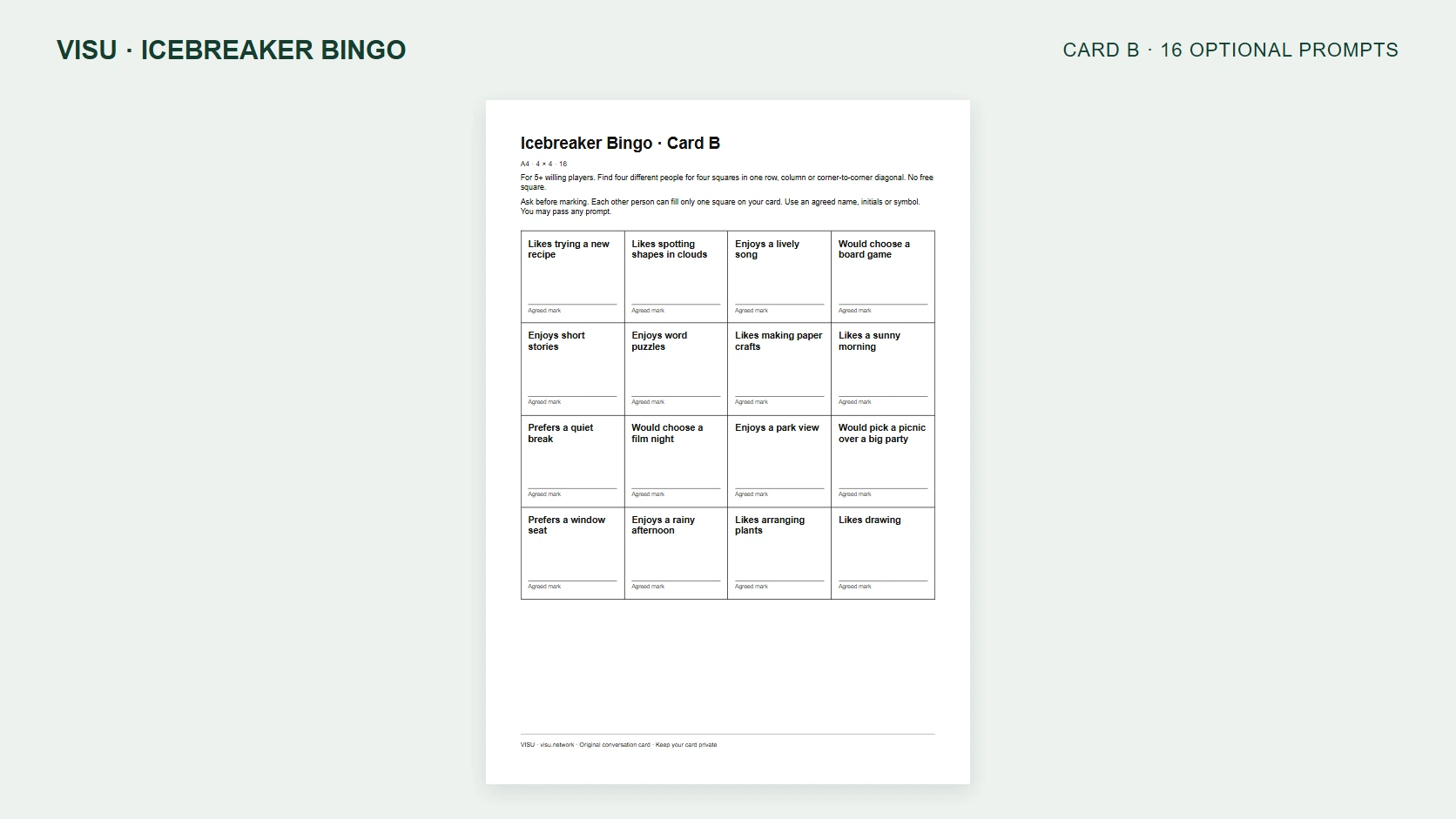
The prompts are everyday preferences, not a test of identity or achievement. Ask a question such as “Do you enjoy word puzzles?” and let the other person decide whether it fits. A person can say yes, no or pass without explaining.
Use an agreed first name, initials or a symbol in a matching square. Choose marks you can distinguish if people share initials. Do not fill a square by guessing from someone’s appearance or by copying a name from another card. If you want a different conversation format afterwards, try conversation topics.
The prompts on every card
- Enjoys word puzzles
- Likes drawing
- Prefers a quiet break
- Enjoys a lively song
- Enjoys a park view
- Likes trying a new recipe
- Likes a sunny morning
- Enjoys a rainy afternoon
- Would choose a board game
- Would choose a film night
- Likes arranging plants
- Enjoys short stories
- Prefers a window seat
- Likes making paper crafts
- Likes spotting shapes in clouds
- Would pick a picnic over a big party
Keep the Activity Links Together
Add the printable page and any other public resources to VISU Link. Keep marked cards and participant answers private.
Check a Four-Square Line
A line is four marked squares in one horizontal row, one vertical column or one of the two corner-to-corner diagonals. Four scattered squares or the four corners alone do not count. There is no free middle square on these 4×4 cards.
When someone calls bingo, pause. The host checks that the four marks belong to four different other players and that each match was agreed. Do not ask anyone to prove a preference or give extra personal details to the room. If a mark needs correction, let the player fix it or continue the round.
K20 Center’s Human Bingo describes finding matches through conversation and using different card variations. These are original 4×4 cards with the four-square rule explained here; they do not use K20’s card text or its five-square victory rule.
Offer a Seated or Spoken Version
Moving around is optional. Players can remain seated while willing conversation partners rotate, or talk in a small circle. Someone may read the prompts aloud or write an agreed mark for another player. The four-person line rule stays the same.
A prompt can be skipped. Do not replace a skipped preference with a question about health, income, faith, immigration or another sensitive topic. Agree on a calm way to pass before starting. Keep completed cards with their players instead of posting names or answers on a public page.
For a group that wants an activity without printouts, our guide to games without equipment offers a separate set of ideas.
End the Round Without Pressure
Agree when to stop and whether the group wants to recognize the first checked line or simply finish a conversation round. You can choose a short time window as an organizer, but no duration guarantees that someone will find a line. There is no fee, wager or cash prize in this version.
If nobody completes a line, close the activity at the agreed point. Invite an optional comment about a pleasant conversation, not a public report of another person’s answers. Participants can keep or discard their cards.
Before reusing the activity, ask whether any wording was unclear and adjust your own copy for the group. Keep the participation choices and the matching rule clear rather than adding pressure to fill every square.
Plan the Next Conversation
Share the next activity choice and public event information through VISU Link.
Frequently Asked Questions
How many files are available?
This page has six PDFs in English: cards A, B and C, each in A4 and US Letter. Each file contains one static printable page.
Are the three cards different?
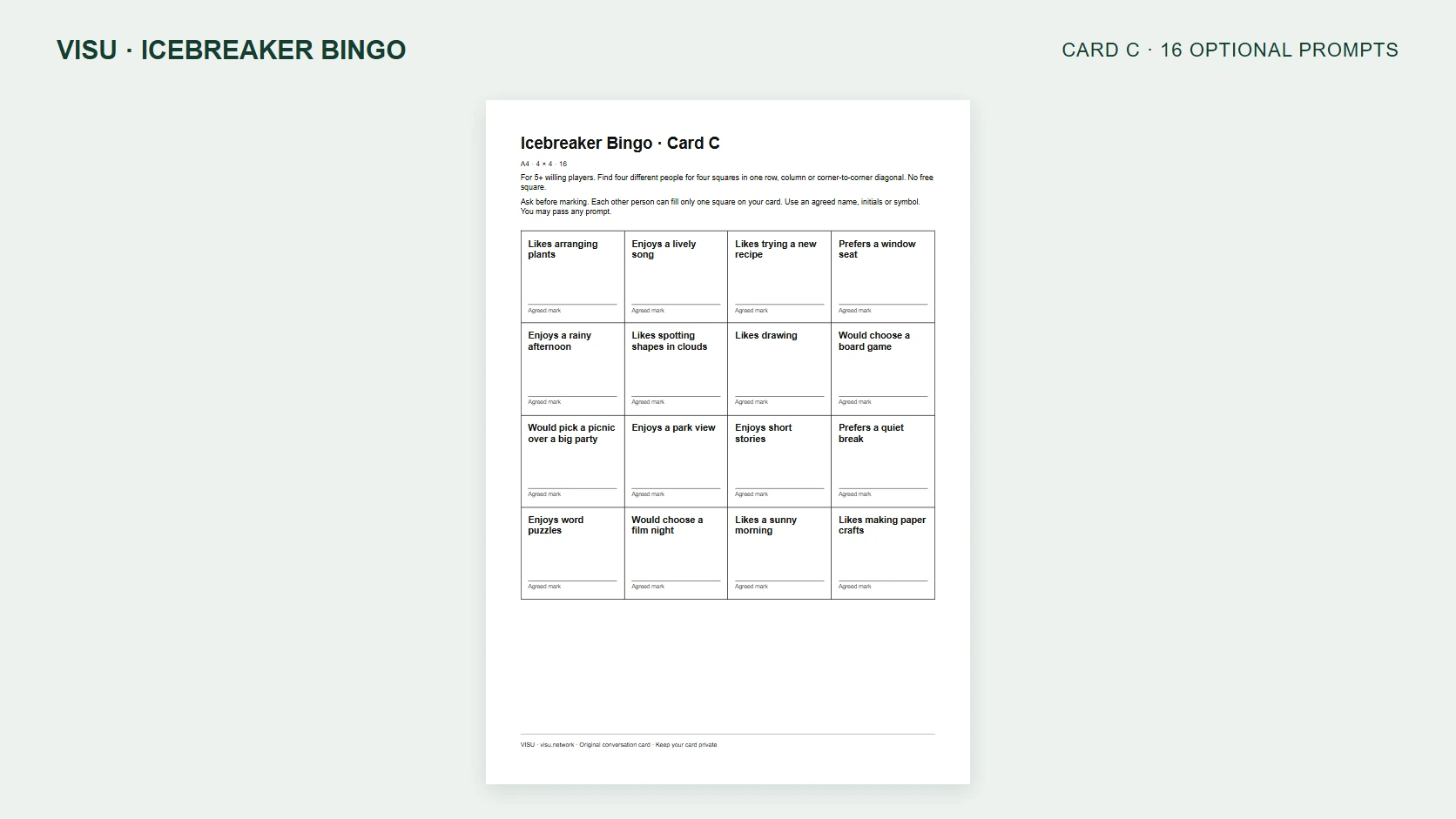
The positions differ, but all three contain the same 16 prompts. You can print repeated copies of A, B and C for a larger group.
What counts as bingo?
Four agreed matches in a horizontal row, vertical column or full corner-to-corner diagonal. Each match must be a different other player. There is no free square.
Can the same person fill several squares?
No. In this version, each other person can fill only one square on your entire card, even if several prompts fit them. You cannot use yourself.
How many players do we need?
At least five willing players for the line game, so each can find four other people. Smaller groups can use the prompts without scoring a line.
Do players have to move around or answer every prompt?
No. Use a seated or read-aloud version, and let anyone pass without explanation. Mark a square only when the other person agrees.