
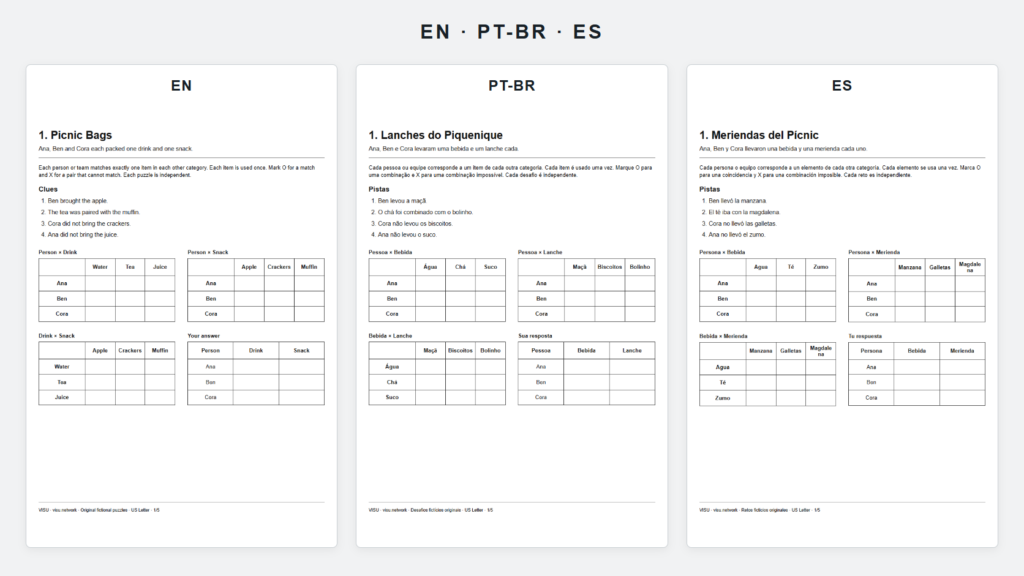
Match people or teams with two other categories using four clues per puzzle. These four original 3×3 logic grid puzzles are independent, and each has one complete solution. Use the blank grids below or download a five-page packet: four puzzle pages followed by the answer key.
Keep the Puzzle Links Together
VISU Link can collect this public puzzle page and other resources for your gathering.
Download the Puzzle Packet
- Download A4 PDF · 5 pages / 87 KB
- Download US Letter PDF · 5 pages / 87 KB
Both paper sizes contain the same four puzzles and answers in English. Choose the size your printer uses. The files are static PDFs with blank grids; write on a printed copy or use your own PDF annotation tool. The answer key is on page 5, so keep that page separate if you are handing the puzzles to someone else.
Preview the print settings before printing. A4 and US Letter have different dimensions; select the matching file and check the page preview for margins. No account is required to use the download links on this page.
How the Matching Grids Work
Each category has three items. Every person or team gets exactly one item from each other category, and every item is used once. There are no shared drinks, duplicate book positions or simultaneous time slots within a puzzle.
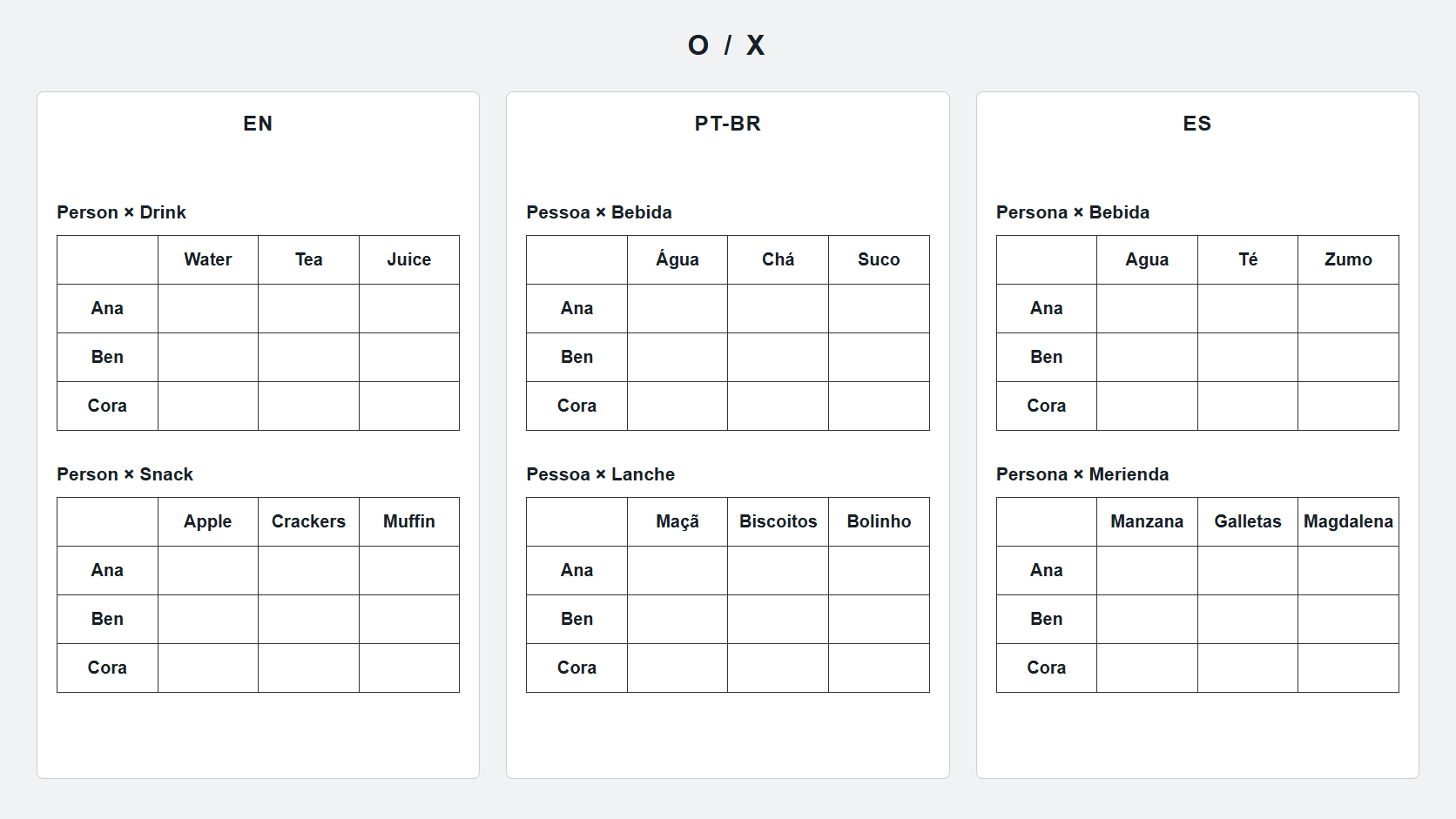
- Mark O where two items match and X where a clue rules out a match.
- An O removes the other possibilities in that row and column.
- Use the third grid to connect the two non-person categories, such as drink and snack.
- When a row or column has one possibility left, check it against every clue.
- Fill the three-column answer table after the matches are settled.
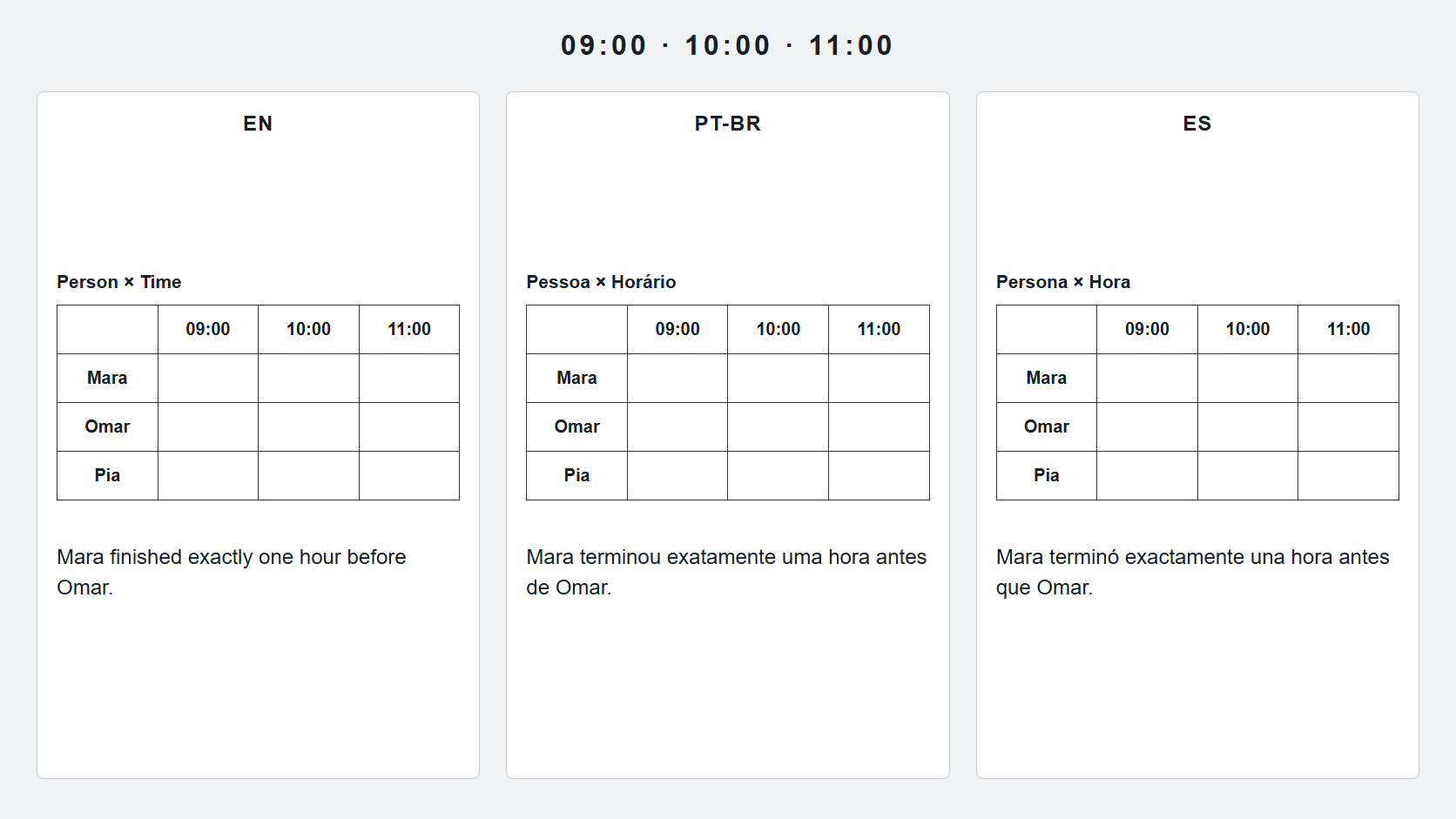
A clue can connect items directly or rule out a pair. In the morning puzzle, “exactly one hour before” uses the three printed times, not an unspecified earlier time. Cambridge’s NRICH resources similarly encourage explaining why a grid entry must be correct; the puzzles here use their own fictional settings and clues.
If your group would rather answer spoken knowledge questions, choose a separate round from general trivia questions for adults. These grids are deduction tasks, so all the information needed is in the categories and clues.
1. Picnic Bags
Ana, Ben and Cora each packed one drink and one snack.
Clues
- Ben brought the apple.
- The tea was paired with the muffin.
- Cora did not bring the crackers.
- Ana did not bring the juice.
Person × Drink
| Water | Tea | Juice | |
|---|---|---|---|
| Ana | |||
| Ben | |||
| Cora |
Person × Snack
| Apple | Crackers | Muffin | |
|---|---|---|---|
| Ana | |||
| Ben | |||
| Cora |
Drink × Snack
| Apple | Crackers | Muffin | |
|---|---|---|---|
| Water | |||
| Tea | |||
| Juice |
Your answer
| Person | Drink | Snack |
|---|---|---|
| Ana | ||
| Ben | ||
| Cora |
Share the Blank Packet
Link to the public packet page or an external folder you already use. Keep the answer-key page separate when you hand out the puzzles.
2. Library Display
Ivo, Lia and Nuno each placed one book on one of three stands.
Clues
- The atlas was on the left stand.
- Nuno used the middle stand.
- Ivo did not bring the stories book.
- Ivo did not use the left stand.
Person × Book
| Atlas | Poems | Stories | |
|---|---|---|---|
| Ivo | |||
| Lia | |||
| Nuno |
Person × Stand
| Left | Middle | Right | |
|---|---|---|---|
| Ivo | |||
| Lia | |||
| Nuno |
Book × Stand
| Left | Middle | Right | |
|---|---|---|---|
| Atlas | |||
| Poems | |||
| Stories |
Your answer
| Person | Book | Stand |
|---|---|---|
| Ivo | ||
| Lia | ||
| Nuno |
3. Morning Helpers
Mara, Omar and Pia each completed one task at a different time.
Clues
- Mara finished exactly one hour before Omar.
- The plants task was completed at 09:00.
- Pia finished at 09:00.
- Mara did not do the signs task.
Person × Task
| Signs | Plants | Chairs | |
|---|---|---|---|
| Mara | |||
| Omar | |||
| Pia |
Person × Time
| 09:00 | 10:00 | 11:00 | |
|---|---|---|---|
| Mara | |||
| Omar | |||
| Pia |
Task × Time
| 09:00 | 10:00 | 11:00 | |
|---|---|---|---|
| Signs | |||
| Plants | |||
| Chairs |
Your answer
| Person | Task | Time |
|---|---|---|
| Mara | ||
| Omar | ||
| Pia |
4. Game Tables
Teams Amber, Blue and Coral each played one game at a different table.
Clues
- Team Coral played cards.
- Dominoes were played at the table by the plant.
- Team Blue did not play dice.
- Team Coral did not use the table by the door.
Team × Game
| Cards | Dominoes | Dice | |
|---|---|---|---|
| Amber | |||
| Blue | |||
| Coral |
Team × Table
| Window | Door | Plant | |
|---|---|---|---|
| Amber | |||
| Blue | |||
| Coral |
Game × Table
| Window | Door | Plant | |
|---|---|---|---|
| Cards | |||
| Dominoes | |||
| Dice |
Your answer
| Team | Game | Table |
|---|---|---|
| Amber | ||
| Blue | ||
| Coral |
Check Your Answer Without Guessing
Read your completed rows back against all four clues. Check that every item appears once in its category. A table that satisfies one clue but repeats an item is not complete.
If you get stuck, return to a direct match before trying a negative clue. Say what each mark means: “this pair is impossible because…” Keeping a short reason beside an X can help you find an earlier mistake.
The final PDF page gives all four answer tables and short explanations. Each puzzle was checked across every possible one-to-one assignment, with a separate exhaustive checker confirming the same single solution. This checks the puzzle and answer key; it is not a claim about how quickly a particular person will solve it.
For a change of format after finishing, try funny riddles. Keep answers covered until the players are ready to compare their reasoning.
Save the Next Activity
Add your next activity link and public meeting details to VISU Link so the group can find them again.
Frequently Asked Questions
How many puzzles are in the download?
Four independent puzzles, each with three categories of three items and four clues. The packet has five pages: four puzzle pages and one answer-key page.
Does each puzzle have only one solution?
Yes. All one-to-one assignments were checked, and a separate exhaustive checker found the same single solution for every puzzle.
What do O and X mean?
O marks a pair that matches. X marks a pair that cannot match. Each item matches exactly one item in each other category.
Are the PDFs fillable forms?
No. They are static printable PDFs. You can write on a printed copy or use your own PDF annotation tool.
Which paper size should I download?
Use A4 for A4 paper or US Letter for Letter paper. Both files contain the same puzzles and answers; check the print preview and margins.
Where is the answer key?
Page 5 of each packet contains the completed tables and short reasoning. Keep that page separate while solving the first four pages.