

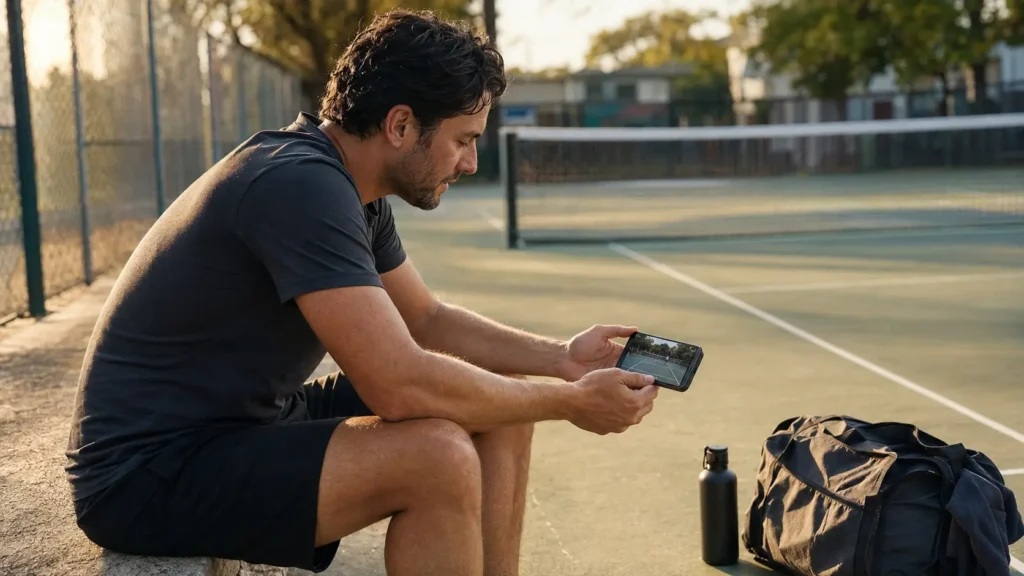
I spent about a year convinced I knew what my game looked like. Then somebody filmed a match I played and I watched it back that evening, and the gap between the two was uncomfortable. Not because I played badly. Because almost nothing was where I remembered putting it.
What follows is not a training programme. It is an honest look at what actually changes when you start watching yourself play, what the research says about why it works, and the specific way it fails for most people who try it.
The Part That Surprised Me
The obvious errors were not the interesting ones. I already knew about those. What I did not know was that I was standing about two metres deeper than I thought for most of the match, which explained a category of late arrival I had been blaming on fitness for months.
That is the thing nobody warns you about. You do not discover that you are worse than you thought. You discover that your internal picture of your own movement is a rough sketch, and that some of the things you have been trying to fix were never the problem.
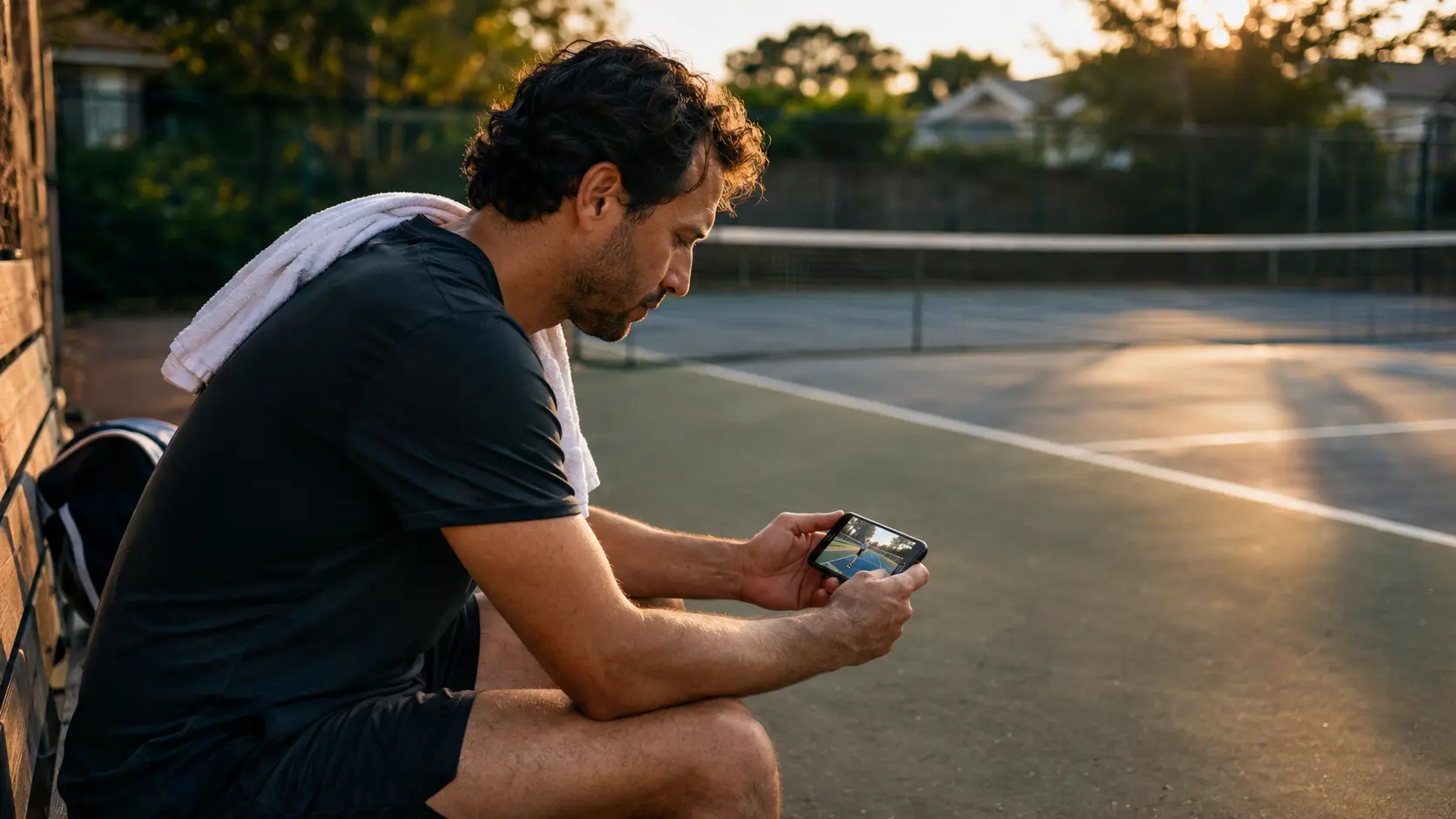
A friend I sent it to had the opposite reaction, which is worth recording because it is more common: he watched thirty seconds, said "I look terrible", and never asked to be filmed again. That reaction is not vanity. It is what happens when you watch yourself with no idea what you are supposed to be looking at.
What the Research Actually Found
Video feedback in sport has been studied for decades, mostly in schools and structured coaching rather than at amateur level, and the findings are more specific than "watching yourself helps".
A systematic review of video-based visual feedback in physical education screened 2,030 studies and found 11 that met its quality criteria. The conclusion was that video feedback does appear to improve motor learning, and appears more effective than verbal feedback alone. That is a real finding and it is the reason this is worth doing at all.
But the same review contains the caveat that matters most for anyone doing this without a coach. In ten of the eleven studies, the video came with verbal feedback pointing out the main errors and key points. The video was not doing the work by itself. It was giving somebody something concrete to point at.
The review goes further and notes evidence that self-modelling without verbal feedback may be ineffective, and that identifying your own errors is more achievable for advanced learners than for beginners. Which lines up uncomfortably well with my friend watching thirty seconds and concluding only that he looked bad.
Watching It Usefully
The fix is unglamorous: decide the question before you press play. One question per session, chosen before you watch, and everything else deliberately ignored.
Questions that produce something you can act on:
- Where am I standing when the play starts? Position is the most common gap between what players believe and what happens, and it is the easiest to see on video.
- What am I doing when the ball is not near me? Usually more revealing than anything you do on the ball, and almost never remembered.
- What happens immediately after I lose it? The recovery habit is invisible from inside the match and obvious from outside.
- Am I doing the thing I told myself to do? Set the intention before the match, then check the footage. This is the only version that gives you a clean answer.
What does not work is watching the whole match hoping something jumps out. It will not. You will notice the goals, feel briefly good or bad, and learn nothing you can take to the next session.
The practical form of this is short. Two or three clips of the same situation, watched with one question, beats forty minutes of footage watched with none. Which is also why clip quality matters more than people assume, covered in what makes a good sports clip.
Where It Goes Wrong
Three failure modes, all of which I have either done or watched somebody else do.
Filming instead of playing. Somebody has to hold the phone, so somebody is not in the game. In an amateur match that person is usually the one who most wanted the footage, and the trade rarely feels worth it after a few weeks.
This is the practical reason the habit dies, and it is worth being clear that it is a logistics problem rather than a motivation problem. The people who keep doing it are the ones who removed the person holding the phone from the equation, which is what fixed cameras at a venue do and what a friend on the sideline does not.
Watching for judgement instead of information. There is a version of this where you are not analysing, you are marking yourself. It feels productive and produces nothing except a worse mood, and it is the version most people default to on their first watch.
Confusing the highlight with the lesson. The clip worth sharing and the clip worth studying are almost never the same clip. Your best moment teaches you very little. The play where you arrived a second late teaches you where you were standing.
So Does It Improve Your Game
Yes, with a condition attached, and the condition is doing most of the work.
Filming improves your game when the footage answers a question you asked in advance, and when somebody, even a teammate, helps you interpret what you are seeing. That is the setup the research supports. It is also, conveniently, the least effortful version: one question, a few clips, a two-minute conversation.
Filming does very little when you watch a whole match with no question, alone, hoping to spot something. And it actively costs you when the filming itself removes a player from the game.
What it changes fastest is not technique. It is the accuracy of your own self-picture, and that turns out to be the thing most amateur players are quietly wrong about. Once the picture is accurate, the training you were already doing starts pointing at the right problem.
If you are starting from nothing, the sequence that works is small: get one match recorded, pick one question, watch three clips, talk about it with somebody who was on the pitch. The wider practicalities of recording amateur sport are in the guide to filming amateur sports.
Get the Footage Without Anyone Sitting Out
The reason most players stop filming is that somebody has to hold the phone. Courts with VISU Replay record continuously, so you press a button after a play and the clip is already there. Nobody misses the game to capture it.
FAQ: Filming and Improving
Does watching yourself play actually make you better?
The research suggests yes, but mainly when the video is paired with someone pointing out key errors and reference points. A systematic review of video feedback in physical education found it more effective than verbal feedback alone, while also noting evidence that self-observation without any guidance may be ineffective. Watch with a specific question rather than watching for a general impression.
How much footage do I need to see a difference?
Far less than people expect. Two or three clips of the same situation, watched with one question in mind, is more useful than a full match watched passively. Long footage encourages scanning for highlights, which is the least informative way to watch yourself.
What should I look for the first time I watch myself?
Position when the play starts, and what you are doing when the ball is nowhere near you. Both are things players consistently misremember, both are easy to see on video, and both are fixable without changing technique. Leave technique for later watches.
Is it worth filming if I do not have a coach?
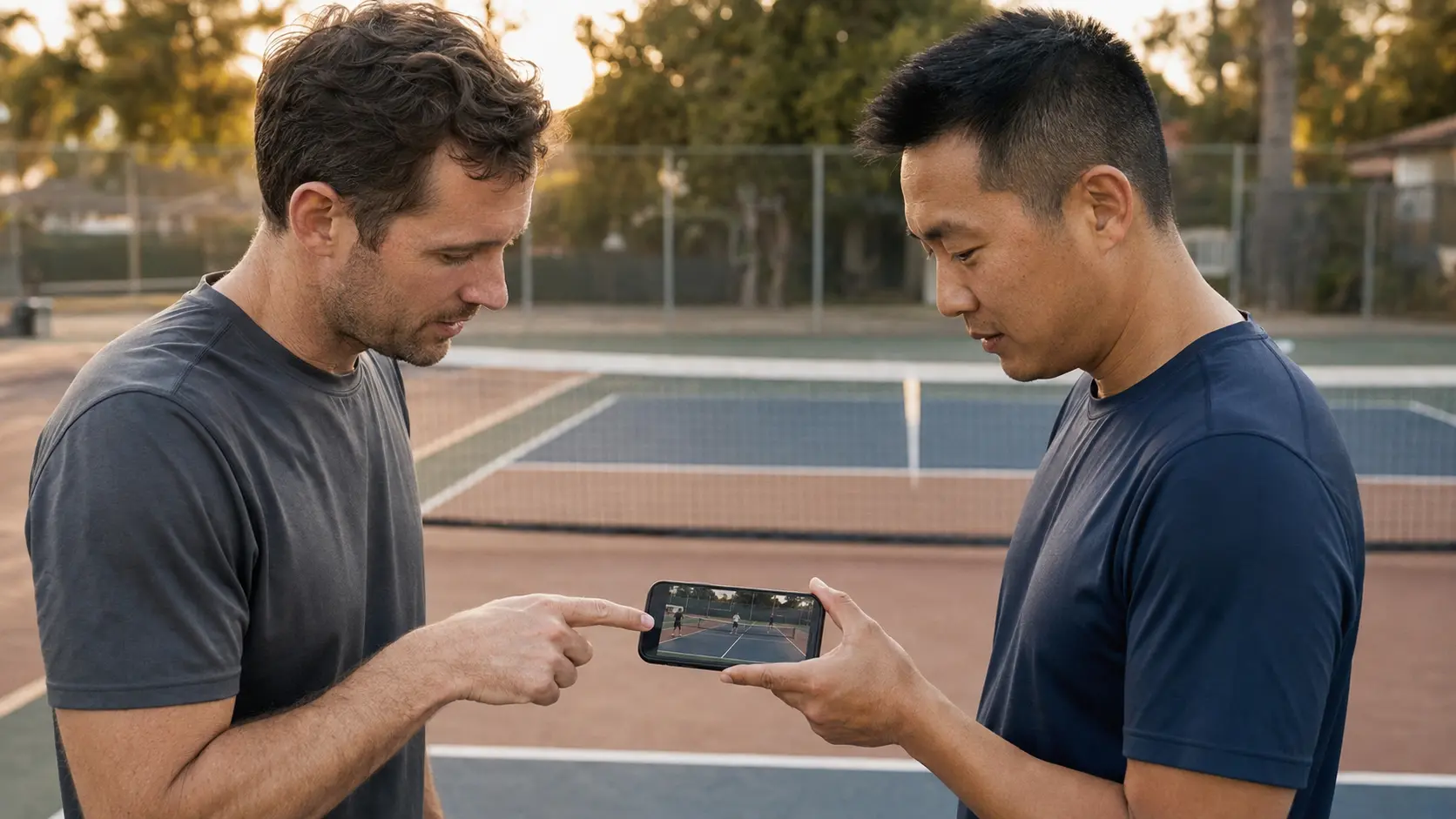
Yes, with an adjustment. The evidence points to guidance mattering more than the video itself, so replace the coach with a teammate who played the same match. Watching the same clip together and saying out loud what you each saw recreates most of the benefit the studies attribute to verbal feedback.
Why do I feel worse after watching myself play?
Because without a specific question, watching yourself becomes self-assessment rather than analysis. That reaction is very common on a first viewing and is the main reason people abandon the habit. Choosing one narrow question before pressing play changes what the footage feels like as much as what it teaches.
Should I film every match?
No. Filming every match usually means somebody is permanently not playing, and the footage piles up unwatched. One match every few weeks, actually reviewed, beats a full archive nobody opens. The exception is when recording happens automatically at the venue, since then it costs nobody a game.
References
- German Journal of Exercise and Sport Research — Video-based visual feedback to enhance motor learning in physical education: a systematic review
- The Role of Augmented Feedback on Motor Learning: A Systematic Review
- Frontiers in Psychology (2025) — Real-time feedback enhances motor learning and motivation in youth team sports