

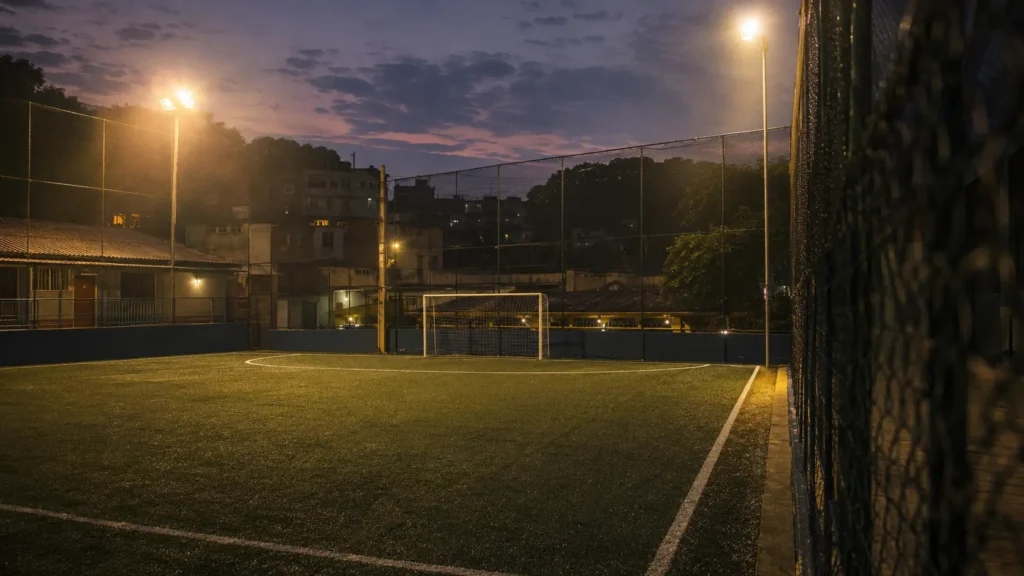
An empty court at seven on a Tuesday is almost never a pricing problem. Owners drop the hourly rate, fill the slot once, and watch it empty again the following month with a thinner margin. This guide covers what actually decides where amateur players go, why they stop coming back, and the changes that hold occupancy without cutting what you charge.
Most of it applies whether you run a five-a-side pitch, a padel club, a futsal court, a beach tennis complex or a multi-sport space. If yours is soccer, the soccer camera page is the specific version of the recording argument below. The mechanics of a regular weekly group are the same everywhere: people book with the same friends, at the same time, in the place that makes showing up easiest.
Give Players Something to Take Home
A venue with a camera gives every player a clip of their own game to share. It is the cheapest word of mouth there is, and it happens without anyone on your staff doing the marketing.
For court and venue owners.
Why a Court Sits Empty
There are only a few real reasons, and they call for completely different responses. Diagnosing the wrong one is what makes owners spend money without moving occupancy.
Nobody knows you exist. A visibility problem. The fix is being findable when someone searches for a place to play, which is mostly maps, reviews and local presence rather than advertising.
People came once and did not return. A retention problem, and by far the most expensive one. You already paid to acquire those players and got a single booking out of it.
They play, but only at peak hours. A distribution problem. Your Tuesday evening is full and your Thursday afternoon is dead. Discounting the peak slot does nothing for this.
They chose the venue down the road. A competition problem, and worth being honest about: something there makes showing up easier or better, and it usually is not the price.
Before changing anything, work out which of these you actually have. The rest of this guide assumes you know.
How Players Actually Choose
Amateur players are not comparison shopping. A group of friends picks a place once and then keeps going there until something breaks the habit. That means the decision is made rarely, by one person, under mild time pressure.
The organiser decides, not the group. Every weekly game has one person who books it. They are doing an unpaid admin job for their friends, and they optimise for not having hassle: easy booking, reliable court, no surprises. Make that person's life easy and you keep ten players.
Distance beats almost everything. A slightly worse court fifteen minutes closer wins most of the time. You cannot change your location, but it tells you who to market to: people near you, not people across the city.
Certainty beats quality. Players tolerate a mediocre surface far better than a booking that might not be honoured, lights that might be off, or a gate that might be locked. Reliability is a feature and it is cheaper than renovation.
Then, and only then, price. It matters at the margin, between two similar options. It rarely creates a decision on its own.

The Price Trap
Cutting the hourly rate is the fastest lever available and the one that damages the business most, because it is almost impossible to reverse. Raising a price back is a visible loss to the customer; lowering it was invisible gain.
The maths rarely works. A ten percent discount needs a meaningful jump in bookings just to stand still, and the bookings you gain from price are the ones most likely to leave for the next discount. You are buying customers who were never loyal to you.
It also resets your reference price. Players who book at the promotional rate treat that as the real price. Going back to the original feels like an increase, and some leave over it.
What to do instead: keep the rate and change what the hour includes. A better time slot, a guaranteed court, priority booking, or something the players take home with them. Retaining players without lowering price covers the specific alternatives.
Retention Beats Acquisition, by a Lot
A weekly group that stays for a year is worth vastly more than the same number of one-off bookings, and costs nothing to keep once it forms. Almost everything worth doing is about turning first visits into habits.
Help groups become regular. The transition from a one-off booking to a fixed weekly slot is where the value is created. Ask for it directly, offer the same time each week, and make the renewal automatic instead of something the organiser has to remember. Building regular teams and monthly members versus drop-ins both cover this.
Give them a reason to talk about you. Players recruit players. A group that grows finds its own replacements when someone drops out, which keeps the slot alive without you doing anything.
Give them something to take away. This is where a camera changes the equation. A player who leaves with a clip of their own goal shows it to people who do not yet play at your venue, and does it in the group chat where the next organiser is sitting. Whether replay cameras actually attract players looks at the honest version of that claim, and branding your venue in every clip covers making sure your name travels with it.
Notice when a group stops coming. Most venues find out months later. A group that misses two consecutive weeks is usually gone, and that is the moment a message still works.
Every Clip Carries Your Venue
When a player shares a moment from your court, your space is in it. VISU turns that into something structured: clips that travel with your venue attached, and a reason for the group to come back and make more.
For court and venue owners.
Filling the Hours Nobody Wants
Peak slots sell themselves. The business is decided in the hours around them, and those need a different audience rather than a lower price.
Daytime belongs to different people. Shift workers, retired players, students, remote workers and parents during school hours are all available when your evening crowd is not. They are a separate marketing problem, not a discount problem.
Recurring formats beat one-off bookings. A weekly tournament, a beginners' session or an open game that anyone can join fills a dead slot permanently once it establishes. Running a court tournament covers the format in detail.
Partnerships fill daytime reliably. Schools, youth academies and corporate groups book blocks at hours you cannot sell otherwise, and they book for months. Partnering with youth academies goes through how those deals usually work.
Events use the space differently. Birthdays, company days and small championships pay well for hours that would otherwise be empty, and each one brings people who have never seen your venue. Hosting events at your court covers the practical side.

Being Found in the First Place
Most people looking for somewhere to play search on their phone, look at a map, read a few reviews and pick. If you are not in that flow, nothing else in this guide matters.
Maps and reviews are the whole funnel. An accurate listing with real photos, current hours and recent reviews outperforms any advertising you could buy at this scale. Reviews specifically: a venue with recent ones looks open and cared for, and one with nothing from the last year looks abandoned. Google reviews for sports courts covers how to ask without being annoying.
Local presence beats reach. Your audience lives within a few kilometres. Spending on anything wider is spending on people who will never book. Local marketing for sports courts goes through what works at that radius.
Social media is proof, not advertising. Nobody follows a court for its posts. They check the profile to see whether the place looks alive before booking. That means recent photos of actual games matter more than designed graphics. Instagram for sports courts covers the version that works, and player clips solve the content problem better than anything you produce yourself.
The full first-contact playbook is in how to attract players to your court.
What to Measure
Most venues track revenue and nothing else, which tells you what happened but never why. Three numbers explain almost everything.
Occupancy by hour and day, not overall. An overall figure hides the pattern you need to act on. The point is knowing which specific slots are dead. Measuring court occupancy covers doing this without a management system.
How many groups return after a first booking. This one number tells you whether your problem is acquisition or retention, and it changes what you should spend money on.
How long a regular group lasts. If groups last four months, the business is a leaking bucket and more marketing will not fix it. If they last two years, acquisition is the right investment.
Once clips are part of the venue, there is a fourth: how often players share them, and what that brings back. Sponsorship in sports clips covers turning that attention into revenue rather than just reach.
Turn Your Court Into Something People Show Off
The venues filling their calendar are the ones players talk about. A camera on the wall gives every group a reason to post, a reason to come back, and a reason to bring someone new. Get your court on VISU.
For court and venue owners.
FAQ: Filling and Retaining Players
How do I attract more players to my court?
Start with being findable: an accurate maps listing, real photos and recent reviews handle most first contact. Then focus on the person who books for the group rather than the players, since one organiser brings ten people. Discounting is the last lever, not the first, because it buys the customers most likely to leave.
Should I lower my prices to fill empty slots?
Usually not. A discount fixes a price objection, and most empty slots are a visibility, retention or timing problem instead. Cutting the rate also resets what players consider the normal price, which makes going back feel like an increase. Changing what the hour includes works better than changing what it costs.
What makes players keep coming back?
Habit, mostly. A group that gets a fixed weekly slot stays for months or years, so the entire game is converting first bookings into recurring ones. Reliability matters more than facilities, and giving players something to take away, such as a clip of their own game, gives the group a reason to talk about the venue.
How do I fill daytime and off-peak hours?
With a different audience rather than a lower price. Shift workers, students, retired players and remote workers are free when your evening crowd is not. Recurring formats such as weekly tournaments or open sessions fill a dead slot permanently, and partnerships with schools or academies book blocks of daytime hours for months.
Does a camera at the venue actually bring in players?
It works indirectly rather than as an advertisement. Players who leave with a clip share it in group chats where other players are, which is the most credible form of word of mouth available. It also solves the venue's content problem, since real footage of real games outperforms designed posts.
What should I track to know if things are improving?
Occupancy broken down by hour and day rather than as a single figure, the share of groups that return after a first booking, and how long a regular group lasts. Those three tell you whether to spend on acquisition or retention, which is the decision most venues get wrong.