

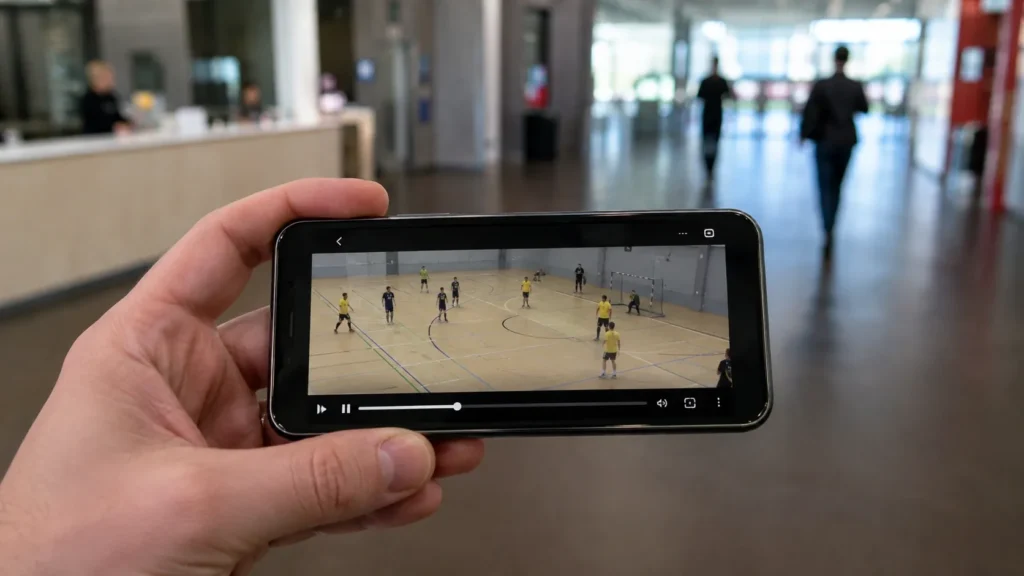
Every clip that leaves your venue is either carrying your name or somebody else's. A player films a good point on a phone, posts it, and the video says nothing about where it happened. The same point recorded by the court itself can arrive with the venue attached, in the frame and in the file, without anybody being asked to tag anything.
This page is about that difference: what venue branding in a clip actually consists of, which parts survive being reposted, and where the line sits between a clip people share and an advert people scroll past.
The Clip Has to Come From the Court
Branding only travels if the venue produced the video. At a court with VISU Replay, the recording belongs to the court, so what goes out is yours to shape.
For court and venue owners.
Why Phone Footage Loses Your Name
When a player films at your venue, three things are true at once. The video exists, it is good enough to post, and it is completely anonymous. It shows a court, and one indoor court looks much like another on a phone screen.
The usual answer to this is a sign on the wall and a hope that it lands in frame. It rarely does. Phone video is shot at eye level from wherever the person was standing, which is exactly the angle that misses the walls. The nets, the lighting rig and the far glass appear. The signage does not.
The second usual answer is asking players to tag the venue. This works when somebody remembers, which is a fraction of the time, and it puts your visibility inside a decision somebody else makes twenty minutes later while doing something else. Neither of those is a system.
The Four Places Branding Can Live
It helps to separate them, because they behave differently once a clip starts moving between apps.
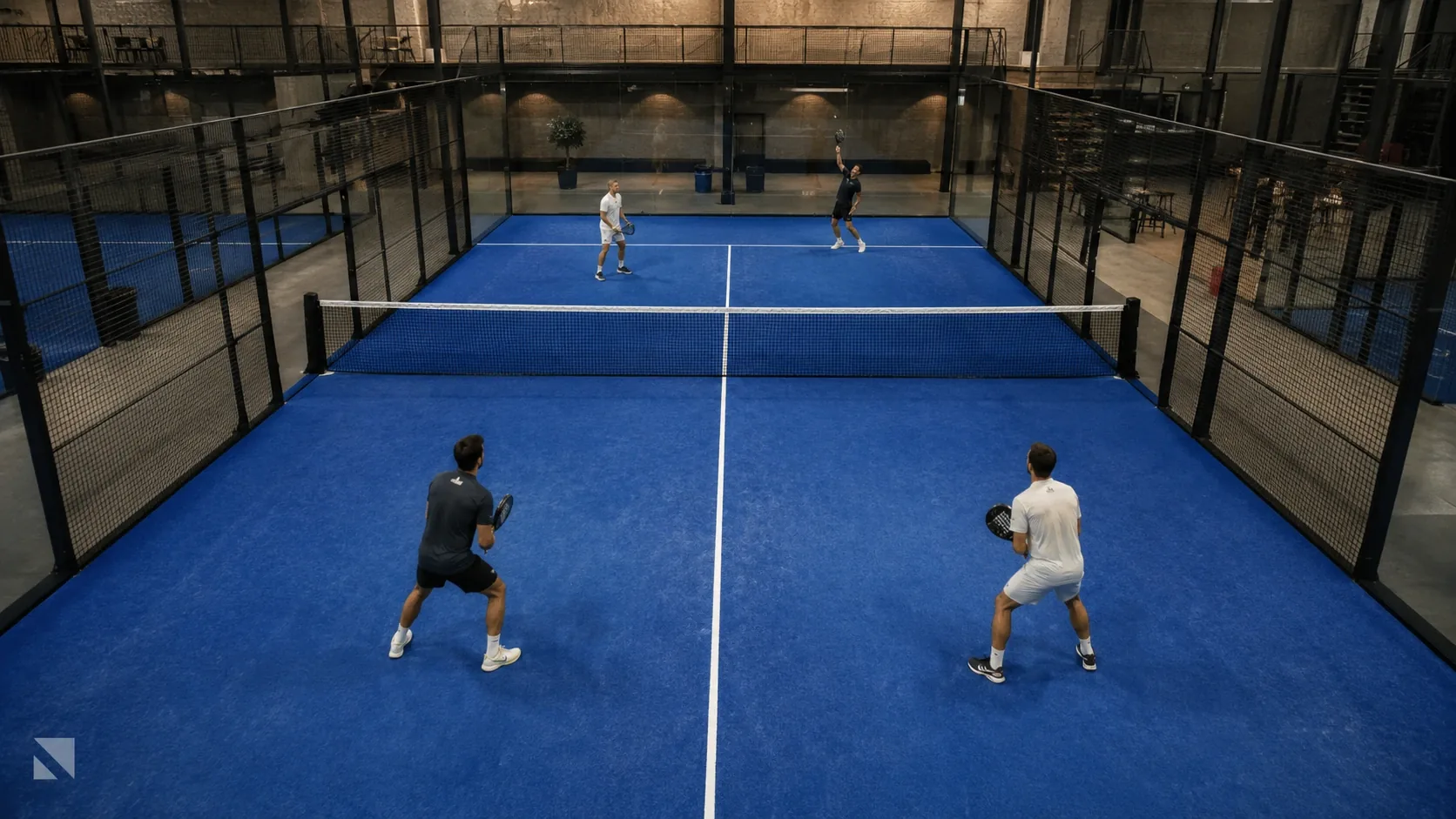
In the physical frame. Court-side boards, wall graphics, net logos. This is the oldest layer and the only one that survives everything, because it is part of the image itself. It also depends entirely on the camera angle, which is why the fixed court camera matters more here than any sign.
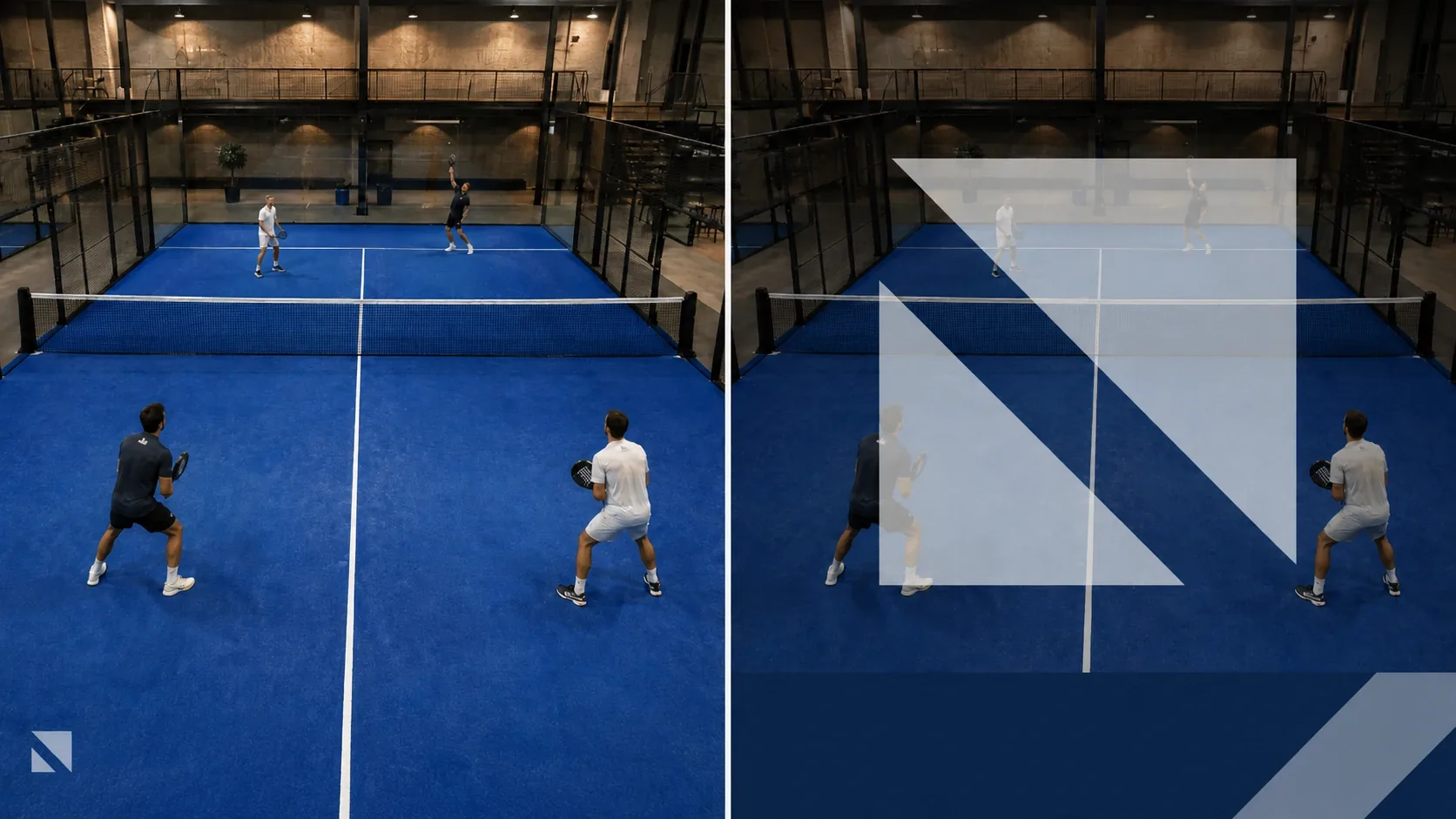
Burned into the video. A watermark or corner mark added when the clip is produced. It travels with the file wherever it goes, including to platforms that strip everything else.
In the file and the page. The filename, the title, the page the clip lives on before somebody downloads it. This is the layer that feeds search and link sharing, and it is invisible on a re-upload.
In the caption and the tag. The weakest layer, because it belongs to whoever posts. It is worth prompting for and never worth relying on.
Rank them by what survives a screen recording. Somebody will screen-record your clip and post it elsewhere. Only the first two layers are still there afterwards.
What Survives a Repost and What Does Not
The route a good clip takes is predictable: it goes to a group chat first, then to a story, then occasionally somewhere public. Each hop strips something.
A message app usually re-encodes the video and drops the filename. A story crops it, often aggressively, and the crop is vertical, which means the sides of your frame are the first thing to go. A repost from a screen recording keeps only what was visible on the screen at the time.
This has a practical consequence for where a mark goes. Branding placed at the left or right edge dies in the vertical crop. Branding at the very bottom competes with platform UI. The area that survives most often is the upper portion of the frame, inset from the edge, which is also where it interferes least with the play. Clip length by destination covers the same problem from the other direction.
Branding That Ships With the File
Clips from a VISU Replay court leave the venue already carrying its mark, so what a player shares in a group chat still says where it happened.
For court and venue owners.
The Point Where Branding Kills the Clip
There is a threshold, and crossing it costs more than under-branding does. A clip with a discreet mark is a clip about a player. A clip with an intro card, a large watermark and an end frame is an advert about a venue, and people do not share adverts about venues.
This matters because the entire mechanism depends on voluntary sharing. The player is the distribution. If the branding makes them slightly embarrassed to post it, the reach goes to zero and the strongest possible branding produces the weakest possible result.
The failure is easy to spot in your own footage. Watch a clip as if you were the player in it and ask whether you would send it to your group. If you hesitate, the mark is too big.
Intro cards deserve a specific warning. Three seconds of logo before the play means three seconds of nothing at the exact moment a viewer decides whether to keep watching. On short-form platforms, that is most of the clip's chance to survive.
What to Actually Put on the Clip
The venue name, legible at phone size, in one corner. That is the core of it, and for most venues it is the whole of it.
A short handle underneath works when the venue is active on the platform players use, because it converts a viewer into a follower without requiring them to search. A city name helps if the venue belongs to a group with sites in several places, and hurts if it makes the mark two lines long.
What to leave out: phone numbers, full URLs, booking prompts and slogans. None of them are read at that size, and each one moves the clip further towards looking like an advert. The clip's job is to make somebody think the place looks good. The booking happens later, somewhere else.
Size is worth being concrete about, because it is where most venues overshoot. If the mark occupies more than about a twentieth of the frame height, it stops reading as a signature and starts reading as an overlay.
Knowing Whether It Worked
Branding on clips is genuinely difficult to attribute, and it is worth being honest about that before setting expectations. Somebody who saw your name in a friend's story and booked three weeks later will not appear in any dashboard as a clip conversion.
What can be observed is coarser and still useful. Follower growth that tracks clip volume rather than posting schedule suggests clips are doing the work. Direct traffic and branded search for the venue name is the clearest signal of a name that is travelling. And the simplest one: ask at the desk. New players who mention seeing the place in a video are the mechanism working, counted by hand.
What not to do is invent a number. A precise-sounding claim about clip-driven bookings, without the measurement behind it, is worse than an honest estimate, because it makes the next decision on a false basis.
Start With Clips Worth Sharing
Branding only compounds if the underlying clips are good enough to post. A VISU Replay court produces them from every session, without anybody stepping off to film.
For court and venue owners.
FAQ: Branding Your Venue in Every Clip
Where should the venue mark go on the clip?
Upper portion of the frame, inset from the edge. Marks at the left or right edge are cut by the vertical crop stories apply, and marks at the very bottom compete with the platform's own interface. The upper inset area survives the most common crops and sits away from the play.
How large should the watermark be?
Small enough to read as a signature rather than an overlay. As a rough ceiling, more than about a twentieth of the frame height starts to dominate the image. The test that matters is whether the player in the clip would still send it to their group with the mark on it.
Should we add an intro card with the logo?
No, for short clips. Three seconds of logo before the play uses the window in which a viewer decides whether to keep watching, and on short-form platforms that is most of the clip's chance. If a card is used at all, it belongs at the end, after the play has already earned the attention.
Does branding survive when the clip is reposted?
Only some layers do. Marks that are part of the image, either physical signage in frame or a watermark burned into the video, survive re-encoding and screen recording. Filenames, page titles and captions do not survive a re-upload, so they are worth having but not worth relying on.
Is court-side signage enough on its own?
It depends entirely on the camera angle, which is why it usually is not. Phone footage is shot at eye level from wherever the person stood, and that angle tends to miss the walls where signage lives. A fixed court camera has a consistent frame, so what is inside it is predictable rather than accidental.
How do we know whether clip branding is bringing players in?
Not precisely, and it is better to say so. Follower growth that tracks clip volume, direct traffic and branded searches for the venue name are the usable signals, alongside simply asking new players at the desk. A specific conversion figure without measurement behind it is worse than an honest estimate.