
Knowing how to run an Instagram giveaway is less about the post and more about the work around it: a goal, a prize your audience actually wants, rules written before you announce, a check of the law where you and your entrants live, and a draw you can show was fair. This guide walks through each step in order, using Instagram's own Promotion Guidelines and official government pages for the legal parts. It is not legal advice: prize promotions are regulated in most countries, so a business running one should show its plan to a local lawyer. When the rules are ready, our free giveaway rules generator drafts them, and the giveaway picker draws the winner from the comments you paste.
Keep the Rules, Entry Link and Winner on One Page
A free VISU Link page holds your giveaway rules, the link to the post and the winner announcement, with a single link for your bio.
Start With the Goal and the Prize
A giveaway is a trade: you give a prize, entrants give attention. Decide what you want from that attention before you choose anything else, because the goal shapes the prize, the entry method and the rules.
- New followers who might become customers. The prize should be something only your likely customers would want: your own product, a service you sell, a voucher for your shop. A generic prize can attract people who enter for the prize alone and have no interest in your business.
- Reach for a launch. A prize tied to the new product puts the product in front of people and gives them a reason to talk about it in the comments.
- Thanking an existing community. Here the entry method can be simple, such as one comment, and the prize can be smaller. The point is the gesture.
- Local foot traffic. A prize that must be picked up in person, such as a dinner for two or a class at your studio, limits the giveaway to people who can actually come.
Then settle the practical side of the prize before it appears in a post:
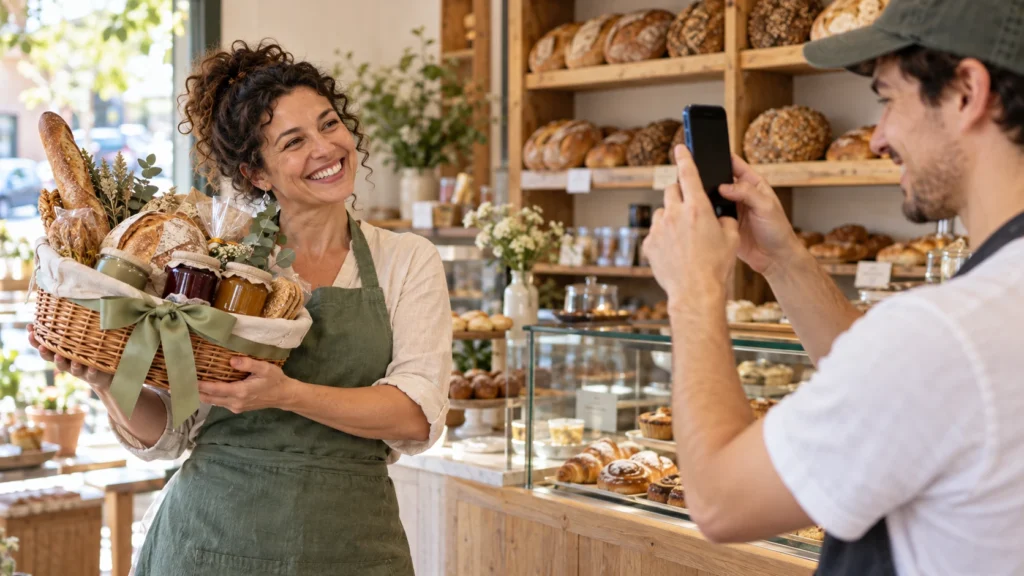
- Describe it exactly. Name, quantity, size or model, and anything that is not included. "A basket of our bread" invites arguments; "one basket with two sourdough loaves, one jar of jam and one bag of coffee" does not.
- Know its value. The value of the prizes can change what the law asks of you, as the legal section below shows, and some rules ask you to state it.
- Decide how it reaches the winner. Pickup, shipping or a digital code. If you ship, say where you ship to, because that also decides who can enter.
- Avoid cash in Brazil. Brazilian law forbids cash prizes in commercial promotions, and the regulator says that includes payments by PIX.
What Instagram's Promotion Guidelines Require
Instagram has a short page called Promotion Guidelines. It applies to anyone who uses Instagram to communicate or administer a promotion, such as a contest or a sweepstakes. Here is what it says, point by point:
- You are responsible for the lawful operation of the promotion. That includes the official rules, the offer terms and eligibility requirements (Instagram's examples are age and residency restrictions), and compliance with the rules that govern the promotion and the prizes, including registration and any regulatory approvals needed.
- No inaccurate tagging. You must not tag content inaccurately or encourage people to do it. Instagram's example: do not encourage people to tag themselves in photos they are not in. Asking for a mention of a friend in a comment is a different thing from asking people to tag themselves on your photo.
- A complete release of Instagram by each entrant.
- An acknowledgement that the promotion is in no way sponsored, endorsed or administered by, or associated with, Instagram.
- No help from Instagram. The page says Instagram will not assist you in administering the promotion, and that if you use the service to administer it, you do so at your own risk.
The page also carries a specific notice for Brazil: if you use Instagram to communicate or manage a commercial promotion there, you must comply with the regulation of the Secretaria de Prêmios e Apostas (SPA) of the Ministry of Finance.
In practice, the release and the acknowledgement go into both texts: a short line in the caption and the full wording in the rules. A line that covers both points reads: "This giveaway is in no way sponsored, endorsed or administered by, or associated with, Instagram. By entering, you release Instagram from any responsibility."
Check the Law Where You and Your Entrants Are
Instagram puts the legal side on you, and the legal side changes by country, and in the United States by state. What follows is what official pages say for four markets. It is a starting point for a conversation with a lawyer, not a full list, and it does not cover tax.
United States
- Free and by chance. The Federal Trade Commission tells consumers that real sweepstakes are free and by chance, and that it is illegal to ask people to pay or buy something to enter or to increase their odds of winning. If entering your giveaway depends on a purchase, talk to a lawyer before you post.
- Entry posts are incentivized posts. If people must post about your brand to enter, the FTC's guidance on endorsements says a hashtag such as #YourBrandSweepstakes or #YourBrandContest should be enough to show the post was part of a promotion, that "sweeps" probably is not, and that you should tell entrants where to put it.
- Some states ask for registration. Florida says game promotions offering prizes totaling more than $5,000 must be filed with the state seven days before they start, with a surety bond or a statement of trust, and that this includes promotions based in other states that are open to Florida residents. New York says a game of chance with prizes above $5,000 must first be registered with the Department of State, with a certificate of deposit or a surety bond for the total prize amount. Other states have their own rules.
Brazil
- Prior authorization. Lei 5.768/1971 says that giving away prizes as advertising, through a draw (sorteio), an instant prize, a contest or a similar operation, depends on prior authorization from the Ministry of Finance. The SPA grants it, and the request is filed in its SCPC system, as a rule 40 to 120 days before the promotion starts.
- Companies only. The law allows authorization only for companies in commerce, industry or real estate, and the SPA says individuals cannot run a commercial promotion, on social networks included. An influencer who takes part must join as a company with its own registration number.
- How winners are chosen. In the draw modality, winners are defined by the results of the Federal Lottery. For promotions on social networks, the SPA highlights that choosing the winner at random through automated platforms is forbidden.
- No cash, no raffles, no early publicity. Cash prizes are forbidden, PIX included. The SPA says raffles are not allowed under Brazilian law, and that a promotion cannot be advertised before its authorization certificate is issued.
- The cultural contest exception. A contest that is exclusively cultural, artistic, sporting or recreational, with no element of chance, no payment and no link to buying or using a product, does not need authorization. The SPA reads it narrowly: picking phrases that praise the sponsor, or a contest only for customers, is not cultural.
Mexico
- Draws are regulated at federal level, and the Dirección General de Juegos y Sorteos of the Secretaría de Gobernación (SEGOB) authorizes them. The regulation defines a draw for commercial advertising as one where entry is not conditioned on a payment or a purchase, and says draws can only be advertised once the permit has been granted.
Spain
- Spain's gambling regulator (DGOJ) says a draw run only to advertise or promote a product or service, with no charge to take part beyond buying the product itself, needs no licence, authorization or prior notice to the DGOJ, and falls under general civil and commercial law. It is still taxed: the gambling activities tax applies at 10% of the market value of the prizes.
If your followers live in several countries, the simplest honest option is to limit who can enter to the places whose rules you have checked, and say so in the eligibility line. Instagram itself lists residency restrictions as an example of what your terms should cover.

Write the Rules Before You Announce
The rules are the contract between you and every entrant. Write them first, publish them where anyone can read them, and do not change them once entries start. A complete set covers:
- Organizer. Who runs the giveaway, with the account handle and a way to contact you.
- Prize. The exact description, the quantity and, where relevant, the value.
- Dates. Start and end, with the time and the time zone. "Ends Sunday" is not a deadline; "ends Sunday, November 23, at 11:59 p.m. Eastern Time" is.
- Who can enter. Minimum age, country or state, and who is excluded, such as employees and their families.
- How to enter. Each step, whether each comment counts once or as a separate entry, and whether entering is free.
- How the winner is chosen. A random draw, the date, and how many alternates you will draw.
- Result and reply. How you will announce the winner, how you will contact them, and how many days they have to reply.
- Delivery. Pickup, shipping or digital, and who pays for shipping.
- Disqualification. Fake accounts, bought comments or anything that breaks the rules.
- Data. What you collect from the winner and why.
- Platform line. The Instagram release and acknowledgement.
The caption only needs the short version: prize, steps, deadline, eligibility, the Instagram line and a link to the full rules. Our giveaway rules generator produces both texts from one form, adds the line Instagram asks for, and switches off entry options a network forbids. It is a template, so it does not replace the lawyer's review.
Give Your Giveaway a Home Outside the Caption
Create a free VISU account and build a page with the full rules, the entry post and, later, the result, all behind one link.
Write the Giveaway Post
The post has two jobs: show the prize well and make the steps impossible to misread. A structure that works:
- An image or reel of the real prize. The actual basket, the actual candles, the actual class, not a stock photo.
- A first line that says what it is. "Giveaway: a basket from our bakery" tells people at a glance; a clever pun buried in the third line does not.
- Numbered steps. Each step on its own line. Common steps are following the account, liking the post and commenting, with or without mentioning friends. Ask only for what you can check on the draw date.
- The deadline and eligibility, in the same words as the rules.
- The Instagram line and the link to the full rules. A link in the bio, or on a link page, keeps the caption short.
A note on entry methods. Mentions in comments are easy to count, and a picker can require a minimum number of them. A share to Stories is hard to verify after the Story expires, so if you ask for it, say in the rules how you will check it. If the steps ask entrants to post something themselves in the United States, that post needs the contest or sweepstakes hashtag described in the legal section.
Pick the Winner Fairly
A fair draw has two parts: an entry list cleaned by the rules you published, and a random pick that you can show afterwards. Do both on the date the rules give.
- Collect the entries after the deadline. Copy the comments from the post, or export them with Instagram's own tools if you have access to them. Do not use tools that log in to your account or scrape the comments: the VISU giveaway picker is paste-only for exactly that reason, because Instagram does not allow other sites to collect comments from its pages.
- Apply the rules, not your preferences. In the picker, keep "one entry per person" on unless the rules say each comment counts, require the keyword or hashtag the rules ask for, set the minimum number of mentions (mentioning yourself does not count), and leave out your own accounts and anyone excluded by the rules.
- Draw winners and alternates together. The picker uses your browser's cryptographic random generator, so no entry gets a higher chance and no one is picked twice. Drawing alternates in the same draw means nobody can say a replacement was hand-picked later.
- Keep the proof. Each draw shows a draw ID, the time, the number of entries and a fingerprint of the eligible list, which changes if the list changes. Post those with the result, or record your screen while you draw.
The entry list stays in your browser: nothing is uploaded or saved. For a draw from a sign-up sheet rather than comments, the random name picker works the same way with plain names.
One exception matters in Brazil. In a commercial promotion authorized by the SPA, the winner is defined the way the approved plan says, which in the draw modality means Federal Lottery results, and the SPA highlights that automated random platforms are forbidden for social network promotions. A browser picker is not the method there.
Announce the Winner Without Inviting Scams
Announce the result where you announced the giveaway: a comment pinned on the original post, a Story, or both. Include the winner's handle, the draw ID and time, and the number of eligible entries. The picker's winner card puts the handle, the entry count and the draw ID on one image you can download and post.
Then contact the winner yourself, from your own account, and only in the way the rules said you would. Giveaways attract copycat accounts that message entrants pretending to be the organizer. Two habits reduce the damage:
- Say in the post how you will contact the winner, and that you will never ask for a payment, a card number or a password to release a prize. The FTC's advice to consumers is plain: real sweepstakes are free, and it is illegal to ask people to pay to enter or to improve their odds.
- Announce publicly before you message privately, so the winner can check the result on your post before replying to anyone.
If the winner does not reply within the deadline in the rules, move to the first alternate and announce the change the same way.
Deliver the Prize and Close the Giveaway
Delivery is where a giveaway either earns trust or loses it. A few habits keep it clean:
- Ask only for what delivery needs. A name and a shipping address for a parcel, nothing for a pickup beyond a time. The rules should already say what you collect and why.
- Ship on the date you promised, and share a photo of the prize leaving, if the winner agrees.
- Keep your records. The entry list, the draw details and the delivery confirmation. In Brazil, the SPA asks that the evidence of participation in authorized social network promotions be kept for three years.
- Thank everyone who entered. A short post that shows the prize arriving, and what is coming next, gives the new followers a reason to stay.
Afterwards, compare the results with the goal you set at the start. If the goal was followers who become customers, look at how the account behaves in the following weeks, not only on the day of the result. Our engagement rate calculator helps compare the posts before and after. And if you plan to run giveaways regularly, keep the rules, past winners and the next date on a VISU Link page, so your audience can always find the current one.
Publish the Rules Where Everyone Can Find Them
A free VISU Link page gives your giveaway rules, past winners and the next draw a permanent address, linked from your bio.
Frequently Asked Questions
How long should an Instagram giveaway run?
Instagram's Promotion Guidelines set no minimum or maximum length. Give followers enough time to see the post, write the closing date, time and time zone in the rules, and if a permit or registration applies where you are, plan the dates around it.
Can I require entrants to follow my account?
Instagram's Promotion Guidelines do not list following as a forbidden condition; what they rule out is inaccurate tagging. Put the follow step in the rules and check it on the draw date only if the rules say you will.
What happens if the winner does not reply?
Follow the rules you published. Set a reply deadline, draw alternates in the same draw as the winner, and move to the first alternate when the deadline passes, announcing the change the same way as the result.
Can I run a giveaway together with another brand or creator?
Yes. Name every organizer in the rules, say who sends the prize and who handles the winner's data, and include the Instagram line. In Brazil, the SPA says an influencer in a commercial promotion must join as a company.
Can I change the rules after the giveaway starts?
Avoid it, because people entered under the published rules. If you must fix a mistake, correct it publicly on the post before the draw and never shorten the deadline. In Brazil, once an authorized promotion starts, changes go through an amendment request to the SPA, and the modality and mechanics cannot change.
References
- Instagram Help Center: Promotion Guidelines
- FTC Consumer Advice: Fake Prize, Sweepstakes, and Lottery Scams
- FTC: FTC's Endorsement Guides, What People Are Asking
- Florida Department of Agriculture and Consumer Services: Game Promotions/Sweepstakes
- New York Department of State: Games of Chance Registration
- Brazil, Ministry of Finance, SPA: Commercial promotion FAQ (in Portuguese)
- Brazil: Lei 5.768/1971 (in Portuguese)
- Mexico: Reglamento de la Ley Federal de Juegos y Sorteos (in Spanish)
- Spain, DGOJ: Promotional draws (in Spanish)
- Spain: Ley 13/2011 de regulación del juego (in Spanish)