

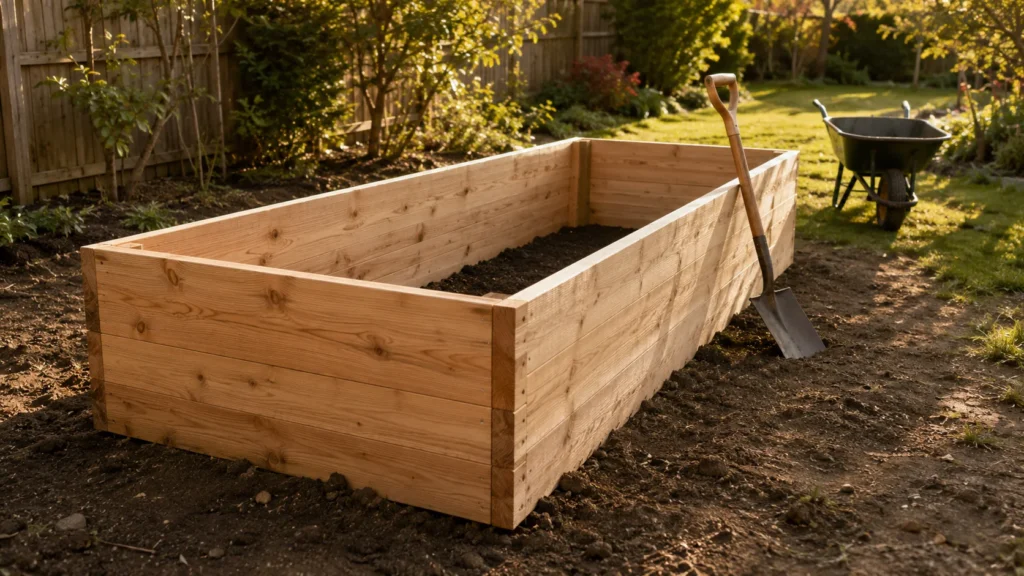
A raised bed is four boards and a pile of soil, and almost every decision that matters is made before you pick up a saw. How deep, how wide, what wood, what to put in it and whether to close the bottom. This guide answers each one with the numbers extension services actually publish, including the one point where two universities disagree.
This is the build guide. What goes inside the finished bed, meaning what to plant where, is a separate question and it lives in raised bed garden layout. For growing in pots and planters rather than beds, start at the container gardening pillar.
One Link for Your Whole Garden
A short address you control, pointing to your growing notes, your pages and everything else you share.
What a Raised Bed Actually Fixes
Utah State University Extension frames the case plainly: a gardener might build a raised bed "in order to by-pass non-amended or other problem soils," and the method "may benefit areas that have high soluble salts, heavy metals or other contaminates, or clay dominated soil types." If your native soil is the problem, a raised bed lets you skip it rather than fix it.
Three more benefits are documented and worth knowing before you commit:
- Earlier planting. Utah State notes that raised bed soils "warm more quickly in the spring, allowing for earlier planting." Clemson agrees: "They tend to warm up faster in the spring, so the growing season begins earlier."
- Better drainage. Oklahoma State puts a number on it: "A six-inch increase in height above the existing soil grade will greatly enhance drainage." They add the mechanism, which is that "looser (non-compacted) soil also drains better."
- Less compaction and easier work. Utah State observes that raised beds "alleviate soil compaction issues because the soil is rarely walked on," and that weeding happens "by walking around the sides of the bed."
There is a real trade-off, and both Clemson and Utah State name it. Clemson: "Raised beds will dry out more quickly than in ground beds, and will require more irrigation during dry periods." Utah State says the same in different words, warning that "higher soil temperatures will increase evaporative moisture loss, requiring more frequent irrigation during the hot summer months." A raised bed is a commitment to watering.
Step 1: Pick the Site
Sunlight first. Utah State: "The location should have at least 6 to 8 hours of direct daily sunlight for maximum fruit and foliage production." Watch the spot across a day before you build, because moving a filled bed is a different project entirely.
Two practical checks that save rework. If the bed is going where lawn is now, Utah State advises to "make certain to kill the grass first." And decide where the water comes from before you build, because Utah State is blunt that "a raised bed garden must be irrigated," recommending drip as "a simple and efficient method that is perfectly suited for this method."
Step 2: Width, Length and Depth
Width is the one number nobody should improvise. Oklahoma State gives both the rule and the reason: "The maximum recommended width of a raised bed is about four feet, since the average adult can reach about two feet into the garden from each side." The University of Florida arrives at the same place: "It should be no wider than 4 feet because most people can only comfortably reach 2 feet to the center." Clemson recommends narrow beds "about 3 to 4 feet wide" so the gardener can "reach the center of the bed without stepping into the bed."
Three sources, one answer: 3 to 4 feet (0.9 to 1.2 m). The point is never stepping in the bed, because stepping in it recreates the compaction the bed exists to avoid.
Length is free. Florida's Gardening Solutions: "Eight feet is a common length, but there is no one-size-fits-all for raised beds." Clemson says beds "can be as long as desired."
Depth depends on the bottom. Utah State sets the floor: "The raised bed box should be at least 6 to 12 inches high to accommodate the rooting depth of most vegetables." Florida gives the working range: "The depth of the bed should be between 6 and 24 inches deep." Oklahoma State notes beds can go "18 inches to 24 inches tall or higher to accommodate gardeners who like to sit while gardening," and Florida adds that elevating beds "one to three feet high makes gardening possible for people with limited mobility."
| Dimension | Recommended | Source |
|---|---|---|
| Width | 3 to 4 ft (0.9 to 1.2 m) | Oklahoma State, Florida, Clemson |
| Length | 8 ft common, no limit | Florida, Clemson |
| Depth, minimum | 6 to 12 in (15 to 30 cm) | Utah State |
| Depth, working range | 6 to 24 in (15 to 61 cm) | Florida |
| Sitting or accessible height | 18 to 24 in, or up to 3 ft | Oklahoma State, Florida |
| Path between beds | 18 in minimum, 3 ft for a wheelbarrow | Florida |
Florida names 4 ft × 8 ft × 16 to 24 in deep as "a common size," which is a reasonable default if you want one handed to you.
Step 3: Choose the Material
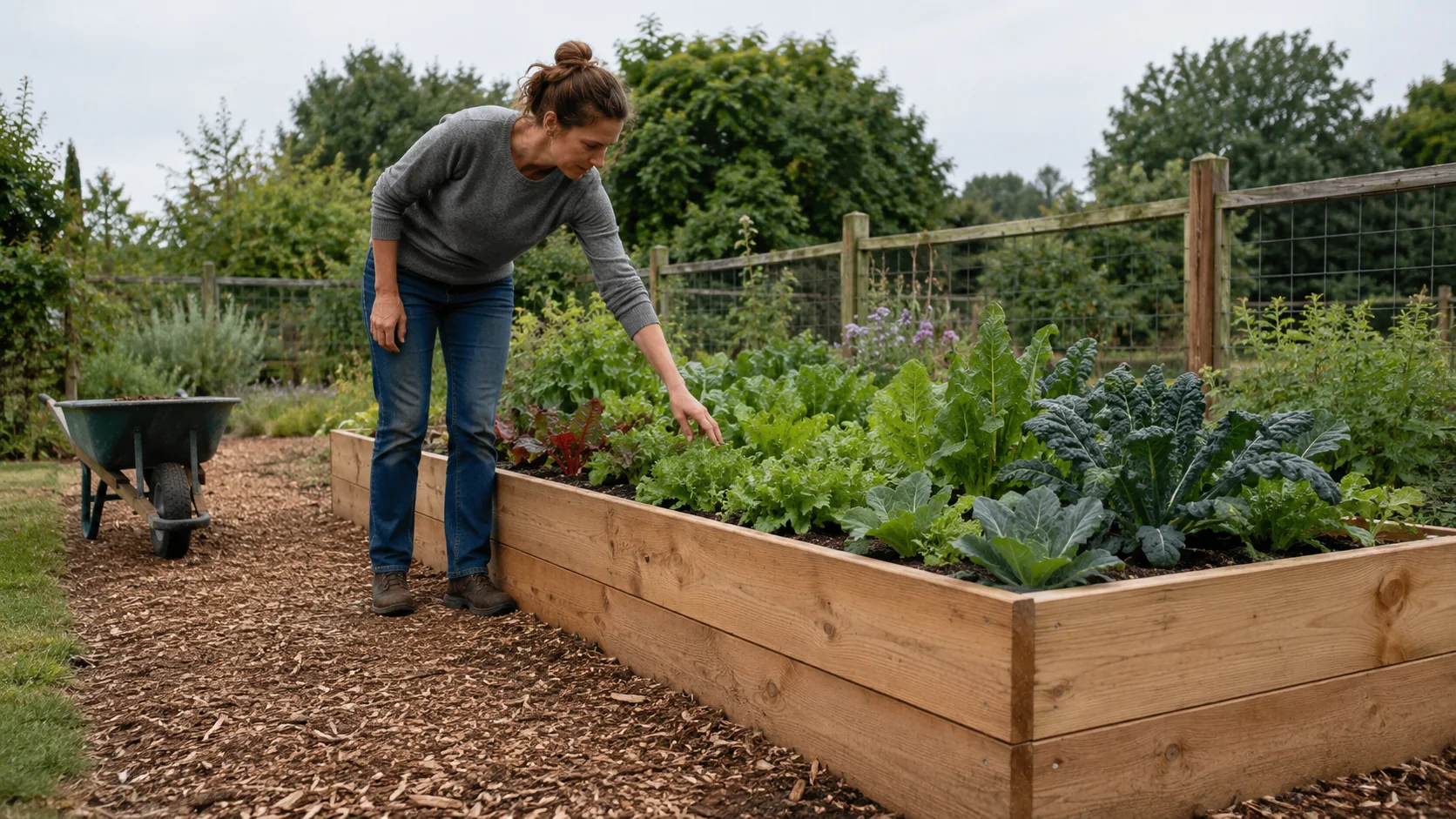
Utah State lists the field: a framed bed "can be constructed as a more permanent structure from any non-toxic, rot-resistant, durable material. Lumber, synthetic (composite) lumber, concrete blocks, brick or stone are a few possibilities."
On wood specifically, there is broad agreement about the naturally durable species. Utah State: "Cedar and redwood lumber is naturally rot resistant." Clemson widens the list: "Natural woods that are slow to decay include redwood, cypress, cedar, and oak; however, these woods can be expensive." Florida confirms the cost trade: cedar, redwood and synthetic wood "are naturally rot-resistant, but they are more expensive than pressure treated lumber."
Untreated construction lumber is the false economy. Utah State: "Untreated lumber, such as fir, will rot and breaks-down within a few years." Florida is harsher: "untreated lumber starts to rot within a year."
The sources differ in how strongly they warn against railroad ties. Florida advises against them for edible gardens: "Do not use railroad ties or old pressure treated lumber purchased prior to January 2004 for edibles because of the potential for food contamination from creosote and arsenic." Oklahoma State says their "use is not recommended, unless they are well aged" because "creosote vapors can burn tender plants." Clemson advises against ties that ooze or smell of creosote: "It is advised to not use railroad ties that are oozing or smell of creosote in the landscape. Old discarded railroad ties should be used with caution." Utah State warns that ties "treated with creosote may cause physical damage to plants touching the black, sticky ooze."
The Treated Lumber Question
This is the one place where the sources genuinely differ, so here is both positions rather than a fake consensus.
First, the shared history. Clemson: "In 2002, the wood preserving industry made a voluntary decision to phase out use of arsenic and chromium containing preservatives in wood products for the general consumer's use." What replaced it: "wood purchased at lumber outlets for residential landscapes is treated with micronized copper azole (CA) or alkaline copper quaternary ammonium (ACQ)," and "newer residential wood products are no longer treated with arsenic and chromium wood preservatives." Clemson adds that "by 2004, the Environmental Protection Agency (EPA) moved for limited use of CCA."
The University of Florida's position is that modern treated lumber is fine as is. Their recommendation: "For longevity and cost effectiveness, use modern pressure treated lumber, also known as Alkaline Copper Quaternary (ACQ) lumber, which is treated with copper preservatives and approved by the Food and Drug Administration for food production."
Utah State recommends a barrier anyway. Their wording: pressure treated lumber "is impregnated with copper-based compounds and may be used for raised bed construction; however, a plastic barrier should be placed between the lumber and the soil mix to prevent contaminants leaching into the garden soil." Florida offers the same option more softly: "If you're uncertain about the safety of treated lumber, place a heavy plastic liner between it and the soil used for growing plants."
Clemson supplies the nuance that explains the split. Leached preservative components "have the potential to be taken up by garden plants roots," and while "scientists generally agree that these elements can move from soil to the human body by way of edible plants, the process is highly dependent on soil type and degree of exposure." Clemson also points to a purchasing standard from the American Wood Protection Association (AWPA): "AWPA recommends use of UC4A or higher labeled treated lumber for horticultural uses."
Practical reading: modern ACQ or copper azole lumber is considered acceptable for food gardens by these extension sources. Florida presents a liner as an additional option; Utah State says a plastic barrier should be placed between pressure-treated lumber and the bed soil. Florida's guidance discusses the older arsenic- and chromium-containing preservatives separately from newer residential treated lumber, and railroad ties are a separate creosote question, covered above. One more handling note from Oklahoma State, which applies whatever you decide: "use caution when sawing or drilling," and "use protective clothing like dust masks and unlined rubber gloves when working with treated lumber."
Keep the Garden Log in One Link
Your build notes, your planting plan and everything else you share, behind one short address.
Step 4: Build the Box
The assembly is genuinely simple. Utah State describes it in two sentences: "Cut two pieces of lumber the width of the bed and two others the length of the bed. Screw the corners together with 4 inch long decking screws, to make a four-sided box." For strength, "to reinforce the corners, screw the sides into a wooden block or metal plate placed inside the corner."
Do not skip the corner block: it is the reinforcement Utah State specifies.
Then siting: "Place the box-like frame on the prepared soil and fill with additional soil." Utah State suggests an upgrade worth considering while you have the lumber out, which is "adding a top ledge on the raised bed boxes as a sitting bench at the edge of the garden."
Leave real paths. Florida: "Leave a walkway of 18 inches or more between the beds for weeding and harvesting. For wheelbarrow access, we recommend leaving 3 feet between beds." Utah State recommends mulching those paths, spreading "bark mulch or straw, over the walkways to reduce weed growth and mud problems."
Step 5: The Bottom, Weeds and Gophers
Most raised beds should have no bottom at all. Utah State states the rule and the exception clearly: "Raised bed gardens shallower than 12 inches deep should be constructed with no bottom to allow plant roots access to existing soil below the box." When the bottom is open, they add a preparation step: "Till the soil beneath the box 6 to 12 inches deep prior to adding new garden soil."
The exception is a bed on legs. Florida, for elevated beds specifically: "Add a sturdy bottom, with drainage holes."
Two things can go under an open bed, and they are not the same:
- For weeds, Florida advises: "If weeds have been a problem on the site, line the bottom of the beds with 4-5 layers of newspaper or cardboard to create a weed barrier." This breaks down over time, which is fine, because it only needs to outlast the existing weeds.
- For burrowing rodents, you need wire. Florida: "If burrowing rodents like moles are a problem, the bottom of the bed can be lined with poultry wire or hardware cloth." The University of California's IPM program is more specific for gophers: "Lay hardware cloth or 3/4-inch-mesh poultry wire under raised beds before planting," and "use galvanized or stainless steel wire to extend the life of the fencing."
Cardboard stops weeds and nothing else. If gophers are the problem, the wire goes in before the soil, and there is no retrofitting it later.
Step 6: Fill It
This is where budgets get surprised, and where the sources give you options at different price points.
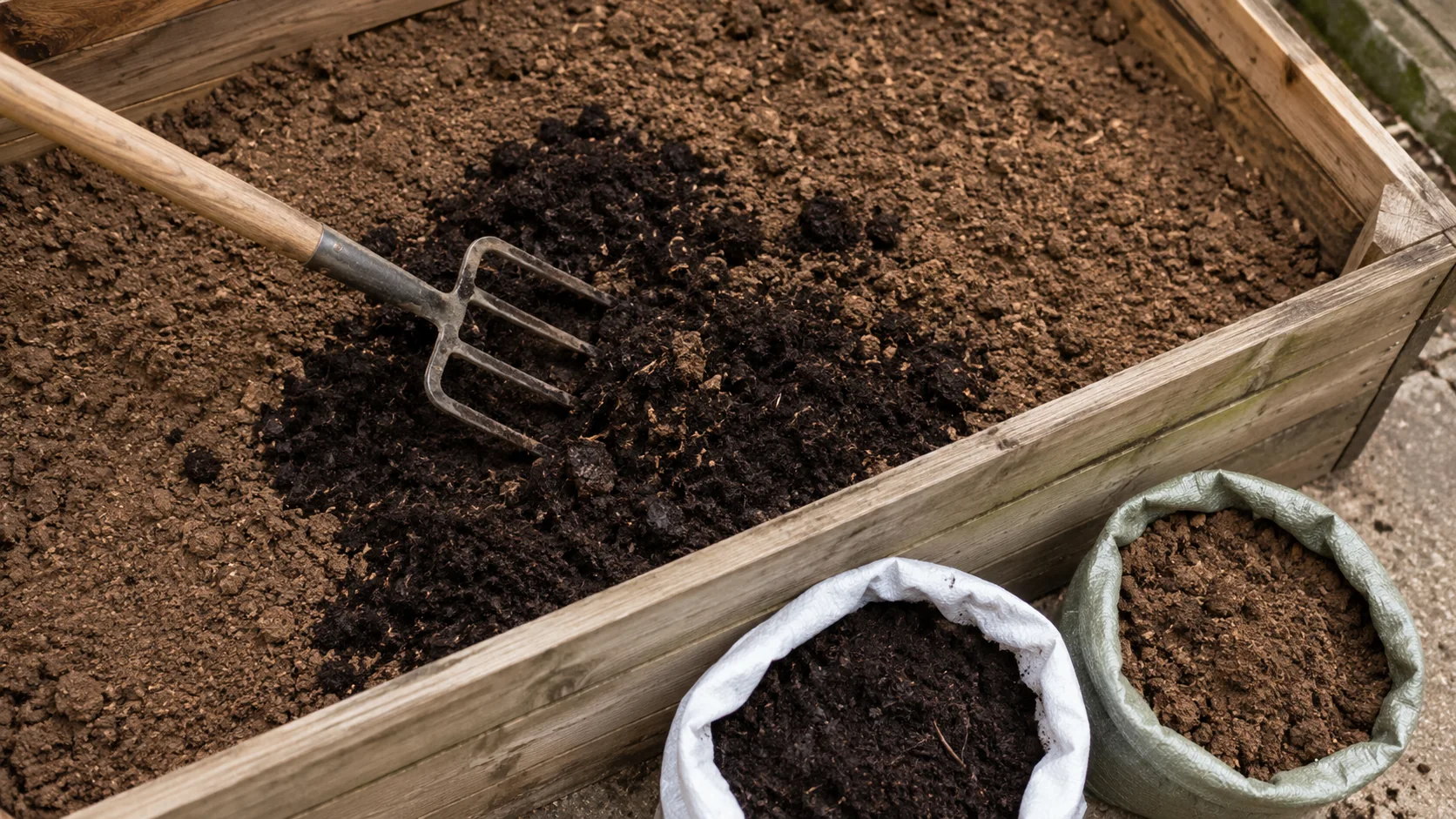
Amend what you have. Utah State: "If using existing soil, amend the native topsoil with 30-50% (by volume) well composted organic matter." They make the case that native soil earns its place, because amended topsoil "contains valuable minerals, encourages beneficial microorganism activity, improves soil aeration and drainage, provides excellent plant support, and improves the nutrient and water-holding capacity of the soil."
Or mix your own. Utah State gives a recipe in "equal parts (1:1:1 by volume)" combining composted organic matter, drainage increasing materials such as "coarse-grained sand (no finer than builder's sand), vermiculite, pumice, or perlite," and soil. Florida lists the components to choose from: "compost, composted pine bark, composted manures, peat moss, perlite, vermiculite, and topsoil."
Or buy a soilless mix. Utah State's assessment is balanced: these "are typically expensive and may become nutrient deficient over time," but they are "loose, friable in texture, provide good drainage, and retain soil moisture."
Now the number that catches people out. Clemson gives a specific range: "The amount of compost added should be in a range of 10-20% of the total volume." Utah State's 30 to 50% applies to amending native topsoil, which is a different operation from filling a bed. Clemson's warning cuts both ways: "Too little organic matter as well as too much composted organic material can cause future problems in the raised bed."
Clemson's baseline is the safe one to start from: "A mixture of good topsoil and compost provides a foundation for proper plant health when filling the raised bed." Oklahoma State suggests a filling technique too, noting that "a raised bed filled with alternating layers of compost and soil will make an ideal environment for plant growth."
One caution if your organic matter is not finished. Utah State: "If the organic matter is not fully composted, apply nitrogen to expedite decomposition of the high-carbon organic matter." They quantify it, "for every 1 inch of added woody organic material, incorporate 1/4 pound of actual nitrogen per 100 square feet," and warn that "actual nitrogen is not equal to the weight of fertilizer," since ammonium sulfate at 21-0-0 and urea at 46-0-0 carry very different amounts per bag. Easier route: use finished compost and skip the arithmetic.
Whatever you fill with, Utah State recommends confirming rather than guessing: "it is always best to have your garden soil tested in order to identify necessary fertilization additions."
Step 7: Water, Because It Will Dry Faster
Florida ties the drainage benefit to its cost in one sentence: "Irrigation is critical to success since soil used in raised beds is typically well drained and may dry quickly."
Before planting, Utah State suggests checking the basics: "ensure the raised bed garden has a water source and that irrigation water freely drains through the soil, away from the plant rooting zone."
On method, they are direct: "Irrigation of raised beds is most efficient when using some form of drip or trickle irrigation," which "can be accomplished with a simple soaker hose wound throughout the box or a more sophisticated system using drip tubing controlled by a timer." Sprinklers work but are the weaker option, since "sprinkler heads are not as water efficient and they water outside the planting box."
The No Build Version
If you want the drainage and the warm soil without buying lumber, there is a documented alternative. Utah State calls it an unframed raised bed: "created by tilling the existing garden soil 6 to 12 inches deep. Then add 2 to 3 inches of organic matter to the area and till it into the soil."
The shape is the same as a framed bed: "Create beds that are 8 to 12 inches above the surrounding soil and 3 to 4 feet wide." Clemson gives a lower figure for an unlined bed, saying it "should be 4 to 8 inches high," so treat anywhere in that 4 to 12 inch band as reasonable depending on how much soil you have to mound.
Same path rules apply. Utah State: "Walkways between the beds should be included to eliminate foot traffic within the planting area," wide enough for a wheelbarrow and mulched.
Show the Beds You Built
One VisuLink holds your garden photos, your pages and everything else you share.
FAQ
How deep should a raised garden bed be?
At least 6 to 12 inches (15 to 30 cm) to accommodate the rooting depth of most vegetables, per Utah State University Extension. The University of Florida gives a working range of 6 to 24 inches. Beds of 18 to 24 inches or higher are used so gardeners can sit while working, and elevating a bed one to three feet makes it accessible for people with limited mobility.
How wide should a raised bed be?
Three to four feet (0.9 to 1.2 m). Oklahoma State explains the reason: the average adult can reach about two feet in from each side, so four feet is the maximum that lets you work the middle without stepping into the bed. Stepping in it compacts the soil, which is the problem the bed was built to avoid.
Is pressure treated wood safe for a vegetable garden?
Extension sources differ slightly. The University of Florida recommends modern ACQ pressure treated lumber and notes it is approved by the FDA for food production. Utah State says it may be used but recommends a plastic barrier between the lumber and the soil. Florida also warns separately about older lumber treated with arsenic-containing preservatives, and the sources differ in how strongly they warn against creosote-treated railroad ties.
What do I fill a raised bed with?
A mixture of good topsoil and compost is the baseline, per Clemson, which recommends compost at 10 to 20% of the total volume. Utah State offers a 1:1:1 mix of composted organic matter, a drainage material such as coarse sand or perlite, and soil. Avoid filling with pure compost: Clemson warns that too much organic material causes problems just as too little does.
Should a raised bed have a bottom?
Usually not. Utah State advises that beds shallower than 12 inches be built with no bottom so roots can reach the soil below, and that you till that soil 6 to 12 inches deep first. Elevated beds standing on legs are the exception and need a sturdy bottom with drainage holes.
What should I put under a raised bed?
It depends on the problem. For weeds, Florida suggests 4 to 5 layers of newspaper or cardboard as a barrier. For burrowing rodents you need wire: hardware cloth or three quarter inch mesh poultry wire laid under the bed before planting, using galvanized or stainless steel so it lasts. Cardboard will not stop gophers.
Do raised beds need more watering?
Yes. Clemson states that raised beds dry out more quickly than in ground beds and need more irrigation during dry periods, and Utah State notes that the higher soil temperature increases evaporative loss in hot months. Drip or soaker irrigation is the recommended method because sprinklers waste water outside the box.
References
- Utah State University Extension, Raised Bed Gardening
- Clemson Cooperative Extension, Raised Beds
- Clemson Cooperative Extension, Treated Wood in the Landscape
- University of Florida IFAS Extension, Gardening in Raised Beds (ENH1211)
- University of Florida IFAS, Building Raised Beds
- University of Florida IFAS, Raised Beds: Benefits and Maintenance
- Oklahoma State University Extension, Raised Bed Gardening
- University of California Statewide IPM Program, Pocket Gophers