
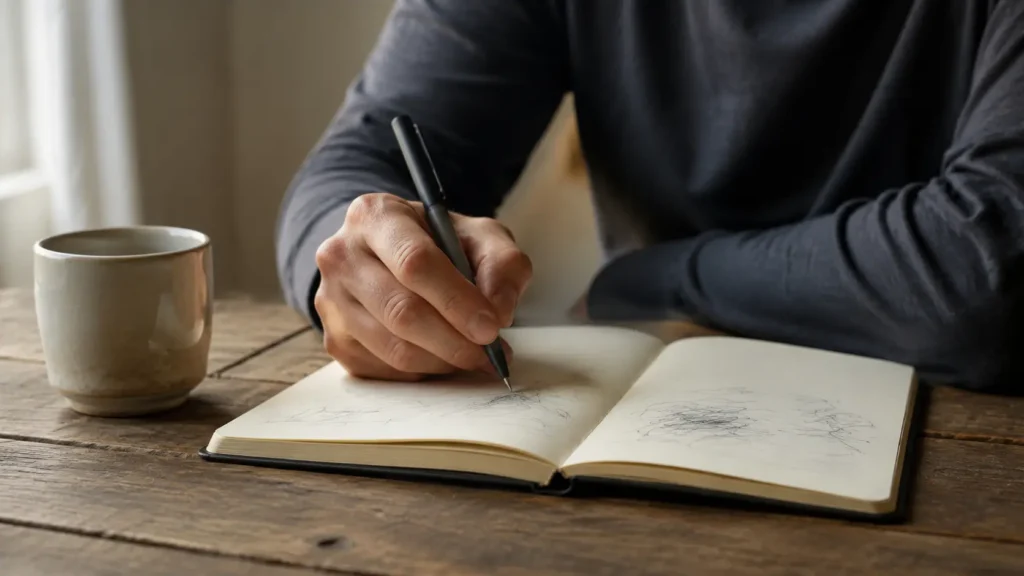
A gratitude journal is a notebook where you write down what you noticed, who helped, what worked and what was simple and good. The hard part is never the writing. It is the blank page at seven in the morning when nothing comes to mind. This is a bank of 100 original prompts, sorted by the moment you are writing in and by how long an answer they ask for.
Every prompt below is an instruction to look at something specific, not a question about how you feel. Pick the block that matches the moment, take one prompt, and write what you actually saw. One line is a complete entry.
One Link for the Pages You Keep
A short address you control, holding the prompts you liked, the entries you want to reread and the photos that go with them, in one place.
How to Use These Prompts
The blocks are organised by moment: when you open the notebook, not what kind of person you are. A morning prompt asks you to look ahead at the day. An evening prompt asks you to look back at it. The weekly and monthly prompts ask for a wider view, and the situation blocks (people, home, work, travel, dates) are for when the day already has a shape.
Each prompt also fits one of three formats. Use whichever one the time allows:
- One line. A single sentence, often just a noun and a reason. "The bus driver who waited." Done.
- A list of three. Three items, no explanation required. Good for evenings when you are tired of sentences.
- A paragraph. Five or six lines that describe one thing properly: where it was, who was there, what made it work.
Three ground rules that keep the habit light:
- Specific beats general. "Coffee" is a word. "The coffee was still hot when I got back to the desk" is an entry.
- Repeats are allowed. If the same thing shows up four days in a row, write it four times. The notebook is a record, not a competition.
- Skipped days do not need an apology. Open the notebook at the next date and carry on.
The numbering is continuous so you can note favourites and come back to them. If you want the same prompts on your phone and in the notebook, keep them behind one shared link and add the ones you write yourself.
Morning Prompts
For the first ten minutes of the day, before the phone. These prompts look forward, or at what is in front of you right now. One line is the natural format here.
- Name one thing in the room you are sitting in that somebody else made, and write down that it works.
- What is the first sound you heard today that was not an alarm?
- Write down one part of today that is already arranged and does not need you to arrange it.
- Who will you see today that you are glad to see? One name, one reason.
- What did you eat or drink first this morning, and where did it come from before your kitchen?
- Look out of the nearest window and write one line about what the weather is doing for you, not to you.
- What is one thing you can do today that you could not do a year ago?
- Write down one task on today's list that somebody once taught you how to do, and name them.
- What is clean, charged, folded or ready this morning because of something you did yesterday?
- Write one line about the best thing in your calendar this week, even if it is small.
Evening Prompts
For the end of the day, when you have the whole day to look back on. These prompts ask you to pick things out of what already happened. A list of three works well when you are short on words.
- Three things that went as planned today. No detail needed.
- One thing that went better than planned. Where were you when you noticed?
- Who made something easier for you today without being asked? Write what they did, not who they are.
- What was the best fifteen minutes of the day, and what were you doing?
- Write down one conversation you had today that you would be glad to have again.
- What is one thing you finished today, even if it was small?
- Describe one meal from today in three lines: where, with whom, what stood out.
- What did you see today that you had never noticed on that route before?
- Name one object you used today that did exactly what it was supposed to do.
- Write one line that starts with "Today I got to" and finish it honestly.
End of the Week
For a Friday evening or a Sunday afternoon, with seven days behind you. These prompts look for patterns, so they usually want a paragraph. Reading back through the week's daily entries first makes them easier.
- Which entry from this week would you keep if you could keep only one? Copy it out again.
- Who showed up in your notebook more than once this week? Write what they were doing each time.
- What is one thing that happened this week that you did not plan and would not undo?
- Name the best place you were this week and describe it in four lines.
- What did you learn how to do this week, even partly?
- Write down one problem from Monday that is solved by Friday, and how it got solved.
- What did you eat this week that you would order or cook again?
- Which day of the week had the most entries, and what was different about it?
- What is one thing you own that you used every single day this week?
- Write one line to yourself on Monday, from the vantage point of the weekend, about what turned out fine.
Once a Month
For the last day of the month, or the first day of the next one. These prompts are longer and rely on the month's pages. If you have been writing one line a day, you have thirty lines to work from.
- Read the whole month and list the three entries that surprise you now.
- What was the best day of the month? Write it as a short story with a beginning, a middle and an end.
- Who did you thank this month, out loud or in writing? Who did you mean to and did not?
- What is one thing about this month that was better than the same month last year?
- List three things that are in your life now that were not there at the start of the month.
- Which habit, tool or routine carried you through the month without you thinking about it?
- Describe one photo you took this month that you would print.
- What was the best thing you bought or were given this month, and what did you use it for?
- Name one place you went for the first time this month.
- Write the month in one sentence, the way you would describe it to a friend who was away.
People Who Helped
A block about other people. The prompts ask for what somebody did, in enough detail that you could describe it back to them. Names are optional; actions are not.
- Who held a door, a place in the queue or a lift for you recently? Write the moment down.
- Who answered a message from you faster than they needed to?
- Write down one thing a colleague, neighbour or relative explained to you that you still use.
- Who cooked for you this month? Describe the dish.
- Who noticed you were carrying too much, in the literal sense, and took some of it?
- Name one person whose work you rely on every day and have never met.
- Who remembered something about you that you did not expect them to remember?
- Write down the last time somebody waited for you without complaint.
- Who lent you something, and did you give it back? Write both parts.
- Who made you laugh this week? Write what they said, as closely as you can.
Keep the Entries Worth Rereading
Save the pages you want to find again, and the photos that go with them, behind one address you can open from any phone.
Around the House
For a weekend morning or any day you spend mostly indoors. These prompts point at rooms, objects and routines that are usually invisible because they work.
- Walk through one room and write down three things in it that you would keep if you had to move tomorrow.
- What is the oldest thing in your kitchen that still works? Where did it come from?
- Which chair, corner or spot in your home do you end up in most, and what is good about it?
- Describe the light in your home at the best hour of the day.
- Name one repair or fix in your home that has held for years.
- What do you hear from your home that you would miss if it stopped?
- Write down one thing a previous owner, builder or tenant left that you are glad about.
- Which plant, pet, or window box is doing well right now?
- What is one meal you can make in your kitchen without looking anything up?
- Describe your bed, your bath or your shower in three lines, as if to someone who has never had one.
At Work
For the commute home or the last five minutes before you close the laptop. These prompts stay on what happened at work, not on how work is going. That keeps them easy to answer on a difficult day.
- What is one thing you finished today that will still be finished tomorrow?
- Who at work asked a question that made your job easier this week?
- Name one tool, template or shortcut you use at work that somebody else built.
- Write down one piece of feedback you received that you have kept.
- What was the best meeting, call or conversation you had this week, and why did it work?
- What can you do at work now without thinking that took effort to learn?
- Who covered for you, waited for you or took a task off your list recently?
- Describe your desk, bench, van or workstation, and name the one thing on it you would not swap.
- Write down one thing about your commute, or the lack of one, that is good.
- What is one skill you brought to work this week that you learned somewhere else entirely?
On the Road
For trains, airports, hotel rooms and the first morning somewhere new. Travel entries can be worth rereading later, so a paragraph may be worth the time. Write while the details are still fresh.
- Describe the first thing you saw when you arrived, in enough detail to draw it.
- Who helped you get somewhere today: a driver, a stranger with directions, a person at a counter? Write what they did.
- What did you eat today that you cannot get at home?
- Write down one thing that went smoothly in transit: a connection, a queue, a seat.
- What is one word or phrase you learned or used today in a language that is not yours?
- Describe the view from where you slept last night.
- What is one thing you packed that turned out to be exactly right?
- Write down one sound from this place that you would recognise with your eyes closed.
- Who is travelling with you, or who are you travelling to see? Write one line about them from today.
- What is one thing about home that you noticed because you are away from it?
Birthdays, Holidays and the End of the Year
For days that already have a name. These prompts use the date as a fixed point to look back from. Most of them want a paragraph, and some of them make a good letter.
- On your birthday: list one thing from each year of the last five that you are glad happened.
- On your birthday: who was at your table, or on your phone, today?
- On a holiday: describe the meal, the room and who sat where.
- On a holiday: write down one tradition that somebody in your family started and kept going.
- On an anniversary of any kind: what is one thing that is still true since that date?
- On the first day of the year: copy out the best entry from each month of last year.
- On the first day of the year: write one line about the person, place or thing that showed up most in last year's notebook.
- On the last day of the year: what is one thing that did not exist in your life in January?
- On the last day of the year: who would you write a thank-you note to for this year, and what would the first line be?
- On any date that matters to you: describe where you were exactly one year ago today, as far as you can remember.
Days When Nothing Happened
For the days that were plain: no visitors, no trips, nothing finished. These prompts are the smallest in the list on purpose. They point at the parts of a day that are always there.
- What was the temperature of the first thing you drank today?
- Name one thing that worked today without you touching it: a lock, a light, a route, a rule.
- What did you wear today that was comfortable?
- Write down one word somebody said to you today, and who said it.
- What is one thing you did not have to do today?
- Describe the most ordinary object within arm's reach, and what it is for.
- What was the quietest moment of the day, and where were you?
- Write down one thing you looked at for longer than a few seconds today.
- What did you have enough of today: time, food, light, space, water, company? Pick one and say how you know.
- Write tomorrow's first line now: one thing you already know will be there in the morning.
The Same Prompts on Every Phone
Keep the list, the entries you copied out and the photos from the good days behind one link you can share or keep to yourself.
FAQ
What do you write in a gratitude journal?
Specific things you noticed: what worked, who helped, what was simple and good. The prompts above are ways of looking at a day so that something specific comes to mind. "The bus was on time" is a real entry. "Everything" is not.
How many prompts should I do in one sitting?
One. The blocks have ten each so you can spread a block over ten days, or pick one prompt a week for a year. The list is meant to last, not to be finished.
Is it better to write in the morning or at night?
Whichever time you will actually open the notebook. The morning block looks forward and the evening block looks back, so they ask different questions. Some people do one line in the morning and three at night. Either alone is fine.
What if I keep writing the same things?
Write them again. Repeats are a record of what is reliably good, which is worth having. If you want variety, change block: the "Around the House" and "Days When Nothing Happened" prompts point at things that rarely make it into the notebook otherwise.
How long should an entry be?
One line is complete. A list of three or a paragraph is for when you have the time and the material. Long entries that never get written are worth less than short ones that do.
Can I use these prompts with a partner or a family?
Yes. The "People Who Helped" and holiday blocks work read aloud at a table, with each person answering the same prompt. Keep one notebook per person or one shared page; both work.
Do I need a special notebook?
No. Any paper, any pen, or a note on your phone. The prompts do not depend on the format. What they depend on is being specific.