

A thirteenth birthday sits in an awkward gap: the formats that worked at nine feel childish, and the formats adults use are not on the table yet. The fix is not a bigger party. It is a clearer brief: who comes, where, for how long, what actually happens, and which adult is in charge of what.
This guide treats the party as an event to plan rather than a mystery to solve. It walks through the five decisions to make first, a simple timeline, ideas grouped by format (at home, outdoors, out and about, themed), and the practical side that most idea lists skip: food timing, declared allergies, and supervision that is present without hovering.
One Link for the Whole Plan
Guest list, timing, the playlist and the photos afterwards, behind a single address you can share with the people who need it.
Why Thirteen Is Its Own Brief
Most birthday party advice is written for one of two audiences: small children, where the adults run everything and the activities are short and simple, or adults, where the event is built around a dinner, a venue and a late finish. A thirteenth birthday fits neither template. Party games designed for a six-year-old will land badly, and an evening built like an adult celebration is out of scope for this age.
The practical consequence is that the guest of honour has to be part of the planning. Not in charge of it, but consulted on the things that decide whether the party feels like theirs: the guest list, the format and the music. The adult keeps the things that are about safety and logistics: the venue, the end time, the food, the supervision and the transport.
The same approach carries with light adjustments into fourteen, fifteen and sixteen, where the guest list gets more independent and the formats lean further toward going out. This guide stays on thirteen and only points at that direction.
Decide These Five Things First
Every idea further down this page depends on these five answers. Settle them before you look at a single theme.
1. Who is coming, in writing. University of Minnesota Extension's guidance for parents whose teen is hosting a party starts here: have the teen write down a list of who is invited, and encourage a party with a limited number of guests, because large parties can get out of hand. The written list is also what lets you plan food, seating and transport without guessing.
2. Where. Home, a park or outdoor space, or a paid venue. The place sets the ceiling on headcount, noise and duration, so choose it before the theme, not after.
3. Start and end time. The same Minnesota Extension page recommends settling on a time the party will end and communicating it in the invitations, noting that open-ended invitations can let a party go later than you want. Put both times on the invitation and treat the end time as part of the plan, not a suggestion.
4. What actually happens. A party at this age needs a spine: one main activity that fills most of the time, plus food and a stretch of unstructured hanging out. "Help your teen figure out party activities" is on the Extension list for a reason. A room full of thirteen-year-olds with nothing planned is not a party, it is a waiting room.
5. Which adults, doing what. Decide who is home, who handles food, who handles the door, and who drives. Naming the roles in advance is what makes the supervision feel light on the day.
A Planning Timeline That Holds
This timeline is a suggested working order, not a rule. Compress it for a small gathering; keep it whole for anything with more than a handful of guests or a booked venue.
Three to four weeks before. Agree the five decisions above with the guest of honour. Book the venue if there is one. Draft the invitation with start time, end time, address, the pickup arrangement and a line asking about food allergies and dietary needs.
Two weeks before. Send invitations. Minnesota Extension points out that timing matters: inviting people too far ahead can draw uninvited guests, while too short a notice does not give other parents time to plan. Two weeks is a reasonable middle for most home parties; a paid venue with a headcount deadline may need more.
One week before. Confirm numbers. Finalise the food plan around any allergies that came back. Ask the guest of honour to build the playlist. Buy or borrow anything the main activity needs.
The day before. Prepare whatever food can be made ahead and refrigerated. Set up the space. Charge speakers. Print or write out anything the activity needs, such as scavenger hunt clues or tournament brackets.
The day. Brief the adults on their roles. Put the food out in stages rather than all at once (the reason is in the food section below). Run the main activity while energy is high, then food, then free time, then a clear wind-down before pickups.
Ideas at Home
Home is the easiest venue to control and the hardest one to make feel like an occasion. Pick one main activity from this list, give it the living room or the garden, and let the rest of the house be normal.
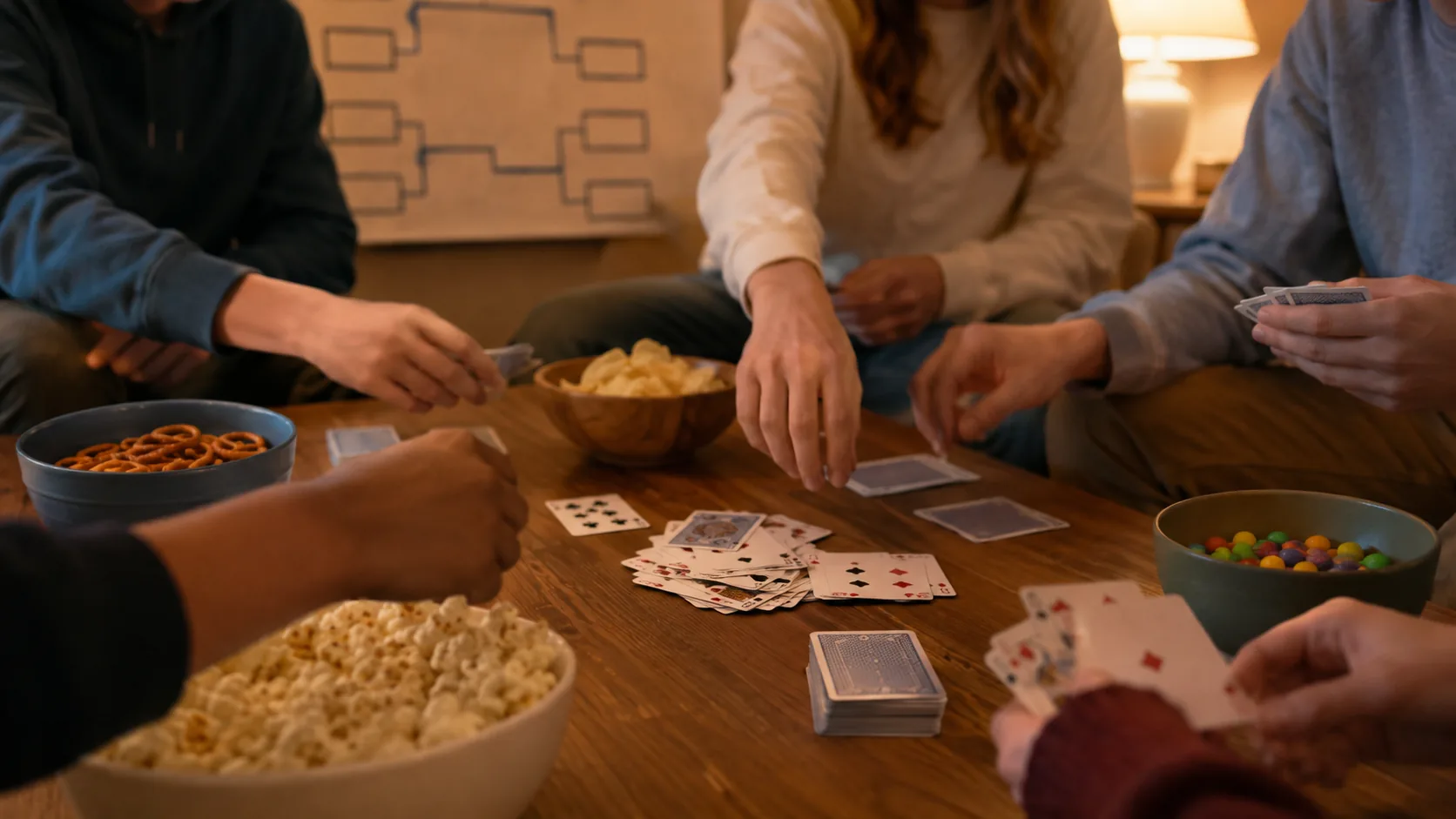
Game night with a bracket. Card games, board games and party games the group already knows, run as a short tournament with a written bracket on the wall. The bracket is what turns "we played some games" into an event: it has a start, rounds and a winner.
Movie marathon with a vote. Three films chosen by the guest of honour, guests vote on the order, and the room is set up as a proper screening: lights down, cushions on the floor, snacks in bowls, phones face down by agreement. Pick a break between films for food so the screening is not interrupted.
Make-your-own pizza. Bases and toppings laid out, each guest builds their own, an adult runs the oven. It doubles as the main activity and the meal, and it works with almost any allergy declared in advance because each person controls their own plate.
Backyard campout. Tents or a tarp in the garden, torches, a late snack, and the house right there when someone wants to come inside. If there is a fire, an adult lights it, watches it and puts it out, and local rules on open fires apply.
Karaoke or lip-sync battle. A screen, a speaker, and a sign-up sheet so nobody is pushed into it. A lip-sync version works for guests who will not sing.
Home escape challenge. A set of puzzles the host writes in advance, hidden around one room, each solved clue leading to the next and the last one opening a locked box with the cake inside. It takes an afternoon to prepare and about an hour to run.
Keep the Plan Where Everyone Can See It
Put the schedule, the playlist and the address behind one short link and send that instead of a thread of messages.
Ideas Outdoors
Outdoor parties solve the noise and space problems of home in one move and add two new ones: weather and supervision distance. Have an indoor fallback for the first and decide the adult positions for the second before the day.
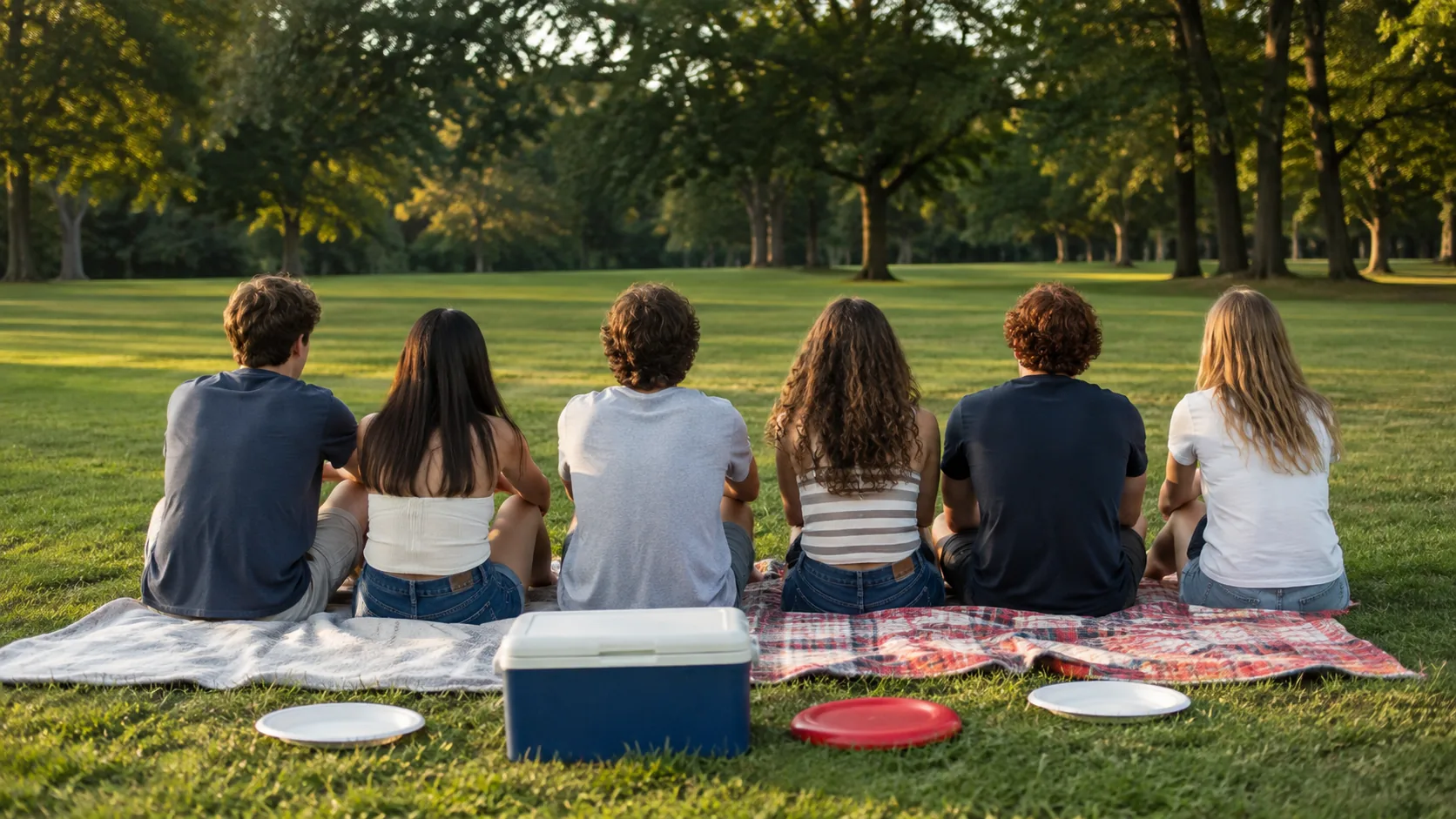
Park picnic with a game. Blankets, a cooler, and one game that scales to the group: football, frisbee, a bat and ball, or a relay with whatever is in the boot of the car. Food goes in the cooler, and the cooler stays closed until it is time to eat.
Beach, lake or river afternoon. Works for a small group where an adult can see everyone in the water at all times. Agree the swimming boundary out loud before anyone goes in, and pick a spot with a lifeguard where one exists.
Pool afternoon. Same rule: an adult whose only job is watching the water, for the whole time. Food and cake happen away from the pool edge.
Photo walk. Guests pair up, each pair gets a list of shots to find (a reflection, a shadow, something red, a dog with its owner's permission), and the group meets back to compare. Our guide to photography for beginners has a few framing ideas that turn a phone snap into a photo worth keeping.
Ideas Out and About
A paid venue trades control for convenience: someone else handles the activity, and you handle the headcount, the transport and the waiver forms. For any of these, check the venue's minimum age, whether a parent must be present, and whether a signed form is needed from each guest's parent, before invitations go out.
Bowling. Lanes for a set number of hours, food at the venue or afterwards. It works for groups that do not all know each other because the lane order does the introductions.
Trampoline or climbing session. High-energy, short, and almost always with a waiver per participant. Book a slot, arrive early, and plan the food for after.
Laser tag, mini golf or go-karting. Team formats with a scoreboard. Check the height and age rules for karting well in advance.
Cinema and a meal. The simplest out-of-home party for a small group. The guest of honour picks the film, an adult books the seats together, and the meal is where the actual party happens.
One Address for the Day
Venue, meeting time, the waiver link and the pickup spot, in one place that other parents can open without an account.
Themes That Work at Thirteen
A theme is a decoration and dress-code decision, not an activity. Pair it with one of the formats above. These are the ones that hold up at this age without tipping into costume-party territory.
Colour party. One colour for everything: clothes, food, decorations, the cake. Easy to explain on the invitation and easy for guests to join without buying anything.
Decade night. Music, clothes and snacks from one decade, chosen by the guest of honour. The playlist does most of the work.
Glow party. Lights off, glow sticks, white clothes, a blacklight if you can borrow one. Works indoors after dark and pairs well with a dance playlist or a lip-sync battle.
Tournament. Every activity of the evening scores points for a team: a video game round, a trivia round, a relay in the garden, a cook-off. A whiteboard tracks the totals and the last round decides it.
Food, Allergies and Timing
Two things about party food are not a matter of taste. Both come from the U.S. Food and Drug Administration, and both are easy to build into the plan.
Ask about allergies on the invitation. The FDA identifies nine major food allergens under U.S. labelling law: milk, eggs, fish, crustacean shellfish, tree nuts, peanuts, wheat, soybeans and sesame. The same FDA page notes that symptoms of an allergic reaction may appear from within a few minutes to a few hours, and that any allergic reaction has the potential to lead to anaphylaxis. The practical version for a party: put a line on the invitation asking about allergies and dietary needs, read the labels of anything packaged, keep the packaging of what you serve until the party is over, and if a guest arrives with their own medication, know where it is.
Put food out in stages, and watch the clock. The FDA's guidance on serving buffets recommends keeping serving portions small, preparing several small platters ahead of time and replacing dishes with fresh ones through the party rather than adding new food to an already filled dish. Its 2-Hour Rule: discard any perishables left out at room temperature for more than 2 hours unless they are being kept hot or cold, and reduce that to 1 hour when the temperature is above 90 °F (about 32 °C). Hot food is to be held at 140 °F (60 °C) or warmer, cold food at 40 °F (about 4 °C) or colder, and cold dishes that will sit out longer than 2 hours go on ice. For a home party this translates to a simple routine: one tray out at a time, the rest in the fridge or the oven, and a second wave of food later rather than a full table from the start.
Supervision That Does Not Hover
The Minnesota Extension guidance for teen parties at home gives the clearest practical description of the adult's role, and it is worth following closely: be home during the party, and maintain a discreet presence so that teens know you are around, but do not participate unless invited. Circulating occasionally with refreshments is one of its suggested ways to do that.
The same page suggests inviting another parent or two, who can help with refreshments and might know guests you do not, and setting rules in advance for handling uninvited arrivals: some teens can manage that with their friends, while others will need a parent to help keep numbers under control. It also recommends stressing that once guests are there, they stay there, rather than coming and going.
Turned into a plan for the day, that is four jobs: one adult at the door for arrivals and pickups, one on food, one who can see the main activity area, and one with a car and every parent's number. In a small party the same person can hold two of these; in a large one, do not.
Transport. Put the pickup time on the invitation and hold to it. Have a plan for a guest whose lift does not arrive.
Water and fire. Any format with a pool, open water or a fire gets one adult whose only task is that hazard, for the entire time it is in play.
FAQ
What is a good 13th birthday party idea at home?
Pick one main activity and build the party around it: a game night with a written bracket, a make-your-own pizza evening, a movie marathon with a vote, or a home escape challenge with puzzles the host writes in advance. Add food, a playlist and a set end time.
How many guests should a 13-year-old have at a party?
There is no fixed number. University of Minnesota Extension advises having the teen write down who is invited and keeping the guest count limited, because large parties can get out of hand. Let the venue and the number of adults set the ceiling.
Do parents need to stay at a 13th birthday party?
For a party at home, the Minnesota Extension guidance is to be home and maintain a discreet presence without joining in unless invited. For a paid venue, check whether the venue requires a parent present and whether it needs a signed form for each guest.
How do I handle food allergies at a birthday party?
Ask on the invitation, read the labels of packaged food, keep the packaging until the party ends, and know where any guest's medication is. The FDA lists milk, eggs, fish, crustacean shellfish, tree nuts, peanuts, wheat, soybeans and sesame as the major allergens under U.S. labelling law.
How long should a 13th birthday party last?
Long enough for the main activity, food and some free time, with a set end time printed on the invitation. Minnesota Extension notes that open-ended invitations can let a party run later than you want.
References
- University of Minnesota Extension: There's a party! Can I go?. Written guest list, limited numbers, invitation timing, end time on the invitation, handling uninvited guests, being home with a discreet presence, inviting another parent, and guests staying once they arrive.
- U.S. Food and Drug Administration: Serving Up Safe Buffets. Small serving portions, replacing dishes rather than topping up, the 2-Hour Rule and the 1-hour limit above 90 °F, and the hot and cold holding temperatures.
- U.S. Food and Drug Administration: Food Allergies: What You Need to Know. The nine major food allergens under U.S. law, symptom timing, and the note that any allergic reaction can lead to anaphylaxis.
Keep the Party in One Place
The plan before, the photos after, one link the guest of honour can share with the friends who were there.