
Most lists of trade show booth ideas read like a prop catalog: a prize wheel, a photo wall, a headset. The prop matters less than what it makes a visitor do. These 21 ideas are grouped by the job they do on the show floor: make someone stop, give them something to do, and make the follow-up easy, with a practical section on QR codes at the booth and a QR scavenger hunt across booths.
You will not find lift percentages here. Each idea comes with the mechanism behind it, so you can judge whether it fits your product, your floor space and your staff before you spend anything.
One Dynamic QR Code per Booth
Organizers get an event page, a code for every booth and scan totals per booth, starting with a 30-day pilot.
Booth Ideas That Make Visitors Stop
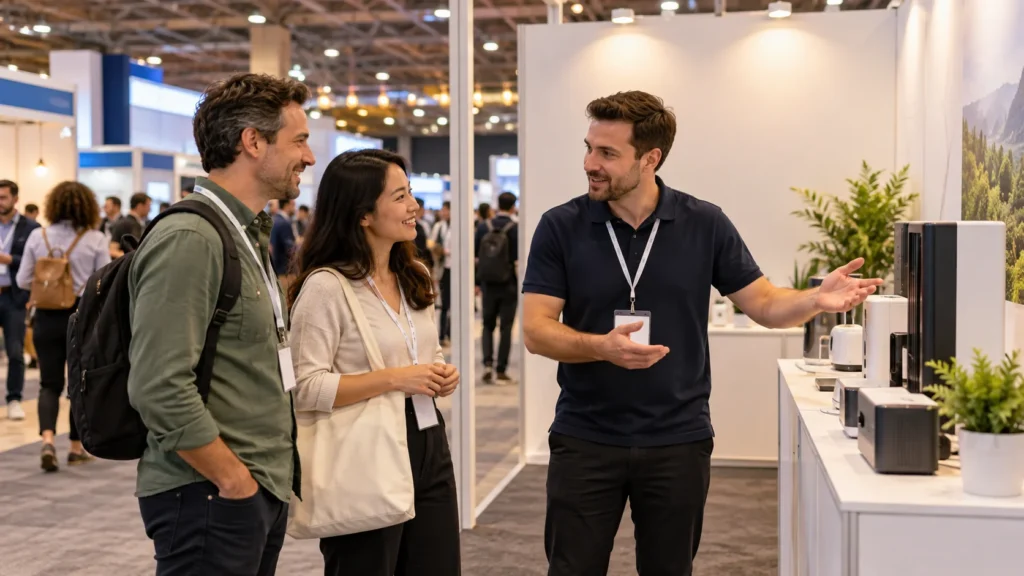
Someone walking an aisle gives each booth a glance that lasts a few steps. They stop when that glance either answers "is this for me?" or raises a question they want answered. Everything in this group works on that glance.
1. A One-Line Promise Readable From the Aisle
Put the outcome you deliver at the top of the back wall, in letters large enough to read from the other side of the aisle. Your company name can sit below it. The mechanism is self-selection: the right visitor recognizes their own problem and slows down, and the wrong visitor keeps walking, which saves your staff a conversation that was never going anywhere.
2. A Question Instead of a Slogan
Replace the tagline with a question your buyers argue about at work, such as "How long does your month-end close take?" An open question creates a small gap that people want to close, and most will answer it in their head before they have passed the booth. It also hands your staff a natural opening line that is not "Can I help you?"
3. Something Moving at Eye Level
Run the machine, assemble the product, pour the sample or loop a real workflow on a screen that faces the aisle. Motion pulls peripheral attention in a hall full of static graphics. A process that is visibly in progress does a second job: people wait to see how it ends, and waiting is the first step into the booth.
4. An Open Front With No Table Across It
Move the table to the side or the back and leave the front edge of the booth empty. A table across the front is a barrier, and it places the visitor face to face with a seller before they have decided to talk. Open floor lowers the commitment of stepping in. People can drift toward a display, look around and be greeted from the side.
5. A Scheduled Moment People Can Plan Around
Run a ten-minute demo at fixed times and print the times on a sign. A start time creates a small deadline, a gathered group attracts more people than an empty booth does, and visitors who pass between sessions have a reason to come back. Put a code next to the schedule made with an add-to-calendar QR code so the next slot lands in the visitor's own calendar.
Booth Ideas and Games That Give Visitors Something to Do
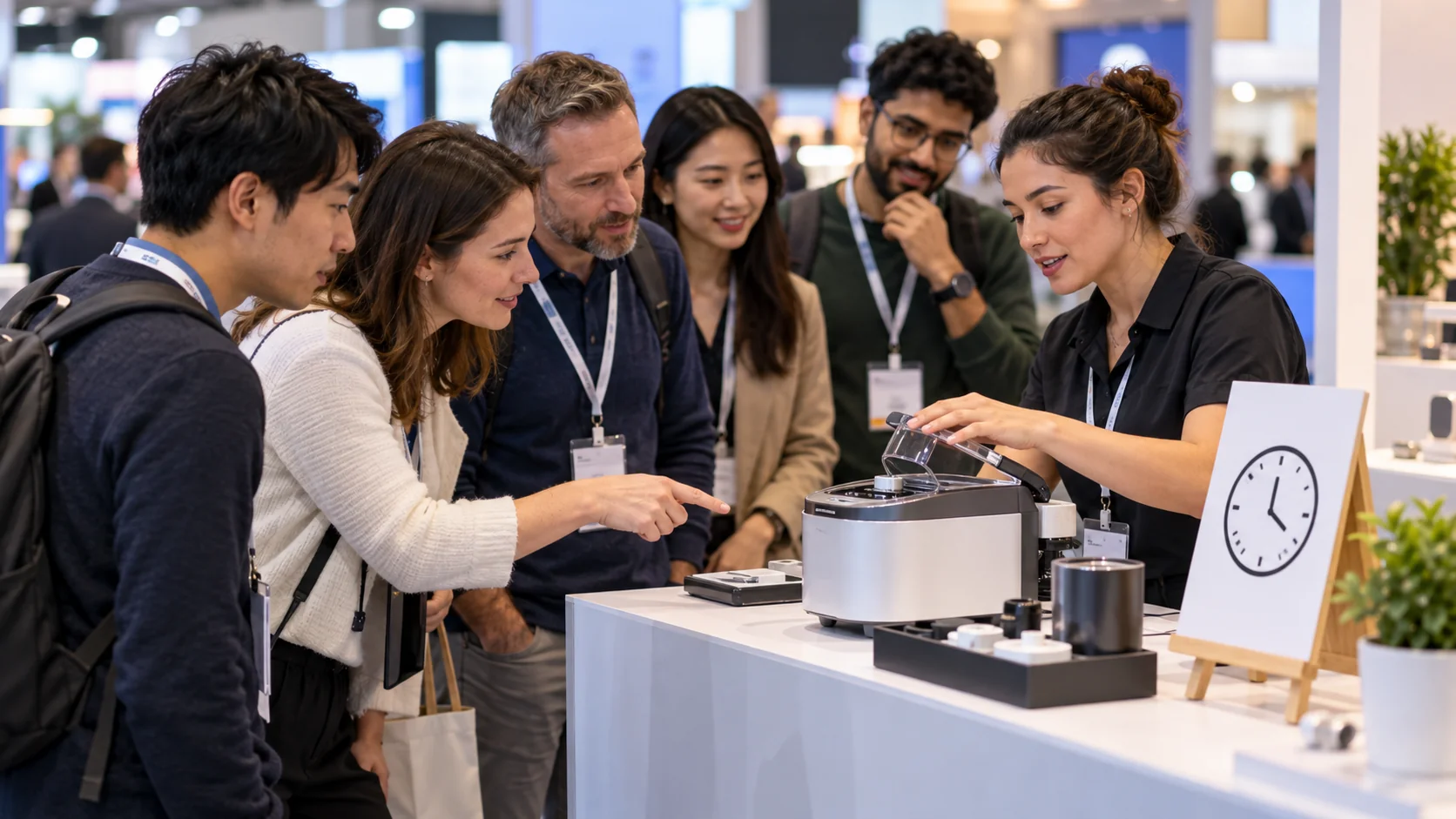
A visitor who stops and only listens leaves when the pitch ends. A visitor who is doing something stays until they finish it, and your staff get to talk while their hands are busy. Trade show booth games belong here, with one condition: the activity should show what the product does.
6. A Hands-On Station With One Task
Let visitors do one thing with the product themselves, something that takes under two minutes and cannot go wrong. A task done by hand tends to stick longer than a pitch heard in passing, and a result they produced with their own hands feels like their result. Keep it to one task so nobody needs instructions.
7. A Short Skill Game Tied to the Product
Turn the product's main benefit into a timed challenge: seal a box fastest with your dispenser, find the fault in a sample report, fit the part without tools. Write scores on a whiteboard. Competition and a visible ranking draw spectators, and people who have been knocked off the top tend to return to win their place back.
8. A Prediction Board
Hang a board with one industry question and a few possible answers, then hand each visitor a sticker to place. It takes five seconds, so almost nobody refuses. The growing cluster of stickers shows passers-by that others have taken part, and each answer gives staff something specific to ask about. Treat the result as a conversation starter, not as research.
9. A Build-Your-Own Sample or Kit
Lay out components and let visitors assemble their own sample pack, configuration or bundle. Every choice they make tells your staff what they care about without a single qualifying question. An item someone configured for themselves also has a better chance of making it home than a generic handout.
10. A Prize Wheel With a Question First
The wheel is a familiar idea because chance is a reliable attraction. Its weakness is that it attracts everyone. Fix that by asking one question before the spin, for example what tool the visitor uses today. The chance element earns the stop, and the question makes the stop useful. Rules for prize draws vary by country and state, and following them is the responsibility of whoever organizes the draw.
QR Code Ideas for the Booth
A QR code is a door, not an idea. It earns its place when the sign says what the visitor gets and the page behind it is useful on a phone with weak venue signal. Four uses hold up on a real show floor.
11. One Code per Job, With the Payoff Printed Beside It
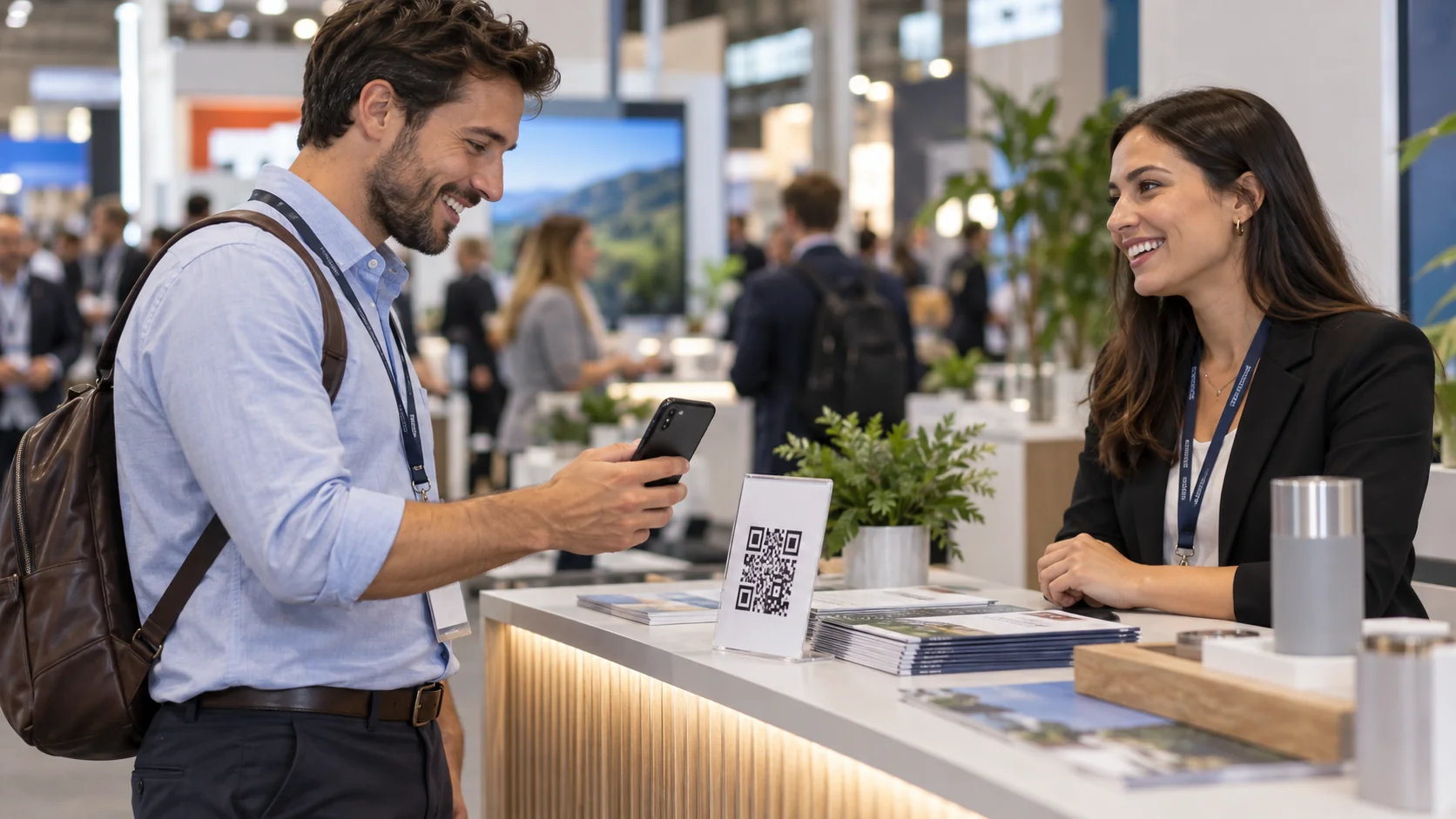
Print a separate code for each thing you want visitors to do, and label each one with its payoff: "Scan for the spec sheet", "Scan to book a demo". A bare code asks for effort with no stated reward, and a labelled code removes that uncertainty. You can make them in a QR code generator in a few minutes. Size them for the distance people will actually stand at, which a QR code size calculator works out from the print size.
12. A Dynamic Code on Anything Expensive to Reprint
Back walls, banners and printed handouts are fixed weeks before the show, while your plans keep changing. With a VISU dynamic QR code, the destination can be edited after printing, so the same printed sign can open the demo sign-up page in the morning and the slides in the afternoon. Each dynamic code has one total scan counter and an on/off switch, and the free plan includes 2 dynamic QR codes. The counter is a total. It does not show who scanned, where or when.
13. A Take-Home Page Instead of a Brochure Stack
By mid-afternoon a visitor's bag is full, and paper gets left in the hotel room. A link that sits in their phone survives the trip home. Put the spec sheet, the demo video and your booking link on one page and point a code at it. VISU Link is a link page that counts clicks per link and shows page visits by country, city, device and hour, and the free plan includes 1 VISU Link.
14. A Staff Contact Code on the Badge
Give each staff member a code that saves their name, role, phone and email to the visitor's contacts. A vCard QR code does this with no typing. The mechanism is personal: after the show the visitor has a named person in their phone, not a company inbox, and it is easier to reply to someone you remember meeting.
Plan a Hunt Across Every Booth
Each booth code keeps an editable destination and one total scan count, compiled into a per-booth report by the VISU team.
A QR Scavenger Hunt Across Booths
This idea belongs to the organizer, or to a group of exhibitors who agree to send visitors to each other. It moves traffic toward the back rows and gives every participating booth a ready-made opening line.
15. A Hunt Card That Sends Visitors Booth to Booth
The mechanism is a collection with visible gaps. A card with eight empty boxes and five filled in is hard to put away, so visitors walk to booths they would otherwise have skipped. A simple version runs like this:
- Choose six to ten participating booths spread across the hall, including the quiet corners.
- Give each booth one printed QR code and one question. The answer sits on the page behind the code or comes from the booth staff.
- Hand visitors a paper hunt card at the entrance. At each booth they write the answer, or staff initial the box.
- Collect completed cards in a box at the organizer desk.
- If there is a prize, the organizer sets it, draws it and owns the rules.
Write questions that take a thirty-second conversation to answer, not a glance at a poster. That short exchange is the entire point of the visit for the exhibitor. Keep the route short enough to finish in one lap of the hall, because an unfinishable card gets abandoned.
Be clear about what the technology does. Completion is self-declared on the card or checked by staff at each booth. In the VISU events setup, each booth gets one dynamic QR code, the event gets an event page built on VISU Link, and the VISU team compiles a scan report per booth. It runs as a 30-day pilot. What the organizer gets is an editable destination for each booth code and one total scan count per booth. VISU does not check who completed the hunt and does not run the draw.
Editable destinations are useful here. If a booth's question turns out to be too hard on day one, the organizer changes the page behind the code overnight and the printed sign stays where it is.
Ideas That Make the Follow-Up Easy
The show ends, and a week later most conversations have blurred together on both sides. These ideas move the first follow-up step into the booth, while the visitor is still standing there.
16. A Two-Field Form Behind a Code
Build a short form in the form or CRM tool you already use, with name and work email plus one optional question, and point a QR code at it. The code only opens the page: the contact details go into your own tool. Visitors type their own details, so there are fewer misspelled addresses than with handwritten notes, and nobody has to hand over a badge to be scanned.
17. A Booked Next Step Before They Leave
For any visitor who wants a longer conversation, open your scheduling page and agree a time on the spot. A date in two calendars is a commitment both sides made in person. "We will be in touch" is a promise only one side made.
18. A Note per Conversation, Written Within a Minute
Give staff a fixed three-line note to fill in straight after each serious conversation: the problem the visitor described, their timeline, and who else decides. A follow-up message that mentions the actual conversation is recognizable in a crowded inbox. A generic "great to meet you at the show" is not.
Small-Budget Booth Ideas
A standard inline booth with two people can outperform a custom build if it gives visitors a reason to stay. None of these three needs a contractor.
19. A Charging and Wi-Fi Corner
A power strip, two stools and a small sign solve a real problem that every visitor has by early afternoon. A phone takes a while to charge, and that wait is unhurried conversation time you did not have to earn. If the venue lets you run your own guest network, a Wi-Fi QR code connects visitors without anyone spelling out a password.
20. One Good Giveaway Instead of a Bowl of Small Ones
Spend the giveaway budget on fewer, better items and hand them over after a real conversation, not from a bowl at the edge of the booth. Something given personally carries more weight than something grabbed in passing, and a useful item that ends up on a desk keeps your name in view after the show.
21. An "Ask Us About" Sign With Three Topics
Print three specific topics on a floor sign or on staff shirts: "Ask us about switching mid-contract", for example. Visitors who do not know how to start get a script, and the opening moves toward the subjects your team answers best. The cost is one print job.
What to Measure After the Show
Pick one number per goal before the show opens, and decide who records it. A number nobody was assigned to count will not exist on the last day.
| Goal | Ideas | What you can count | Where it comes from |
|---|---|---|---|
| Make visitors stop | 1 to 5 | Conversations started per hour | Staff tally sheet |
| Give them something to do | 6 to 10 | Activities completed | Scoreboard or tally |
| QR codes at the booth | 11 to 14 | Total scans per code, clicks per link | QR and link page totals |
| Hunt across booths | 15 | Cards returned, total scans per booth code | Organizer desk, per-booth scan report |
| Follow-up | 16 to 18 | Forms submitted, meetings booked | Your own form, CRM or calendar |
Read scan totals for what they are. A total scan count shows how often a code was opened, not how many different people opened it, since one visitor can scan twice. Use it to compare codes with each other: the back wall against the handout, day one against day two, one booth against another in the same hall.
To see what visitors did after the scan, use your own analytics. Tag the link behind each printed code with a UTM builder so the wall, the handout and the staff badges show up as separate sources on your website reports.
Fictional illustration: an exhibitor prints three codes that all lead to the same demo page, each with its own tagged link. After the show the back wall has the most scans, but the handout code produced more booked demos. Next time, the handout gets the better position and the wall gets a simpler message.
Start With a 30-Day Event Pilot
One dynamic QR code per booth, an event page built on VISU Link and a scan report per booth.
Frequently Asked Questions
What Makes a Trade Show Booth Attract Visitors?
A booth attracts visitors when a quick glance from the aisle tells the right person it is for them. A readable one-line promise, a question on the wall, something moving at eye level and an open front with no table across it all work on that glance.
What Are Good Trade Show Booth Games?
The best booth games demonstrate the product while people play. A short timed skill challenge with a visible scoreboard, a prediction board with stickers and a prize wheel that starts with one qualifying question all keep visitors busy long enough for a real conversation.
How Do You Use QR Codes at a Trade Show Booth?
Use one code per job and print the payoff beside it, such as a spec sheet, a demo booking page or a staff contact card. Size each code for the distance visitors stand at, and use a dynamic code on anything that is expensive to reprint so the destination can change later.
How Does a QR Scavenger Hunt Across Booths Work?
Each participating booth displays one QR code and one question. Visitors carry a paper hunt card and write the answer or collect staff initials at every stop, then return the card to the organizer. Completion is self-declared or checked by staff, and any prize and its rules belong to the organizer.
What Are Good Trade Show Booth Ideas for a Small Budget?
A charging corner with two stools, one good giveaway handed over after a conversation and a sign listing three topics to ask about all cost very little. Each one gives visitors a reason to stay without a custom build.
Can a QR Code Collect Leads at a Booth?
Not by itself. A QR code only opens a destination. To collect contact details, point the code at a form in your own form or CRM tool. A VISU dynamic QR code gives you an editable destination and one total scan count per code, and the contact details stay in the tool that hosts your form.