


Business events moved 1.3 trillion dollars in direct spending last year, and most organizers still cannot tell you whether their own event worked. That is not a figure of speech. When researchers asked both sides the same question, organizers overestimated their own event by 38 percentage points. This guide covers the types of corporate events, the ideas that hold up under evidence, and the measurement gap that explains the disconnect.
Measure What Actually Happens at Your Event
VISU records interactions at the touchpoints that matter, so the post-event report is built on behavior instead of recollection.
What Is a Corporate Event?
A corporate event is any organized gathering a company hosts to achieve a business objective. Training, selling, celebrating, aligning a team, or launching something.
The defining trait is the goal, not the format or the guest count. A twenty person workshop and a five thousand person conference are both corporate events if a business outcome justifies the spend.
The cleanest way to sort them is by audience. Internal events face employees. External events face the market. That split determines who runs the budget, what success looks like, and which metrics anyone will care about afterward.
The Ten Types of Corporate Events
Most lists present these flat. Sorting them by audience is more useful, because the two groups fail for different reasons.
Internal: events that face your own people
- Sales kickoff. Aligns the team on quota, strategy and compensation. Typically 50 to 1,000 people over two or three days, owned by sales enablement.
- Town hall or all-hands. Internal communication and transparency. Whole company, recurring, owned by internal comms.
- Team building. Cohesion and morale. Usually 10 to 100 people, owned by HR.
- Holiday or year-end party. Recognition and culture. Whole company, owned by HR.
- Executive retreat. Strategy and governance. Small, 5 to 30 people, owned by the chief of staff or executive office.
- Incentive travel. Rewards top performers and aids retention. 20 to 200 people at a destination, run with a travel management partner.
External: events that face the market
- Conference. Knowledge exchange and industry positioning. Hundreds to tens of thousands, multi-day, owned by marketing or an association.
- Product launch. Demand generation and press coverage. 50 to 500 people plus media, owned by product marketing.
- Trade show as an exhibitor. Lead generation and pipeline. Your booth inside someone else's event, owned by field marketing.
- Seminar or workshop. Training and skills transfer. 20 to 100 people, half day or full day, owned by learning and development.
Award ceremonies, shareholder meetings, anniversaries, charity events and customer advisory boards also appear regularly, and each maps to one of the two groups above.

How Big the Corporate Events Industry Is
The authoritative number comes from the Events Industry Council, modeled by Oxford Economics across more than 180 countries.
- 1.65 billion participants attended business events globally in 2025
- 1.3 trillion dollars in direct spending, 12.2 percent above 2019
- 1.8 trillion dollars contributed to global GDP, supporting 24.2 million jobs
To put the GDP figure in context, business events as a sector would rank as roughly the sixteenth largest economy in the world.
Oxford Economics forecasts direct spending reaching 1.6 trillion dollars by 2028. That last figure gets misquoted constantly as the size of the industry. It is direct spending only, which is a narrower measure.
On cost, there is a gap worth naming. No credible industry-wide benchmark for cost per attendee exists in public. The figures circulating online come from vendor pricing pages with no methodology behind them.
What is documented is direction. American Express Global Business Travel surveyed 601 meeting professionals across eight countries for its 2026 forecast, fielded by YouGov.
More than 70 percent expected cost per attendee to rise. 38 percent expected a slight increase, 27 percent a moderate one.
Hands-On Beats Spectacle, and It Leaves a Record
The evidence points at interaction, not entertainment. A scan at a touchpoint captures who engaged with what.
Corporate Event Ideas That Increase Engagement
Search for event ideas and you get escape rooms, comedians and pottery classes. Some of that works. None of it has published outcome data. Here is the split.
Ideas with evidence behind them
These come from Freeman's attendee research, the largest body of published data on what actually moves people at events.
Hands-on product interaction. This has the strongest evidence-to-action link available.
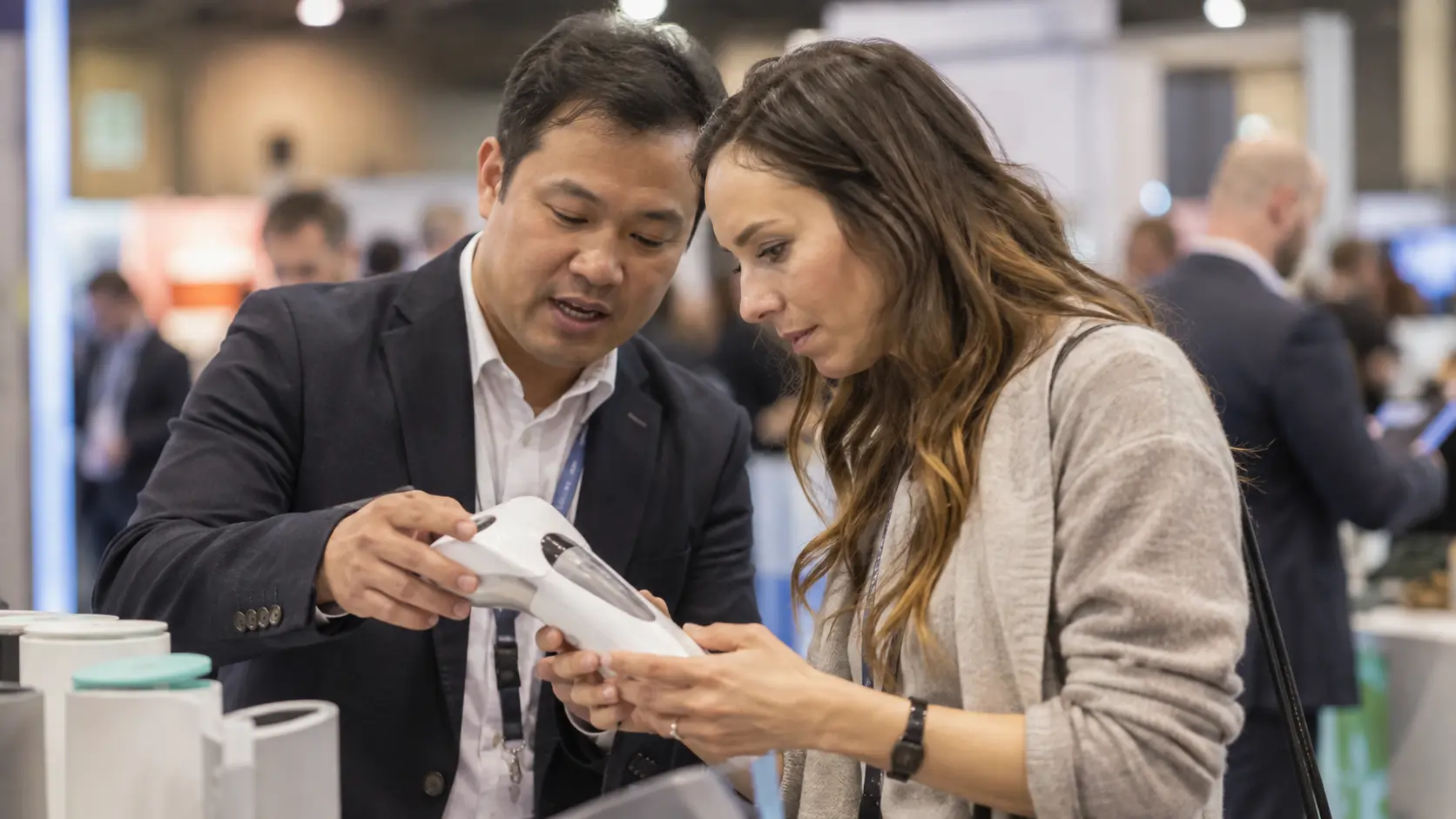
Around 25 percent of attendees said their most critical event offered nothing hands-on. 42 percent deprioritized a vendor because of that absence. And 96 percent said touching or testing a product made them more confident advocating for it internally.
Engineer one real conversation per attendee. 51 percent said they would return if they connected meaningfully with just one person. Not a room full. One. Structured introductions beat an open networking reception.
Design deliberately for a standout moment. Only 40 percent of attendees experienced what Freeman calls a peak moment at their most important event. Of those who did, 85 percent were more likely to return.
Matchmaking between attendees and sponsors. 35 percent of planners named this a top use for AI in 2026, tied with event communications. It is where the industry is actually investing.
Learning with a payoff the attendee can take back. 44 percent measure event value by whether they learned something that benefits their company. Sessions built around transferable outcomes beat thought leadership theater.
Worth noting what drives those peak moments. They came from vendor relationships, learning, and making connections. Not from spectacle.
Popular ideas nobody has measured
Escape rooms, comedians, tug of war, cricket matches, live music, charity auctions. These fill most listicles on this topic.
We looked for outcome data on any of them and found none. That does not make them worthless. Plenty of good events include entertainment. It does mean you should not budget for them expecting a measurable engagement return, because nobody has published one.
The same caution applies to gamification vendors. Claims about scan mechanics lifting booth traffic are everywhere, and none of them are backed by a published study with a sample size.
How to Measure Corporate Event Success
Senior event teams typically track eight to twelve KPIs. A metric describes what happened. A KPI judges it against a goal. Confusing the two produces dashboards nobody acts on.
- Registration to attendance rate. Checked-in divided by registered. Above 80 percent is healthy, below 70 percent points at a promotion or relevance problem.
- Dwell time. Minutes spent in a session or at a booth. Separates presence from interest, which headcount cannot do.
- Post-event NPS. Percentage of promoters scoring 9 or 10, minus percentage of detractors scoring 0 to 6. Passives count in the denominator only.
- Qualified leads. Captured contacts matching your ideal customer profile with demonstrated intent, not badge scans.
- Pipeline influence. Opportunity value touched by attendance, tracked at 30 and 90 days from first interaction.
- Cost per attendee. Total spend divided by attendees. Expect it up in 2026.
- Peak moment incidence. Share of attendees reporting a standout moment. Baseline is 40 percent, and almost nobody measures it.
The last one is the most actionable metric on the list and the least used, for a reason covered in the next section.
The Measurement Gap: Why Organizers Misjudge Their Own Events
This is the finding that reframes everything above.
78 percent of organizers believe they deliver peak moments. 40 percent of attendees experience one. A 38 point gap between what the people running events think happened and what the people attending them report.
The same pattern appears on value. Only 20 percent of organizers thought attendees measured events by exposure to new products. 47 percent of attendees said exactly that.
This is not an opinion about measurement being difficult. It is a measured error, and it has a structural cause.
Consider what instrumentation actually exists in a physical venue. Badge scanning at controlled entry points. RFID badges. Beacon tracking. Lead retrieval apps at booths. Post-event surveys.
Every one of those has the same limitation. Badge scans only fire at gated checkpoints, so a room entrance or a booth scanner produces a data point and everything between checkpoints stays invisible. Missed scans and forgotten badges break the record further.
Surveys carry a different problem. They arrive after the fact and capture recollection rather than behavior, filtered through whoever bothered to respond.
The asymmetry is stark when you compare channels. A digital campaign produces deterministic, real-time logs of every interaction. A ballroom hosting 1,200 people produces a door count.
That is why organizers get their own events wrong by 38 points. They are not careless. They are working from a feedback loop weaker than the one behind a small display ad campaign, while deploying a share of 1.3 trillion dollars.
It also caps what the industry says it wants next. Attendee and sponsor matchmaking is only as good as the behavioral data feeding it. Without a record of what people actually did, there is nothing to match on.
Where VISU Fits
VISU is not event management software. It does not handle registration, ticketing or agendas, and it does not replace the platform you already use for those.
It addresses the layer underneath the measurement gap. Attendees scan a QR code at a touchpoint and receive something for doing it.
That scan produces a record. The interaction happened, at a specific place and time, tied to a person you can reach afterward.
For sponsors that changes the conversation. Instead of selling booth-adjacent foot traffic, you can show verified interactions at the sponsor's touchpoint. Given that 42 percent of attendees penalize vendors offering nothing hands-on, routing attention deliberately is worth more than estimating it.
The honest limit: this measures interaction, not sentiment. It will not tell you whether someone had a peak moment. It tells you who showed up, where they went and what they engaged with, which is the input the survey was guessing at.
Give Sponsors Something Better Than a Door Count
Verified interactions at the sponsor touchpoint, tied to people you can reach after the doors close.
FAQ: Corporate Events
What is considered a corporate event?
Any organized gathering a company hosts to achieve a business objective, whether that is training, selling, celebrating, aligning or launching. It covers internal events such as all-hands meetings, sales kickoffs and team building, and external ones such as conferences, product launches and trade shows. The defining trait is the business goal, not the format or the size.
What are the main types of corporate events?
The most common are conferences, seminars and workshops, team building, sales kickoffs, incentive travel, holiday parties, product launches, town halls, trade shows and executive retreats. The cleanest way to sort them is internal, meaning employee facing, versus external, meaning market facing.
How much does a corporate event cost per attendee?
There is no credible published industry-wide benchmark. The figures circulating online come from vendor pricing pages without methodology. What is documented is direction: in American Express Global Business Travel's 2026 forecast, more than 70 percent of meeting professionals expected cost per attendee to rise in 2026, with 38 percent expecting a slight increase and 27 percent a moderate one.
How big is the corporate events industry?
Business events generated 1.3 trillion dollars in direct spending in 2025, drew 1.65 billion participants, and supported 1.8 trillion dollars in global GDP along with 24.2 million jobs, according to the Events Industry Council study modeled by Oxford Economics. Direct spending is forecast to reach 1.6 trillion dollars by 2028.
How do you measure the success of a corporate event?
Combine attendance quality such as registration to attendance rate and dwell time, sentiment through post-event NPS, and business outcomes including qualified leads, pipeline influence and cost per attendee. Most senior teams track eight to twelve KPIs. The most overlooked is whether attendees actually had a standout moment, since only 40 percent do while 78 percent of organizers believe they deliver one.
What corporate event ideas actually increase engagement?
The evidence points to hands-on product interaction, since 42 percent of attendees deprioritized a vendor for lacking it, structured one-to-one matchmaking, since 51 percent would return after a single meaningful connection, and designing explicitly for standout moments, since 85 percent of attendees who have one return. Popular ideas such as escape rooms and comedians have no published outcome data.