
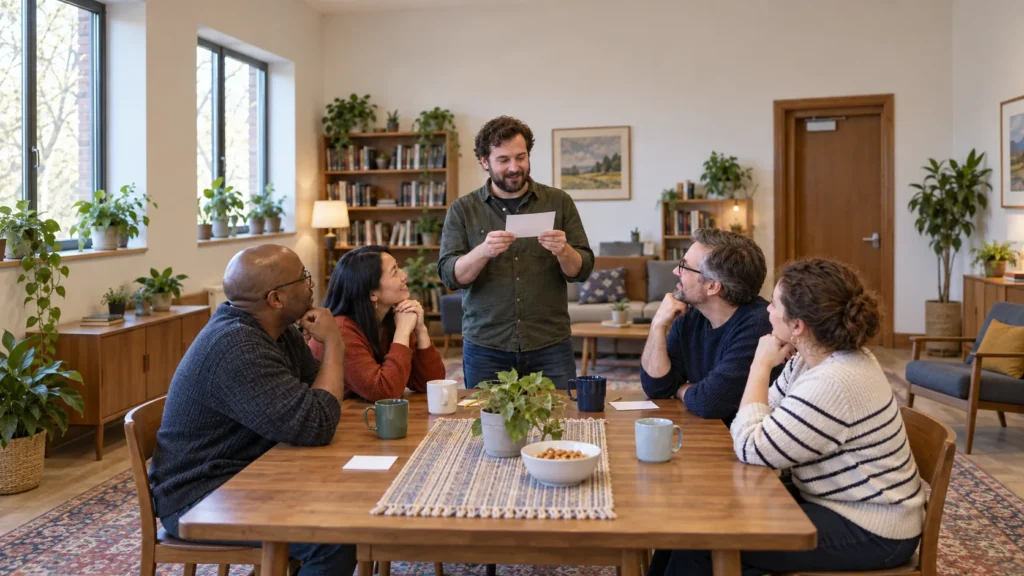
One moderator reads while two teams listen. Each tossup adds clues toward one answer; the bonus drills let teammates discuss. This original mini-packet contains six tossups and nine bonus parts. Keep this host copy off players’ screens because the answers and acceptance notes appear below each question.
Keep Practice Resources Together
A VISU Link page can point to your meeting details, external sign-up form and study resources. Keep this answer-bearing host page separate while playing.
Set up this practice format
Choose a moderator and two small teams. Agree on a signal before starting: a buzzer or a raised hand the moderator can recognise. During a tossup, teammates do not confer. During a bonus, they may discuss and write a shared answer.
PACE’s concise rules explain the distinction between individual tossup attempts and team bonus conferral. This packet adapts that structure for a short practice session; it is not an official PACE, NAQT or ACF tournament packet.
Read each tossup’s three sentences continuously and stop when you recognise a signal. Do not read the answer or acceptance note aloud beforehand. Read all remaining clues after the question has been settled so the group can learn what it missed.
Scoring and response rules
A correct tossup is worth 10 points. Give the recognised player five seconds to begin an answer. Each team gets one attempt per tossup; an incorrect answer locks that team out while the moderator resumes for the other team. There is no negative score or early-answer power bonus.
If an answer is incomplete, use the acceptance note. One neutral request for specificity is allowed, with five more seconds; it is part of the same attempt, not an invitation to offer a different guess. If neither team answers correctly, reveal the answer and award zero.
If the moderator cannot distinguish simultaneous signals, stop that tossup for scoring and discuss it without points. Do not decide a disputed signal by having players shout louder.
After each pair of tossups, both teams receive the three-part bonus. Read one part, allow ten seconds of discussion, and have each team lock a written answer before revealing it. Each correct part is worth 10; there are no bouncebacks. These shared written bonuses are the practice adaptation, rather than a bonus awarded only to a tossup winner.
A team can score up to 60 on six tossups and 90 on nine bonus parts: 150 in total. This is a per-team maximum, not a single pool shared by both teams. Leave an overall tie as a draw.
| Component | Maximum per team |
|---|---|
| Six tossups × 10 | 60 |
| Nine bonus parts × 10 | 90 |
| Total | 150 |
Accept the named order, genus/species or instrument and a clear equivalent in the chosen language. For Bonus 2A, Ginkgo is enough; for 2B, Welwitschia is enough; for 2C, require the genus Victoria. Glass harmonica is accepted for glass armonica, but an ordinary mouth harmonica is not.
Round 1: Tossups 1–2 and Bonus 1
Tossup 1
Metal plates on the front and back of this object carried instructions among densely written inscriptions. Those inscriptions concern astronomy and calendars, and the instrument was used for forecasts in those fields. Name the ancient scientific mechanism recovered with finds from the Antikythera shipwreck and held by the National Archaeological Museum in Athens.
Answer: Antikythera mechanism
Acceptance: Accept Antikythera mechanism or Antikythera astronomical calculator; not merely a clock or the island.
Tossup 2
This message carrier is a twelve-inch copper disc plated with gold. Its contents include natural sounds, music and spoken greetings in fifty-five languages. Name the phonograph record placed aboard both Voyager spacecraft to present life and culture on Earth to possible extraterrestrial listeners.
Answer: Voyager Golden Record
Acceptance: Accept Golden Record or Sounds of Earth when clearly identifying the Voyager record; prompt on record alone.
Bonus 1: Greek architectural orders
Part A. Which Greek order is identified by a capital with two prominent scrolls, called volutes?
Answer: Ionic
Part B. Which Greek order has a bell-shaped capital decorated with acanthus leaves?
Answer: Corinthian
Part C. Which Greek order has a frieze alternating triglyphs and metopes?
Answer: Doric
Share the Next Session’s Links
Gather the public resources you want to use after the round. VISU Link does not score this packet or recognise player signals.
Round 2: Tossups 3–4 and Bonus 2
Tossup 3
This Japanese work is a woodblock print made with ink and colour on paper. It belongs to Hokusai’s Thirty-six Views of Mount Fuji series. Name Hokusai’s print whose title places the viewer under a wave off Kanagawa.
Answer: The Great Wave off Kanagawa
Acceptance: Accept The Great Wave, Under the Wave off Kanagawa or an equivalent title; Hokusai alone names the artist, not the work.
Tossup 4
Hannes Meyer and Ludwig Mies van der Rohe were successive directors of this school. Its history moved from Weimar to Dessau in 1925 and then to Berlin in 1932. Name the art and design school founded in Weimar in 1919 by Walter Gropius.
Answer: Bauhaus
Acceptance: Accept Bauhaus or the Bauhaus school; not only Gropius, modernism or the Dessau building.
Bonus 2: Recognise the plant name
Part A. Name the tree with distinctive fan-shaped leaves often divided into two lobes.
Answer: Ginkgo biloba
Part B. Name the Namib Desert plant known for its two leaves; its genus commemorates Friedrich Welwitsch.
Answer: Welwitschia mirabilis
Part C. Give the genus, not a species: which giant-waterlily genus was named after Britain’s Queen Victoria?
Answer: Victoria
Round 3: Tossups 5–6 and Bonus 3
Tossup 5
Holes in a linked chain of cards determine which warp threads this machine raises for a pass of its shuttle. Demonstrated in Lyon in 1801, it could reproduce complex patterns in silk. Name the punched-card-controlled weaving loom associated with Joseph Marie Jacquard.
Answer: Jacquard loom
Acceptance: Accept Jacquard loom or Jacquard weaving mechanism; prompt on loom alone.
Tossup 6
Institutions depositing material here keep ownership, and only the depositor can withdraw its own material. Its storage conditions include minus eighteen degrees Celsius, and genebanks send duplicate seed collections to it. Name this Norwegian global seed-backup facility associated with the Arctic archipelago of Svalbard.
Answer: Svalbard Global Seed Vault
Acceptance: Accept Svalbard Seed Vault or equivalent full name; prompt on seed bank without the location.
Bonus 3: How instruments make sound
Part A. Name the electronic instrument played without physical contact, whose pitch changes as the player moves a hand near an antenna.
Answer: Theremin
Part B. Benjamin Franklin completed which instrument in 1761, using nested glass bowls that rotate and sound when touched with moistened fingers?
Answer: Glass armonica
Part C. Name the keyboard instrument whose hammers strike metal plates, heard in Tchaikovsky’s Dance of the Sugar Plum Fairy.
Answer: Celesta
Review the clues after playing
After scoring, ask which clue led to each answer. A fast correct response and a late correct response both earn 10 here, but recording the clue where recognition happened can guide what the group studies next. It is a practice note, not a calibrated ability score.
Use the same language for a round. The EN, BR and ES copies preserve the clue sequence and facts; reading another language after an incorrect answer would add a new opportunity. Accept accents and equivalent names according to the answer notes, not an exact pronunciation test.
For direct single-question prompts rather than progressive clues, use trivia questions for adults. If your group wants a separate music round, music trivia questions offers that different format.
Keep disputed factual answers for a source check after the round. The references below identify the museums, institutions and educational sources behind this original packet. No result from a live practice session is claimed.
Make the Follow-up Easy to Find
Share one page address or its QR code for the resources you choose. Keep personal participant details in your own appropriate private channel.
Frequently Asked Questions
Is this an official tournament packet?
No. It is an original short practice packet with an explicitly adapted scoring format. Consult the actual organiser’s rules for a competition.
How many answers are in the packet?
There are six tossup answers and nine bonus-part answers, for fifteen answer lines. Each tossup has three progressively revealing clues.
Can teams discuss a tossup?
Not in this practice format. Teams may discuss the bonus parts and submit written answers, but tossup attempts are made without conferral.
What is the maximum score?
A team can earn 60 points from six tossups and 90 from nine bonus parts, for 150. Both teams answer the written bonuses, so 150 is not the combined match total.
Do incorrect early answers lose points?
No. This training format has no negative scores or power bonuses. An incorrect attempt locks that team out of the current tossup.
Do we need buzzers?
You can use a signal agreed with the moderator, such as a raised hand. If the moderator cannot separate simultaneous signals, the tossup is discussed without points.
References
- PACE: Concise Rules of Tossup/Bonus Quizbowl
- National Archaeological Museum: inscriptions
- National Archaeological Museum: collections
- NASA: Golden Record Overview
- The Met: Under the Wave off Kanagawa
- Bauhaus Dessau Foundation: chronology
- Computer History Museum: Jacquard loom
- NordGen: Seed Vault FAQ
- The Met: Architecture in Ancient Greece
- Kew: Ginkgo biloba
- Kew: The living fossil
- Kew: Giant waterlily research
- Science Buddies: Theremin project
- Franklin Institute: Glass Armonica
- Schiedmayer: The celesta