
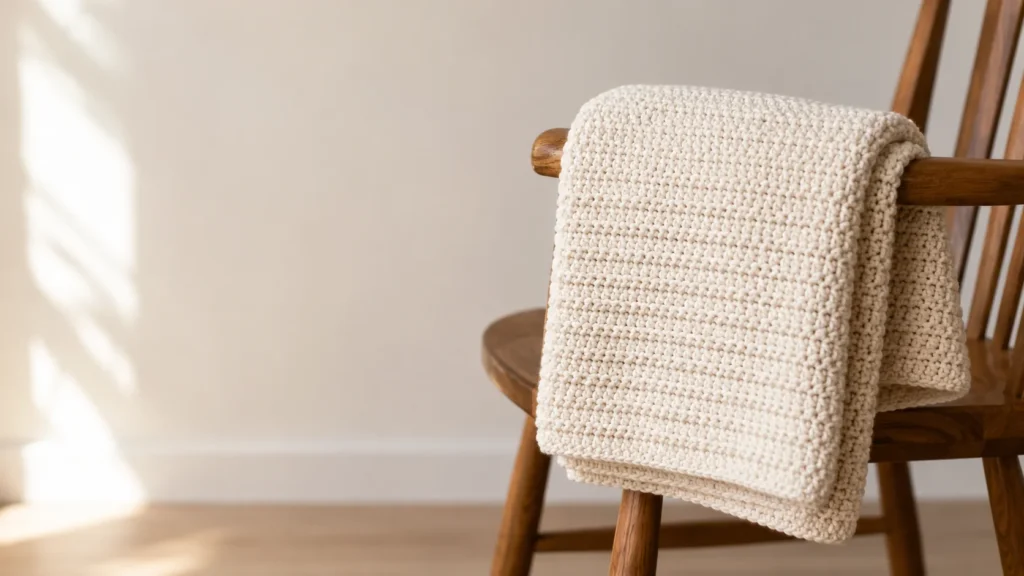
The Straight Edge Baby Blanket: a complete, free crochet blanket pattern in one stitch, worked flat in rows, with edges that actually stay straight. Half double crochet in bulky yarn on a 9 mm hook, 68 stitches by 60 rows, about 30 by 34 inches finished, and every number below was calculated and re-derived in code before publishing.
This is the fourth project in our crochet series. If you have never held a hook, start with the crochet patterns for beginners hub, which decodes every abbreviation in full. The coaster teaches color changes at a friendly size, and the basket covers working in the round; this post is the big flat one, where the whole game is keeping a long edge straight.
One Link for Everything You Make
A short address you control, pointing to your projects, your pages and everything else you share.
What You Will Make
A baby blanket of 30.2 by 34.3 inches (76.8 by 87.1 cm), worked flat in rows of half double crochet with no shaping, no increases, no decreases and no required color changes. One honesty note that most patterns skip: these dimensions are our design decision, not an industry standard. There is no published standard for blanket sizes from the Craft Yarn Council or any equivalent body; we looked, and no such chart exists. We chose this size because it suits a crib and a stroller and keeps a first blanket finishable, and the formula at the end recalculates everything for any size you prefer.
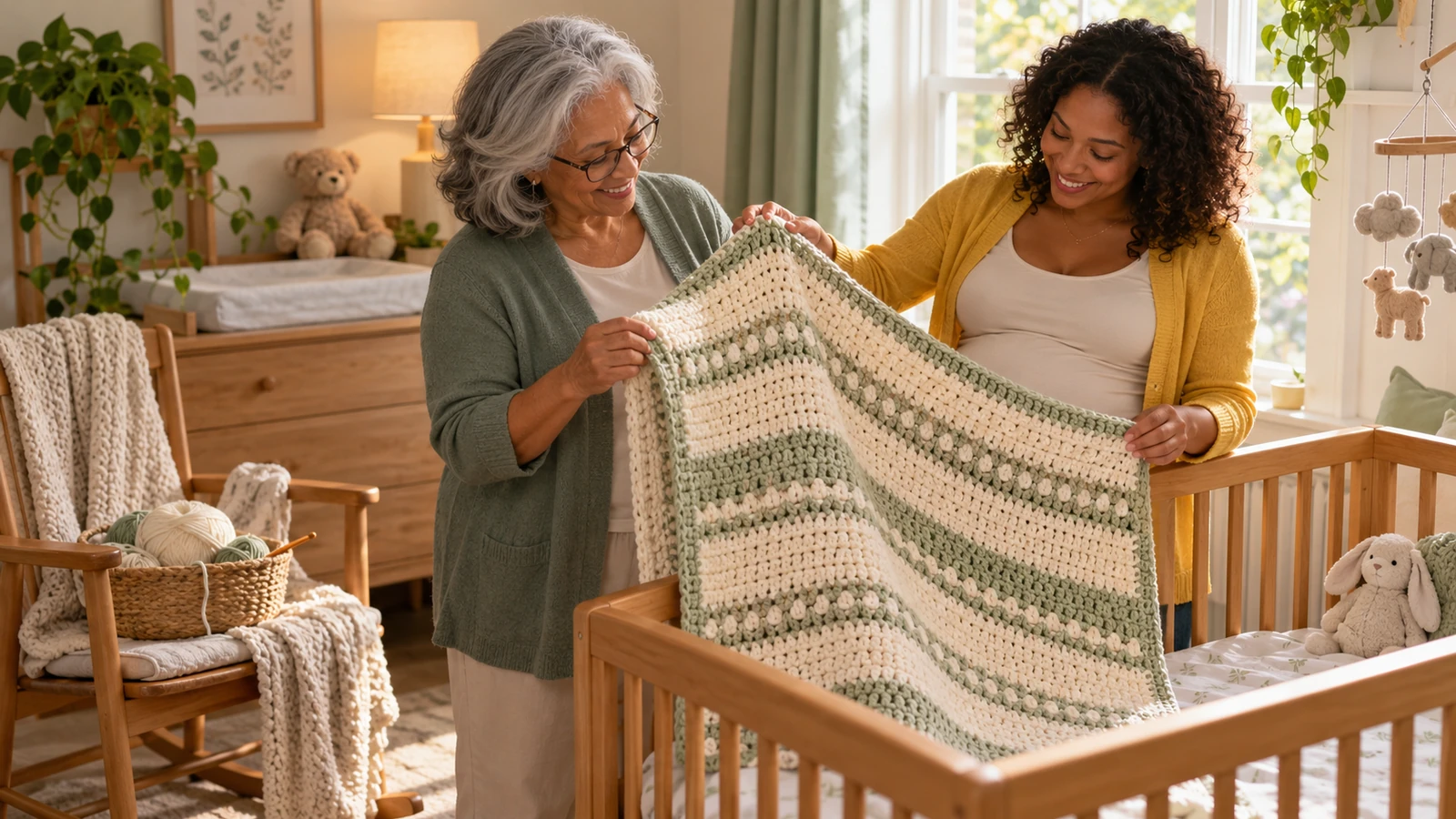
Why half double crochet and not the usual single crochet? Two reasons, and the second is the surprise. Speed: an hdc row is taller, so this blanket takes 60 rows where single crochet would take around 78. And ease at this scale: over a 30 inch row, single crochet's tight top edge makes the last stitch genuinely hard to see, which is exactly how beginners gain or lose a stitch at the edge; hdc's taller post keeps that final stitch visible. On a coaster, sc is easier. On a blanket, hdc is.
One Warning First: US and UK Terms Collide
This pattern uses US terms. The Craft Yarn Council's crochet abbreviation standard, which covers US, UK and Canadian usage, documents the collision: the same words name different stitches on each side of the Atlantic. Our half double crochet (hdc) is the UK's half treble (htr); the UK's "double crochet" is our single crochet. A UK reader who sees hdc and works a UK dc will produce a blanket roughly a quarter shorter than stated, in a different amount of yarn. If you learned UK terms: our hdc is your htr, and everything else follows the table in any conversion chart.
What You Need
Yarn: bulky weight, Craft Yarn Council category 5. Smooth and plied, in a light or medium color: stitch definition is what lets you see the top of each stitch, and seeing the top of the last stitch in a row is this pattern's entire edge game. Avoid dark, fuzzy, chenille and novelty yarns. For a baby blanket, machine-washable yarn and genuine softness are worth prioritizing.
Quantity: the blanket uses an estimated 1,707 to 2,131 yd (1,561 to 1,949 m). Buy at least 2,500 yd (2,286 m); the estimate is a convention, not a guarantee. Depending on skein size that is roughly 13 skeins at 200 yd, 15 at 170 yd, or 17 at 150 yd. And a warning this project genuinely needs: buy all skeins in one purchase, from the same dye lot, spare included. A dye lot difference across a 30 inch blanket shows as a visible band.
Hook: 9 mm (US M/N-13). Go by the millimeters: CYC's own guidance says letter and number sizing vary from company to company, so the package's mm figure is the accurate one. The category 5 standard calls for hooks from 6.5 to 9 mm, so ours sits at the top of the range, which is what makes this blanket fast.
Notions: scissors and a tapestry needle for weaving in ends. No stitch markers; this is worked flat in rows.
Gauge, and Why It Matters More on a Blanket
Gauge: 9 hdc and 7 rows = 4 in / 10 cm on a 9 mm hook. Two honest notes: the stitch gauge of 9 sits inside the category 5 standard range of 8 to 11 and is our chosen value within it, and the row gauge of 7 is a design input with no external source, because CYC publishes no crochet row gauge for any category. Confirm both with your swatch.
Gauge swatch: ch 20, hdc in the 3rd chain from the hook and in each chain across (18 hdc), then work Row 2 as in the pattern for 13 more rows, for 14 rows in total. Fasten off and measure across the middle, never at the edges. The stakes are bigger here than on any small project: at 8 hdc per 4 in instead of 9, the same 68 stitches produce a blanket 34 inches wide instead of 30.2, nearly 4 inches out, and about 12% more yarn, not because you work more stitches but because each stitch is bigger. Swatch.
Track the Rows, Share One Link
Your progress photos, your pages and everything else you share, behind one short address.
The Pattern
At a glance: ch 70 · 9 mm hook · 9 hdc per 4 in · 68 stitches · 60 rows · buy at least 2,500 yd.
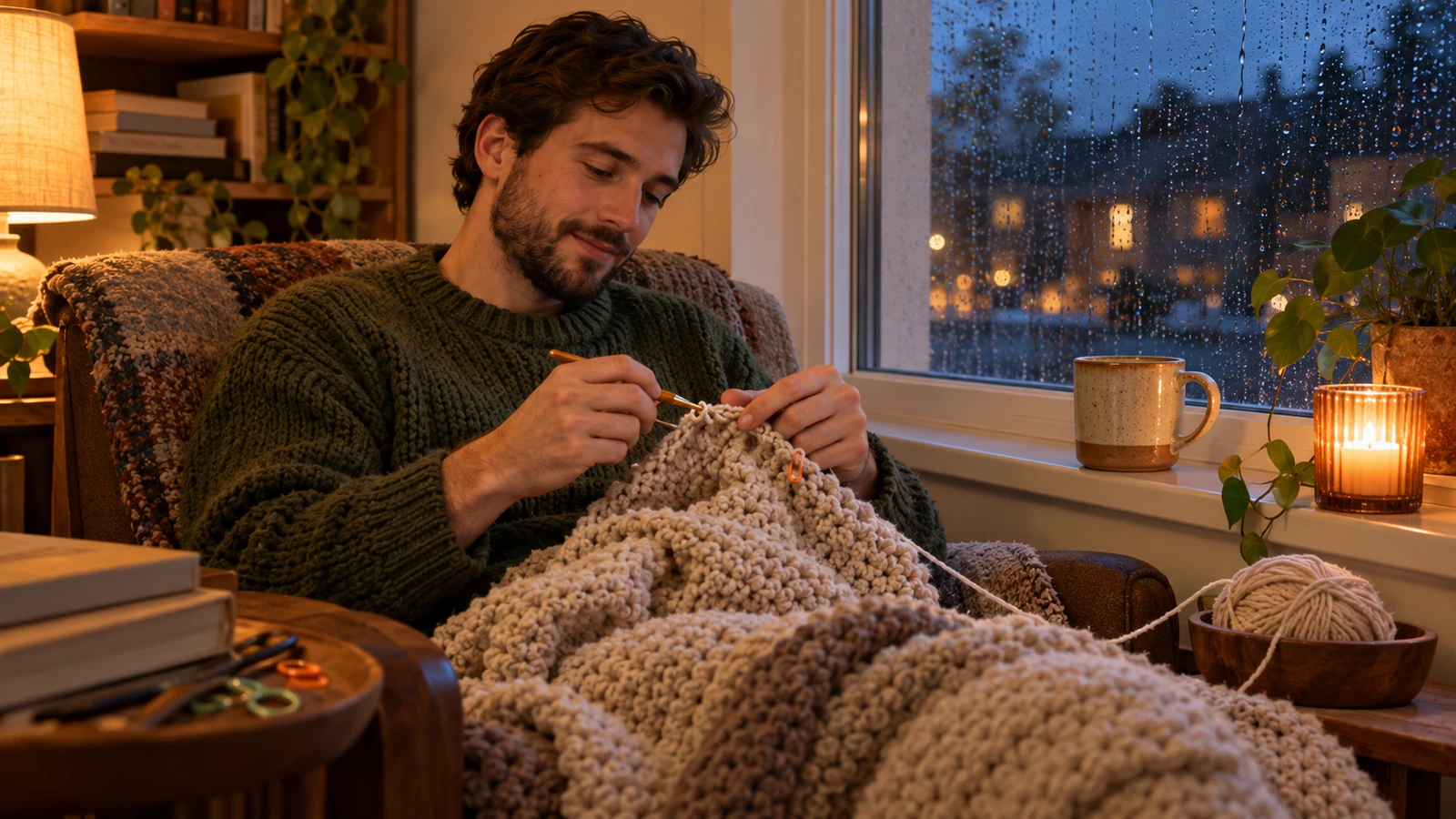
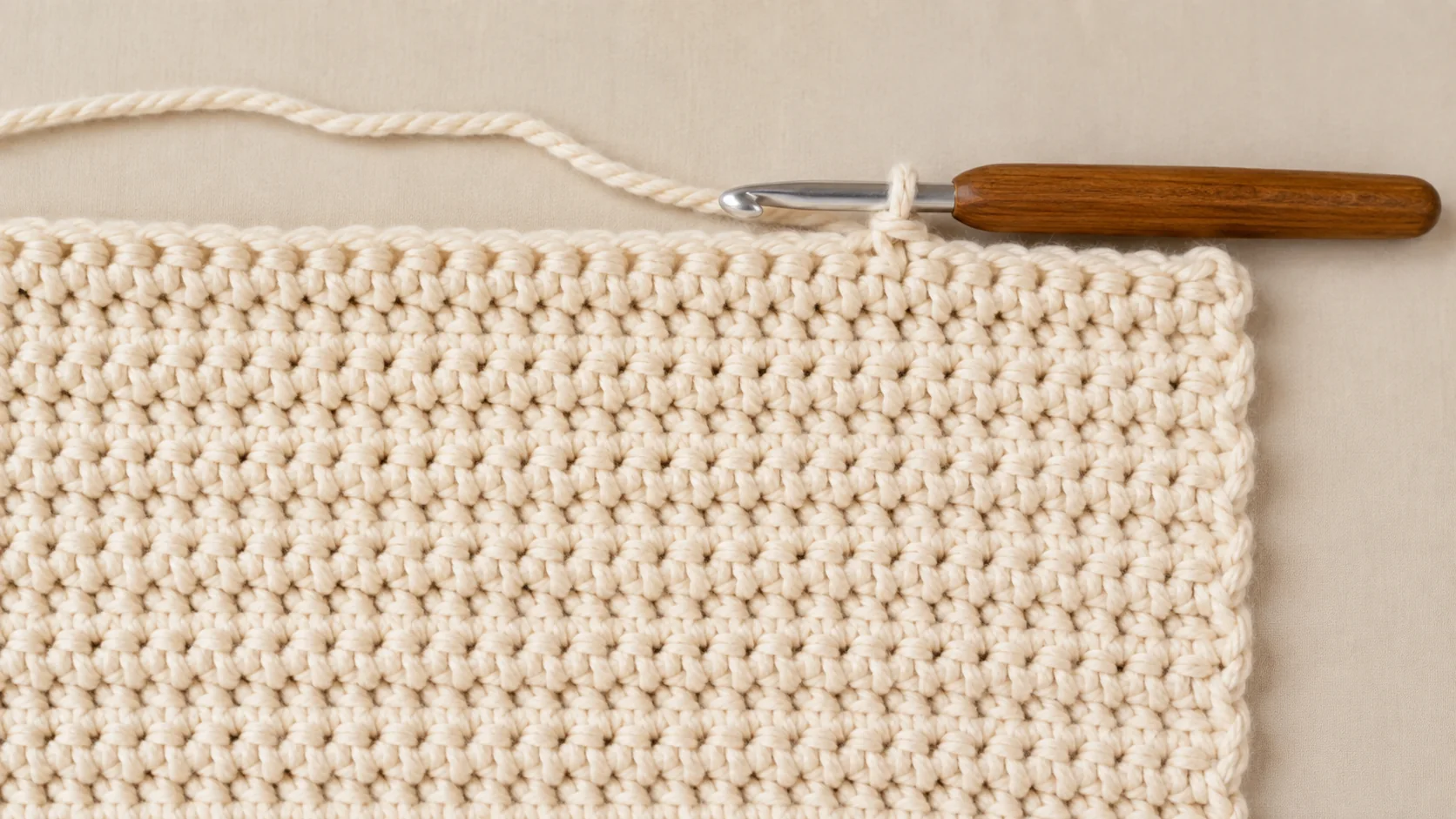
🔴 Read this before your first row. Every row of this blanket starts with ch 2, and that turning chain does NOT count as a stitch. After you turn, work your first hdc into the very first stitch of the row, not into the second. Every row ends with 68 hdc, from the first row to the last. If your count is 67 or 69, the fix is in this rule, and over 60 rows this one rule is the difference between straight edges and a slow diagonal drift.
Foundation: ch 70.
Row 1: hdc in the 3rd chain from the hook, counting the loop on your hook as zero, and in each chain across. In plain words: skip the first two chains, then work into the next one. (68 hdc)
Row 2 and every row after: ch 2, turn, hdc in each stitch across. (68 hdc)
Repeat Row 2 fifty-nine times, for 60 rows in total. The check along the way: the finished body measures about 34.3 in / 87.1 cm. Fasten off if you are not adding the border, weave the ends in along the back of a row for at least 2 in / 5 cm, and trim.
The Border (Optional, One Round)
A reader who stops at Row 60 has a finished blanket. If you want a frame: with the right side facing, join the yarn with a slip stitch in any corner and ch 1. Work 1 sc in each stitch along the top and bottom edges, 1 sc in the end of each row along the two side edges, and 3 sc in each of the four corners. Join with a slip stitch to the first sc and fasten off. (268 sc: 136 along top and bottom, 120 along the sides, 12 in the corners.)
Why 3 sc in each corner: one stitch pulls the corner into a pucker; three let the fabric turn flat. And the honesty note about the sides: row ends are not stitches, so "1 sc in the end of each row" involves judgement. If the side edges ripple, you put in too many; if they pull in, too few. Adjusting by eye is the correct technique, not a failure.
Variations: Lap Size and Stripes
Lap blanket, 36 x 48 in / 91 x 122 cm: ch 83 for 81 hdc, work 84 rows. That is 6,804 stitches against the baby blanket's 4,080, roughly 2,817 to 3,518 yd of yarn, so buy at least 4,000 yd. It is a much larger commitment; know that going in.
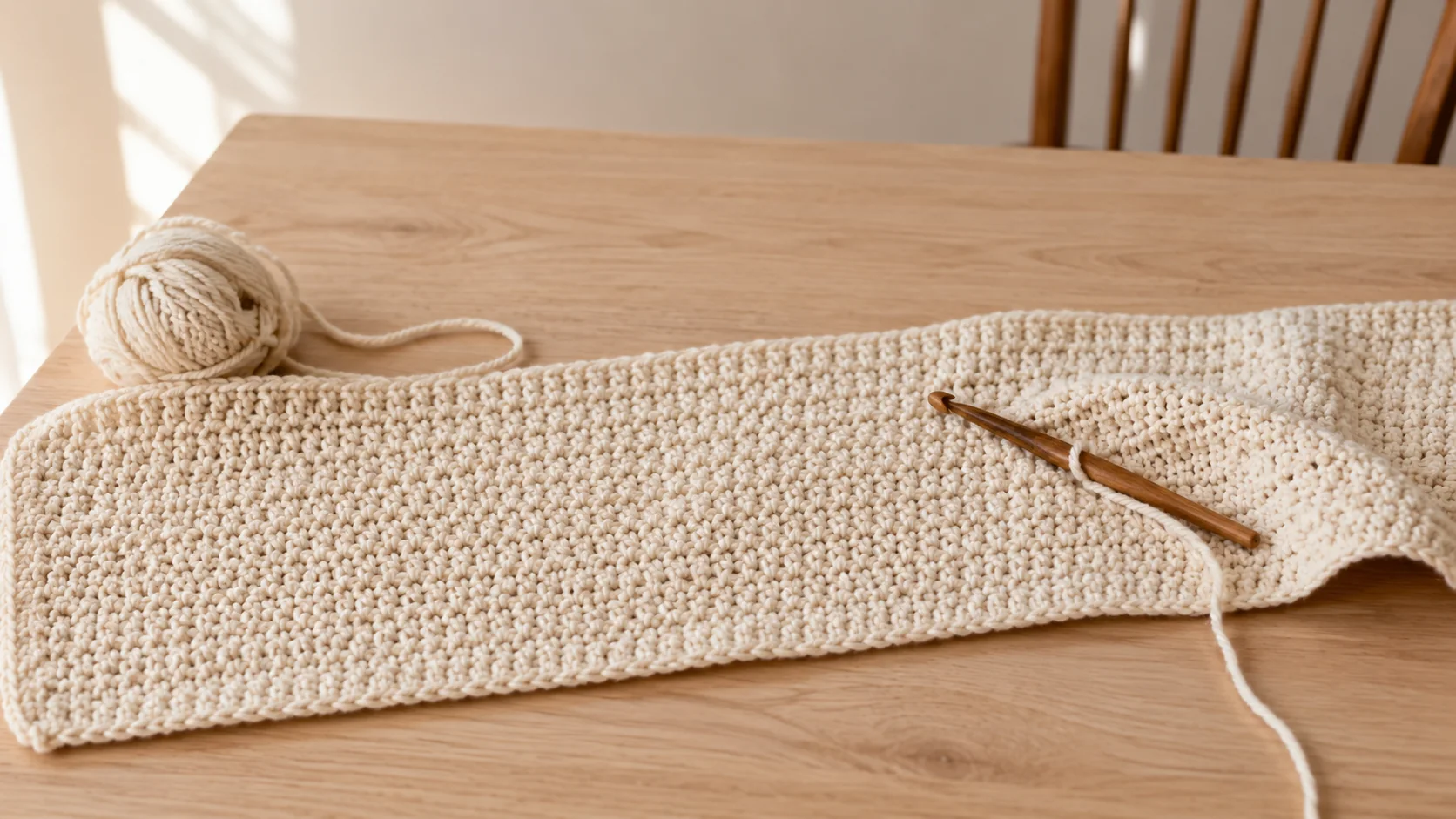
Stripes: 60 rows divides evenly into 15 four-row bands, 12 five-row, 10 six-row or 6 ten-row bands. Change color at the start of a row; the mechanics of a clean color change live in the coaster pattern, which teaches them at a friendlier size. No color changes are required for the blanket itself.
If Your Gauge Does Not Match (or You Want Another Size)
Two formulas resize everything:
Foundation chain = round(desired width in inches × your stitches per inch) + 2. Rows = round(desired height in inches × your rows per inch). Your stitches per inch is your swatch's stitch count divided by 4; same for rows. The + 2 is not optional: two chains are consumed at the start of Row 1, and dropping them makes the blanket two stitches narrower than calculated.
| Your gauge (hdc / 4 in) | Per inch | Chain | Stitches | Actual width |
|---|---|---|---|---|
| 8 hdc | 2.00 | 62 | 60 | 30.00 in / 76.2 cm |
| 9 hdc (pattern gauge) | 2.25 | 70 | 68 | 30.22 in / 76.8 cm |
| 10 hdc | 2.50 | 77 | 75 | 30.00 in / 76.2 cm |
| 11 hdc | 2.75 | 85 | 83 | 30.18 in / 76.7 cm |
| Your row gauge (rows / 4 in) | Per inch | Rows | Actual height |
|---|---|---|---|
| 6 rows | 1.50 | 53 | 35.33 in / 89.7 cm |
| 7 rows (pattern gauge) | 1.75 | 61, we use 60 | 34.29 in / 87.1 cm |
| 8 rows | 2.00 | 70 | 35.00 in / 88.9 cm |
| 9 rows | 2.25 | 79 | 35.11 in / 89.2 cm |
One declared exception: the formula gives 61 rows at pattern gauge, and we chose 60 so the row count divides evenly for stripes, at a cost of 0.71 in of height. If you follow the formula and get 61, you have not made a mistake. And remember the yarn: a looser gauge means a wider blanket and meaningfully more yarn, so buy the extra skein up front, in the same dye lot. When the blanket is done, the hub has the next project, and the basket is there when you want to try working in the round.
Show Off the Finished Blanket
One VisuLink holds your projects, your pages and everything else you share.
FAQ
How much yarn do I need to crochet a blanket?
For this 30 by 34 inch baby blanket in bulky yarn, an estimated 1,707 to 2,131 yd; buy at least 2,500 yd, all in one purchase and the same dye lot. The 36 by 48 inch lap variation needs at least 4,000 yd. Looser gauge uses more.
What is the easiest crochet stitch for a blanket?
At blanket scale, half double crochet. Single crochet is simpler on paper, but over a 30 inch row its tight top edge hides the last stitch, which is how edges go crooked. Hdc is taller, faster (60 rows instead of about 78 here) and keeps the row's final stitch visible.
Does the turning chain count as a stitch?
In this pattern, no. Every row starts with ch 2 that does not count, and the first hdc goes into the very first stitch of the row. Every row ends with 68 hdc; a count of 67 or 69 almost always traces back to this rule.
What size is a baby blanket?
There is no published industry standard; blanket sizes vary between makers and countries, and the Craft Yarn Council publishes no blanket chart at all. This pattern's 30 by 34 inches is a design choice that suits a crib and stroller, and the resize formula adapts it to any dimensions you want.
Why are the edges of my crochet blanket crooked?
Almost always a stitch gained or lost at the row ends, and the usual culprit is treating the turning chain as a stitch or missing the first stitch after turning. Count every row: 68 means straight edges; anything else compounds over 60 rows into a visible slant.