
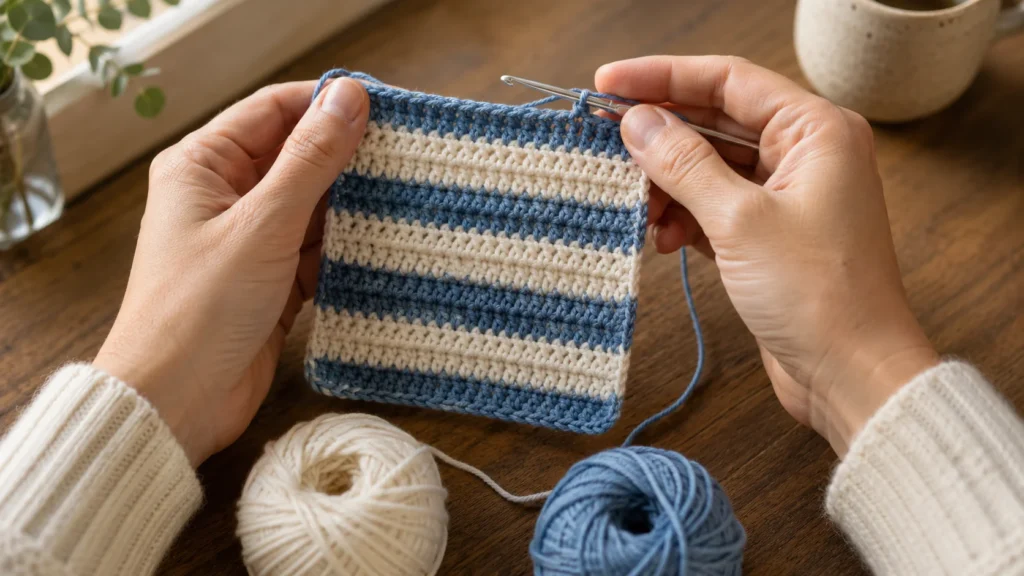
Your first real crochet pattern should fit in an afternoon and survive a coffee mug. This striped coaster is exactly that: one stitch, two colors, fourteen stitches a row, and every skill it teaches, counting, clean edges, changing colors, is the skill every bigger pattern assumes you have.
This is an original basic-level pattern in US terms, written the long way on purpose: every row spelled out, every classic beginner trap flagged where it happens. If you have never read a pattern before, the crochet patterns for beginners hub decodes the abbreviations; this page assumes only that you can chain and single crochet.
One Link for Everything You Make
A short address you control, pointing to your project photos and favorite patterns wherever they live.
Materials and Gauge
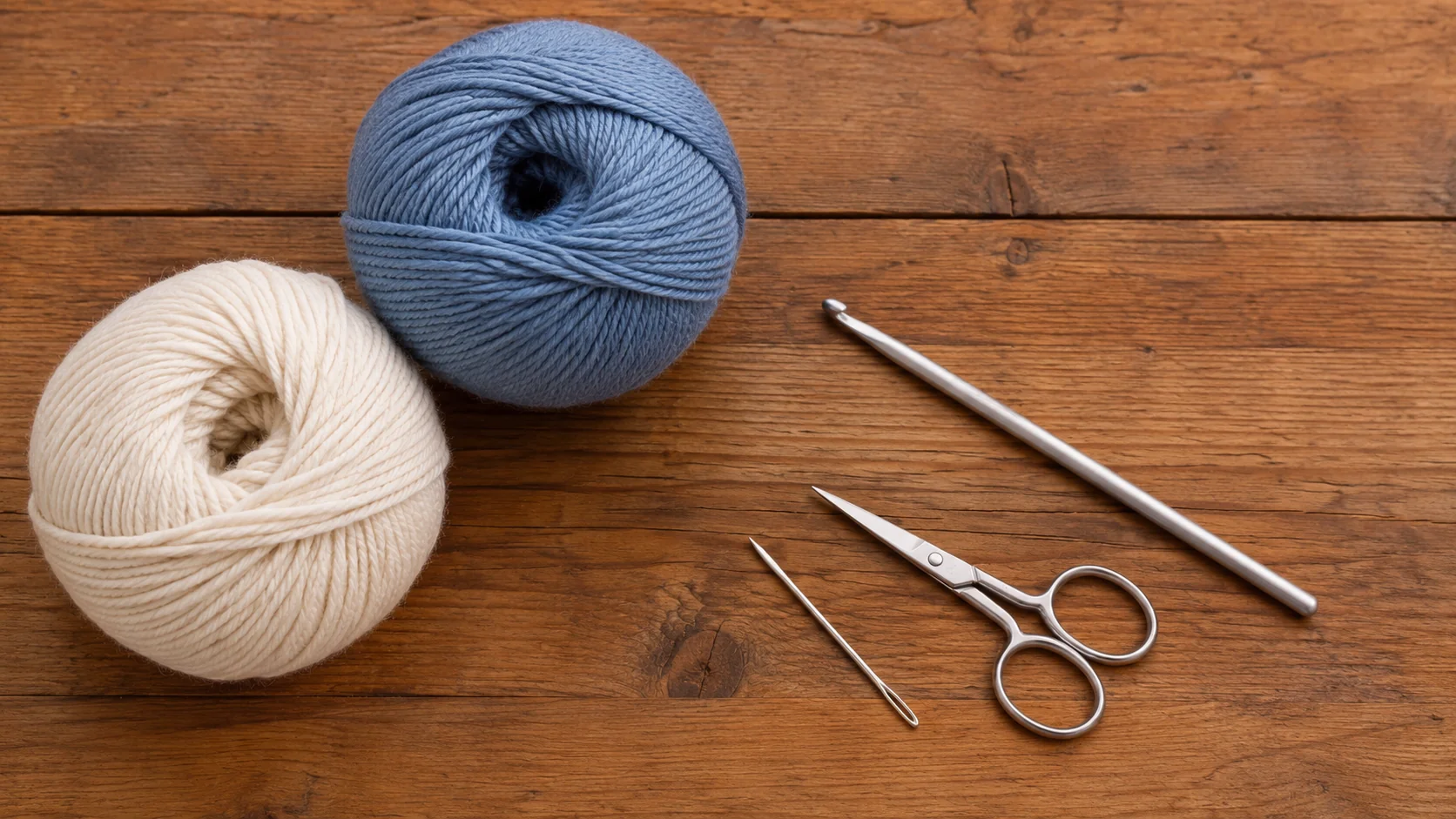
Yarn: worsted weight cotton (category 4) in two colors, Color A and Color B. Cotton takes heat and washing, which is the whole job of a coaster. Scraps work: this project uses only part of a ball of each color.
Hook: 5 mm. Also: scissors and a yarn needle for weaving in ends.
Gauge: 14 single crochet and 16 rows = 10 cm. At that gauge the coaster comes out at approximately 10 by 10 centimeters; your tension will vary it a little, and a coaster forgives every variation. One honest note about single crochet: stitches are wider than rows are tall, which is why this square uses 14 stitches but 16 rows. Patterns that use the same number of each produce rectangles pretending to be squares.
The Pattern, Row by Row
US terms. The turning ch 1 never counts as a stitch and is never worked into.
Foundation: with Color A, ch 15. If your chains run tight, chain with a hook one size larger, then switch back for Row 1.
Row 1: sc in 2nd ch from hook and in each ch across. 14 sc. Ch 1, turn. Count now: fourteen. This checkpoint is the pattern's foundation stone.
Row 2: sc in each sc across. 14 sc. Ch 1, turn.
Rows 3 and 4: repeat Row 2. That completes the first Color A stripe.
Rows 5 to 8: switch to Color B (the clean method is in the next section) and work 4 rows of sc, 14 sc each row.
Rows 9 to 12: switch back to Color A, 4 rows.
Rows 13 to 16: switch to Color B, 4 rows. 16 rows total, four stripes.
Finish: fasten off, leaving a 15 cm tail. Weave all tails into same-color stripes with the yarn needle.
Keep Your Craft Life in One Place
Link your project gallery, pattern bookmarks and progress photos from one short address.
Changing Colors Without the Ugly Seam
The secret every striped project shares: the new color enters one stitch early. Work the final sc of the last row of a stripe until 2 loops remain on the hook. Stop. Yarn over with the new color and draw it through both loops to complete the stitch. That finishing loop is what paints the top of the stitch, so completing it in the new color makes the stripe line crisp instead of jagged.
Then: cut the old color leaving a 15 cm tail, ch 1 in the new color, turn, and carry on. The turning chain must be new-color too, or a stray loop of the old color sits on the edge of every stripe forever. Four color changes in this coaster means four chances to make this move automatic, which is precisely the point of the project.
The Three Traps That Make Trapezoids
Trap one: missing the last stitch. The final sc of every row goes into the last stitch of the row below, the one hiding right under the turning chain. Skip it and the piece loses a stitch per row, narrowing into a trapezoid. The cure is mechanical: count 14 at the end of every row.
Trap two: working into the ch 1. The turning chain is scaffolding, not a stitch. Put an sc into it and the piece gains a stitch per row, widening into the other trapezoid. Fourteen, every row.
Trap three: reading "Rows 2 to 16" as sixteen more rows. It is fifteen more after Row 1, sixteen total. When in doubt, count stripes: four blocks of four.
Finishing and Washing
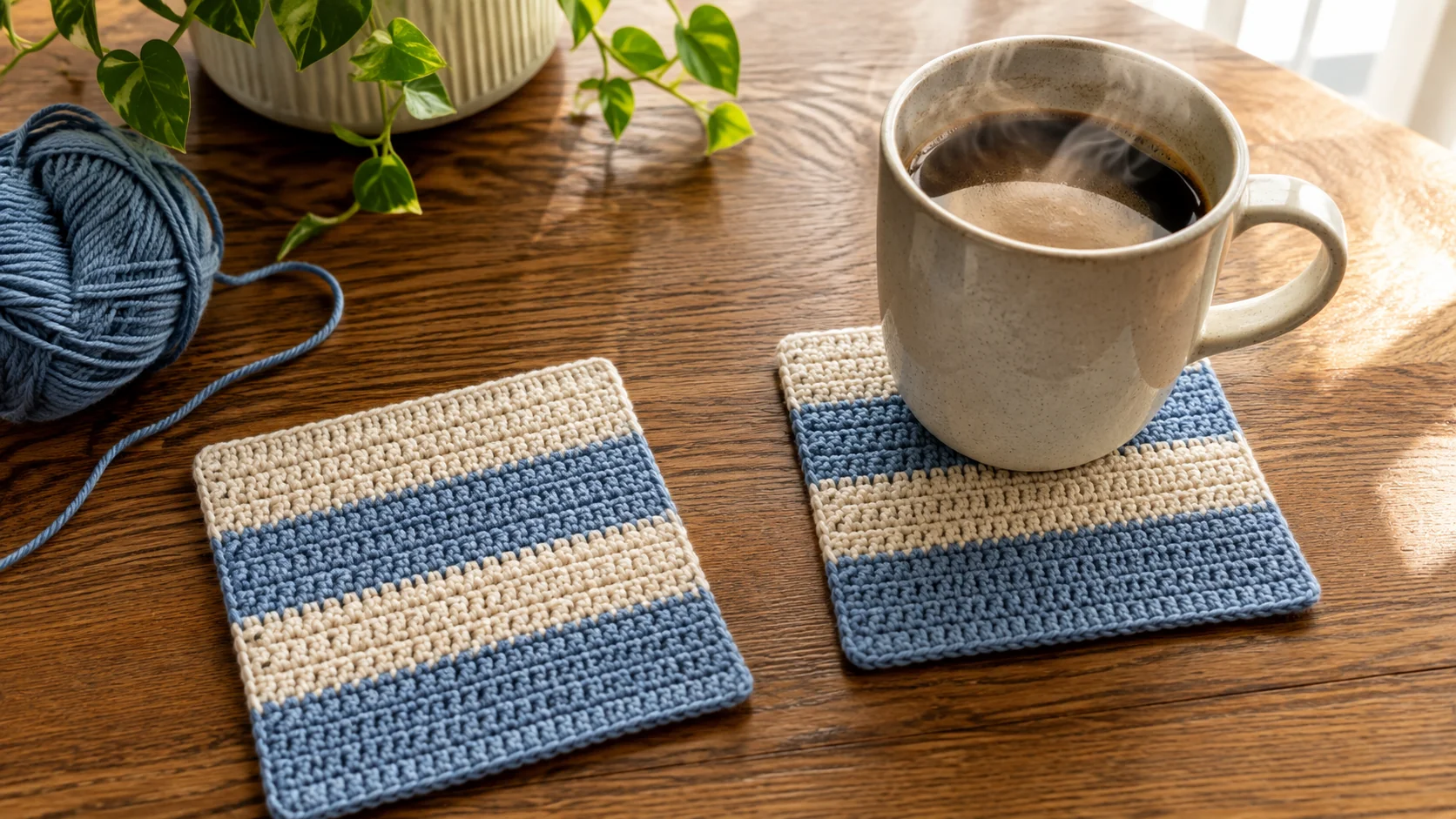
Weave each tail into its own color stripe, changing direction once mid-weave so the tail locks in place, then trim close. If the coaster curls at the corners, wet it, press it flat between two towels under a book overnight, and it behaves; cotton blocks beautifully.
Care is the easy part: cotton coasters go in the wash with the towels. Skip the dryer's hottest setting and they keep their shape for years, which is more than can be said for the mugs.
Make It Yours: Variations
A set of four uses the same pattern with the stripe colors swapped on alternating coasters, and a set is a gift where a single is a swatch. A mug rug is the same pattern with a longer foundation: ch 23 for 22 sc, same 16 rows. Thinner stripes: change every 2 rows instead of 4, doubling the color-change practice. And once the counting habit is automatic, the washcloth in the beginner patterns hub is the same fabric at four times the size.
Share the Finished Projects, Not Ten Links
One VisuLink holds your maker gallery, your pattern list and everything else you share.
FAQ
How long does this crochet coaster take?
An afternoon for a first-timer, under an hour once the counting habit settles. The four color changes are the only slow part, and they are the skill the project exists to teach.
Why 14 stitches but 16 rows for a square?
Single crochet stitches are wider than their rows are tall. Fourteen stitches across and sixteen rows up land at roughly the same 10 cm at standard worsted gauge, which is what makes the piece square instead of a wide rectangle.
Can I use acrylic yarn instead of cotton?
For learning, yes. For a working coaster, cotton wins: it takes hot mugs and machine washing without complaint, and it shows stitch definition while you learn.
My coaster is getting narrower. What happened?
The last stitch of the row, hiding under the turning chain, is being skipped. Count 14 at the end of every row and put the final sc into that last hidden stitch.
Is it okay to sell coasters made from this pattern?
Yes. Simple striped single crochet is a generic construction nobody owns, and things you make with your own hands are yours to sell or gift.