
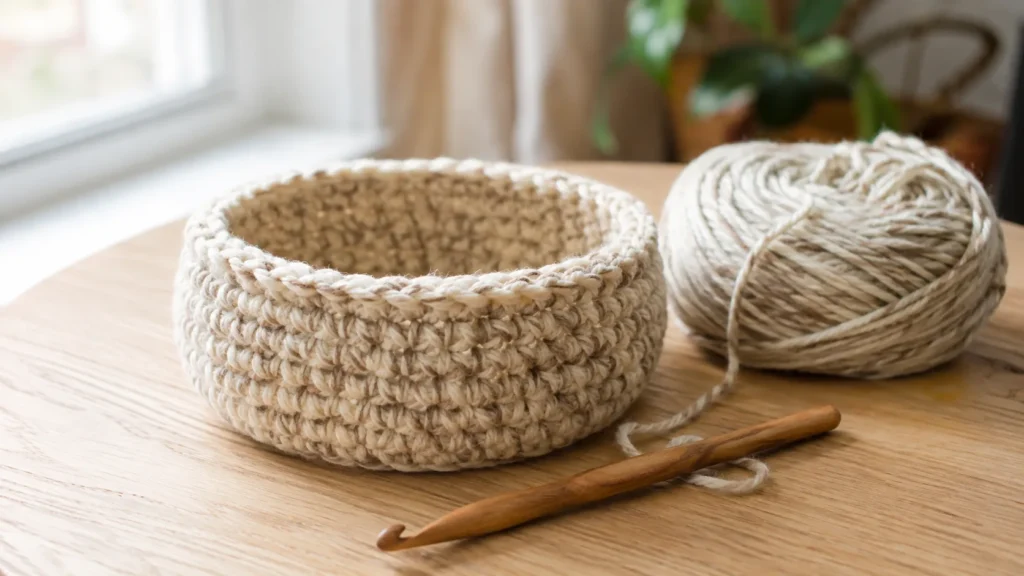
One skein of ordinary worsted yarn, held double, makes a little basket that stands up on its own, no wire, no stiffener, no special yarn. This is a complete original pattern with every stitch count checked by computer, five basic stitches, and about two to three hours of hooking. If you can chain and single crochet, you can finish this today.
This pattern uses US crochet terms. If you learned UK terms, our single crochet (sc) is your double crochet (dc); working the UK stitch where we say sc gives the wrong height and the basket will not hold its shape. New to crochet entirely? Start with our beginner crochet hub and come back.
One Link for Everything You Make
A short address you control, pointing to your finished projects, progress photos and pages wherever they live.
What You'll Make (and Why Doubling the Yarn Is the Trick)
A small catch-all basket, roughly 5½ in (14 cm) across and 3½ in (9 cm) tall, for keys, yarn scraps, rolled socks, desk clutter. The numbers are approximate on purpose: handmade fabric follows your hands, and a slightly bigger or smaller basket is still a basket.
The teachable idea, and the reason to make this one instead of any other: holding two strands of ordinary category 4 worsted together produces a thick, firm fabric that stands up by itself. No stiffener, no wire frame, no hunting for special chunky basket yarn; the doubled strand behaves like a bulky yarn you already own. The other technique you will walk away with is the back-loop-only turn, the single round that folds a flat circle up into a wall.
Materials and Hook (Yes, 6.5 mm on Purpose)
Yarn: category 4, worsted weight, per the Craft Yarn Council yarn weight standard, in a smooth plied acrylic, cotton or blend. Skip fuzzy or halo yarns; a beginner needs to see their stitches. You will work with the yarn held double throughout: two strands together as one, either from two balls or from both ends of one center-pull ball. Budget about 300 yd (274 m) of yarn in total, which is 150 yd (137 m) per strand; one standard worsted skein of around 350 yards covers it with room to spare, and two smaller skeins in different colors give you a marled basket for free.
Hook: 6.5 mm (US K-10½). Read that twice, because it contradicts your yarn label on purpose. A single strand of worsted calls for about 5.0 mm; you are working two strands as one, and the doubled yarn needs the bigger hook. Follow the label instead and you will produce a fabric so dense the hook barely enters, and conclude, wrongly, that you are bad at crochet.
Also: a stitch marker (or a scrap of contrasting yarn), a yarn needle for weaving in ends, scissors, tape measure.
The Five Stitches You Need (US Terms)
The whole pattern uses five operations, all beginner-level and all standard per the Craft Yarn Council abbreviations: ch (chain), sc (single crochet), inc (increase: 2 sc worked into the same stitch), BLO (back loop only: working into just the back loop of the stitch), and sl st (slip stitch). If any of those five is new to you, learn it first in the beginner hub; this page assumes them and spends its energy on the object.
Gauge, and Why You Shouldn't Panic About It
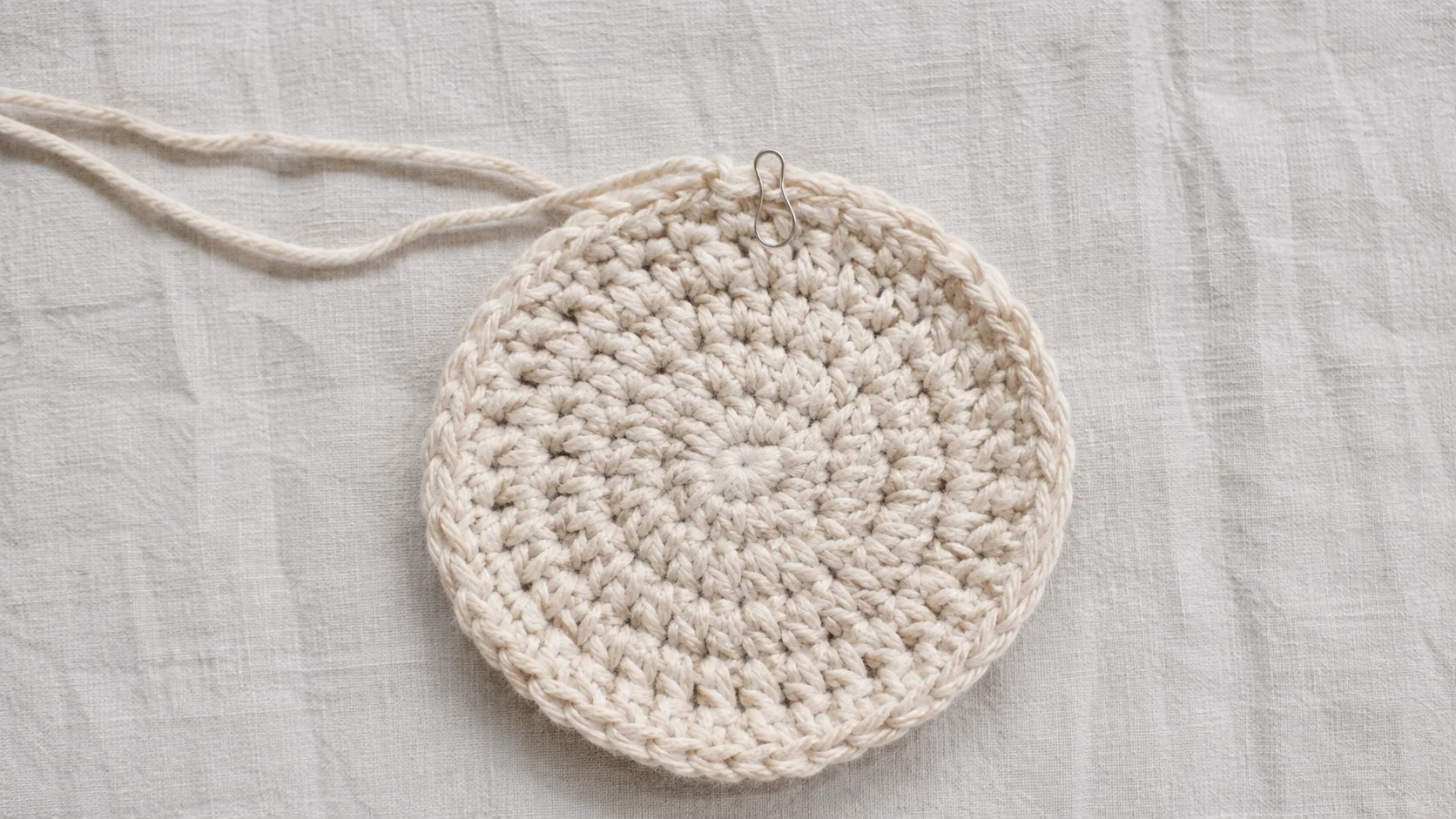
Target gauge with the doubled yarn on the 6.5 mm hook: 10 sc and 10 rounds = 4 in (10 cm), measured on the flat base. The friendly way to check it: work the base through Round 4 (24 stitches) and measure across; it should be around 3 in (8 cm). Wider, go down a hook size; narrower, go up. The swatch is the project, so nothing is wasted.
And the honest part: gauge is not critical here. Off gauge produces a slightly different-sized basket, not a failure. Do not let gauge anxiety stop you at the door.
The Pattern: Base, Rounds 1 to 7
The base is worked in a continuous spiral: no chain-1 at the start of rounds, no joining until the very end. Place your marker in the first stitch of Round 1 and move it up into the first stitch of every new round; in a spiral, the marker is your only landmark, and losing it is the number one way beginners lose their place. Count your stitches at the end of every round, every time.
Round 1: 6 sc into a magic ring. Beginner alternative: ch 2, then work 6 sc into the first chain you made, the one farther from the hook. (6 sts)
Round 2: inc in each stitch around. (12 sts)
Round 3: [1 sc, inc] six times. (18 sts)
Round 4: [2 sc, inc] six times. (24 sts)
Round 5: [3 sc, inc] six times. (30 sts)
Round 6: [4 sc, inc] six times. (36 sts)
Round 7: [5 sc, inc] six times. (42 sts)
Base complete: a flat circle of 42 stitches. Every round adds exactly 6, and every repeat closes with no stitches left over; if you end a round with extras, recount before moving on, because the pattern's arithmetic has no orphans by design.
The Pattern: Sides and Finishing, Rounds 8 to 17
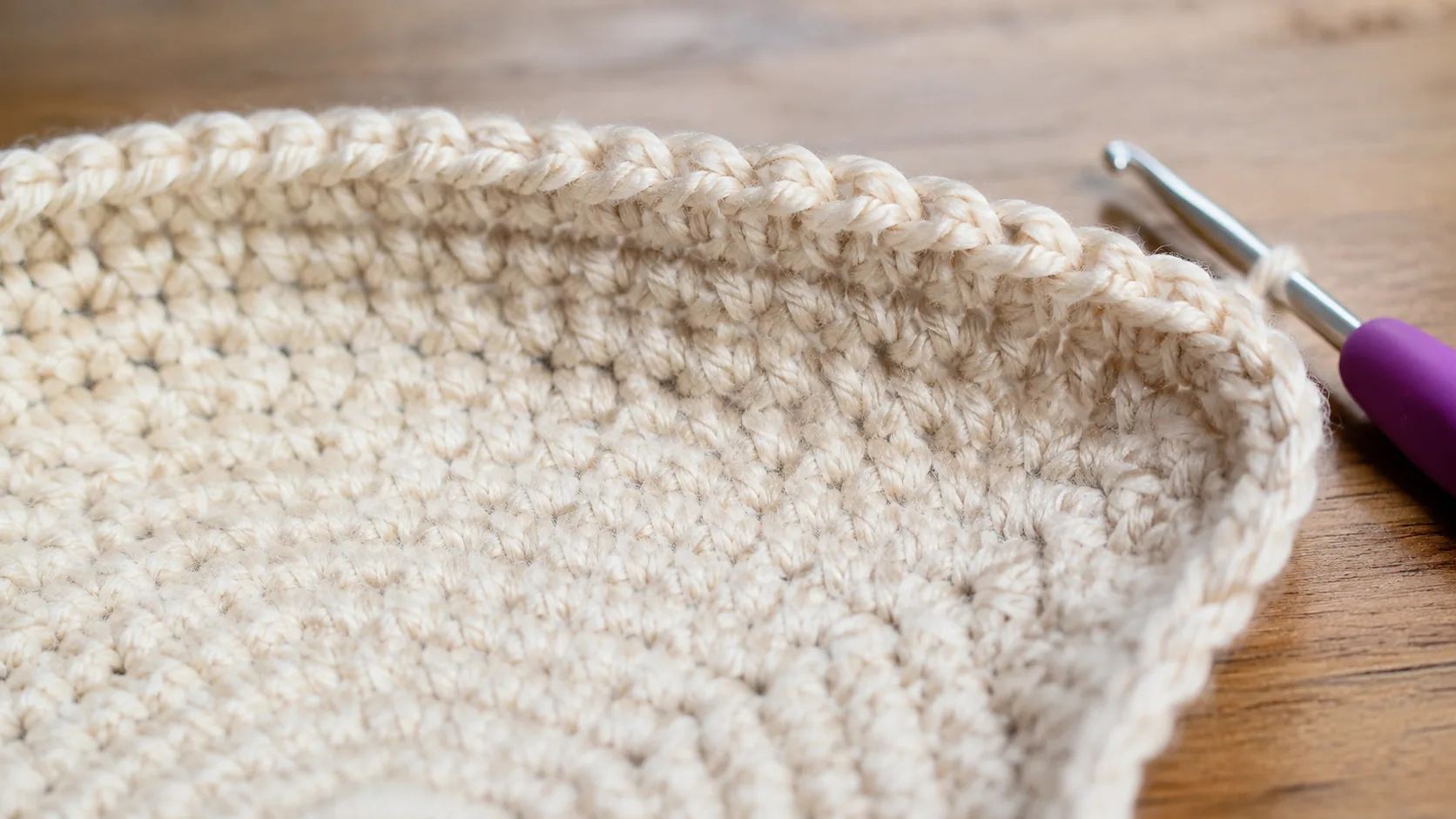
Round 8 is where the basket becomes a basket: work sc BLO in every stitch around (42 sts), no increases. Working into only the back loops leaves the front loops sitting as a visible ridge around the base, and forces the fabric to turn upward at a right angle. That ridge is a feature, the pattern's signature line, not a mistake.
Rounds 9 to 16: sc in every stitch around, through both loops again, 42 stitches per round, for eight rounds. No shaping, just height; this is the meditative part.
Round 17, edging: sl st loosely in each stitch around until you arrive back at your marker, then fasten off, leaving a 6 in (15 cm) tail. Weave in all ends with the yarn needle, and it is done: 546 working stitches from first loop to last.
Keep Your Makes in One Place
Link your finished projects, progress photos and favorite patterns from one short address.
Make It Your Own: Three Variations That Still Work
Taller: add more plain rounds at the Rounds 9 to 16 stage; each extra round adds about 0.4 in (1 cm) of height and nothing else changes. This is the safe variation. Wider: continue the increase sequence past Round 7, [6 sc, inc] six times for 48, then [7 sc, inc] for 54, and so on, before working the BLO round; fair warning that every increase round adds 6 stitches to every side round after it, so yarn use climbs faster than you expect. Marled: hold one strand each of two colors, zero change to any count, and the cheapest visual upgrade in this whole post. It is a different effect from stripes; for flat color-change work, our striped coaster pattern is the flatter, faster project.
Beyond those three, resist improvising the numbers. The six-per-round rhythm is what keeps the base flat: change it and the circle either cups or ruffles, which is also exactly how to read the troubleshooting below.
Troubleshooting: The Five Things That Go Wrong
The base cups upward: tension too tight or a missed increase; go up a hook size or recount the last round. The base ruffles and waves: too loose or an extra increase snuck in; go down a hook size or recount. Lost your place in the spiral: the marker did not move; find the ridge or the increase seams, count stitches from the last round you are sure of, and re-place the marker. The sides slant outward instead of rising straight: increases continued past Round 7; frog back to 42 and rework from Round 8. The basket flops: a single strand was used, or the hook was far too big even for doubled yarn; this pattern's stiffness lives in the doubled strand.
FAQ
How long does it take to crochet this basket?
About two to three hours at a beginner pace, 546 stitches in total. It is deliberately a one-sitting project: long enough to feel like a real object, short enough not to be abandoned.
Why does the pattern use a 6.5 mm hook with worsted yarn?
Because the yarn is held double. Two strands of worsted behave like one bulky strand, and bulky yarn needs a bigger hook. Follow the single-strand hook size on the yarn label and the fabric turns impenetrably dense.
Can I make this basket with one strand of yarn?
You can crochet the shape, but it will flop. The stiffness that lets it stand without wire or stiffener comes entirely from the doubled strand. One strand of a genuinely bulky yarn with a matching gauge check is the only single-strand substitute.
What does back loop only (BLO) do?
Each stitch has two top loops. Working into only the back one leaves the front loops as a ridge and weakens the vertical connection just enough that the fabric folds upward along that line. It is how a flat crochet circle turns into a wall with no shaping at all.
Do I need to check gauge?
Lightly. Work the base to Round 4 and measure, around 3 in (8 cm) across is on target. Off gauge just means a different-sized basket, and since the check happens inside the project itself, no swatch is wasted.