
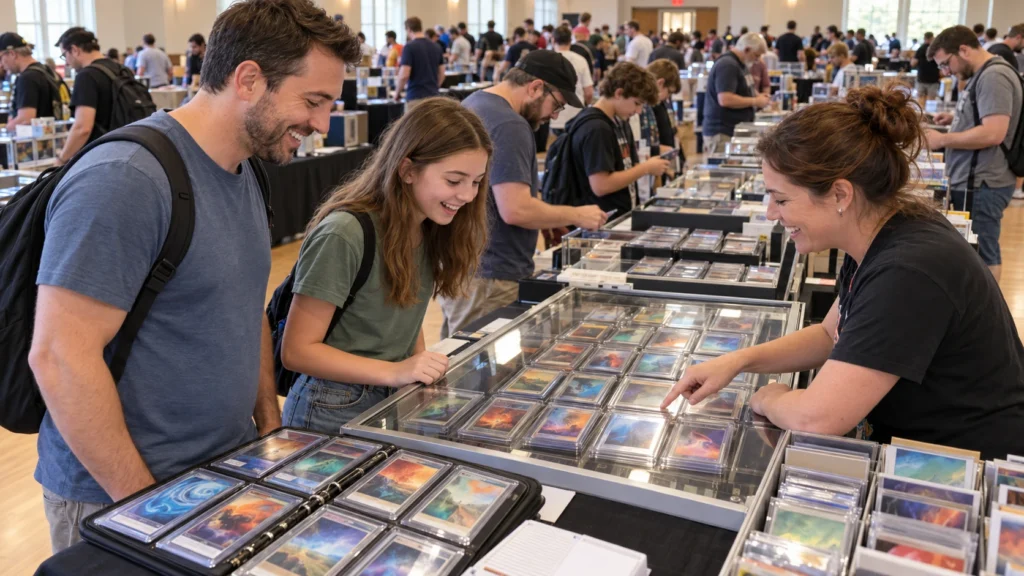
A card show is the fastest way to see hundreds of cards in person, compare prices across many tables and buy, sell or trade in a single afternoon. It is also an easy place to overpay, undersell or lose a binder if you walk in unprepared. This guide covers how to find card shows near you, what to bring as a buyer and as a seller, how to set up a table, which payments to accept, the etiquette regulars expect and how grading drop-off works at shows. It does not list prices or dates, because both change every month. It shows you where to check them for your own city and your own cards.
Bring One QR Code to Your Card Show Table
A free VISU Link page gathers your listings, socials and contact links in one place, with a QR code you can print on your table sign so buyers can reach you after the show.
What Happens at a Card Show
A card show is an event where dealers and collectors rent tables to buy, sell and trade trading cards. Visitors walk the aisles, look through display cases and binders, ask for prices and make offers. Many shows mix sports cards with trading card games such as Pokémon, Magic: The Gathering, Yu-Gi-Oh! and One Piece, and many also have tables of comics, coins or other collectibles.
Shows come in three rough sizes, and it helps to know which one you are going to:
- Store events and trade nights. A local game store hosts a tournament, a league night or an open trading session. Few or no dealer tables, but a steady crowd of players who trade.
- Local and regional card shows. A hotel ballroom, community hall or convention room with rows of folding tables. This is what most people mean when they search for a card show, and it is where a small seller can rent a first table.
- Large conventions. Multi-day events with big dealers, grading company booths, artists and special guests. More choice, more competition and higher table fees.
The same habits work at all three. Know what you want before you arrive, check prices against real sales, inspect every card in hand and pay or get paid in a way you can verify.
How to Find Card Shows Near You
There is no single official calendar of card shows. They are run by independent promoters, stores and clubs, so you find them by combining a few sources. Start with the ones that publish dates in advance and work outward.
- Official game event locators. The publishers of the big card games run their own finders for stores and events. Wizards of the Coast has a Store and Event Locator for Magic, Play! Pokémon has an event finder and points new players to their local Pokémon League, and Konami lists Official Tournament Stores for Yu-Gi-Oh!. These mostly show store events and organized play rather than dealer shows, but the stores that appear there are exactly the places that know when the next show is coming.
- Local game stores and card shops. Ask at the counter, read the store's social pages and check the bulletin board. Stores often host trade nights and many promote nearby shows.
- Collector groups. City and regional groups on social networks, chat servers and forums are where promoters announce shows and where sellers say which tables they will have. Search for your city name plus "card show" or the name of your game.
- Search with the city name. People look for shows by city, so a search such as "card show" plus your city or nearest metro area usually brings up promoter pages and event listings. Look for the venue, date, hours, admission price and whether tables are still for rent.
- Grading company calendars. Some graders publish the shows they attend, which also tells you in advance that the show will have a grading booth.

Before you go, read the event page carefully. Check the opening hours for the public (dealers often set up earlier), whether there is an entry fee, whether parking is nearby, and whether the promoter allows trading in the aisles. If you plan to sell, check the table price, the table size, what is included (chair, cloth, power, wifi) and the deadline to book.
What to Bring as a Buyer
Buying at a show is different from buying online. You can see the card, but you also make decisions quickly, in a noisy room, with sellers who do this every weekend. A short kit and a plan keep you on budget.
- A want list. The exact cards you are looking for, with set, number and version. Without one, a show turns into impulse buying.
- A budget, split into cash and other payments. Some tables take only cash, and cash speeds up small sales. Bring smaller bills so sellers can make change.
- A charged phone and a power bank. You will check sold prices at almost every table, and phones drain fast in crowded halls with weak signal.
- Protection for what you buy. Penny sleeves, top loaders or a small binder, and a bag that closes.
- A small light or magnifier. Useful for checking corners, edges, surface scratches and print lines under the hall lights.
When a card catches your eye, ask the seller to take it out of the case, look at the front and back, and compare the price with recent sales on your phone. If you are not sure a card is authentic, walk away; there will be other copies. Our guide to Pokémon card values explains how to read rarity symbols, check condition and spot fakes before you pay.
What to Bring to Sell
Whether you sell from a full table or from a binder you show to dealers, the work happens before the show. Sort, price and pack the night before, so that at the show you only talk to buyers.
| Item | Why it matters |
|---|---|
| Sorted inventory | Group cards by game, set or player and by price range, so you can find any card in seconds. |
| Price on every card | A sticker on the sleeve or top loader, or a clear label per binder page. Unpriced cards slow every sale. |
| Display cases and stands | Your best cards stay visible and out of reach. Binders hold the rest. |
| Table cloth and signs | A dark cloth makes cards stand out; a sign with your name, what you sell and how to pay answers the first questions. |
| Change and a payment setup | A cash box or pouch with small bills, a card reader if you accept cards and your payment app ready to show. |
| Supplies for buyers | Spare sleeves, top loaders and small bags, so buyers leave with their cards protected. |
| A sales log | A notebook or a phone note to record each sale, trade and price, so you know what you earned. |
| Business cards | Buyers who are not ready today can reach you later. |
If you are only bringing a few cards to sell to dealers, skip the table. Put the cards in a binder or in top loaders, know the recent sales of each one and show them to several dealers. Expect offers below the market price: a dealer has to resell the card and pay for their table. If the show also has coin tables and you have an old jar at home, our guide to coins worth money explains how to check a coin before you show it to a dealer.
Price Your Cards With Sold Comps
A "comp" is a comparable sale: a recent, completed sale of the same card, in the same version and a similar condition. Prices at a show are negotiated against comps, so both buyers and sellers should look them up the same way.
- Match the exact card. Same set, same number, same version (holo, reverse holo, first edition, language) and the same grade if it is graded.
- Use sold prices, not asking prices. On large marketplaces, filter results to sold or completed listings. Price guides built on recent sales, such as TCGplayer Market Price for the US, are a good shortcut.
- Look at several recent sales. One high sale is not a price. Use the middle of the last few sales.
- Adjust for condition. A card with whitening on the edges or a scratch sells for less than a clean copy. Be honest about it on your price sticker.
Sellers who price every card in advance save time at the show and look more trustworthy. Many tables price slightly above the comp to leave room to negotiate, and offer a small discount for bundles. For a table sign that shows your prices by category, a free price list maker prints a clean list and can add a QR code at the bottom.
Put Your Card Shop on the Map
If you run a card store, VISU Local gives it a public listing on the VISU map with your address, opening hours and posts with an end date, such as tonight's trade night. The first listing is free on every plan.
How to Set Up a Card Show Table
A good table answers three questions from a distance: what you sell, how much it costs and how to pay. Buyers walk past tables that look closed, crowded or unpriced.
- Put the best cards in front, inside cases. Display cases or stands at eye level, facing the aisle. Keep the case closed and open it only for the buyer you are serving.
- Make browsing easy. Binders or boxes by price range ("everything in this box at the same price") let buyers dig without asking you for each card.
- Show prices and payments on a sign. A printed price list by category, plus the payment methods you accept, saves you from repeating the same answers all day.
- Add a QR code. A small sign with a QR code that opens your page lets buyers see the rest of your inventory and follow you. A free QR code generator works for the sign, and our printable business card maker adds a QR code to cards you can hand out.
- Keep your side organized. Cash box, card reader, phone, sales log and supplies stay behind the table, not on it.
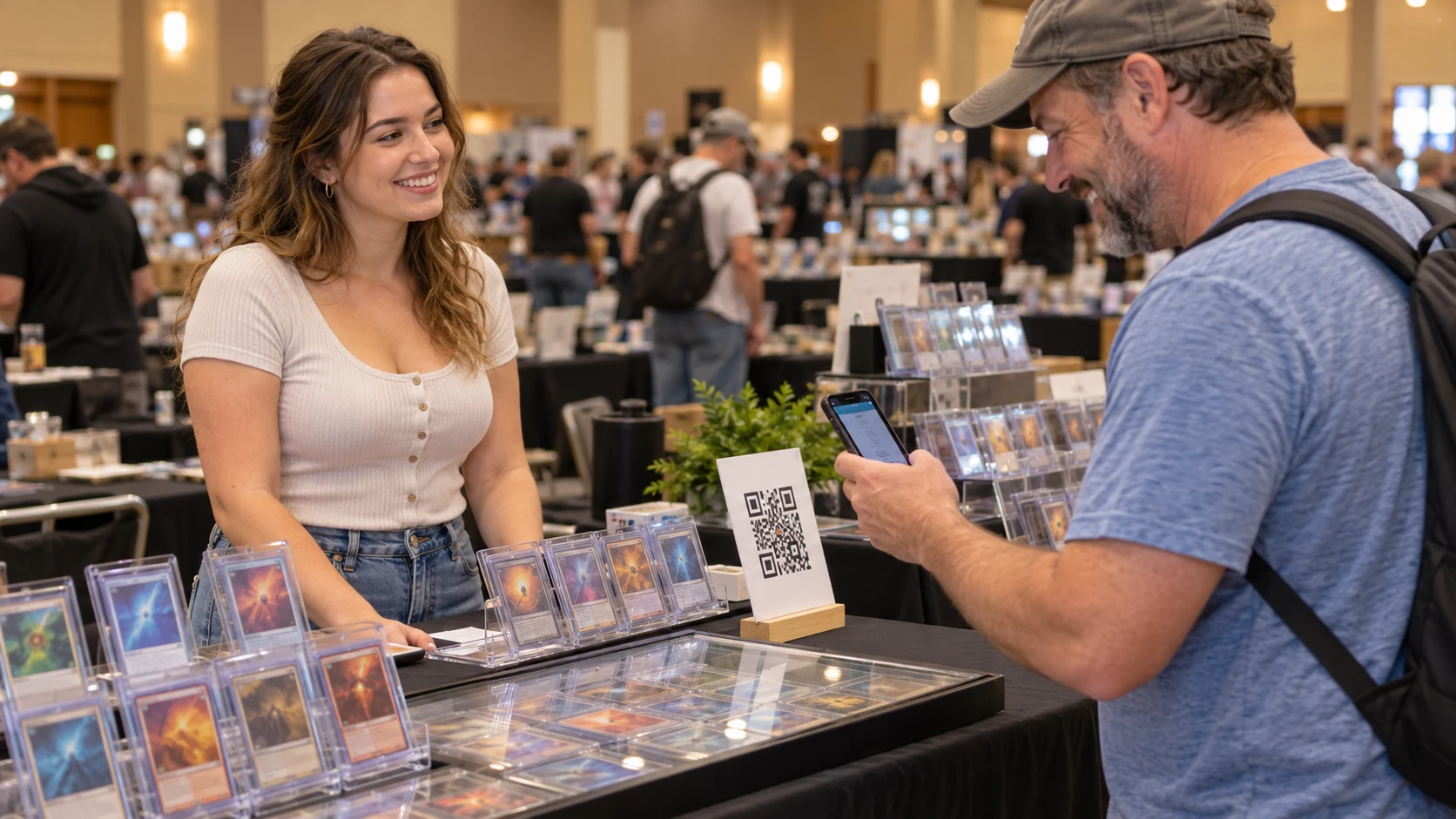
If you can, bring a friend. Two people at a table can serve one buyer while watching the cases, take breaks without leaving the table alone and double-check counts at the end of the day.
Payments: Cash, Card Readers and Apps
Most sellers accept more than one way to pay, and each one has a weak spot. Decide in advance what you accept and put it on your sign.
| Method | Good for | What to watch |
|---|---|---|
| Cash | Quick sales, no fees, works without signal | Counterfeit bills, keeping change, carrying a lot of cash at the end of the day |
| Card reader | Larger sales and buyers without cash | A processing fee on every sale and the need for signal or wifi |
| Payment apps | Fast transfers between phones | Confirm the money arrived in your own app before handing over the card |
For cash, learn the security features of large bills. The US Currency Education Program shows the watermarks and other features of each note, which you can check by holding the bill to the light. For card readers, know what each sale really pays you after fees; our credit card fee calculator shows what lands in your account at the rate on your own processor statement.
For payment apps, the FTC notes that money someone sends you goes to your balance in the app, and that once a payment is sent it is hard to get it back. In practice, that means two rules. Sellers check their own app for the incoming payment, not a screen the buyer shows them. Buyers double-check the recipient's name before tapping send.
Safety for Buyers and Sellers
Card shows are friendly places, but crowds, small high-value items and quick cash attract the occasional thief or scammer. A few habits cover most of the risk.
- Never leave cases or binders alone. Not for a minute, not to look at the next table. Close the case when you step back.
- One card out at a time. Hand a buyer one valuable card at a time and take it back before showing the next.
- Keep trades and payments on the table. Count cards and money in view, and do not finish a deal in the parking lot.
- Check graded slabs. Look up the certification number on the grading company's site and compare the card in the slab with the photo, if there is one.
- Watch for fakes. Compare texture, colors, font and card stock with a card you know is real, and be suspicious of prices far below the comps.
- Plan the trip home. Pack up in pairs, keep the cash box out of sight and avoid announcing a big sale on social media until you are home.
Card Show Etiquette
Regulars notice how you behave, and good manners often lead to better deals and future trades. These are the unwritten rules most tables follow:
- Ask before you touch. Let the seller take cards out of the case, and keep cards over the table, not in the air.
- Wait your turn. Do not interrupt a seller who is negotiating with someone else, and never make an offer on a card another buyer is still discussing.
- Make fair offers. Base your offer on the comps and explain it. A very low offer without a reason ends the conversation.
- Bundle to negotiate. Buying several cards from one table is the most natural way to ask for a discount.
- Respect the space. Do not set drinks or food near cards, and do not block a table to sort your own binder.
- Sellers: be clear and patient. Price everything, answer the same question politely for the tenth time and say no to an offer without making it personal.
If you are new to collecting and want to build a collection you will enjoy bringing to shows, our guide on how to start a card collection covers focus, handling, storage and trading.
Grading Drop-Off at Card Shows
Grading means sending a card to a company that authenticates it, assigns a condition grade and seals it in a plastic holder, the slab, with a certification number. Some grading companies attend larger shows. CGC, for example, publishes an events calendar that marks shows where it accepts card submissions or offers on-site grading, filterable by country and month.
Dropping cards off at a show saves you packing and shipping, but the decision is the same as at home. Grading costs a fee per card, so it pays only when the graded card is likely to sell for clearly more than the ungraded one plus the fee, or when buyers will not trust a valuable card without a certificate. Before the show:
- Check on the grader's own site that it will be at that show and which services it offers there.
- Pick only the cards whose comps justify the fee, and look at them under good light for scratches, whitening and centering.
- Fill in the submission online if the grader allows it, and bring the cards sleeved and in top loaders or semi-rigid holders.
- Ask how the cards come back: picked up at the same show, at a later show or shipped to you.
Grading scales and their criteria are explained in our guide to checking Pokémon card values, which also covers when grading a single card makes sense.
Earn VISU Credits Between Shows
Scan eligible QR codes with the VISU app and you can earn VISU Credits, an in-app reward with its own rules and daily limits for each offer. It is not cash and it does not depend on what your cards are worth.
Frequently Asked Questions
How do I find card shows near me?
Combine sources: ask your local game store, check collector groups for your city, search "card show" plus your city, and use the official locators from Wizards of the Coast, Play! Pokémon and Konami to find the stores that host events and know about nearby shows.
What should I bring to a card show to sell?
Sorted cards with a price on each one, display cases or binders, a table cloth and sign, change in small bills, a card reader or payment app, sleeves and top loaders for buyers, a sales log and business cards.
Should I bring cash to a card show?
Yes. Some tables take only cash, and small bills speed up small sales. Bring smaller bills, keep a budget, and use a card or payment app for larger purchases when the seller accepts them.
How do I know if a price at a card show is fair?
Compare it with recent sold prices for the same card, version and condition on your phone. Use sold listings, not asking prices, and the middle of several recent sales rather than a single high one.
Can I get cards graded at a card show?
At some larger shows, yes. Grading companies such as CGC publish the events where they accept submissions or grade on site. Check the grader's own calendar before you go and grade only cards worth clearly more than the fee.
References
- Wizards of the Coast: Store and Event Locator for Magic and D&D
- Play! Pokémon: event finder and local Pokémon Leagues
- Konami: Yu-Gi-Oh! events and Official Tournament Stores
- CGC Cards: events with submissions and on-site grading
- TCGplayer: how Market Price is calculated
- FTC: Mobile Payment Apps, how to avoid a scam when you use one
- U.S. Currency Education Program: security features of each note