

Almost every family has a box of baseball, football or basketball cards somewhere, and almost every box holds the same question: is any of this worth money? Most of it is not, and a few cards can be. The difference rarely shows from across the room. It sits in details you can learn to read in an afternoon: whether a shiny card is a true refractor or one of the many holographic baseball cards printed in huge numbers, whether a parallel carries a serial number, whether a player's card is his real rookie card, and how sharp the corners still are. This guide walks through those details, then shows how grading works, where to find prices that reflect real sales, how to avoid fakes and altered cards, and how to sell without getting burned. No dollar figures appear here: card prices swing with each player's season, and what lasts is the way you check.
Put Your Whole Trade List on One Page
A free VISU Link page gathers the links to your listings, your socials and a way to contact you, so buyers and traders find every card you have for sale in one place.
Identify the Exact Card Before You Price It
A player is not one card. The same athlete can appear in dozens of products in a single year, and each version sells on its own. Before you look up any price, write down five things from the card itself, most of them printed on the back:
- Year. Usually in the copyright line or the stats on the back.
- Brand and product. The company and the specific line, such as a flagship set or a chrome set.
- Card number. The number printed on the back, which separates it from every other card in the set.
- Base or insert. A base card belongs to the main numbered set. An insert is a separate subset with its own design, usually with a prefix in front of the number.
- Finish and stamps. Shine, color, a serial number like 23/99, an autograph or a piece of fabric.
With those five details, "old baseball card" becomes one specific card, and only then do prices mean anything. Sort into three piles: plain base cards, anything shiny, numbered, signed or marked as a rookie, and cards you cannot identify yet. The second pile is where the value usually is.
Hold every card by its edges while you sort, and sleeve anything that lands in the second pile. Sleeves, rigid holders and dry, flat storage are covered in our guide to starting a card collection, and they protect value far better than any price check.
What Holographic Means on a Baseball Card
People search for holographic baseball cards for three different reasons, and only one of them usually points to money. Check which one you have.
A Hologram Sticker on the Back
Some cards from the late 1980s and 1990s, Upper Deck's above all, carry a small hologram. Upper Deck's first baseball set came out in 1989, and Wikipedia's history of the company says the man behind the idea knew about card counterfeiting and saw holograms as a way to protect cards. A hologram on the back tells you the brand and era. On its own, it does not make the card rare.
A Holo or Foil Finish on the Front
Some cards shine across the front because they are printed on foil or holographic stock. In many modern products, the shiny version of a base card is a parallel, a scarcer twin of the plain card. Whether it is worth more depends on which parallel it is and how many were made, which the next sections cover.

A Refractor or Prizm
A refractor is a chrome card with a coating that throws rainbow light when you tilt it. These are the cards most collectors mean when they talk about shiny cards with real value, and they get their own section below.
One caution about holographic baseball cards from the 1990s. Wikipedia's history of trading cards explains that cards were produced in much higher numbers from the 1980s well into the 1990s, which kept many cards from that era low in value, and that makers then began producing scarcer versions to keep collectors interested. For that era, check the scarce versions first.
Refractors and Chrome Cards
Refractors began with Topps Finest baseball in 1993, according to Wikipedia's entry on refractor cards. Today they are a fixture of Topps Chrome and Bowman Chrome. The idea is simple: the chrome set has a base version, and the refractor is the same card with a reflective coating that breaks light into a rainbow.
To tell them apart, hold the card under a single lamp and tilt it slowly. A base chrome card looks metallic but mostly flat. A refractor shows a moving rainbow across the image and the borders. Then turn it over: Wikipedia notes that later releases confirm a refractor on the back with an R or the word Refractor, usually beside or beneath the card number, while the first refractors from 1993 had no such mark.
"Refractor" is a registered trademark of Topps, so other brands use their own names for similar cards. Wikipedia lists Prizms from Panini, Reflectors from Press Pass and Mirrors from Leaf. When you search for prices, use the name the brand itself uses, or the results will mix different products.
Refractors also come in colors. The same Wikipedia entry notes that most color variants are simple color swaps of the base refractor, typically but not always serial numbered, and that orange and red are often among the rarest, though this varies from set to set. So do not assume a color means a fixed rarity: look at the serial number or the set's checklist.
Parallels and Serial Numbers
A parallel is a version of a base card with the same photo and number but a different finish, color or border. Modern sets often have many parallels of every card, which turns one player's card into a whole ladder of prices.
The most useful clue is a serial number stamped on the card, usually on the back and sometimes on the front, such as 23/99. The second number is the print run: only 99 copies of that parallel exist. The first number is that copy's position in the run. Wikipedia's trading card article describes serially numbered cards as produced in much smaller amounts than regular base set cards, which is why they draw so much attention.
| What you see | What it means | What to search for |
|---|---|---|
| No shine, no number | Base card | Year, set, card number |
| Shine or color, no serial number | Unnumbered parallel or refractor | Add the exact parallel name |
| Stamp such as 23/99 | Numbered parallel, 99 copies | Add the parallel name and "/99" |
| Stamp reading 1/1 | One of one, a single copy | Look for past sales of similar one of ones |
Two practical notes. First, a lower print run usually means fewer copies, but demand for the player still decides the price: a /25 of a little-known player can sell for less than a /199 of a star. Second, a 1/1 has no exact comparable sale, because there is only one. That makes them hard to value and easy to overprice.
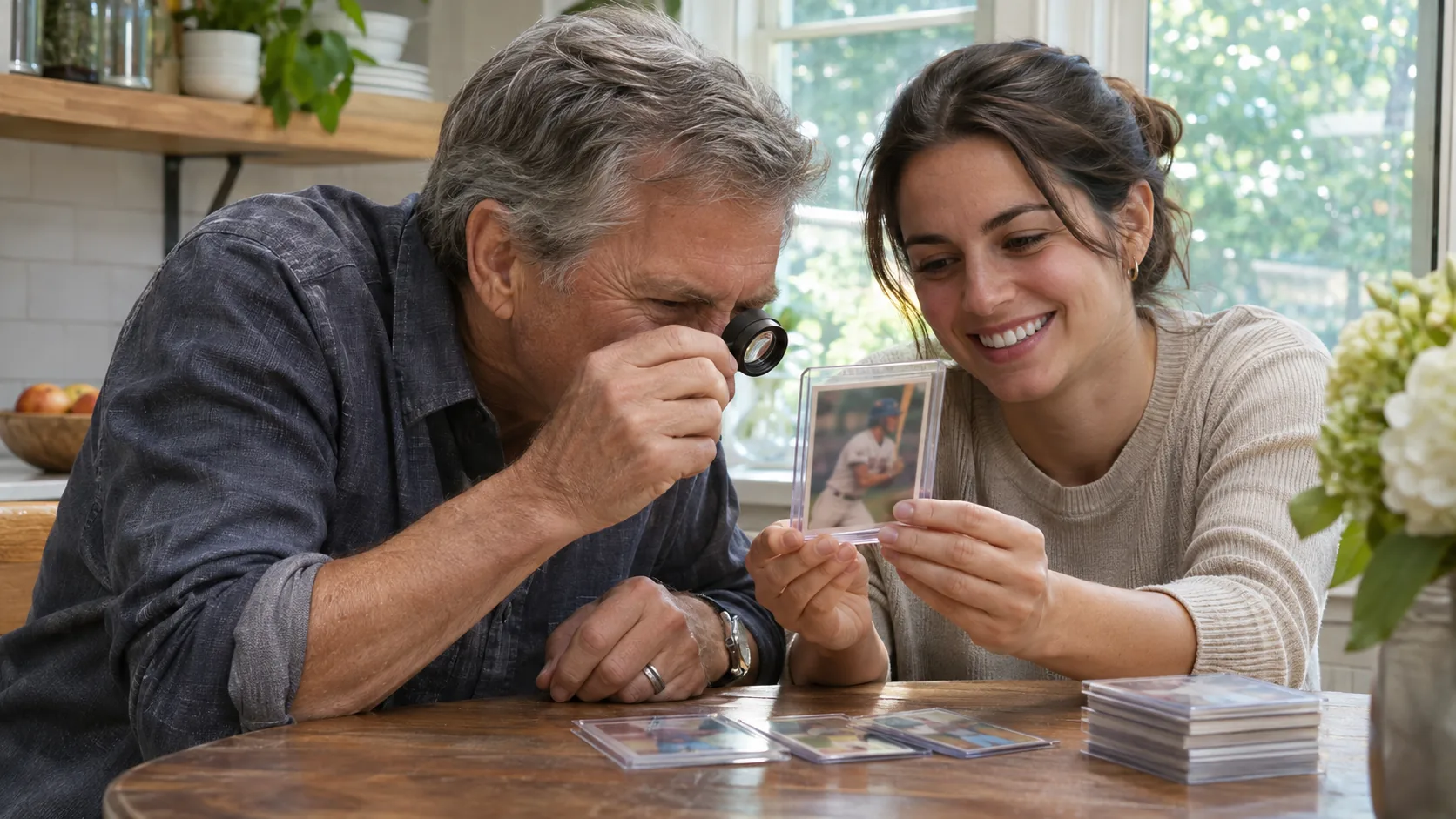
Rookie Cards and the RC Logo
If one word moves sports card prices, it is rookie. Wikipedia's history of Topps notes that a rookie card is typically the most valuable card of any given player, which is why card companies compete to be first to print a future star.
What counts as a rookie card is less obvious than it sounds. According to Wikipedia's rookie card entry, it is generally agreed that a true rookie card must be part of a product's base set, so limited inserts are usually not counted. In 2006 Major League Baseball introduced guidelines for which cards could carry the official rookie card logo, the small RC you see on modern baseball cards. Even so, many collectors consider a player's first officially licensed prospect card to be the "true" rookie, and the debate has not gone away.
In practice:
- Look for the RC logo on modern cards. It is the quickest sign the card is treated as a rookie card.
- Check the year. A player can have earlier prospect cards, often in Bowman products, that collectors value alongside or above the official rookie.
- Remember that a rookie card is not automatically valuable. Most rookies never become stars, and their cards follow their careers.
Earn VISU Credits While You Sort
Scan eligible QR codes with the VISU app and you can earn VISU Credits, an in-app reward with its own rules and daily limits for each offer. It is not cash, and it does not depend on what your cards are worth.
Autographs and Relic Cards
Since the 1990s, card makers have added two kinds of cards that are scarce by design: signed cards and cards with a piece of memorabilia. Wikipedia's trading card article traces autographs inserted by card makers back to 1990, when Upper Deck randomly inserted signed Reggie Jackson cards into boxes.
Autographs. Certified autograph cards are signed for the card maker and inserted into packs, often with a statement on the back that the signature is authentic. Some are signed directly on the card, called on-card autographs. Others are signed on a clear sticker that is then applied to the card, called sticker autographs. Many collectors prefer on-card signatures, so note which kind you have when you search.
Relics. A relic or memorabilia card holds a piece of fabric or equipment. Read the wording on the back carefully. Wikipedia's entry on Upper Deck shows how that company's card backs moved from saying the material was worn by the player in a game to softer wording, and notes that some material comes from events such as rookie photo shoots instead of real games. "Worn in a game", "used" and "event-worn" are different claims, and buyers care about the difference.
Condition and Grading With PSA, BGS or SGC
Two copies of the same card can sell far apart, and the usual reason is condition. In good light, with a loupe or your phone's zoom, check the corners, the edges, the surface (scratches, print lines, dents) and the centering of the borders. Graders look at the same four things.
A grading company inspects the card, assigns a number from 1 to 10 and encapsulates it in a sealed holder, the slab, whose label carries the grade and a unique certification number. For sports cards the names you will see most are PSA, Beckett (BGS) and SGC, and CGC grades sports cards too.
A 10 is hard to get. In PSA's published standards, Gem Mint 10 is "a virtually perfect card": sharp corners all around, sharp focus, full original gloss, no staining, and an image centered no worse than roughly 55/45 on the front and 75/25 on the reverse. CGC's published scale, which gives sports cards their own centering limits, asks for 60/40 or better on the front and 90/10 on the back for a Mint 9. Beckett and SGC publish their own scales too, and the definitions differ in the details, so read the current scale of the company you plan to use before you guess a grade.
One rule matters more than any number: do not try to improve a card. PSA's standards say it will not give a numeric grade to cards with evidence of trimming, recoloring or restoration, and its "altered stock" category includes crease pressing, scratch removal, enhanced gloss and cleaning sprays or wax on the surface. A card someone tried to fix can end up worth less than the honest, slightly worn original.
Should you grade? Do the math first: the graded copy has to sell for more than the ungraded card plus the fee and insured shipping both ways, and for most base cards it will not. Our Pokémon card values guide walks through that math step by step, and it works the same way for sports cards.
Check Sold Prices, Not Asking Prices
A listing price is only what a seller hopes to get. The value of your card is what buyers have actually paid, lately, for the same version in the same condition or grade.
- Marketplace sold listings. On eBay, filter a search by sold items to see finished sales instead of open listings.
- Grader sales data. PSA's site includes auction price and population report tools, which show recent sales of graded copies and how many copies have received each grade.
- Local card shops and card shows. Dealers see real sales every day, even if they will offer you less than market to buy.
To compare like with like, match every detail: year, set, card number, parallel name, serial number, autograph or relic, and condition or grade with the grader's name. A PSA 9 and an ungraded card are different items. A /99 and a /199 are different items. Then read a handful of recent sales together: one sale on its own can be a typo, a shill bid or an auction that got lucky.
Prices also move with the player. An injury, a trade, a big season or a retirement can change demand within days, so check again on the day you list.
Fakes, Reprints and Altered Cards
The more a card is worth, the more likely someone has copied it. Before you buy or sell anything of value, run these checks:
- Verify the slab. Type the certification number from the label into the grader's verification page (PSA lists Cert Verification in its own menu) and confirm the card, year, number and grade match.
- Compare with a real copy. Look at photos of verified graded copies: font, colors, card stock, the back design and the position of logos and text.
- Check for reprints. Many classic cards were reissued later as reprints. Legitimate reprints are often marked as reprints or carry a later copyright year. A card with a suspiciously modern feel or gloss deserves a second look.
- Watch the edges. PSA describes a trimmed card as one with a hooked edge, unusually sharp edges for its issue, uneven color along an edge or a wavy, unnatural look. Trimming is done to make corners look sharper, and PSA will not grade a card that shows it.
- Distrust a price that is too good, especially for autographs without certification and for high-grade slabs of famous rookies.
When in doubt, ask a local card shop to look at the card in hand, or buy only graded copies whose certification number you can verify.
How to Sell Sports Cards Safely
Pick the channel by value and speed:
- A local card shop pays on the spot, in cash or store credit, but below market price because it has to resell the card. Good for lots of base cards and quick sales.
- Online marketplaces reach more buyers but take fees and expect careful shipping.
- Card shows let buyers see the card in hand, which helps with higher-value cards. Our guide to card shows near you covers finding one and setting up a table.
Before you list anything:
- Take clear photos of both sides, plus close-ups of the corners and the serial stamp if there is one. Our free photo watermark tool stamps your name on a whole batch in the browser, so a copied photo still carries your name.
- Write the title the way buyers search: year, brand, set, player, card number, parallel and serial number, then list every flaw in the description.
- Pack it like it matters: penny sleeve, top loader or other rigid holder, a padded mailer or small box, tracking, and insurance on anything you could not afford to replace.
- Get paid first, through a method that protects both sides, and ship only once the money has actually arrived.
- Trade in person somewhere busy, such as a card shop, and look up any slab's certification number on your phone before you hand over the card or the cash.
Selling from a binder or a table? Print your asking prices once instead of quoting them all day: the price list maker turns a few lines of text into a printable sheet with an optional QR code to your page, and the QR code generator works for any other link. The same sort, check and compare routine also fits other collectibles, as our guide to coins worth money shows.
Know Which of Your Cards Draw Interest
VISU Link analytics count visits, unique visitors and clicks on each link, even on the free plan, so you can see which card listings people open before you cut a price.
Frequently Asked Questions
What is the difference between a holo card and a refractor?
Holo usually means a hologram sticker or a foil, holographic finish. A refractor is a chrome card, such as Topps Chrome or Bowman Chrome, with a coating that shows a rainbow when you tilt it. Refractor is a Topps trademark; Panini calls its similar cards Prizms.
Are refractor cards worth more than base cards?
Usually more than the base version of the same card, because fewer were made, but not always much more. The player, the color, the serial number and the condition decide the price. Compare recent sales of the exact refractor, not the base card.
What does a number like 25/99 on a sports card mean?
It is a serial number. The second number is the print run, so only 99 copies of that parallel exist, and the first is that copy's position. A 1/1 means a single copy. Lower print runs are scarcer, but demand for the player still sets the price.
How do I know if my card is a rookie card?
On modern baseball cards, look for the RC logo, which follows guidelines MLB introduced in 2006. A true rookie card is generally a base set card, not a limited insert. Many collectors also value a player's first licensed prospect card, often from Bowman.
Are sports cards from the 1980s and 1990s worth money?
Most base cards from that era are not, because they were printed in very large numbers. The exceptions are key rookie cards in top condition, scarce inserts and parallels, and certified autographs. Check sold prices for the exact card before you decide.