


Piano chords are two recipes, not two hundred shapes: root, then 4, then 3 semitones for major; root, then 3, then 4 for minor. Learn the recipes once and you can build any major or minor chord anywhere on the keyboard, starting with the four chords that unlock everything: C, G, Am and F.
This guide assumes you can already find a named key on the keyboard; if not, our piano keys labeled guide is the five-minute prerequisite. Everything here is counted on the keys, never written on a staff, and when the chords are under your fingers, the easy piano songs pillar is the natural next step.
One Link for Your Whole Music Journey
A short address you control, pointing to your practice log, your pages and everything else you share.
What a Chord Actually Is
A chord is several notes sounding at the same time. The most common chord has exactly three notes and is called a triad, and triads are what this whole guide teaches. The three notes have names you will use constantly: the lowest is the root, which gives the chord its name; then come the third and the fifth.
Here is the reassurance that carries everything else: you do not need to memorize hundreds of chords. There are two recipes, major and minor, and every chord in this article is one of those two recipes applied to a different starting key. Learn the recipes and the chart becomes unnecessary.
The One Measurement You Need: Semitones
A semitone (also called a half step) is the smallest distance commonly used in Western music, and on the keyboard it means the very next key, black or white. That is the unit every chord recipe is measured in, so try it once physically: put a finger on any key, then move to the very next key in either direction, black keys included. That move is one semitone. Two of those moves make a whole tone. That is all the theory this article needs.
How to Build a Major Chord: Root, Then 4, Then 3
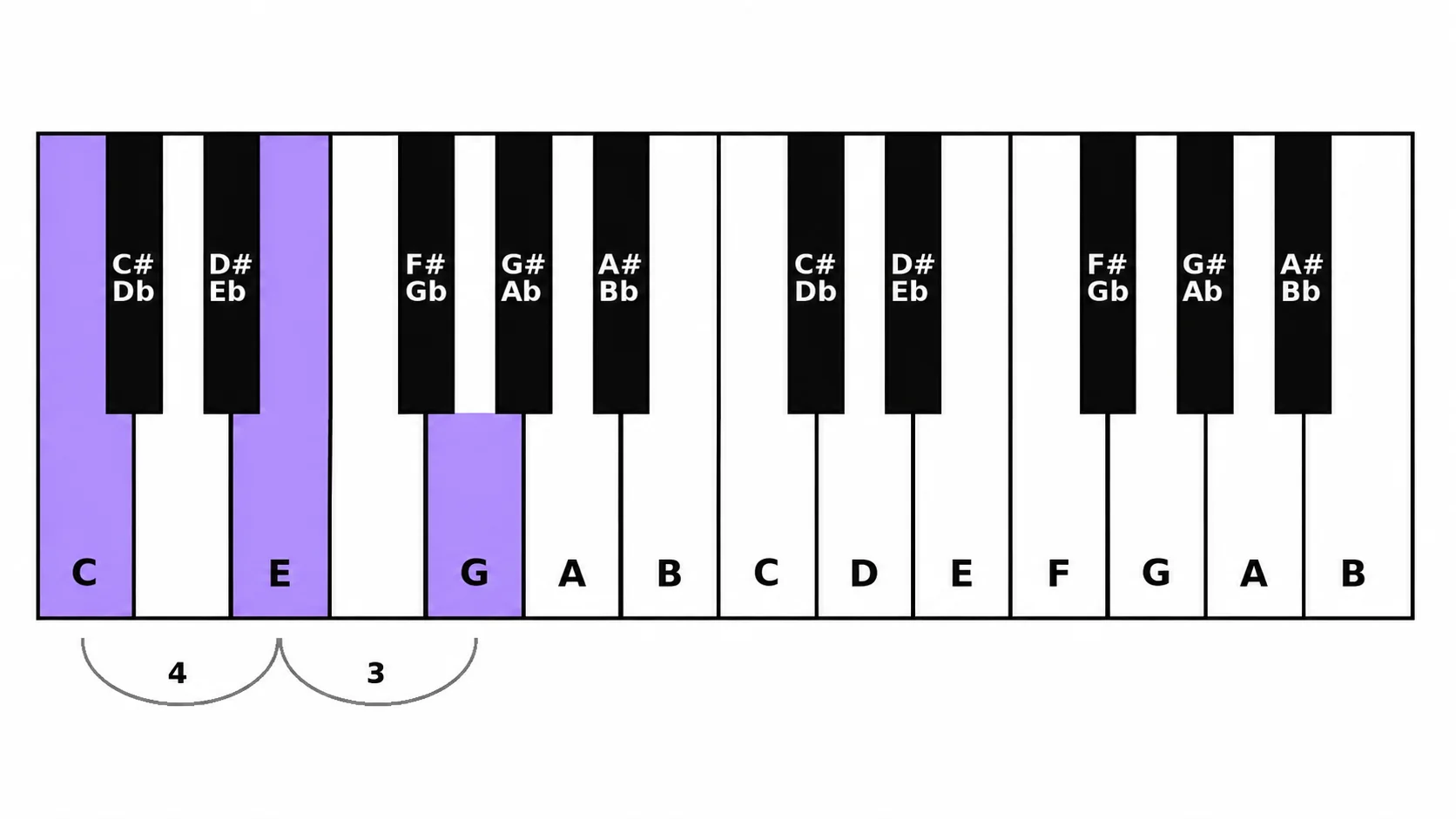
Start on any key. That key is the root, and it gives the chord its name. Now move up four semitones, one key at a time, black keys included. That note is the major third. From there, move up three more. That note is the fifth, which sits seven semitones above the root. Play all three together: that is a major triad.
Worked example: C major. Start on C and move up four times, one key at a time: C♯, D, D♯, E. Four moves, and you are on E. Now three more: F, F♯, G. You are holding C, E and G, and that is the C major chord.
This recipe works from any key on the instrument. That is the highest-value idea on this page: the player who knows "root, then 4, then 3" never needs to look up a major chord again. Every chord chart on the internet is just this recipe, pre-computed.
How to Build a Minor Chord: Root, Then 3, Then 4
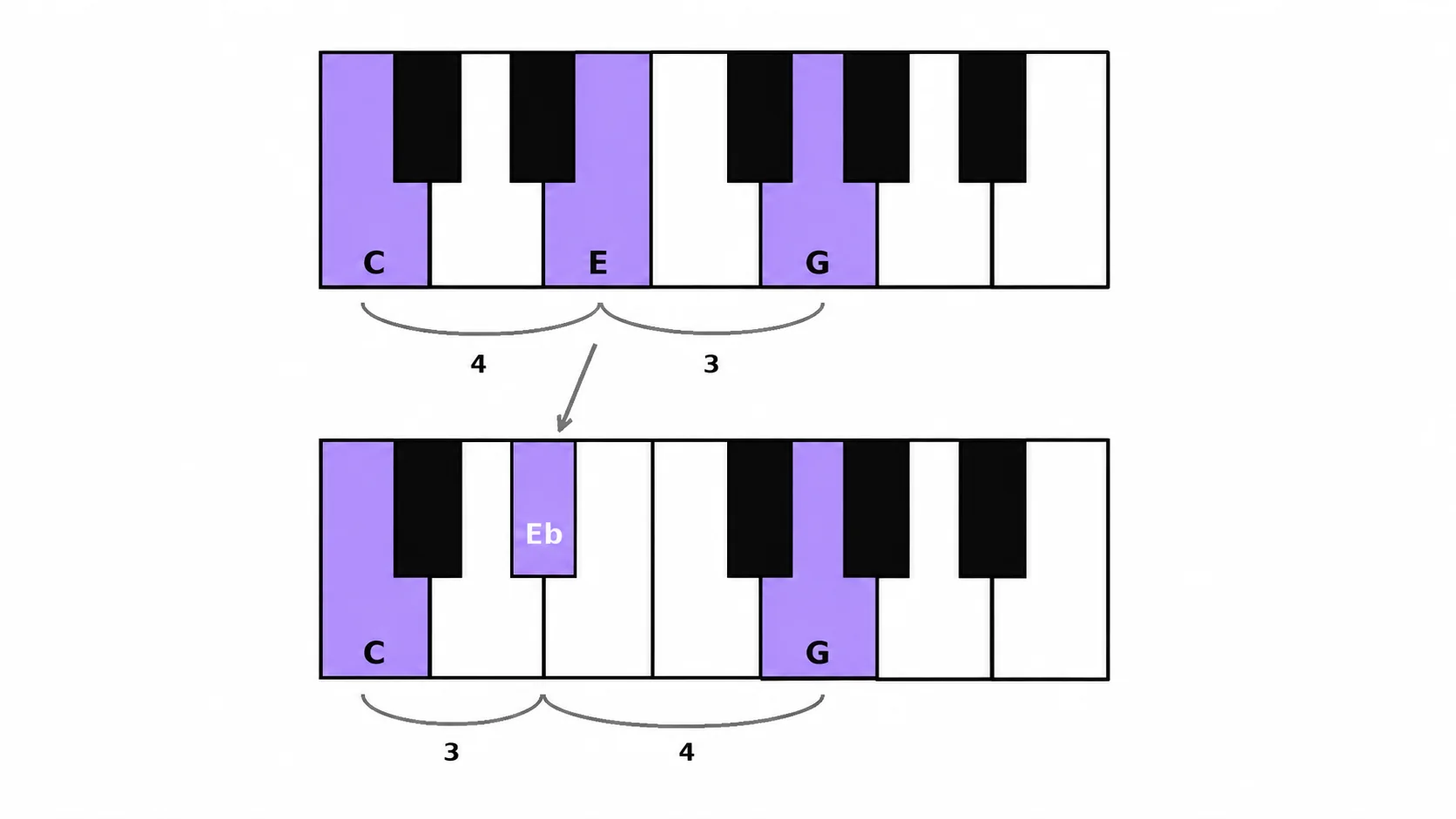
The minor chord is the same recipe with the two numbers swapped: root, then three semitones up to the minor third, then four more to the fifth. The fifth lands in exactly the same place in both recipes, seven semitones above the root. Only the middle note moves.
Worked example: A minor. Start on A, move up three: A♯, B, C. Then four more: C♯, D, D♯, E. You are holding A, C and E, the A minor chord.
And here is the one-note difference made physical: play C major (C, E, G), then move the middle note down one semitone, from E to E♭. You are now playing C minor, and you can hear the character change. The major chord's sound is often described as brighter, the minor's as darker. Play both a few times and let your ear learn the difference.
Track the Practice, Share One Link
Your progress, your recordings and your pages behind a single short address.
Your First Four Chords: C, G, Am, F
These four are the universally taught first set, and instead of accepting them from a chart, derive each one with the recipe:
| Chord | Notes | Recipe |
|---|---|---|
| C major | C, E, G | root, then 4, then 3 |
| G major | G, B, D | root, then 4, then 3 |
| A minor | A, C, E | root, then 3, then 4 |
| F major | F, A, C | root, then 4, then 3 |
Two facts worth noticing. First, every note in the set is a white key; no sharps or flats anywhere, which is exactly why it is the first group every beginner learns. Second, as scale degrees in the key of C these four are I, V, vi and IV, and the I-V-vi-IV pattern is one of the most common in popular music.
Practice instruction: play each chord and let it ring, then pick two of them and move between them slowly until your hand finds the shape without looking. The three notes fall naturally under the thumb, a middle finger and the little finger of either hand; beyond that, let your hand find its own comfort.
Chord Symbols: Reading C, Cm and C7
You will meet chord symbols within minutes of leaving this page, so here is the whole system in three lines. A major chord is written as just the letter of its root: C means C major. A minor chord is usually a lowercase m after the letter, and you will also see min, mi or a minus sign, all meaning the same thing: Cm, C min and C- are all C minor. A number means an extra note has been added: C7 is the C major triad plus one more note, four notes in total, and that is all you need to know about it for now.
One Thing to Know About Inversions
The three notes of a chord can be arranged in different orders. When the root is the lowest note, the chord is in root position; when it is not, the chord is inverted, and it is still the same chord with the same name. Inversions are how players move between chords smoothly, and they are a topic for later. For now you only need this: meeting a C major with the E or the G at the bottom does not mean you found a new chord.
Practice: Four Things to Do at the Keyboard Today
1. Build a major chord on three different white keys by moving up 4 and then 3, one key at a time, out loud. Check each one against the recipe, not against a chart.
2. Play C major, then lower the middle note one semitone to hear it become C minor. Do the same on two other roots.
3. Play C, G, Am and F in order, slowly, letting each chord ring fully before moving.
4. Say each chord's symbol out loud as you play it: "C", "G", "A minor", "F".
Short daily sessions beat long weekly ones, and slow enough to be correct always wins. The free chord-identification drills at musictheory.net pair well with this page, and when the four chords feel like home, the beginner songs pillar is waiting.
Show the World the First Chord
One VisuLink holds your recordings, your pages and everything else you share.
FAQ
What piano chords should a beginner learn first?
C major, G major, A minor and F major. All four use only white keys, they cover the I, V, vi and IV degrees of the key of C, and each one can be derived with the two recipes this page teaches: root plus 4 plus 3 semitones for major, root plus 3 plus 4 for minor.
How do I make a major chord on the piano?
Pick any key as the root, move up four semitones (one key at a time, black keys included) to find the third, then three more to find the fifth. Play the three together. From C that gives C, E and G: the C major chord.
What is the difference between a major and a minor chord?
One note. Both share the root and the fifth, seven semitones apart; the middle note sits four semitones up in a major chord and three in a minor one. Lower the middle note of any major chord by one semitone and it becomes minor. The sound is often described as brighter for major and darker for minor.
What does the m in Am mean?
Minor. A chord symbol is the letter of the root, alone for major (C means C major) and with a lowercase m for minor (Am means A minor). You will also see min, mi or a minus sign meaning the same thing.
Do I need to read sheet music to play chords?
No. Chords in this guide are built by counting keys, and in most popular music they are written as letter symbols (C, G, Am, F), not on a staff. Reading notation is a separate skill you can add later.