

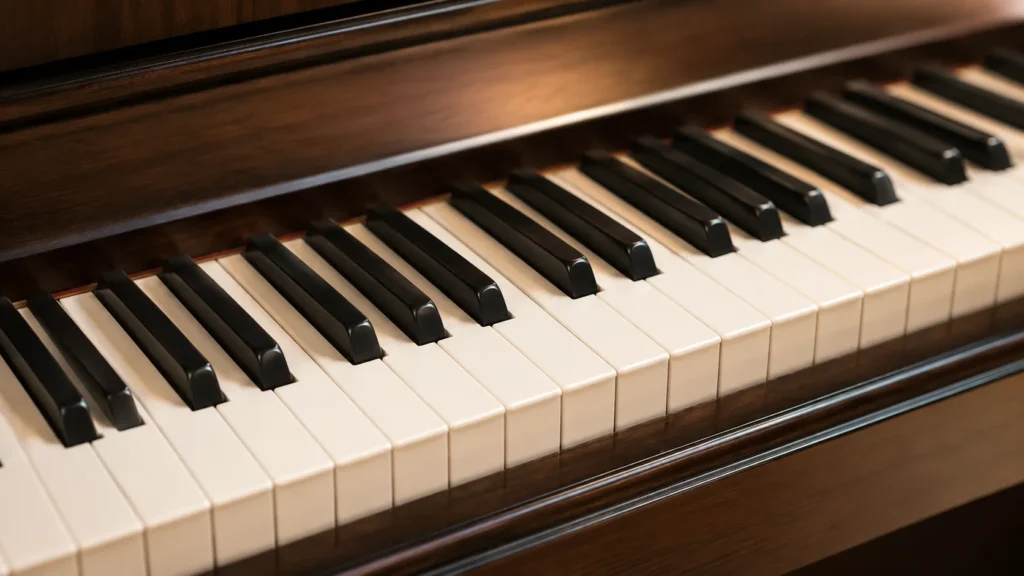
Piano notes and keys, labeled and explained: 88 keys, only twelve names, and one repeating pattern of black keys that tells you where everything is. By the end you will find any C with your eyes closed, name every black key both ways, and know why there is no black key between E and F.
This guide is about the keyboard itself: which physical key is which. Its twin, our guide to reading piano sheet music, handles the paper side; this one puts your hands on the right keys. When both make sense, the easy piano songs for beginners pillar is the natural next step.
One Link for Your Whole Music Journey
A short address you control, pointing to your practice log, your pages and everything else you share.
What You Are Looking At: 88 Keys, and Why That Number
Most modern pianos have 52 white keys and 36 black keys, 88 in total, spanning seven octaves plus a minor third. Older instruments had fewer keys, but 88 has been the standard since the late 1800s.
Here is the sentence that defuses the whole instrument: 88 keys does not mean 88 things to learn. There are only twelve distinct note names, and the keyboard just repeats them, over and over, from the low rumbling end on your left to the bright pinging end on your right. A beginner who understands that has already done the hardest conceptual work on this page.
And if you are sitting at an electronic keyboard instead of a piano, nothing changes. Keyboards commonly come with 61, 76 or 88 keys, and small MIDI controllers go down to 25, but the pattern is identical on all of them. A 61-key keyboard is the same layout with less of it. Everything below applies to your instrument exactly as written.
The Pattern That Repeats: Two Black Keys, Then Three
The twelve notes are laid out with the lowest on the left. The seven longer white keys are the natural notes, C D E F G A B. The five raised, shorter black keys are the remaining notes. And those five black keys are not evenly spaced: they fall into a group of two and a group of three, and that grouping repeats identically all the way up the instrument.

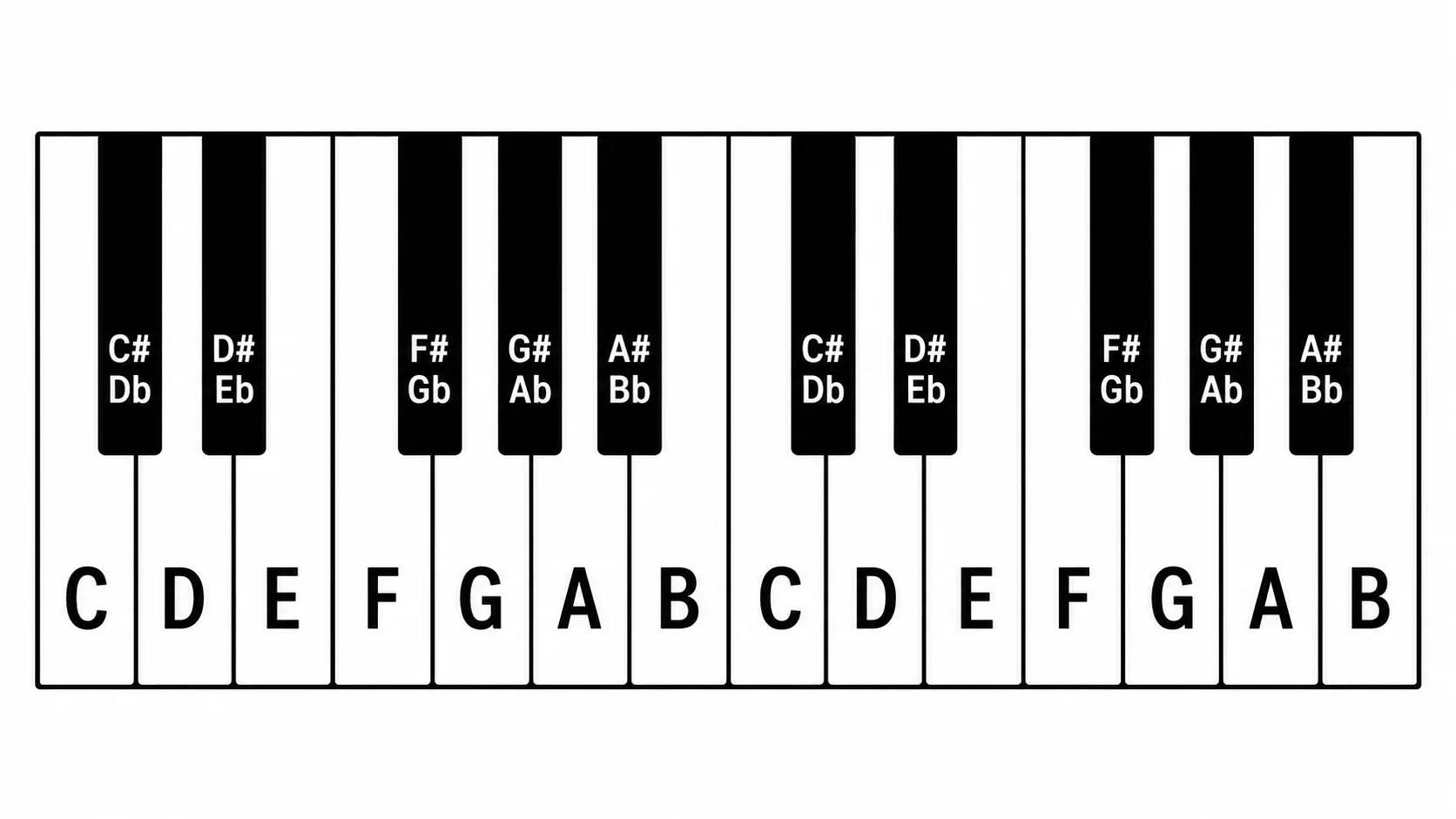
The black-key groups are the map. Without them, every white key looks like every other white key, and the keyboard is a wall of identical teeth. With them, you can locate any note by counting from a group. Everything else in this article is built on this one idea, which is why the chart below is worth a long look before reading on.
A brief aside for readers who grew up with dó ré mi: in Romance-language countries the same seven notes are named dó ré mi fá sol lá si instead of C D E F G A B. Two naming systems, identical pitches.
How to Find C (and Then Everything Else)
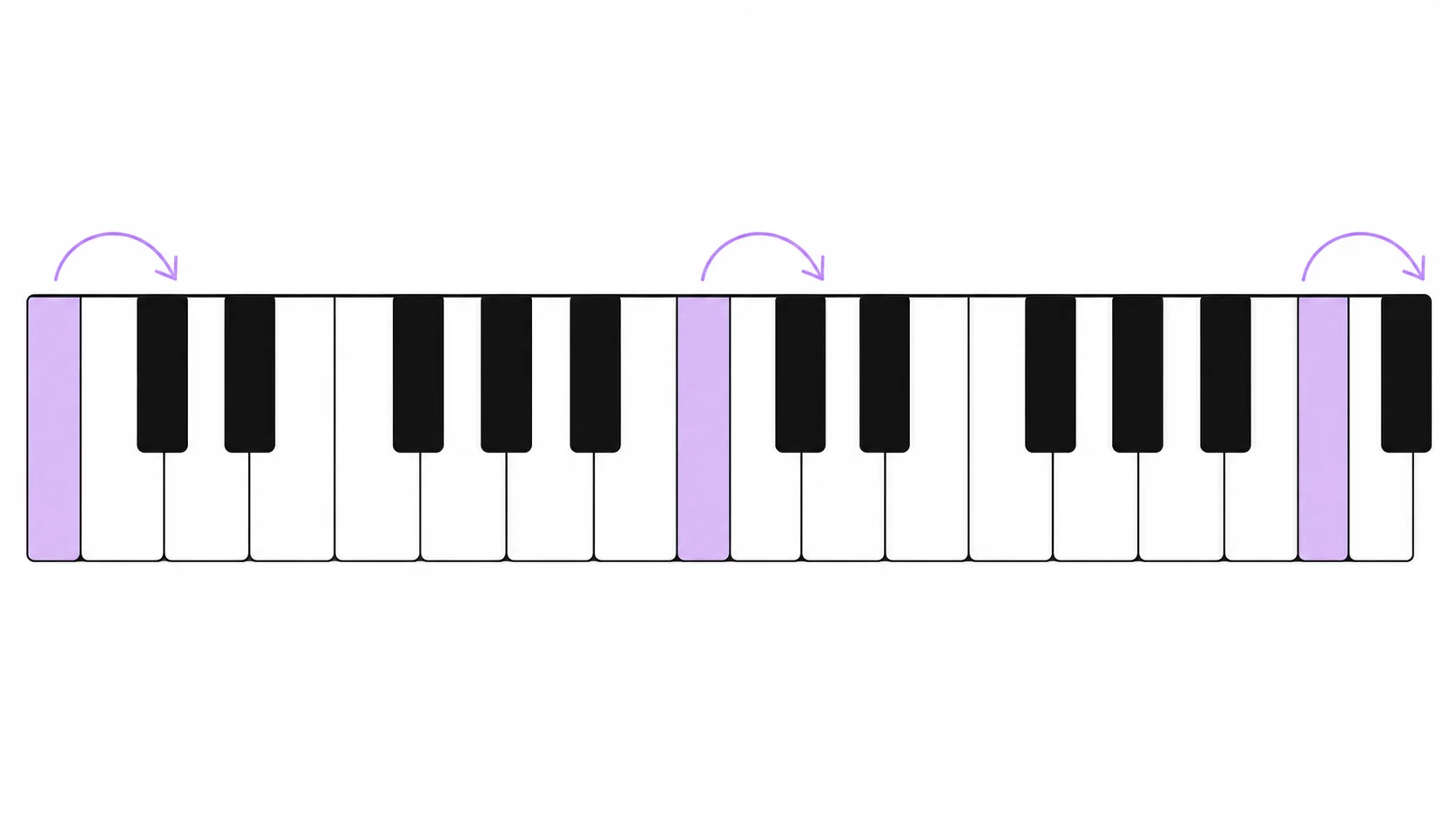
C is the white key immediately to the left of the group of two black keys. Every time, everywhere on the keyboard, no exceptions. That is the single most useful fact about the piano's layout.
F is the white key immediately to the left of the group of three black keys. That is the second landmark, and the only other one you need. Everything else is counted from C or F, moving right through the white keys: C D E F G A B, then C again, and the cycle restarts.
Now do it physically, because this paragraph does not become a skill until your hands run it: find every C on your instrument, left to right, saying "C" out loud at each one. On an 88-key piano you will count eight of them. That little exercise teaches the repeating pattern better than any diagram.
What an Octave Actually Is
Now that you can find every C, the distance between one C and the next has a name: an octave. Acoustically, an octave is the interval between one pitch and another with double its frequency; the A above middle C vibrates at 440 Hz, and the A an octave higher at 880 Hz. The two sound so alike that your ear treats them as the same note in a different register, which is exactly why the note names repeat.
Physically, every octave contains twelve semitones: count every key, black and white, from one C to the next and you get twelve. Twelve keys, seven white and five black, then the pattern starts over. That is the entire architecture of the instrument.
Track the Practice, Share One Link
Your progress, your recordings and your pages behind a single short address.
The Black Keys: Sharps, Flats, and Why One Key Has Two Names
A sharp (♯) raises a pitch by one semitone. A flat (♭) lowers it by one semitone. A natural (♮) cancels either. And on the keyboard, one semitone means the very next key, black or white, whichever comes first.

Each black key sits between two white keys, so it can be named from either side: the black key between C and D is C♯ coming up from C, and D♭ coming down from D, and it is one single key. The five black keys of every octave are C♯/D♭, D♯/E♭, F♯/G♭, G♯/A♭ and A♯/B♭. That two-names-one-key relationship is called enharmonic equivalence; which name gets used depends on musical context, which is a later lesson. For now: one key, two names, both correct.
Now the trap that catches every beginner: there is no black key between E and F, and none between B and C. Those pairs of white keys are already only a semitone apart. So "sharp" does not always mean "black key": E♯ is the same key as F. If you assumed every white key had a black key after it, this is the moment the keyboard stops being confusing, because those two gaps are precisely what create the two-and-three grouping you navigate by.
Middle C and How to Find It
Middle C is a C like any other; what makes it "middle" is position. On a standard 88-key piano it is the fourth C from the left, near the physical center of the keyboard, usually close to the maker's logo. Find it like any C: the white key to the left of a two-black-key group, in the middle region of the instrument.
In apps and software you will meet it written as C4, its name in scientific pitch notation, so it is worth recognizing; the number just says which octave the C lives in. And one bridge to the paper side: middle C is also the note where the two staves of piano sheet music meet, which is where our guide to reading piano sheet music picks up.
Reading a Labeled Keyboard Chart (and Outgrowing It)
A labeled chart, like the one above, shows the white keys carrying their letter names, the black keys carrying their two-name pairs, and the whole thing repeating every twelve keys. Read it octave by octave, not key by key: once you see one octave, you have seen them all.
Now the honest part: stickers and printed labels are training wheels with a real cost. They work for the first days, then they quietly slow you down, because they teach you to read a label instead of reading the black-key groups. Use labels for a week or two if they help you start, then take them off and navigate by the two-and-three grouping. A player who can find C by the black keys never needs a chart again, and that is the actual goal of this page: not to give you a chart, but to make you outgrow it.
Practice: Four Things to Do at the Keyboard Today
Method beats theory. In order:
1. Find and play every C from lowest to highest, saying the name out loud. Then every F.
2. Play C D E F G A B C with one hand, slowly, naming each key as you press it. Then come back down.
3. Pick any black key and name it out loud both ways as you play it: "C sharp, D flat".
4. Close your eyes and find a C by feel, using the black-key groups. This is the skill that replaces the chart.
Short daily sessions beat long weekly ones, and slow enough to be correct always beats fast. If you want interactive drills, the free note-identification exercises at musictheory.net pair well with this page. When the keys feel like home, the beginner songs pillar is waiting.
Show the World the First Song
One VisuLink holds your recordings, your pages and everything else you share.
FAQ
How many keys does a piano have?
Most modern pianos have 88 keys: 52 white and 36 black, spanning seven octaves plus a minor third. Electronic keyboards commonly have 61, 76 or 88, and the layout pattern is identical on all of them.
How do I find C on the piano?
C is the white key immediately to the left of every group of two black keys, everywhere on the keyboard. F is the white key immediately to the left of every group of three. Those two landmarks locate every other note.
Why is there no black key between E and F?
Because E and F are already only a semitone apart, and so are B and C. The black keys only fill the gaps between white keys that are a whole tone apart, which is exactly what creates the two-and-three grouping you navigate by.
Is C sharp the same as D flat?
On the piano, yes: they are two names for the same black key, one from each side. That relationship is called enharmonic equivalence. Which name gets used depends on musical context, but the key you press is the same.
Should I put letter stickers on my keys?
For the first week or two, if they help you start, fine. Then take them off. Labels teach you to read labels; the black-key groups teach you to read the keyboard, and the second skill is the one that lasts.