

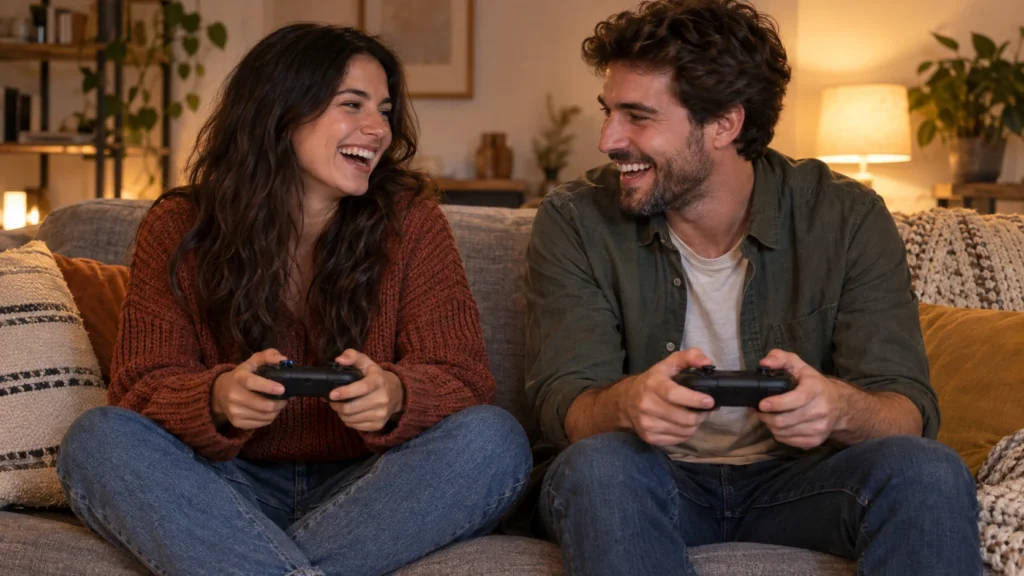
The hard part of playing together on one sofa is almost never finding a game. It is finding one that survives two people with very different levels of skill. One of you has been holding a controller since childhood. The other has not, and is now handed a device with two sticks, four face buttons and a menu written in a language of its own.
This guide is about the choice, not the catalogue: how to sort local co-op by the experience it creates for a pair, how to read the gap between you, and the session rules that keep an evening from turning into an argument.
When the Evening Moves Out of the Living Room
Some nights the sofa loses and a bar, a cafe or a games space wins. If that place is a VISU partner, scanning the code there turns the visit into a small reward. The evening stays yours, the bonus is an extra.
What Local Co-op Actually Is
Start with the category, because the words get used loosely on a menu screen. Wikipedia defines the form plainly: "A cooperative video game, often abbreviated as co-op video game, is a video game that allows players to work together as teammates, usually against one or more non-player character opponents (PvE)."
That last part is the structural difference from the rest of a multiplayer menu: the opposition is the game, not the person next to you. That alone removes most of the reasons an evening goes wrong.
The article names the version you are here for: "Co-op games designed to be played by multiple players on the same display screen have come to be known as 'couch co-op', 'local co-op' or 'single-player co-op' games." The alternative is a network, where each player has their own display.
So couch co-op is not a genre, it is an arrangement: two or more people, one display, one room. Everything below follows from that, because sharing a screen changes what a game can ask of the weaker player. It is also worth knowing why almost everything tops out where it does: "While there are no practical technical limits to how many players can be involved in a co-op game, the industry has settled on games that support up to four players as an informal standard." A pair sits comfortably inside the number every designer builds for.
Reading the Gap Between the Two of You
Before you pick anything, work out which of the three gaps you have.
The vocabulary gap. The less experienced player does not know what the interface is telling them: that the left stick moves and the right stick looks, that a draining bar is urgent. Their hands are not slow, they have not learned the conventions. This closes fast, fastest in games with very few inputs.
The dexterity gap. The player knows exactly what to do and cannot make their thumbs do it in time. They see the jump coming and land short. This closes slowly and does not respond to explanation, so you need generous timing windows and mistakes that cost a retry.
The stamina gap. This one gets missed most. One player holds concentration for two hours, the other is finished after half an hour, not from boredom but from the load of tracking a screen that never stops. It does not show early, which is why the session starts well and ends badly. The fix is short self contained units of play and an agreed stopping point.
Two questions sort it. Does the beginner know what the game wants right now? If no, vocabulary. When they know, does their hand get there? If no, dexterity. If both are yes and the evening still went flat, stamina.

The Five Types of Pair Experience
Sort by what the game asks of a pair, not by what it is called.
Shared task, separate jobs. Both players are needed and each gets a different responsibility at the same moment. One holds a door, the other carries something through. Neither job is mechanically harder, so a skill gap does not become a competence gap. The most reliable shape for a wide gap, because the design does the work instead of asking the stronger player to hold back. Some cooperative games are built this way on purpose, giving each player a distinct role with its own tasks and abilities rather than two copies of one character.
Same job, same screen. Two characters with the same abilities, one objective. Tempting for a first session, but this is where a dexterity gap hurts most: the game measures both against the same demand and the screen shows the difference constantly. Fine when the gap is vocabulary only.
One plays, one guides. The second player supports rather than drives. This is a documented design: the article notes some games "limit the second player to an omniscient, invulnerable helper role, where they can assist the first player", sometimes through a targeting reticle. The word to notice is invulnerable, since a helper who cannot die cannot lose the run for the pair. The fair objection is that the helper is not really playing. If they have a decision every few seconds, they are. If not, they will pick up their phone.
Friendly competition inside a shared frame. Not strictly cooperative, but pairs reach for it constantly. What makes it survive a gap is round length: a short round the beginner loses is a shrug, a long match is an evening.
Low input, high conversation. Very few controls, little timing pressure, and most of the activity is deciding out loud what to do next. For a vocabulary gap this is the fastest bridge there is.
The Place Counts, Not Just the Plan
VISU connects rewards to verified presence at partner locations. If the two of you are already heading somewhere on the map, the bonus comes from showing up, not from spending more.
One Screen or Two Halves
Same screen play arrives in two shapes, and the shape matters more to a mismatched pair than most people expect.
The first is split screen: "Many video games support split screen displays in order to show two or more players in different regions of the game", usually two or four sub-regions "so that 2 to 4 players can roam freely within the game world." That freedom is the point and the risk. The experienced player advances, the beginner is behind working out which way is forward, and neither sees what the other sees. It punishes a vocabulary gap badly: the person who is lost is also alone.
The second is a single shared view, and here the source is specific about the failure mode. Both players "must coordinate their actions, particularly with regard to the scrolling. If the scrolling is limited to a forward direction only, players can potentially kill each other", because "one player lagging behind could cause problems for his partner, as the screen will not scroll onward."
That is a design in which the slower player can, without doing anything wrong, cause the faster player to fail. Designers noticed. The article records a camera "that can zoom in and out over an entire level as needed, keeping both players within the scope of the camera", and an adaptive view allowing "player screens to be split when the player characters are far apart, but combine into one full screen image when player characters are close enough together." So the question at the menu is what the game does when you drift apart.
Games That Forgive a Beginner's Mistake
Forgiveness is not the same as easy. An easy game can still end a run for one bad input, while a forgiving game can be demanding and still make a mistake cost seconds. Four things to check in the first few minutes.
Where the restart point is. If failure puts you back a few seconds before the mistake, the beginner can fail twenty times and nothing is lost. If it puts you back at the start of a long stretch, every failure taxes the other player.
Whether failure is individual or shared. If one player going down ends the attempt for both, the beginner carries the weight of the session. If a downed player can be revived or respawns nearby, failure stays local. Usually visible in the first encounter.
Whether resources are pooled. The article notes that "a common concept in co-op games is the sharing of resources between players", with two players on one team drawing "off the same pool of resources." That is quietly poisonous for a pair with a gap: a beginner who does not yet understand the economy spends what the other was saving. If the game pools, agree out loud who spends what.
Whether difficulty can move mid session. A setting you can change without leaving what you are doing lets you drop it the moment the beginner stalls. A game that makes you abandon progress to change it will never get adjusted.
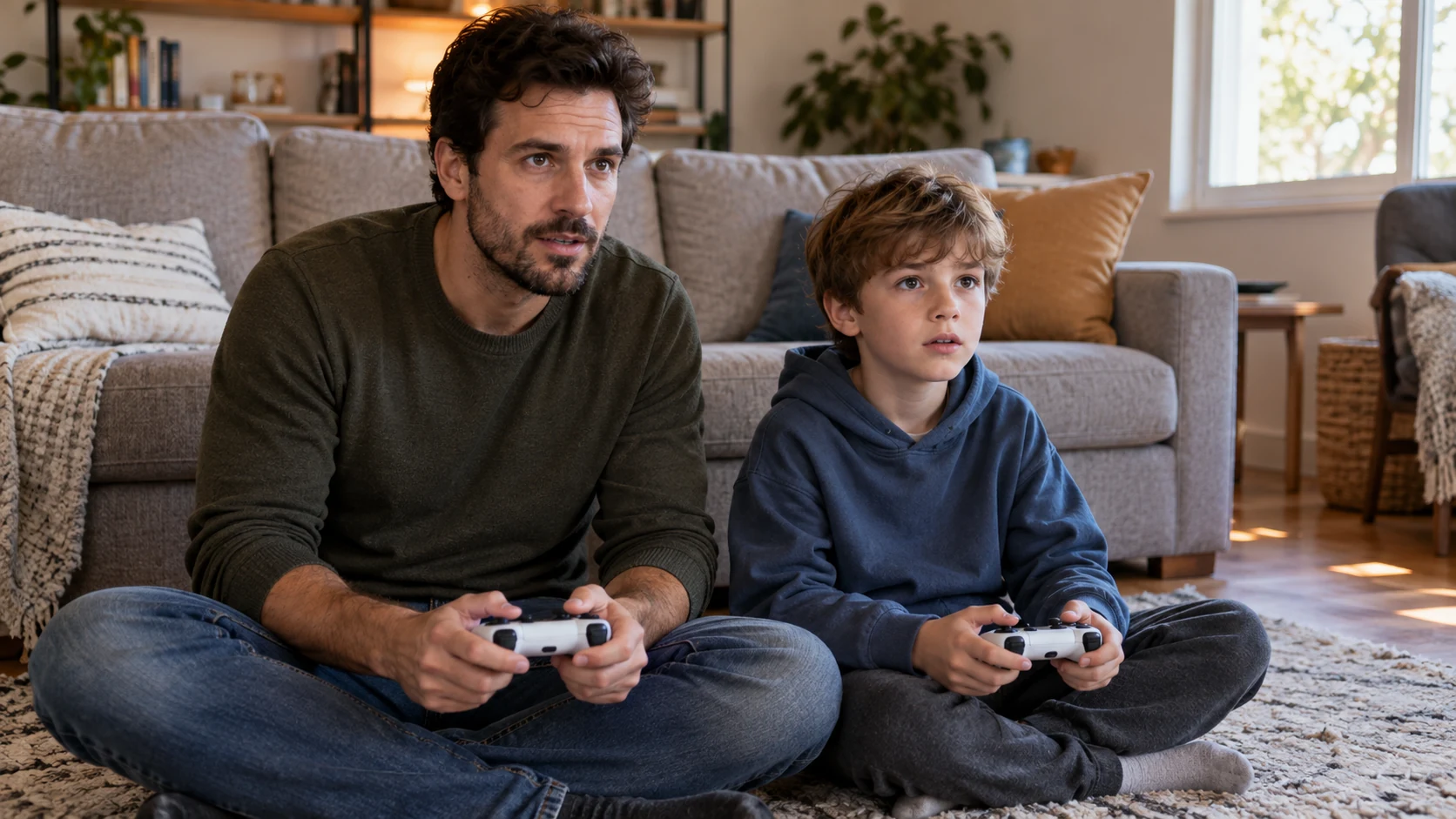
Setting Up Before Anyone Presses Start
Most bad co-op evenings were decided in the five minutes before they began. These are the decisions worth making out loud.
Decide the length first. Name an end time, shorter than you think. Forty five minutes both people enjoyed beats two hours where the last forty were endured.
Give the beginner the lighter set of inputs. Where a game offers roles with different control loads, the less experienced player takes the simpler one. A player fighting the controller is not in the game at all.
Set difficulty for the weaker player, not the average. There is no average of two players: a setting pitched between you is dull for one and impossible for the other. Set it where the beginner can participate.
Agree who is allowed to give instructions. This rule saves the most evenings. Constant coaching is the fastest way to make someone stop enjoying themselves, even when every word is correct. The beginner asks, and until they ask the other stays quiet.
The First Twenty Minutes, in Order
A sequence that works for almost any pair and any game.
Zero to six. Controller in the beginner's hands, game paused. Sticks only: move, turn, stop, no objective. Then add exactly one button, the one they will use most. Name it once and stop naming it. This is where the vocabulary gap starts closing, and skipping it costs you the session.
Six to fifteen. Start at the lowest available difficulty and let the beginner do something that visibly works. Then introduce whatever coordination the game requires, one element at a time, not in the middle of a demanding stretch.
Fifteen to twenty. First check in. Ask directly: too fast, too slow, or right? Then adjust and continue. Asking at twenty minutes is a question. Asking at ninety is an autopsy.
Where the Friction Actually Comes From
When a session goes wrong it is rarely the game. Four recurring causes, in rough order of frequency.
The commentary. One player narrating the other's mistakes, usually with goodwill. The most common cause and the easiest to fix.
The screen problem. Either the shared view that will not scroll because someone is behind, or a split view where the lost player is lost alone. If a game produces this every few minutes, change the game.
Unmatched expectations. One is playing for the outcome, the other for the company. Both need saying out loud, or one reads the other as careless and gets read as intense in return.
Fatigue mistaken for attitude. After an hour the beginner's inputs get worse, not better. That is load, not indifference, and the clearest signal the session should already have ended.
How to End It Before It Turns Into an Argument
Ending well is the part most pairs never plan.
End on a completion, not a failure. Whatever the game's natural unit is, finish one and stop. The last thing that happened is what you will both remember.
Treat the agreed time as a floor. When you reach it, ask once. If either person hesitates, that is a no.
Watch for three signals. Someone stops talking. Someone repeats a mistake they had stopped making. Someone reaches for their phone during a pause. Any one means the useful part is over.
Stop the moment either of you wants to win the conversation. When the discussion moves from the game to who did what, pause it. The same conversation is harmless the next day.
Say the next date before you turn it off. A vague "we should do this again" usually means never. A specific "same time on Thursday" turns one good session into a habit.
If you would rather do this without a screen, the same logic applies to a table. Our guide to indoor activities for kids covers the offline side of the same problem.
Rewards for Being There
VISU is an app that rewards a verified visit to a partner location. Nothing to buy, nothing to prove beyond being where you already are.
FAQ
What Is the Difference Between Couch Co-op and Online Co-op?
The display. Local or couch co-op means one screen in one room. The alternative is described as games "in which players each use their own display system", known as online or network co-op.
Is There a Way to Play Together When One Person Really Cannot Use a Controller?
Yes. Some games give the second player a helper role described as omniscient and invulnerable, able to assist the first player through a targeting reticle. A role that cannot fail cannot cost the pair a run.
Should We Choose Split Screen or a Shared View?
Split screen suits two people who can both navigate. A shared view keeps you together but can let a lagging player stop the screen advancing for the other. Prefer games that adapt, zooming out or splitting as you separate.
My Partner Says They Are Just Bad at Games. Are They?
Usually they are new to the conventions rather than slow. Not knowing which stick does what looks identical to lacking ability from the outside, and feels completely different from the inside.
What if One of Us Wants to Take It Seriously and the Other Does Not?
Say it before you start, because it stays invisible until it produces resentment. If one is there for the outcome and the other for the company, choose short rounds where the outcome resets quickly.