

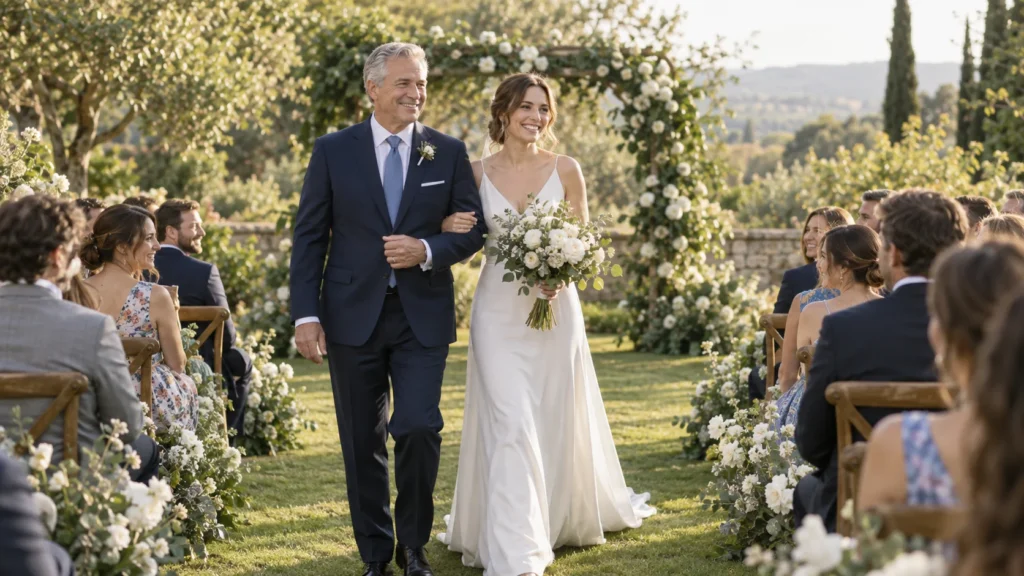
The wedding processional order decides who walks in, in what sequence and who is already waiting at the front when the ceremony begins. There is no single correct lineup. This guide lays out a common modern order, the variations couples use most, what Catholic and Jewish sources actually say about the entrance, and how to build an order that fits your family, your venue and your tradition.
Give Guests One Link for the Day
A VISU Link page can hold the venue map, the timeline and links to your external RSVP form or photo album. Share it with one link or its QR code.
What the Processional Covers
The processional is the organized entrance of the people who take part in the ceremony. It usually starts once guests are seated and ends when both partners have reached the front. The recessional is the exit at the end, and it normally runs in roughly the reverse direction.
Before the processional there is often a short seating moment. Ushers or family members bring grandparents and parents to reserved seats, or those relatives walk in as the first part of the processional itself. Deciding which of the two you want is the first real choice, because it changes how long the entrance lasts and who gets a moment in the aisle.
Three roles shape every lineup:
- The officiant, who either walks in first or is already standing at the front.
- The partner who waits, if one partner is at the front when the other arrives.
- The final entrance, the person or couple who walks last and receives the fullest attention of the room.
A Common Modern Processional Order
Many American weddings with a traditional feel use a sequence close to the one below. Treat it as a starting template, not a rule. Every step can be removed, merged or moved.
- Officiant. Walks up the aisle or enters from a side door and takes the center position.
- Grandparents. Often escorted to the front rows, one side after the other.
- Parents of the partner who waits. Walk together or are escorted to their seats.
- The partner who waits. Walks up the aisle alone, with a parent or with a best friend, or enters from the side with the officiant.
- Attendants. Walk one at a time or in pairs, usually starting with the person who will stand farthest from the couple.
- Honor attendants. The one or two people closest to the couple walk last among the wedding party.
- Ring bearer and flower girl. Walk just before the final entrance, alone or together.
- Final entrance. The second partner walks alone, with one or both parents, with another family member or with a chosen escort.
The order within the attendants is where couples improvise most. Some pair attendants from both sides so they walk in as couples. Others send each person in alone and let them split left and right at the front. Both work. Pairs shorten the entrance, while single walks give each friend a visible moment.
| Option | Who is at the front first | Who walks last | Works well when |
|---|---|---|---|
| One partner waits | Officiant and one partner | The other partner, escorted or alone | You want a classic reveal moment |
| Each partner escorted | Officiant | Both partners, one after the other, each with family | Both families want a visible role |
| Walk in together | Officiant and wedding party | The couple, side by side | You prefer an equal, shared entrance |
| Two aisles | Officiant | Both partners at once, meeting at the center | The venue has two aisles or an open layout |
What Religious Traditions Say
If you are marrying in a house of worship, the tradition and the local community come before any online template. Ask your officiant for the order they expect, because parish, synagogue and congregation customs vary. Two traditions publish clear guidance worth knowing.
Catholic Weddings
The United States Conference of Catholic Bishops has explained that the older Rite of Marriage described a detailed procession: the ministers go first, followed by the priest, and then the bride and bridegroom, who according to local custom may be escorted by at least their parents and the two witnesses. The current English edition, the Order of Celebrating Matrimony, replaced that detail with a general instruction that the procession takes place in the customary manner. The bishops' newsletter reads this as leaving considerable latitude in the details and order of procession.
In practice that means a Catholic couple may see the older model, where the couple enters together after the priest, or the familiar model where one partner waits at the altar. The bishops' marriage site also notes that the priest's welcome can happen at the church door or at the altar, depending on the style of procession chosen. Your parish will tell you which one it uses.
Jewish Weddings
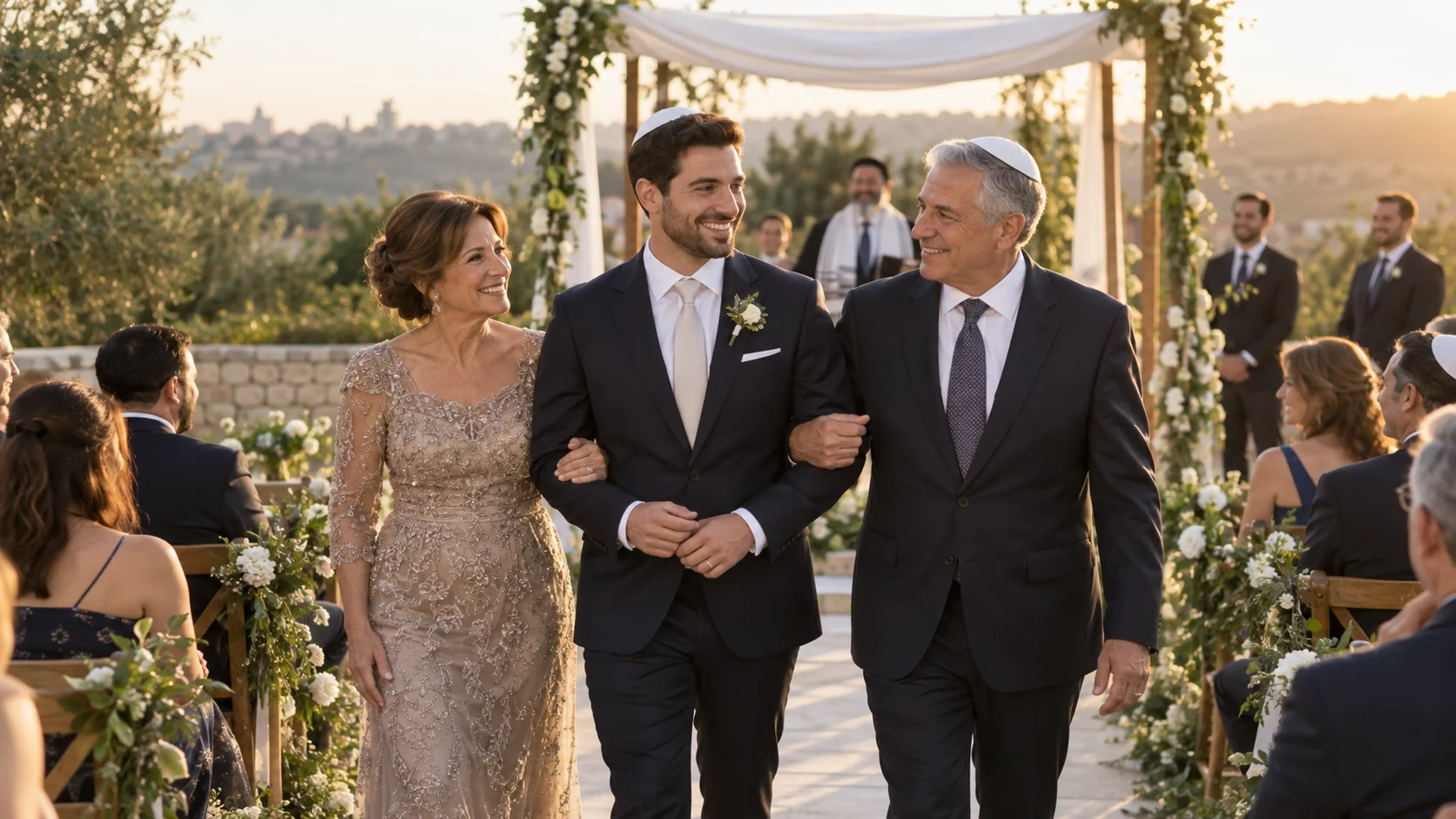
Chabad.org describes a procession in which the bride and groom are brought to the chupah, the wedding canopy, by escorts who are usually their parents. In most communities the groom is escorted by his parents and the bride by hers. In chassidic and certain other communities, the groom walks with his father and father-in-law and the bride with her mother and mother-in-law. The groom is led to the chupah first, the escorts hold candles, and some communities add the grandparents to the escorting group.
Chabad.org also notes that if parents cannot fill the role, another married couple, such as grandparents, married siblings or close friends, may take the honor. Reform, Conservative and Orthodox communities do not all follow the same customs, so confirm the order with your rabbi.
Other Christian and Faith Traditions
Protestant, Orthodox Christian and other faith communities each have their own customs, and some leave the entrance entirely to the couple. We have not found one official order that covers them all, so this guide does not attribute any sequence to them. The practical step is the same: ask the officiant before you print a program.
Civil, Secular and Same-Sex Processionals
A civil or secular ceremony gives the most freedom. There is no liturgical order to follow, so the questions become personal: who do you want beside you as you walk, and who do you want waiting at the front?
For couples of the same sex, or any couple who does not want a one-sided reveal, these options are common:
- Both partners escorted. One partner enters with their family, then the other does the same. Decide the order by coin toss, by who is more comfortable waiting or by which song you want to end on.
- Walk in together. The wedding party enters first and the couple arrives side by side, holding hands.
- Meet in the middle. Each partner walks alone to the midpoint of the aisle, then both finish the walk together.
- Mixed wedding party. Attendants walk in the order that makes sense for friendships, not for sides, and stand wherever the photos balance best.
Nobody needs to be "given away" in a secular ceremony. If a parent escorts one partner, some couples prefer that the parent hugs both partners and takes a seat, which keeps the moment symmetrical.
Small wedding parties also make the entrance quicker and easier to rehearse. If you are trimming the guest list or the number of attendants to control costs, our guide on planning a wedding on a budget covers where those choices usually save the most.
Keep the Day's Links Together
Put the map, the parking note, the livestream link and your external photo album on one VISU Link page, then print its QR code on the program or welcome sign.
Children, Spacing and Music Cues
Children are the least predictable part of any processional. The usual placement for a ring bearer and flower girl is right before the final entrance, so that whatever happens in the aisle becomes a warm-up rather than an interruption. Some couples let very young children walk with an older sibling or a parent who then sits in the front row, which gives the child a safe place to go once they reach the end.
If the rings matter, give the ring bearer a pillow or box with replica rings and let an honor attendant or the officiant hold the real ones. That removes one worry from the day without changing the look of the walk.
Spacing is what makes a processional look calm. Instead of timing everyone in seconds, give each walker a visible cue, such as a musical phrase or the moment the previous person reaches a marked row. A gap that feels long in the aisle usually looks right to guests. Long aisles need bigger gaps than short ones.
Music cues work best with two or three pieces:
- One piece for grandparents, parents and the wedding party.
- A change of music, or a pause, as the final entrance begins.
- A brighter piece for the recessional.
Tell the musician or the person running the playlist exactly who is the last attendant before the music changes. That single handoff is the most common place for a processional to stumble.
Where Everyone Stands at the Front
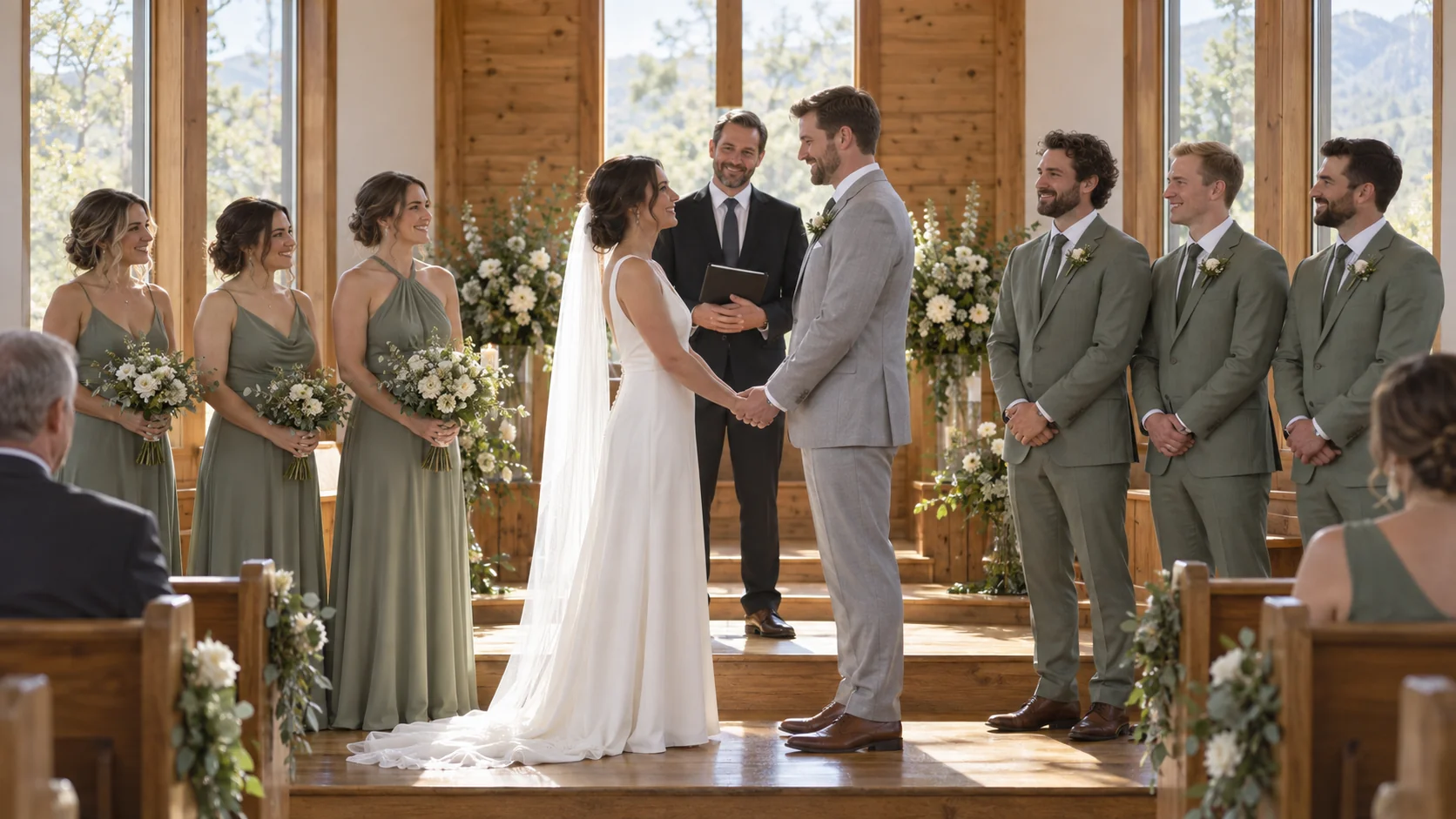
The processional order and the standing arrangement are linked. Whoever walks first among the attendants usually stands farthest out, so each new arrival steps into place without crossing in front of someone else. Honor attendants end up closest to the couple, where they can hold a bouquet, pass the rings or adjust a veil or jacket.
Often each partner's attendants stand on that partner's side. Many couples mix the sides by friendship or height instead. Either works if the photographer knows in advance.
Parents and grandparents normally sit in the first rows. In a Jewish ceremony, Chabad.org notes that others may follow the escorts and join the wedding party under the chupah, so the space around the canopy can hold more people than a standard altar line. Measure your venue's front area and plan the positions before you invite a large wedding party.
The Recessional Order
The recessional is simpler than the processional. The most common version reverses the entrance:
- The newly married couple.
- The ring bearer and flower girl, if they are comfortable walking again.
- Honor attendants, walking together.
- The remaining attendants, in pairs.
- Parents and grandparents, or they may stay seated and leave with the guests.
- The officiant, unless they remain at the front to give instructions.
For Catholic weddings, the bishops' newsletter points out that the Order of Celebrating Matrimony does not describe or mandate a concluding procession, beyond noting that ending with a suitable chant is praiseworthy. That leaves room for local custom, so follow what your parish asks.
A good recessional leaves no one stranded. Decide in advance whether guests should wait until the wedding party has left, and who will announce the next step, such as the receiving line, photos or the move to the reception.
Build Your Own Order in Five Questions
If none of the templates above fits, answer these five questions and the order will almost write itself:
- Does your tradition or venue require a sequence? If yes, start from that and adjust only what the officiant allows.
- Who waits and who arrives? One partner waiting, both escorted or walking in together.
- Who escorts each partner? One parent, both parents, a grandparent, a sibling, a child from a previous relationship, a friend or nobody.
- How many people walk? Count every walker, then decide whether they enter in pairs or alone.
- How long is the aisle? A short aisle suits fewer walkers and smaller gaps. A long one can absorb more.
Write the final order as a numbered list with names, then share it with the officiant, the musician and the photographer.
If you plan to put the program online instead of on paper, our guide to QR codes for events explains how guests can reach a page from a printed code at the entrance.
Share the Program With One Scan
VISU Link gives you a shareable visu.to/<username> page with a native QR code. Use it for the public links you want guests to find, from the map to the photo album.
Frequently Asked Questions
Who walks first in a wedding processional?
In many weddings the officiant enters first or is already at the front, followed by grandparents and parents. In a Catholic ceremony the older rite placed the ministers and the priest first, so ask your parish which model it uses.
Does the groom walk down the aisle?
He can. In many Jewish weddings the groom is escorted to the chupah first, usually by his parents. In other ceremonies he may walk alone, with a parent or enter from the side with the officiant.
Who can walk the bride down the aisle instead of her father?
Anyone she chooses: her mother, both parents, a grandparent, a sibling, a child, a close friend or no one at all. In a religious ceremony, confirm any community custom with the officiant first.
What is the processional order for a same-sex wedding?
There is no fixed order. Common options are both partners escorted one after the other, walking in together, or meeting in the middle of the aisle. Choose what feels balanced for both families.
Do grandparents walk in the processional?
Often, yes, usually near the start and before the parents. Some couples have them seated before the processional begins instead, which is easier if walking a long aisle is tiring.
What is the usual recessional order?
The couple leaves first, then the children, the honor attendants, the other attendants and finally parents and grandparents. Catholic liturgical texts do not mandate a concluding procession, so parishes follow local custom.