
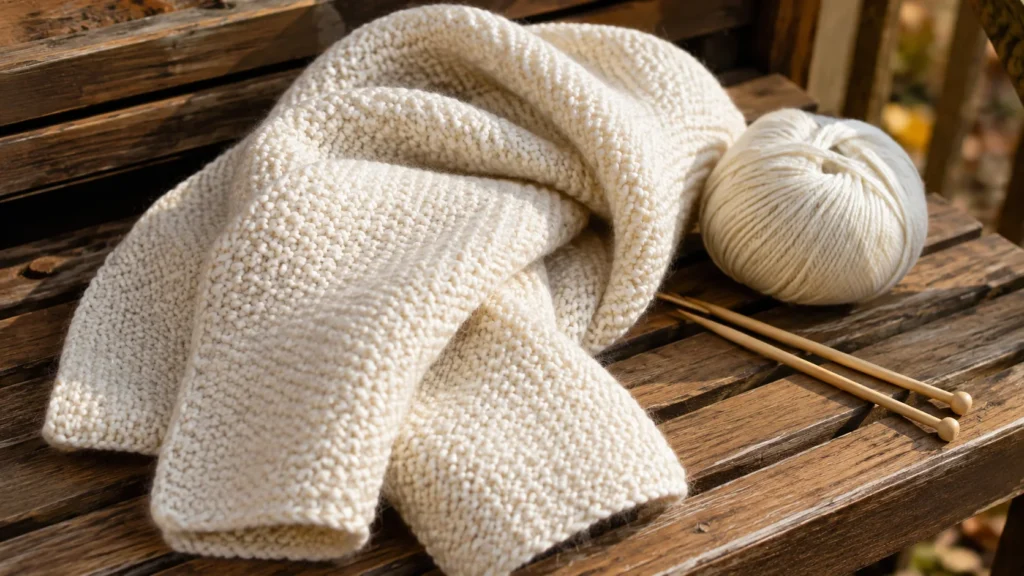
One row, memorized once, repeated 420 times: that is the entire pattern. This is a complete original seed stitch scarf for a true beginner, cast on, knit, purl, bind off, with every number computed and cross-checked. It lies flat without a border, looks identical on both sides, and if your tension runs a little loose or tight, you still get a scarf.
This pattern uses US knitting terms (CO, K, P, BO) throughout, with the UK note in the glossary. If cast on and purl are still new words to you, start with our beginner knitting hub, which teaches the abbreviations and the first stitches, and come back here for your first real project.
One Link for Everything You Make
A short address you control, pointing to your finished projects, progress photos and pages wherever they live.
Why Seed Stitch Is the Right First Scarf
Seed stitch uses only knit and purl, and it solves the two problems that ruin beginner scarves. First, it lies completely flat: stockinette, the fabric on every yarn label photo, curls hard at the edges, and a curled scarf is the most common first-project heartbreak. Seed needs no border, no edging and no mandatory blocking. Second, it is fully reversible, which matters for a scarf that is seen from both sides, and removes any right-side/wrong-side tracking.
And the design decision that makes this pattern beginner-proof: with an odd stitch count, every single row is identical. No row A and row B, nothing to lose track of; you learn one row and repeat it. Along the way you learn the skill that separates a garter-stitch knitter from a knitter, moving the yarn between front and back for the knit-to-purl transition. One naming note: this fabric is seed stitch in US usage; UK books use "moss stitch" for closely related fabrics and the definitions vary, so follow the row instruction, not the name.
Materials: Yarn, Needles and Nothing Else
Yarn: worsted weight, category 4 (Medium) per the Craft Yarn Council yarn weight standard. Pick a smooth, plied, lighter-colored yarn: stitch definition is what lets you see and fix mistakes, and dark or fuzzy yarn hides them. Wool or a wool blend is more forgiving than pure cotton at this length. Buy 2 skeins of 200 yd (183 m), 400 yd (366 m) total, in the same dye lot; the computed requirement is 305 to 372 yd depending on your hand, and a dye-lot change mid-scarf is visible forever.
Needles: 5.0 mm (US 8), straight or circular. Category 4 takes a 4.5 to 5.5 mm needle in the CYC standard, and the CYC US and Canada sizing table confirms 5 mm = US 8, so this sits mid-range. A circular needle worked back and forth carries the growing weight better on a long project, but is not required.
Notions: scissors and a tapestry needle. That is the whole list, deliberately: no markers, no counters, no gadgets. A pen-and-paper tally does everything a row counter does.
Gauge: The Twenty Minutes That Save the Project
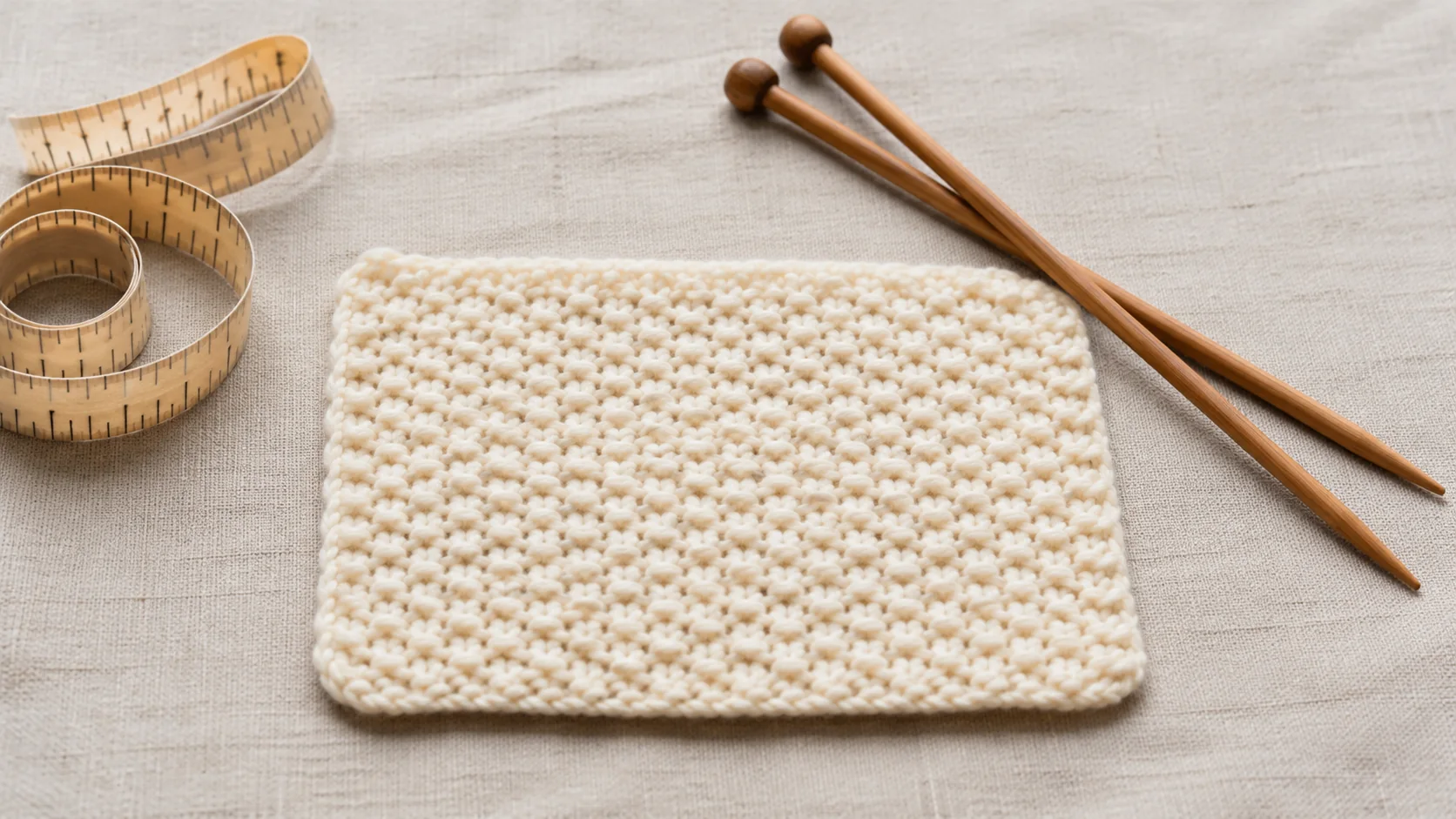
Pattern gauge: 16 stitches and 30 rows = 4 in (10 cm), measured in seed stitch, on 5.0 mm needles, after gentle blocking. The warning that must not be skipped: the number on your ball band is a stockinette number and will not match. Seed stitch measures differently from stockinette in the same yarn, so the only gauge that counts is the one you measure in seed yourself.
The swatch: cast on 21, work the pattern row below for 5 in (13 cm), bind off loosely, and measure across the middle 4 in, never at the cast-on or bind-off edges, which distort. On a 56 in scarf, a small gauge error compounds into real inches, which is why this swatch is worth twenty minutes.
The Pattern: The Everyday Seed Stitch Scarf
Finished size: about 7¼ in (18.4 cm) wide and 56 in (142 cm) long. Skill level: beginner, basic stitches only, no increases, no decreases.
Cast on 29 stitches. Any cast on you know works; if you use the long-tail, start with a tail of roughly three times the width, about 22 in (56 cm) plus margin.
Row 1 (and every row): K1, *P1, K1; repeat from * to end. (29 sts)
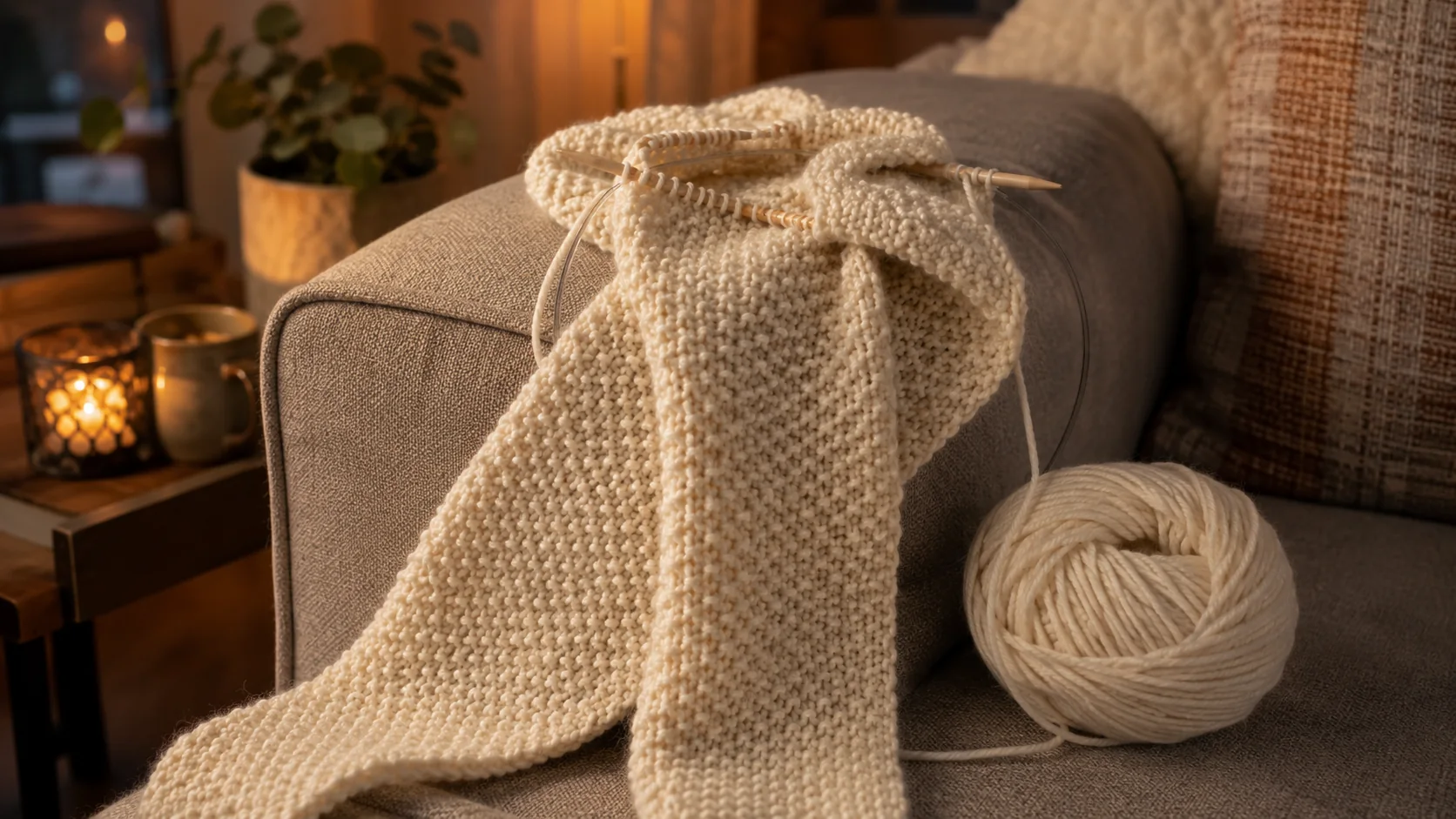
That is the entire pattern. Because the count is odd, every row begins and ends with K1, and each purl lands on a knit from the row below all by itself. There is no second row to learn and no side to track. Repeat this row until the scarf measures 56 in (142 cm) from the cast-on edge, ending after any row, which is approximately 420 rows at pattern gauge. Trust the tape measure over the row count: rows are a checkpoint, not a target. Measuring every 30 rows gives you fourteen even checkpoints of roughly 4 in (10 cm) each.
Bind off loosely in pattern, knitting the knits and purling the purls as they face you. Binding off too tightly is the most common way to ruin a finished scarf, because a tight edge pulls in and flares the fabric below it; if your bind off runs tight, work that one row with a needle one size larger. Cut the yarn with a 6 in (15 cm) tail, pull it through the last stitch, and weave both ends 2 in (5 cm) or more into the textured columns before trimming.
Finishing: seed stitch does not curl, so blocking is optional. To even out the fabric, soak in cool water, press out the excess without wringing, lay flat to size and let it dry fully. Never hang a wet scarf; the weight stretches it for good.
Keep Your Makes in One Place
Link your finished projects, progress photos and favorite patterns from one short address.
If Your Gauge Doesn't Match: The Recalculation
The formula, and it works for any yarn: cast-on stitches = desired width in inches × (your stitch gauge ÷ 4), rounded to the nearest whole number, and if that lands on an even number, add 1. The odd count is not optional: an even count turns this row into 1x1 ribbing, a completely different, elastic, inward-pulling fabric, and the one-row magic is gone.
Worked examples for a 7 in scarf: at 14 sts per 4 in, cast on 25 (7.14 in actual); at the pattern's 16, cast on 29 (7.25 in); at 18, the math gives 31.5, rounds to 32, even, so cast on 33 (7.33 in). Length works the same way: at 26 rows per 4 in you need about 364 rows for 56 in, at 30 the pattern's 420, at 34 about 476. And the yarn warning that goes with it: more stitches or a looser hand means more yarn than the 400 yd estimate, so buy a third skein if your gauge runs loose, or shorten the scarf to the yarn you have.
Easy Variations
Cowl: work to 30 in (76 cm) and seam the ends into a loop. Seaming is a skill this article does not teach, the hub covers it; and buy the same 2 skeins, the shorter length looks like one skein's worth but leaves no safety margin on a single ball. Wider: add stitches in pairs of 2 to keep the count odd; each pair adds about half an inch (1.3 cm) at pattern gauge, and yarn use grows with it. Stripes: change color at any point; since every row is identical, a color change never interrupts the pattern, making this the cheapest personalization on offer.
The Mistakes That Actually Happen
The fabric looks like ribbing, not pebbles: the stitch count went even, or a row started with P1. Count your stitches; 29 means every row starts and ends K1. The width is drifting: stitches were dropped or accidentally added; count at a checkpoint and fix before knitting on. The edge flares at the end: the bind off was tight; undo it and rebind with a larger needle. It curls: real seed stitch does not; curling means long stretches drifted into stockinette, worth catching at the 30-row checkpoints rather than at the end. Ran out of yarn at 48 inches: looser gauge than pattern; a scarf bound off at 48 in (122 cm) is still a scarf, and nobody will measure it but you.
FAQ
How many stitches do I cast on for a scarf?
For this pattern, 29 stitches at a gauge of 16 stitches per 4 inches gives a 7¼ in (18.4 cm) width. The general formula: desired width in inches times your stitch gauge divided by 4, rounded to the nearest whole number, plus 1 if it lands even, because seed stitch needs an odd count.
How long does it take a beginner to knit a scarf?
This one is about 420 rows of a single memorized row, roughly 12,000 stitches. At a relaxed beginner pace of a few rows a day it is a several-week companion project; in focused evening sessions, two to three weeks. The 30-row checkpoints keep the progress visible.
Why does my seed stitch look like ribbing?
The stitch count is even, or a row started with a purl. With an odd count and every row starting K1, purls automatically stack on knits and the fabric pebbles. With an even count, knits stack on knits and you get 1x1 ribbing, a different fabric entirely.
Do I have to block a seed stitch scarf?
No. Seed stitch lies flat on its own, which is exactly why this pattern uses it. A gentle soak-and-lay-flat evens out the fabric if you want, but never hang it wet, the weight stretches it permanently.
How much yarn do I need to knit a scarf?
This pattern computes to 305 to 372 yd (278 to 340 m) of worsted depending on your hand, so buy 400 yd, two 200 yd skeins in the same dye lot. Looser knitters and wider scarves need more; a third skein is cheap insurance.