
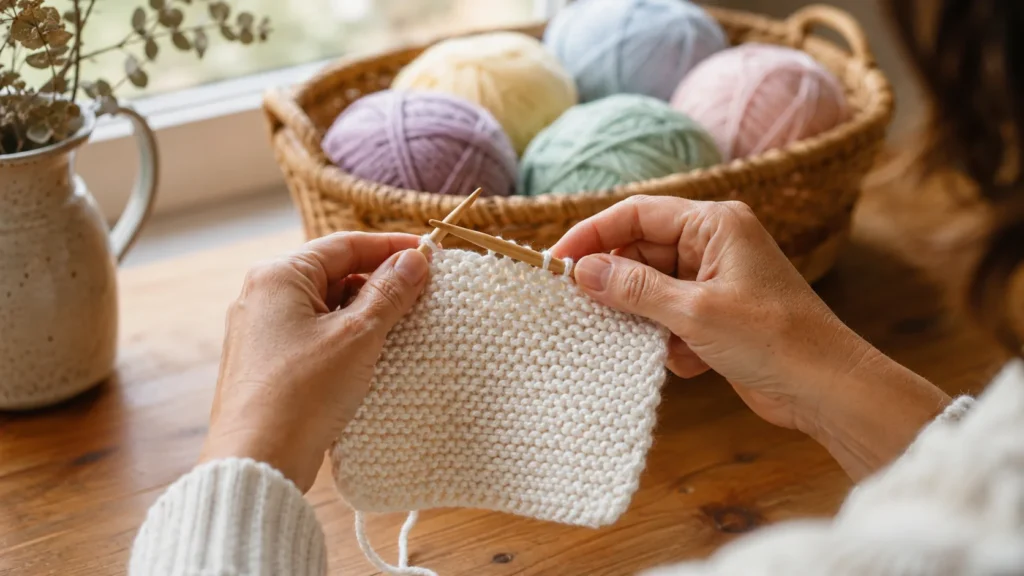
Knitting has exactly two stitches. Knit and purl: everything else, every cable, every lace shawl, every sweater, is those two moves in arrangements. Which means a beginner who learns to read the shorthand and picks a forgiving first project is much closer to finished objects than the craft's reputation suggests.
This hub is the map: how to decode pattern abbreviations, what the difficulty labels really promise, which yarn makes learning easy, the first projects ranked by how loudly they punish mistakes, and a complete original washcloth pattern to cast on tonight. Everything uses US knitting terminology, the convention in most free patterns online.
One Link for Everything You Make
A short address you control, pointing to your project photos and favorite patterns wherever they live.
How to Read a Knitting Pattern
A knitting pattern is a recipe in shorthand, and a small set of abbreviations carries most beginner patterns: CO (cast on, putting the first stitches on the needle), BO (bind off, finishing the edge), k (knit), p (purl), st/sts (stitch/stitches), rep (repeat), inc/dec (increase/decrease), k2tog (knit two together, the everyday decrease), kfb (knit into front and back, an everyday increase), and RS (right side, the public face of the fabric). The Craft Yarn Council publishes the standard US abbreviation list most designers follow, linked in the references.
Asterisks and brackets mark repeats: "*k2, p2; rep from *" means work that pair over and over to the end of the row. And one translation note for pattern hunters: US and UK/Canadian patterns name some things differently. A US bind off is a UK cast off, and US gauge is UK tension. Same actions, different labels; check which convention a free pattern uses before starting.
What "Basic" and "Easy" Actually Mean
Most published patterns carry a standard difficulty tier defined by the Craft Yarn Council. Basic covers projects using basic stitches, possibly with basic increases and decreases. Easy projects may include simple stitch patterns, colorwork or shaping. Intermediate brings involved stitch patterns and more serious shaping, and the top tier gathers the most involved techniques.
The honest reading for a first project: live at Basic for the first piece or two, step to Easy when a full project has gone start to finish without drama. A Basic project finished beats an Intermediate project abandoned mid-sleeve, every single time.
Yarn Weights and Needles, Decoded
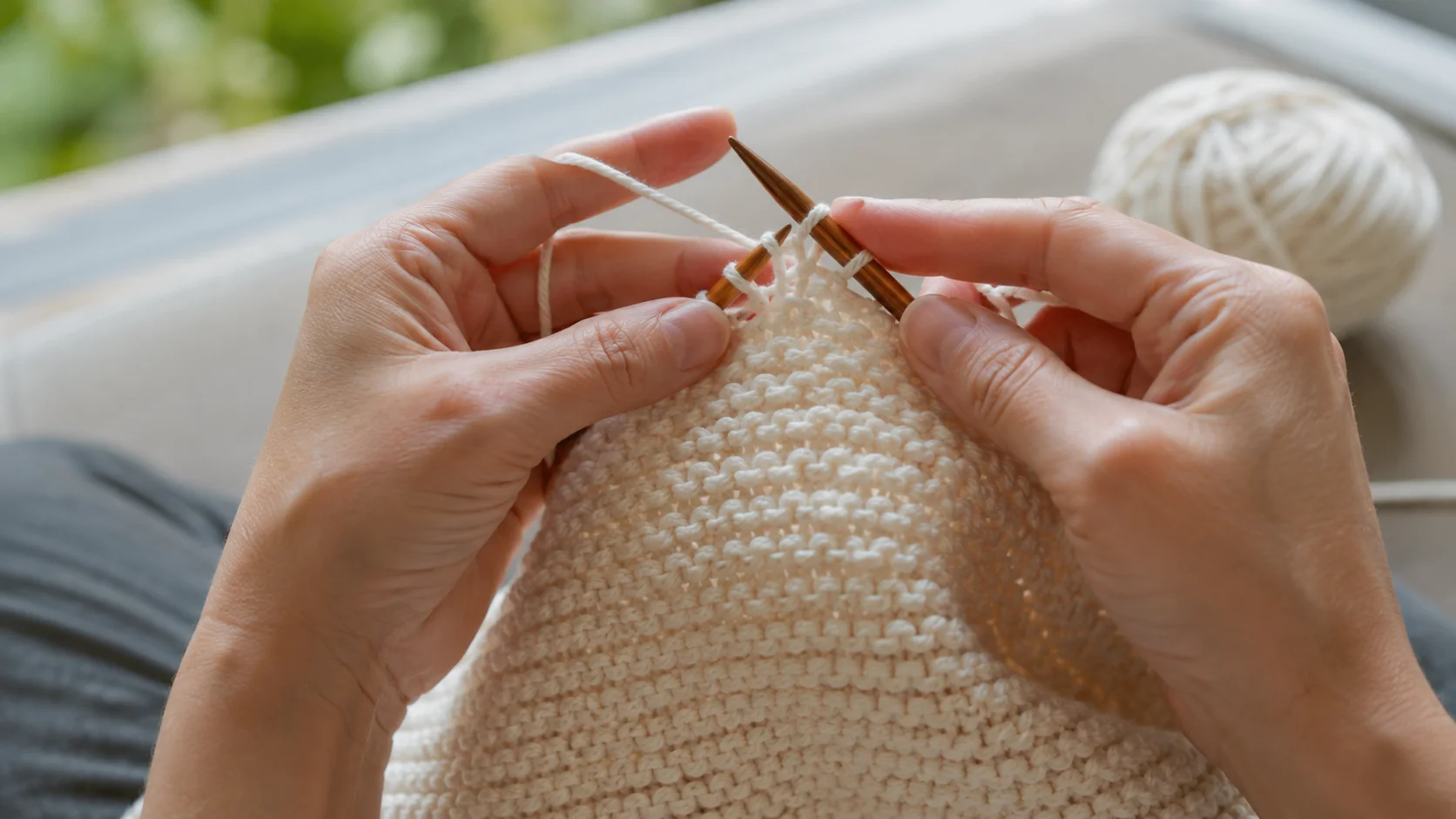
Yarn comes in standard weight categories numbered 0 (lace) through 7 (jumbo) under the Craft Yarn Council's system, and every label shows the category symbol plus a recommended needle range. For learning, the sweet spot is category 4, medium or "worsted" weight, on needles around 4.5 to 5.5 millimeters: thick enough to see every stitch, thin enough that fabric feels like fabric.
Two properties beat color every time. Smooth, light-colored yarn shows your stitches, and seeing stitches is the entire learning curve; dark, fuzzy or highly textured yarn hides them exactly when you need to count. And for the washcloth below, cotton is the classic choice: it holds shape, survives hot washes and shows stitch definition honestly.
Gauge, the stitch-per-inch measurement patterns list, is the one concept you get to postpone. For a washcloth, gauge only changes the size a little. The moment a project must fit a head or a body, the little test swatch stops being optional; building the habit later is fine, knowing it exists now is the point.
Keep Your Craft Life in One Place
Link your project gallery, pattern bookmarks and progress photos from one short address.
The Best First Projects, Ranked by Forgiveness
Beginner-friendliness is really about how loudly a project punishes small errors. Our ranking, from most forgiving to least:
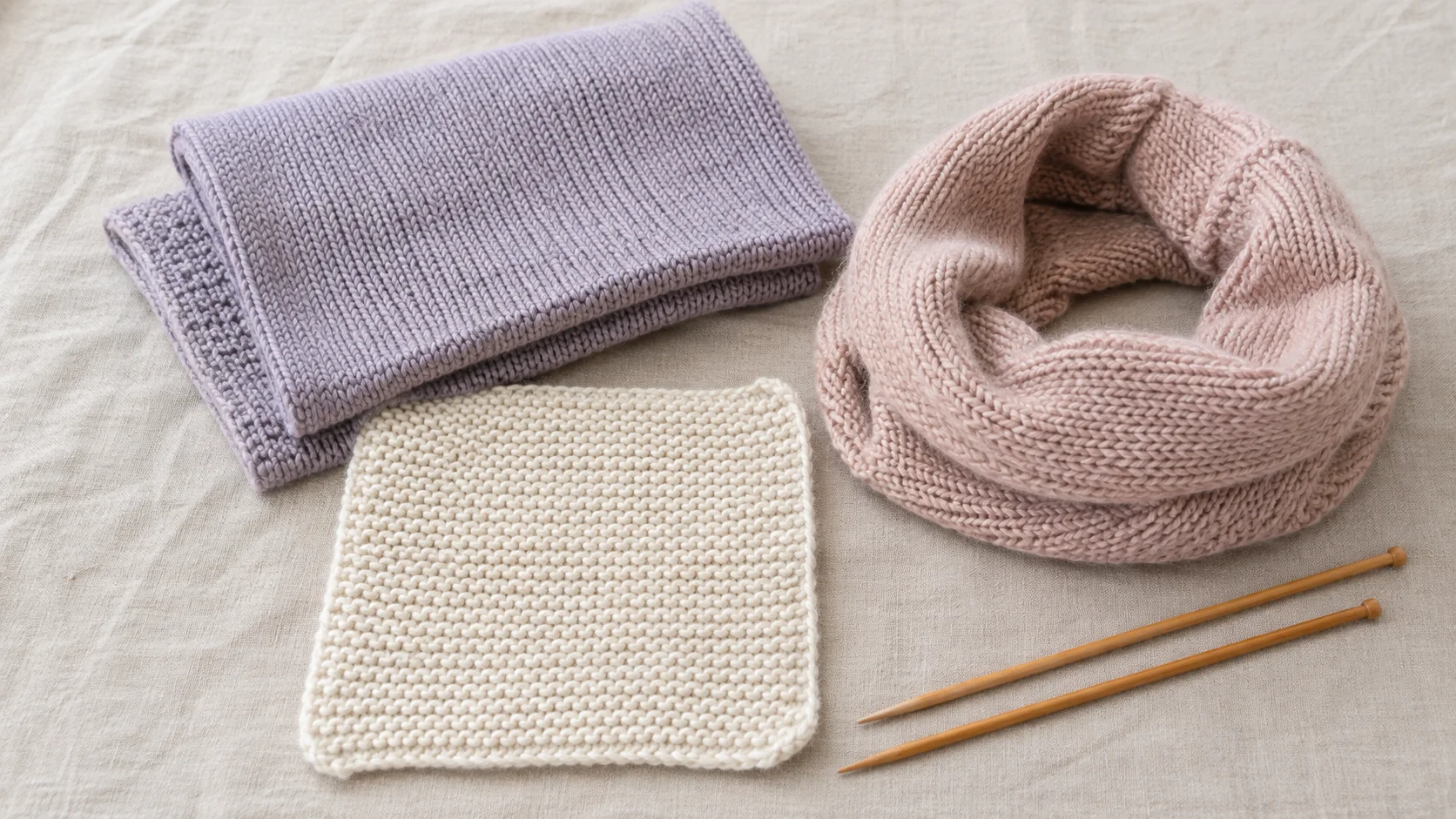
1. Washcloth. Flat, small, square, one stitch throughout. A wobbly edge still washes dishes. The complete pattern is below.
2. Scarf. The same flat fabric, just longer. The risk is not difficulty but drifting stitch counts over length; count stitches every few rows and it stays a rectangle.
3. Cowl. A scarf joined into a loop, either seamed from a flat piece or knit in the round. Adds one new skill with a high-wear payoff.
4. Simple hat. Introduces knitting in the round and basic decreasing. Real shaping, still forgiving: heads do not demand the precision garments do.
5. Sweaters and socks, later. Both need gauge, fit and finishing. They reward a foundation of finished flat projects first; bookmark them for month two, not week one.
Your First Pattern: A Garter-Stitch Washcloth
An original basic-level pattern in US terms. Garter stitch means knitting every row, no purling at all, and every two knit rows build one of its signature ridges. Finished size roughly 17 centimeters square at the stated gauge; tension varies by hand, and the fix is built into the pattern.
Materials: worsted weight cotton yarn (category 4), 4.5 mm needles, scissors, and a yarn needle for weaving in ends.
Gauge (approximate): 18 stitches and 36 rows = 10 cm in garter stitch. Close is good enough for a washcloth.
Pattern:
Cast on: CO 30 sts.
Body: knit every row for 60 rows (30 garter ridges). Count ridges instead of rows if you lose track: two rows make one ridge.
Finish: BO all sts knitwise, cut the yarn leaving a 15 cm tail, pull the tail through the last loop, and weave both ends into the fabric.
The built-in lesson: count your stitches every few rows. Thirty, always. If a row comes up 31, the usual culprit is the yarn slipping over the needle at a row's start creating an accidental extra loop; if 29, a dropped stitch. Catch it while it is one row deep. And if your square comes out wider or narrower than 17 cm, your personal gauge differs, so adjust: width equals stitches divided by your stitches-per-centimeter, and the washcloth forgives every variation.
Prefer working with a hook instead of needles? The same first-project logic, with its own complete washcloth pattern, lives in the crochet patterns for beginners hub.
The Mistakes Every Beginner Makes
The accidental yarn over. Yarn drifting over the needle at the start of a row creates an extra loop that becomes an extra stitch and a mysterious hole. Keep the working yarn under the needle when starting rows, and count.
Death-grip tension. Beginners strangle the yarn, making stitches the needle can barely enter. If knitting the next row feels like prying, loosen up; fabric should drape, not creak.
The too-tight cast on. A rigid cast-on edge pinches the whole piece. Cast on over two needles held together or simply looser than feels natural, and the first row becomes pleasant instead of a fight.
Splitting the yarn. Stabbing through the strand instead of into the stitch leaves fuzzy half-caught loops. Smooth, tightly plied cotton makes this obvious early, another reason it is the right learning yarn.
Panic at a dropped stitch. A dropped stitch ladders down but does not run away. Catch the free loop with anything, a spare needle, a paper clip, and work it back up ridge by ridge, or just secure it and keep going on a washcloth. Nothing about a first project needs to be perfect.
Share the Finished Projects, Not Ten Links
One VisuLink holds your maker gallery, your pattern list and everything else you share.
FAQ
What is the easiest thing to knit for a complete beginner?
A garter-stitch washcloth in worsted cotton: one stitch throughout, flat, small, finished in a few evenings and useful even when imperfect. The complete pattern is in this guide.
What do knitting pattern abbreviations like CO, BO, k and p mean?
CO is cast on, BO is bind off, k is knit, p is purl, st means stitch and rep means repeat. That small set plus asterisk repeats covers most beginner patterns, and the Craft Yarn Council's master list covers the rest.
What yarn should a beginner learn to knit with?
Category 4 worsted weight, smooth texture, light color, on roughly 4.5 to 5.5 mm needles. Visible stitches are the entire point at this stage, and cotton adds honesty and washability.
What is garter stitch?
Knitting every row, with no purling. It lies flat, stretches evenly, hides small errors in its ridges and is the fabric of nearly every good first project.
Is knitting or crochet easier to learn?
Both are beginner-friendly with the right first project, and the honest answer is whichever motion feels better in your hands. Knitting manages many live stitches with two needles; crochet works one loop with a hook. Try a washcloth in each and let your hands vote.