


Most small businesses print a QR code, run one campaign, and then leave the same code up for a year hoping the customer will scan it again. They will not. The first scan was driven by curiosity, the offer, or the moment. Once the customer has seen what is behind the code, the code becomes invisible. They walk past it for the next eleven months without thinking about it once. The placement is still working. The campaign behind it is dead. That gap between a working placement and a dead campaign is where most QR code potential gets quietly wasted in retail and service businesses.
The fix is not a new code. It is a recurring rhythm of campaigns running through the same code. The customer who walks in this week sees one offer behind the scan. The same customer next week sees a different offer behind the same scan. The placement keeps working, the customer keeps having a reason to scan, and the printed surface that would have gone dead after the first month becomes a living channel that produces repeat visits month after month. The infrastructure is the dynamic QR code. The asset is the campaign rhythm sitting on top of it.
This guide walks through six campaign templates that work for small businesses running in-store QR codes, plus the rotation rhythm that keeps customers coming back to scan. Each template is built to slot into a specific moment in the customer's relationship with the business: the surprise to keep things fresh, the slow-day driver, the streak that builds habit, the seasonal hook, the loyalty layer, and the recovery push. Mix any two or three depending on your category and run them in rotation through one printed code.
Run Six Months of Campaigns Behind One Printed Code
VISU QR Ads gives you dynamic codes you can update anytime, real-time scan data per campaign, and the dashboard to see which rotation is producing returning customers.
Why Rotation Beats Single Campaigns
A single QR campaign has a clear lifecycle. The first week or two produces a peak in scans because the placement is fresh and the offer is new. By week three or four, scans drop because the regulars have already seen what is behind the code and the offer is no longer surprising. By month two, the scan rate is a fraction of what it was at launch. By month four, the code is functionally invisible to anyone who has scanned it before. Most owners interpret this curve as "QR codes do not work" when what actually happened is "the campaign expired."
Rotation flips that curve. When the destination behind the code changes every week or two, the customer who scanned it last week has a reason to scan it this week, because the reward is different. The placement decision (which is the expensive part to test and optimize) stays fixed, while the campaign (which is the cheap part to swap) refreshes constantly. The same code that would have gone dead after one campaign produces engagement for as long as the rotation runs, which can be years.
The other advantage of rotation is data accumulation. Each campaign behind the same code generates its own scan profile. After three or four campaigns, the owner has a comparative dataset showing which offers, which timing, and which incentive structures actually drive returning scans for their specific customer base. None of that learning is possible with a single campaign because there is nothing to compare against. The rotation is what turns the QR code from a tactic into a learning system. For a deeper view on how dynamic placements multiply this effect, see our piece on best QR placement ideas.
Template 1: The Weekly Mystery Reward

The weekly mystery reward is the simplest recurring campaign and one of the highest performers across categories. The headline next to the code says "scan for this week's surprise" and the destination changes every Monday. One week it is 10 percent off a category. The next week it is a free small item with any purchase. The next week it is early access to a new product. Same code, same placement, completely different content behind the scan.
The mechanic works on a small dose of curiosity. The customer does not know what they will get, so the scan itself becomes interesting in a way that a fixed offer cannot match. Customers who already know the structure of the campaign tend to scan habitually each week to see what changed, which produces a returning scan pattern that builds visit frequency without any other intervention. The mystery is doing the work of the loyalty program.
The execution requires a small weekly habit from the owner. Every Sunday or Monday morning, log into the QR platform and update the destination to point at this week's offer. The page itself can be a simple template the owner reuses, swapping the headline and the offer details. Ten minutes of work per week. The code stays exactly where it is, the printed signage stays the same, and the customer experiences a fresh offer each visit. For a parallel mechanic that goes further into game-style engagement, our piece on scan and win ideas walks through the gamification angle.
Template 2: The Slow-Day Drop
Every retail and service business has a slow day. Tuesday afternoons in a bakery, Wednesday mornings in a salon, Monday lunches in a restaurant. Those hours produce the lowest revenue of the week and have the most available capacity. The slow-day drop is a recurring QR campaign specifically designed to fill those hours with returning customers, paid for by the unused capacity that would have stayed empty anyway.
The mechanic is simple. On the slow day, the QR destination shows a special offer only redeemable that day. The headline near the code reads "scan Tuesdays for a Tuesday-only deal." Customers learn over a few weeks that the code on Tuesday means something different than the code on Saturday, and a portion of regulars start timing their visits around the slow-day drop. The offer can be modest because the cost of the deal is offset by the customer who would not have visited at all on that day.
The campaign also creates a marketing asset for the business. Instead of generic "we are open Tuesdays" messaging, the owner has a specific reason why a customer should choose Tuesday. The slow day stops being slow. The campaign pays for itself within the first month for most businesses because the incremental revenue from filled slow hours easily covers the cost of the discounted item, and the data on the QR platform shows exactly how many of those visits were attributable to the campaign. That attribution is the part most customer retention software cannot provide for a physical business.
Template 3: The Three-Visit Streak
The three-visit streak is a recurring campaign that uses the customer's natural visit pattern as the trigger. The QR code links to a destination that recognizes the customer (by phone or email entered on their first scan) and tracks how many times they have scanned it. After three scans within a 30-day window, the page automatically unlocks a small reward they can redeem on the next visit. After the redemption, the streak resets and starts again.
The mechanic works because three is short enough to feel achievable and long enough to require actual habit formation. The customer who scans once is curious. The customer who scans twice is interested. The customer who scans three times has built a small visit pattern that the streak then rewards, which reinforces the pattern and tends to extend it past the original three visits. By the time the streak resets, the customer is a returning regular without the business having had to explicitly market loyalty to them.
The streak is best run as a permanent campaign in the rotation rather than a limited-time event, because the value is in the pattern, not the offer. The reward at three scans can be small (a small free item, an upgrade, a category discount) because the pattern itself is what built the relationship. For a complete walkthrough of how to set up the loyalty backbone that supports streak campaigns, see our guide on QR loyalty programs.
Run a Streak Campaign Without Building a Loyalty App
VISU QR Ads tracks scans per customer automatically through dynamic codes, so streak campaigns run in the background without any additional software.
Template 4: The Seasonal Hook
Seasonal QR campaigns use the calendar as the rotation engine. Spring opening, back-to-school, holiday season, end-of-year, summer slowdown. Each season has its own customer mood, its own purchase patterns, and its own reasons to visit. A QR code rotation that explicitly maps to those seasons produces campaigns that feel timely instead of generic, and customers respond more strongly to offers that match the season they are actually living in.
The simplest version is six rotations per year, one per major season or calendar event. Spring renewal in March, summer kickoff in June, back-to-school in late August, autumn comfort in October, holiday season in late November and December, and a January reset campaign. The code stays the same. The destination behind it changes six times per year, each time with creative tied to the season and an offer that matches the customer's mindset for that period.
The seasonal rotation also gives the business a natural content calendar that requires almost no creative thinking month to month. Instead of inventing new campaigns from scratch, the owner adapts the same six templates each year, updating offers and creative slightly. The customer experiences the rotation as fresh because the seasonal context is genuinely different each time, but the operational cost is small because the structure repeats. For more on building creative restaurant-style seasonal campaigns specifically, see our guide on creative restaurant marketing campaigns.
Template 5: The Loyalty Layer Campaign
The loyalty layer campaign is a recurring QR campaign that runs on top of an existing loyalty program. The base loyalty mechanic (visit tracking, reward thresholds, member identification) keeps running unchanged. The QR campaign adds a temporary bonus layer for a specific period, like "double points this week" or "members only, scan for an extra reward this Saturday." The base program is the spine. The campaign is the muscle.
The mechanic works because it gives loyalty members a reason to engage more frequently than they otherwise would. A customer who scans once a month for their normal loyalty visit might scan three times in a week if the bonus campaign is running, because the bonus is time-bound and they do not want to miss it. The visit frequency lift during a bonus week produces revenue the program would not otherwise capture, and the customer ends the week with a stronger emotional connection to the program because they got more value from it than usual.
The cadence to run loyalty layer campaigns is roughly once every six to eight weeks. More often than that and the bonus stops feeling special. Less often than that and the program loses momentum between layers. The campaigns can be themed (a back-to-school bonus week, a holiday bonus week) or just calendar-driven (the first week of every other month). The variety keeps customers paying attention without exhausting the budget on permanent bonuses.
Template 6: The Recovery Push
The recovery push is a targeted recurring campaign aimed at customers who used to visit regularly and have stopped. It runs on top of the in-store QR rotation but is specifically designed to be triggered when the dashboard flags dormant accounts. The QR destination shows a recovery-specific offer ("we miss you, here is something to come back for") and the offer is intentionally generous because the customer is otherwise lost.
The execution is partly automated and partly manual. The QR platform identifies customers who have not scanned in 60 to 90 days. The owner sends them a quick message (text, email, or WhatsApp depending on what was collected at signup) with the recovery campaign link, which is the same QR destination but with a personalized recovery offer. The customer who taps the link redeems on their next visit, and the recovery campaign converts what would have been silent churn into a returning customer.
The recovery push is the highest-margin campaign in the rotation because the customers it targets were already gone, and any visit it produces is incremental. Most small businesses report 15 to 30 percent of recovery messages produce a returning visit within 30 days, which is the kind of return rate that paid acquisition channels almost never reach. The cost is the message itself plus the redeemed offer, both of which are small relative to the value of recovering a regular.
The Rotation Rhythm That Keeps the Code Alive
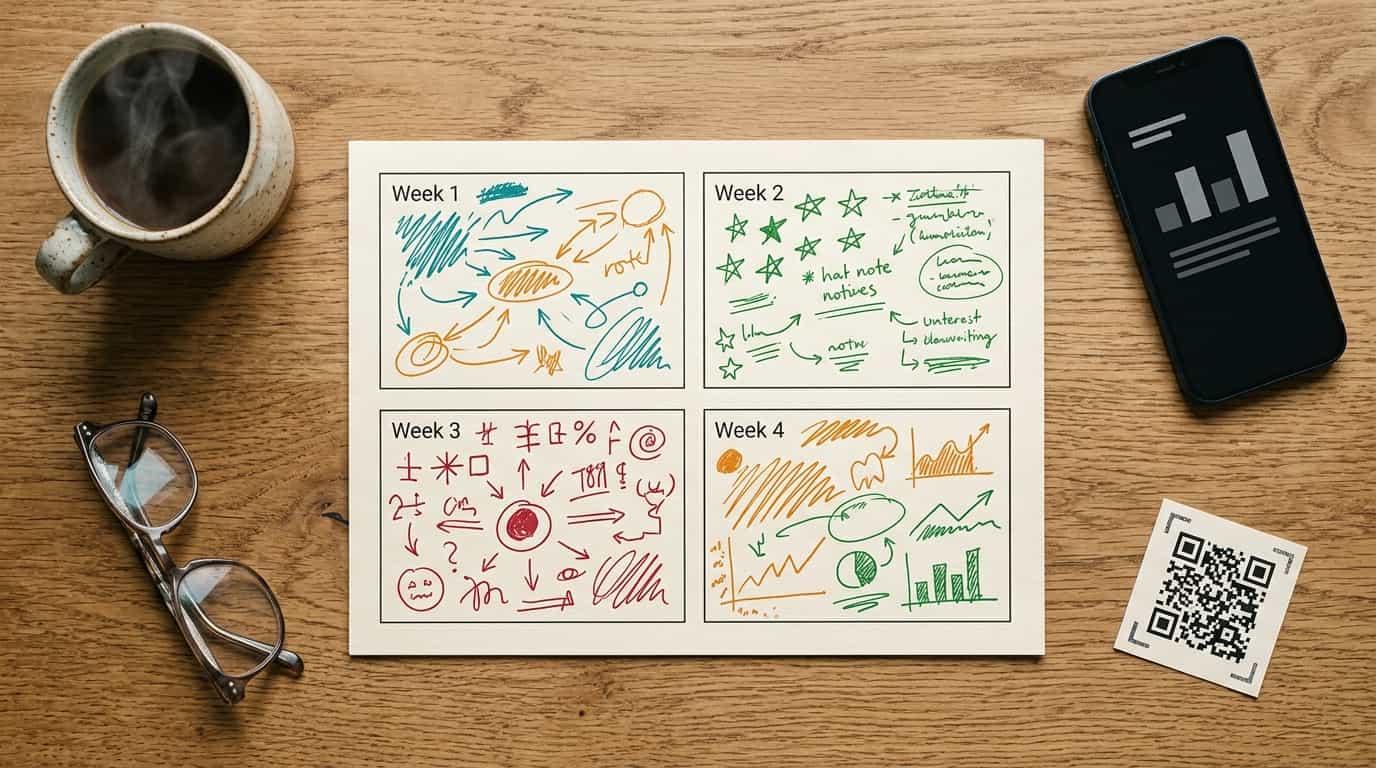
The six templates above are the raw material. The rotation rhythm is what turns them into a working system. Without a rhythm, the owner intends to update the campaign weekly, forgets, and the code goes stale. With a rhythm, the campaign updates happen on autopilot because they are part of an established routine that takes less time than checking inventory.
The recommended rhythm is a Sunday or Monday morning campaign block of 15 to 30 minutes per week. During that block, the owner does three things. First, swap the destination of the QR code to this week's campaign. Second, check the previous week's scan data and note which campaigns produced the strongest return. Third, plan the next two weeks of rotation so there is always a queue ahead and no last-minute scrambling. That is the entire weekly operation.
The rotation pattern that works for most small businesses is a four-week cycle. Week one is the mystery reward. Week two is the slow-day drop. Week three is a seasonal or themed campaign. Week four is a loyalty layer or recovery push. After four weeks, the cycle restarts with a different mystery reward, a different slow-day deal, a different theme. The customer experiences variety because each cycle is fresh, but the owner operates from a stable template that stops feeling like creative work after a month or two of practice.
For owners running multiple QR codes across the business (counter, table, exit, receipt), the rotation can be staggered so each surface runs a different campaign at any given time. The customer who scans the counter code gets one offer, the table code gets another, the exit code a third. The codes still update on the same Sunday block, but they each run on independent rotations, multiplying the variety the customer encounters. For more on how to structure those placements specifically, see our guide on QR codes in retail.
How to Measure Each Campaign
Each campaign in the rotation needs to be measurable on its own, otherwise the rotation becomes guessing. The simplest measurement framework is three numbers per campaign: total scans during the active window, conversion rate from scan to redemption, and incremental visits from scanning customers in the 14 days following the campaign. Together, those three numbers tell the owner whether the campaign drove attention, action, and return behavior.
Total scans is the attention layer. A campaign that produces fewer scans than the previous one in the same slot probably had a weaker offer or a less compelling headline. Conversion rate is the action layer. A campaign with high scans but low redemption suggests the offer is interesting but the value is unclear or the friction at redemption is too high. Incremental visits is the relationship layer. A campaign that produces high scans and redemptions but no follow-on visits is buying transactions, not building loyalty.
After three or four cycles of measurement, the owner has a clear picture of which templates work for their specific business and which do not. The templates that consistently produce scans and follow-on visits get more rotation time. The ones that underperform get rotated out or modified. The rotation evolves into a custom playbook for that specific customer base, which is the long-term asset of running the system. For a parallel approach focused on gamification metrics specifically, see our guide on QR code gamification in retail.
Mistakes That Kill Recurring QR Campaigns
Letting a campaign run too long. The same destination behind the same code for two months produces almost no scans by the end. Even a strong campaign decays. The rule is to swap weekly or every two weeks, even if the current campaign is still performing, because the rotation itself is the product.
Making each campaign too different. If every week is a completely new mechanic, customers cannot build any pattern recognition and the regulars do not develop the habit of scanning. The variety should be in the offer, not the structure. The mystery reward template stays the same. The mystery itself changes each week.
Forgetting to update the in-store signage. If the headline near the code says "scan for 10 percent off" and the destination has been changed to a free item, the disconnect breaks customer trust. The signage and the destination need to update together. The simplest fix is signage that uses generic copy ("scan for this week's surprise") so the destination can change without the printed signage going stale.
Not tracking campaigns separately. If all campaigns flow through the same destination URL with no campaign tag or label, the owner cannot tell which week produced which scans. Each campaign needs its own measurable identity in the dashboard. Most QR platforms support campaign tagging at the destination level, so the data segments cleanly.
Burning out on creative. Owners who try to invent a new campaign concept every week burn out within a month. The six templates exist precisely to remove the creative load. Use the same template multiple times with different offers. The customer experiences variety. The owner experiences a system. For complementary low-cost ideas that fit between QR campaigns, our guide on low-cost loyalty ideas covers gestures that fill the gaps.
Frequently Asked Questions
How often should I rotate an in-store QR campaign?
Once per week or once every two weeks for most small businesses. Weekly rotation produces stronger return scan rates because regulars build a habit of checking what is new. Two-week rotation works for businesses where customers visit less frequently, like service businesses with monthly cadence. Anything longer than two weeks tends to lose momentum.
Do I need a different QR code for each campaign?
No. The whole point of a dynamic QR code is that one printed code can run unlimited campaigns by changing the destination behind it. The customer always scans the same physical code, while the content they reach refreshes on whatever rotation you set. This is why dynamic codes are essential for recurring campaigns and static codes do not work for this use case.
Which campaign template produces the most repeat visits?
The three-visit streak template and the weekly mystery reward template tend to produce the strongest repeat-visit lift, because both use a behavioral mechanic (pattern recognition or curiosity) instead of a one-time offer. The seasonal hook produces strong individual peaks but less consistent week-to-week return behavior.
How long until a rotation starts producing measurable repeat visits?
Most small businesses see early signals within four to six weeks (returning scans from the same customers across multiple campaigns) and clearer patterns within three months as the rotation accumulates data. By month six, the owner usually has a clear picture of which templates work for their specific customer base and can refine the rotation based on actual performance.
What if I do not have time to update campaigns weekly?
A two-week rotation works almost as well as weekly for most businesses, and a monthly rotation still produces returning scans as long as the rotation is consistent. The minimum viable cadence is monthly. Below that, the code starts to feel static and customers stop checking. Plan a Sunday morning block that fits your schedule, even if it is only twice a month, and protect that block as part of the operational routine.
Stop Printing Campaigns. Start Rotating Them.
VISU QR Ads turns one printed code into a recurring channel with dynamic destinations, per-campaign tracking, and the dashboard to find which rotation actually produces returning customers.