


There is a quiet myth in small business marketing that loyalty programs are expensive. App development, points platforms, branded reward catalogs, white-labeled cards. By the time the proposal lands on the owner's desk, loyalty looks like something only chains can afford. The myth is wrong, and the businesses that actually retain customers best are usually the ones running the simplest, cheapest mechanics. The neighborhood cafe that knows your name. The barbershop that throws in a free beard trim on your fifth visit. The flower shop that ties a handwritten note to your bouquet. Those are loyalty programs. They cost almost nothing and they outperform most of the expensive ones.
The reason cheap loyalty often beats expensive loyalty is that the customer does not actually want a points app. They want to feel like a regular. They want the staff to acknowledge them. They want a small surprise on their birthday. They want a reason to choose your shop over the new one that opened two blocks away. Most of those wants do not need software. They need attention, a little structure, and a habit of doing small things consistently. The structure is what this guide covers. The attention has to come from you.
What follows is eight low-cost loyalty ideas a small business can implement starting this week. Some need a printer. Some need a phone. Some need nothing but a notebook behind the counter. Most can run side by side, layered into a loyalty program that costs less than a single small Facebook ad campaign and produces returning customers measured in months and years instead of clicks. Pick two or three to start. Add more as the habits stick.
Run a Cheap Loyalty Program With Real Tracking
VISU QR Ads gives you the simplest possible loyalty mechanic with no app, no monthly platform headache, and a real list of returning customers you can actually message.
Why Cheap Loyalty Often Beats Expensive Loyalty
The expensive loyalty programs from large chains are designed for scale. They have to work for ten million customers across a thousand locations, which means the personal element gets engineered out and replaced with a points balance, a tier badge, and a quarterly email. That trade-off makes sense for chains. It makes no sense for a single neighborhood business with two hundred regulars, because the personal element is exactly what a small business can do that no chain can match.
The math also favors cheap. A small business retaining a single customer for an extra year typically generates between 200 and 1,500 dollars of additional revenue depending on the category. The cost of any of the ideas in this guide ranges from cents to a few dollars per customer. The return on investment is measured in multiples of 50x or more, even when only a fraction of the gestures land. Compare that to paid acquisition where every new customer costs 10 to 30 dollars before they have spent a cent in your shop.
The third reason cheap works is that small gestures are emotionally legible in a way that points are not. A customer who gets a free dessert on their birthday remembers the moment. A customer who earns 200 points has forgotten the transaction by the next morning. Memory drives return visits. Points drive transactions and forget them. For a deeper view of how emotional micro-rewards shape repeat behavior, see our piece on micro rewards that change behavior.
Idea 1: The Handwritten Thank-You Note
The cheapest loyalty mechanic in existence is a small handwritten note that says thank you. Cost: a stack of kraft cards and a pen, maybe ten dollars total for the year. Time: about thirty seconds per note. Use case: any customer who spent meaningfully more than average, asked for a special order, or shared a kind word about the business. The note goes in the bag, on the takeaway box, or tied to the bouquet. The customer finds it later, and the moment lands harder than any digital reward ever could.
The reason this works is that handwritten notes are now so rare that they signal real attention. In a world of automated emails, a person actually wrote your name with an ink pen and meant it. The brain registers that as a personal acknowledgment, which is the exact emotion loyalty programs are trying to manufacture at scale and usually fail to produce. The hand-written version skips the manufacturing step entirely.
The execution is small. Keep ten blank kraft cards near the register. Write three to five lines max. Specific is better than generic. "Thank you for choosing us for Sara's birthday flowers, hope you both have a beautiful day" beats "Thank you for your purchase" by a wide margin. The customer feels seen, and being seen is the foundation of loyalty.
Idea 2: The Birthday Treat (No Database Required)
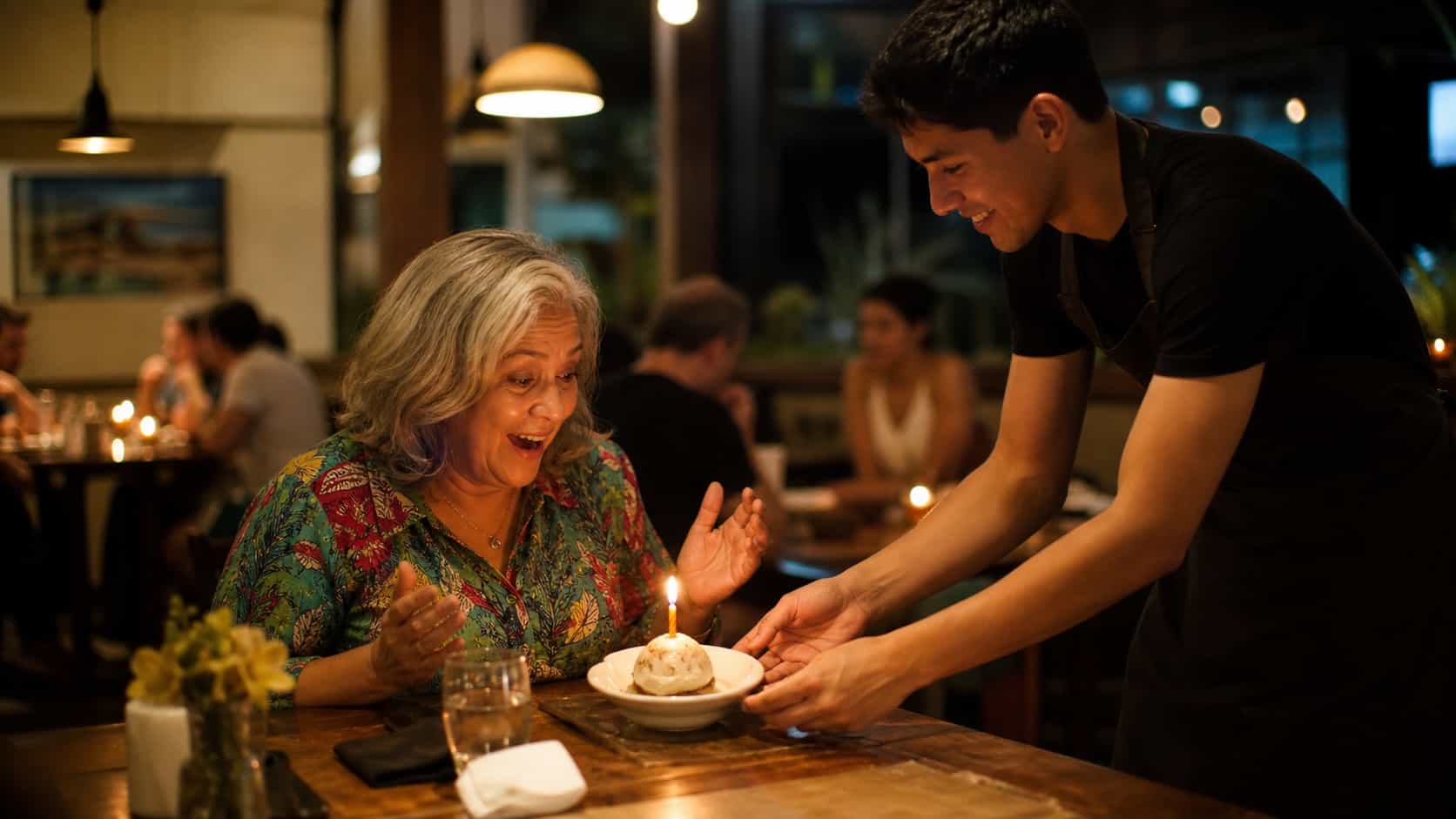
The birthday treat is one of the highest-emotional-return loyalty gestures available, and it can be run with nothing more than a paper notebook behind the counter. When a customer mentions a birthday, an anniversary, or a special occasion, write the date and their name in the notebook. When the date comes around, send them a quick message or text saying happy birthday and offering a small free item on their next visit within the week.
The cost is minimal because most customers will not redeem the offer (estimated 30 to 50 percent do), and those who do are visiting anyway. The gesture itself is what matters. The customer tells their friends. They post about it. They come back next year and bring people. The lifetime value impact of birthday recognition is documented across hospitality and service categories, and the cost of running it is a notebook plus the price of one free item per redemption.
For businesses that want to scale this slightly without losing the personal touch, the same mechanic works through a simple sign-up form (paper or digital) where customers can opt in to "birthday rewards" by writing their name and birth date. No database needed, just the form, the notebook, and the discipline to check it weekly.
Idea 3: The Quiet Sixth Visit
Most loyalty programs announce themselves up front. "Visit ten times for a free coffee." The customer counts visits, the program is transactional, and the relationship feels like a contract. There is a different mechanic that works almost as well and costs nothing to announce: the unannounced reward. The staff simply notice when a customer has been in five or six times in a short period and, on that visit, give them something free without explanation.
The line is short. "Hey, this one is on us. We have noticed you coming in lately and we appreciate it." That single sentence converts a regular into a fierce regular, because the reward arrived as a gift instead of a debt being paid. There is no expectation of continued visits, no fine print, no app to track. Just genuine acknowledgment of the relationship that already exists.
The execution requires staff awareness, which is the harder part of small business loyalty. The simplest way to support staff is a low-tech tally. A small notebook at the counter where staff jot a star next to a familiar face each time. When the stars hit five, the next visit gets the gesture. The notebook costs nothing, the gesture costs whatever the small free item costs, and the customer feels the difference between this shop and every other shop on the block. For more on shifting one-time customers into regulars, our guide on turn walk-ins into repeat customers walks through complementary tactics.
Idea 4: The Referral Card Slipped Into the Bag
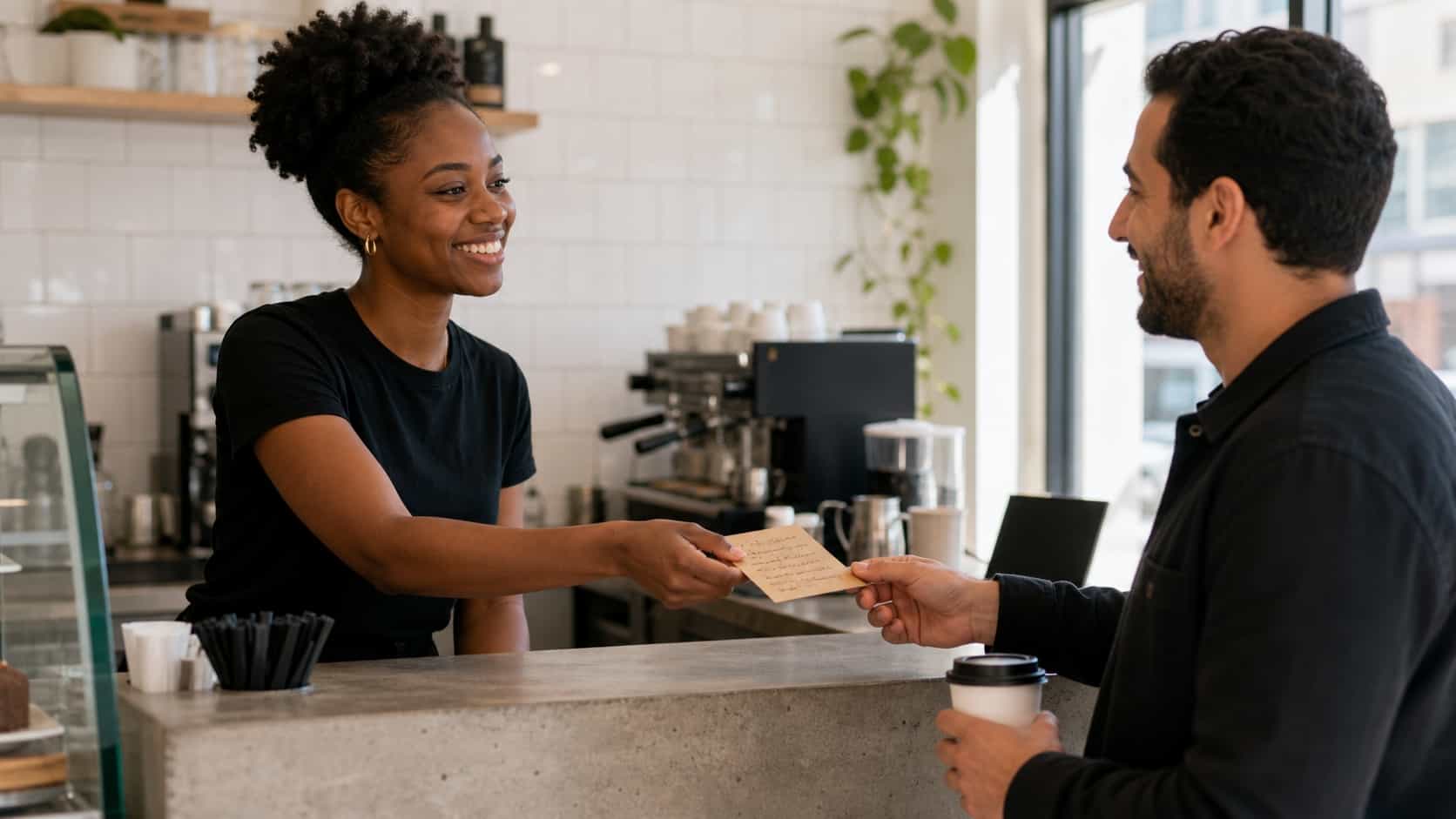
Referrals are the cheapest customer acquisition channel a small business has, and most owners do not run a referral program at all because they assume it requires a system. It does not. A small printed card slipped into the bag of every happy customer, with a clear short message ("Bring a friend, both of you get a free coffee") and the customer's first name handwritten at the bottom, runs a referral program for the cost of card stock.
The handwritten name matters. It transforms the card from a generic flyer into a personal invitation, and the customer is much more likely to actually pass it to a friend instead of throwing it out. When the friend arrives, they bring the card, both get the free item, and now the original customer feels good for sharing while the new customer arrives with a positive first impression and an existing connection.
The cost per card is pennies. The cost per redemption is one free item per pair. The new customer acquisition cost ends up well below any paid channel, and the customer arrives pre-warmed by a friend's recommendation, which means their lifetime value tends to run higher than a customer acquired through ads. For a deeper look at building referral programs specifically for service businesses, see our guide on referral programs for service businesses.
Track Your Referrals Without a CRM
VISU QR Ads lets you run referral mechanics through dynamic codes so you can see exactly which referrals are landing without buying enterprise software.
Idea 5: The Slow-Day Member Hour
Every small business has a slow day. Tuesday afternoon at the cafe, Wednesday morning at the salon, Monday lunch at the restaurant. Those hours produce the lowest revenue of the week and have the highest available capacity. A low-cost loyalty mechanic that uses this dead time is the slow-day member hour, where regulars get a small benefit during off-peak hours that does not cost the business much because the capacity was unused anyway.
Examples by category. A cafe runs "regulars get a second drink free between 2 and 4 PM Tuesdays." A salon runs "members get a free deep-conditioning add-on during Wednesday morning appointments." A restaurant runs "loyalty customers get a small free starter on Monday lunch." The cost is incremental because the staff was already there, the space was already empty, and the customer who shows up may have been part of the otherwise zero-revenue hour.
The win is not just incremental revenue. It is that the regulars start to think of those slow hours as their hours. The cafe at 2 PM on Tuesday becomes the regulars' afternoon, and over months, it builds a small in-house community of repeat customers who actually look forward to the slot. The slow day stops being slow without paying ad spend to fill it.
Idea 6: The Surprise Upgrade
Surprise upgrades are a hospitality industry technique adapted for the small business context. Once a week, the staff picks one regular customer and quietly upgrades their order. A larger drink for the price of a small. A premium pastry instead of the basic. An extra service add-on at no charge. The staff says "we upgraded you today, on us" with a small smile, and that is the entire mechanic.
The cost is low because it is one customer per week, the differential between the basic and premium item is small, and the operation is simple enough that staff can implement it without owner involvement once trained. The emotional impact is high because the upgrade is unexpected, ungated, and feels like a gift from the staff rather than a calculated marketing move.
The reason this works at small scale is exactly the reason it does not work at large scale. A big chain that surprises one in a thousand customers produces no narrative effect because the customer assumes it was random. A small business that surprises one in twenty customers produces conversation, because the customer recognizes that someone actually noticed and decided to do something nice for them specifically. The same gesture, completely different emotional weight.
Idea 7: The Recovery Postcard
Customers who used to be regulars and have stopped coming represent a recovery opportunity that most small businesses ignore entirely. The customer is not gone for a dramatic reason most of the time. They got busy, moved a routine, or simply forgot. A small physical postcard, mailed to their address (or handed to them if they happen to walk in), with a handwritten note saying "we miss you, here is a small reward to come back" recovers a meaningful percentage of these silently-drifted customers.
The cost is minimal. A pack of blank postcards, postage, and a few dollars per redemption when the customer returns. The recovery rate varies by business type, but most small businesses report 15 to 30 percent of recovery postcards produce a returning visit within 30 days, and many of those customers resume their old visit pattern from there. Compare that to paid ads trying to acquire new customers and the math is very kind.
The mechanic only requires a customer list with addresses or contact info, which most small businesses have through receipts, reservation systems, or loyalty signups. Once a quarter, the owner pulls the list, identifies customers who have not visited in 60 to 90 days, and sends ten to thirty handwritten postcards. Thirty minutes of work, a few stamps, and a measurable lift in returning revenue. For a broader view on getting one-time customers back, see our piece on make customers buy again.
Idea 8: The QR Loyalty Replacement
The eighth idea is the cheapest scalable mechanic available, and it sits in the middle ground between paper gestures and full software platforms. A single printed QR code at the counter, replacing the punch card, running a no-app loyalty flow that tracks visits automatically and unlocks a reward at the right number. Cost: a small monthly platform fee plus the printed code stand. No app development, no points catalog, no monthly retainer.
The advantage of QR loyalty over the other ideas in this guide is that it produces customer-level data the others cannot. The owner gets a list of returning customers with visit dates, redemption history, and dormancy signals, all of which compound into smarter decisions over months. The handwritten note builds emotion. The QR loyalty builds the dataset. Run them together and the program covers both sides of the loyalty equation: emotional connection and informed action.
For a small business hesitant about technology, QR loyalty is the lowest-friction technical mechanic that exists. The customer scans a code they already know how to scan, the page works on any phone, the staff prompts the same way they would prompt for a punch card. The technology disappears into the existing workflow. For a complete walkthrough of the mechanic, see our guide on QR code loyalty for small businesses, and for the comparison of paper versus digital specifically in food service, our piece on paper vs digital loyalty cards covers the trade-offs.
How to Stack These Without Burning Out
The temptation when reading a list like this is to try all eight ideas at once. That fails almost every time. Each idea requires a small habit (a notebook check, a card written, a list pulled) and habits stack one or two at a time, not eight at a time. The realistic implementation path is to pick two ideas that fit your current workflow, run them for 30 days, and only then add a third.
The recommended starting pair for most small businesses is the handwritten thank-you note (idea 1) plus the QR loyalty replacement (idea 8). The first builds the emotional layer, the second builds the data layer. Together they cover the two halves of low-cost loyalty without requiring separate workflows. Once those two are running smoothly, add idea 4 (referral card) or idea 7 (recovery postcard) depending on whether you are trying to grow new customers or recover lapsed ones.
The owners who get the most out of this stack are the ones who treat each idea as a small habit instead of a big launch. A few notes on Tuesday afternoon. A QR loyalty review on Friday. A batch of referral cards prepped on Sunday. None of these take long, but together they produce a loyalty program that competitors with much bigger budgets cannot match because the budgets cannot buy the consistency. For a parallel framework on building this kind of routine into a small business, our piece on QR campaigns for repeat visits covers how to layer campaigns on top of the loyalty backbone.
Loyalty Does Not Have to Be Expensive to Be Real.
VISU QR Ads gives you the cheapest scalable loyalty mechanic with no app, real tracking, and a list of returning customers you can reach again whenever you need to.
Frequently Asked Questions
What is the cheapest loyalty program a small business can run?
A handwritten thank-you note slipped into the bag of meaningful purchases. Cost is a stack of kraft cards and a pen, total under ten dollars for an entire year. The emotional return is disproportionately high because handwritten notes have become rare, which makes them feel like real personal attention rather than automated marketing.
Do low-cost loyalty programs really retain customers as well as expensive ones?
For small businesses, often better. Expensive programs are designed for scale and engineer out the personal element that small businesses can deliver naturally. A neighborhood cafe that knows your name and throws in a free pastry on the fifth visit retains regulars more effectively than a chain that gives you a quarterly points statement, because the gesture is emotionally legible and feels personal.
How do I track loyalty without software?
A small notebook behind the counter, with a star next to each visit by a familiar face, works for the first 50 to 100 regulars. Beyond that, a simple QR code loyalty mechanic costs only a small monthly fee and produces data the notebook cannot. Most small businesses combine both: the notebook for emotional gestures, the QR code for actual visit tracking.
How long until a low-cost loyalty program shows results?
Most small businesses see early signals within 30 days (more returning faces, occasional comments about a gesture) and clearer results in 60 to 90 days as the habits compound. The emotional gestures (thank-you notes, surprise upgrades, birthday treats) tend to show effects faster than the structural ones (referral cards, recovery postcards) because the customer experiences them in the moment.
Can I run multiple low-cost loyalty ideas at the same time?
Yes, but stack them gradually. Start with two ideas that fit your current workflow, run them for 30 days, then add a third. Trying all eight at once almost always fails because each idea requires a small habit, and habits do not form in parallel. The most common winning combination is a handwritten note program plus a QR loyalty mechanic, which covers emotion and data without overlapping workflow.