


Small retail has a hard problem that restaurants and service businesses do not have to the same degree. Customers walk in, browse for ten or fifteen minutes, maybe buy something, and walk back out. The visit is short, the interaction is mostly visual, and most of the customers leave without ever giving the store any way to reach them again. Compare that to a coffee shop where the customer sits for thirty minutes, or a salon where they sit for an hour, and the structural disadvantage becomes obvious. Retail has less time to capture the relationship, and less natural reason for the customer to stop and engage with anything beyond the products themselves.
The point of VISU for retail is to use the few high-attention moments retail does have, the moments where the customer is already pausing, already looking around, already in a position to engage. The fitting room. The shelf edge in front of a product they are considering. The checkout counter. The receipt in the bag. None of these are new surfaces, but most retail stores treat them as functional rather than as marketing real estate. A QR code at each of those moments, with a dynamic destination behind it, turns short visits into captured relationships and one-time browsers into shoppers who come back next month.
This guide walks through how a small retail store can use VISU to build a customer channel out of the physical surfaces already in the shop. The mechanics, the placements that produce scan volume, the loyalty and capture flows that fit a retail context specifically, the data the store actually gets, and the weekly habit that runs the whole thing. Everything can be implemented next week without changing anything about the products, the layout, or the staffing. Just a different way of using the surfaces that already exist.
Turn Shelves and Receipts Into a Channel That Brings Shoppers Back
VISU QR Ads gives small retailers dynamic codes, capture flows, and per-surface tracking so the marketing keeps working long after the shopper leaves the store.
Why Retail Is Structurally Harder Than Service for Capture
A retail visit is short and visual. The customer enters, scans the floor, picks up two or three items, maybe tries something on, decides yes or no, and leaves. The total interaction with any single surface in the store is rarely more than 60 to 90 seconds. That brevity is the structural reason most retail marketing fails to capture customer information. There is simply not much time in the visit for the customer to stop, give a phone number, and engage with a loyalty signup, especially if the staff is busy with other shoppers or the store is small enough that there is no dedicated checkout team.
The other structural difference is that retail customers often do not buy on the first visit. They walk in, browse, leave, and the owner never knows if that browser was going to come back next week or never. With no contact captured, there is no way to bring them back, no way to remind them about an item they liked, no way to know whether they made a decision elsewhere. The browsing visit, which is the majority of retail traffic in many categories, produces zero data and zero follow-up opportunity in most stores.
The fix is to use the few seconds of attention retail does produce reliably, at the few high-attention moments that exist in any retail visit. The fitting room pause. The shelf edge while considering. The checkout interaction. The receipt review at home. Each of these is short, but each is also a moment where the customer is open to a small ask, especially if the ask is paired with a clear and immediate value. For a complementary view on bringing in more first-time traffic, see our guide on increase foot traffic.
The Fitting Room: Retail's Highest-Conversion Surface
The fitting room is the single highest-attention surface in any clothing or fashion retail store, and most stores leave it almost completely empty of marketing. The customer is alone, standing still for two to five minutes, with their phone within reach because they often photograph themselves to share with friends. That combination of idle time, privacy, and phone-already-out produces conversion rates on QR codes that no other retail surface can match.
The mechanic is small. A small acrylic frame on the fitting room wall at customer eye level, with a clean QR code and a one-line headline. "Scan to save this look for later." "Scan to join our loyalty program, your first reward is on us." "Scan for an exclusive 10 percent off the items you try on today." The frame stays in place, the destination rotates depending on the week's campaign. Customers who would never have stopped at the counter to sign up for loyalty will scan in the fitting room because they have time, they are alone, and the offer feels tailored to the moment they are in.
The fitting room placement also captures customers who try things on but do not buy. Those customers are the most valuable recovery segment in retail, because they came close to converting and need only a small nudge (a reminder, a discount, a notification when an item restocks in their size) to come back and complete the purchase. Without the fitting room capture, those customers leave invisible. With it, the store has a list of high-intent browsers who can be reached with targeted follow-up. Stores running fitting room QR codes typically see capture rates of 20 to 40 percent of fitters, which is dramatically higher than any other retail surface.
Shelf Edge: Turning Browsing Into Capture
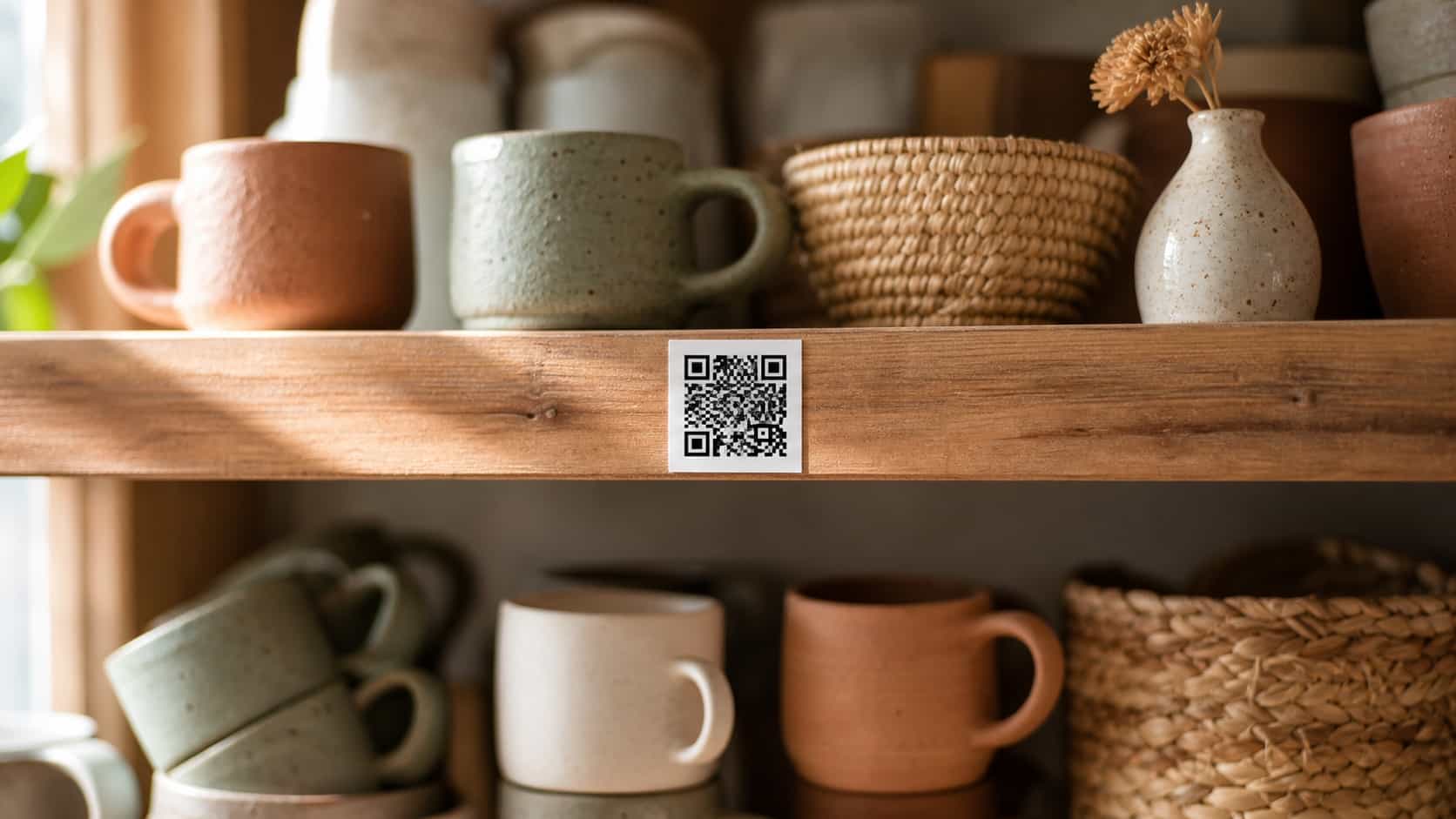
The shelf edge is the second highest-conversion retail surface and the most overlooked. Customers standing in front of a shelf considering a product spend 10 to 30 seconds in close attention, often with phone in hand to compare prices or read reviews. A small QR code on the shelf edge right in front of the products, at customer eye level for the average adult, captures that moment without interrupting the browsing flow.
The most effective shelf edge mechanic is one tied to the products on that specific shelf. "Scan for the story behind these makers." "Scan to save this collection for later." "Scan to be notified when this restocks." The destination is product-specific, which makes the scan feel relevant rather than like a generic marketing ask. The customer who scans the shelf edge in front of a ceramics shelf gets content about ceramics, not a generic loyalty signup, which is what makes the conversion rate stay high.
The shelf edge code is also where most of the discovery-stage captures happen. Customers earlier in their decision process are not ready to buy but might be ready to save an item or follow the maker or sign up for restock notifications. Each of those is a low-commitment capture that turns a browsing customer into a known one, which the store can then bring back when the item restocks or a related collection arrives. For a deeper view on what data to actually collect at this stage, see our guide on collect customer data.
Capture Browsers Before They Walk Out
VISU QR Ads turns fitting rooms and shelf edges into capture surfaces with dynamic destinations you can rotate based on what is in stock that week.
The Counter and the Receipt
The counter is the moment of transaction, which means the customer has phone and wallet both in hand and is in the most attentive state of the entire visit. A QR code at the counter, at customer eye level, with a clear short headline, captures the customer who would not have scanned elsewhere but will scan during the natural pause while their payment is being processed. For small retailers without a fitting room (jewelry, books, home goods, gifts), the counter is the primary capture surface.
The receipt is the cheapest capture opportunity in retail because every transaction reproduces it for free. Receipt scan rates are typically lower than counter or fitting room scans, but the volume is so high that even a modest scan rate produces meaningful follow-on traffic. The receipt code is especially valuable for capturing customers after they have already left, who might think about leaving a review, signing up for the loyalty program, or asking about a restock hours later from home.
For boutique-style retailers, a printed card slipped into the bag with a handwritten thank-you note and a QR code on the back performs even better than the receipt code alone. The handwritten note signals real personal attention, which makes the customer more likely to actually scan the card later instead of throwing it out with the receipt. The capture rate on bag inserts with handwritten elements runs roughly two to three times higher than plain receipt codes, at the cost of about ten seconds of writing time per sale.
Loyalty That Works for Small Retail Specifically
Retail loyalty has to be calibrated differently from cafe or restaurant loyalty because the visit pattern is different. A customer who visits a coffee shop weekly and a customer who visits a clothing boutique quarterly need different loyalty math to keep them engaged. A "buy 10, get 1 free" model works for daily-purchase categories but does not work for categories where customers visit two or three times per year. The reward feels too far away to motivate.
The loyalty mechanics that work best for small retail are spending-based rather than visit-based. Examples: spend $200 across the year, get a 20 percent off coupon for your next visit. Spend $500, get an exclusive early access to the next collection. Reach silver tier, get free alterations on full-price items. These mechanics fit the natural retail purchase pattern, where each visit might be high-ticket but visits are infrequent. The customer earns the reward through cumulative value rather than count, which is closer to how their relationship with the store actually works.
The other mechanic that works well in retail is the early access program. Customers who sign up through a QR code at the counter or fitting room get notified two days early when new collections drop, when items they have shown interest in restock, or when private sales happen. The early access framing is itself the reward, because for shoppers who care about specific items or limited collections, early access is more valuable than discounts. The store gets a captured customer list, the customer gets a real benefit, and the loyalty program does not have to compete on price. For a parallel breakdown of retail loyalty programs that produce returns, see our guide on retail loyalty programs.
Capture Flows for Retail: What to Ask For and When
The destination behind a retail QR code has to ask for the minimum data possible while still delivering enough value to make the trade feel fair to the customer. The general rule is one or two fields maximum on the first scan, with everything else collected later as the relationship deepens. The exact field depends on what the store plans to do with the data, but the priority order for retail is usually phone first, then email, then preferences as optional.
Phone numbers reach customers through SMS or WhatsApp with much higher open rates than email, and they tend to stay accurate for years because customers do not change phone numbers as often as email addresses. For retail specifically, SMS or WhatsApp also fits the cadence of marketing well, since most retail messaging is occasional (new collection, restock notification, early access invite) rather than constant. A list of customer phone numbers with permission to message is the highest-value single asset a small retailer can build.
The value side of the exchange needs to be immediate and tangible. A discount code on the screen right after capture. A confirmation that they are now on the early access list. A digital lookbook of the current collection. A loyalty stamp credited instantly. The customer gave information now, they want value now. Anything that arrives by delayed email an hour later degrades the trust they placed in the exchange. Build the destination so the value lands on the same screen as the capture, not in a follow-up message.
The Data Small Retailers Actually Get
Once QR codes are running across fitting room, shelf edge, counter, and receipt, the data the small retailer accumulates becomes a competitive asset that competitors much larger than them cannot easily match. The dashboard shows which surfaces produce which kinds of customers, which products generate the most shelf-edge scans, which fitting room interactions converted to purchases versus walked out, and which receipt scans came from at-home browsing.
The single most useful data layer for small retail is the high-intent browsing segment. These are customers who scanned in the fitting room or shelf edge but did not purchase that day. They are the recovery opportunity that paid acquisition cannot beat, because they already know the store, already considered the product, and only need a small nudge to come back. A simple SMS sent two or three days later saying "the item you tried on is still in your size" recovers a meaningful percentage of those near-purchases at almost zero marketing cost.
The second useful layer is collection-level interest signals. The aggregate of which shelf-edge scans happen most often tells the owner which products generate genuine consideration versus which ones just take up shelf space. That data informs buying decisions in a way that sales data alone cannot, because the sales data only shows what closed, not what almost closed. A product with high shelf-edge scans but low purchase rate signals a pricing or perception problem, which is actionable in a way that "we did not sell those" is not.
The third layer is dormancy. Customers who used to shop monthly and then stopped, identified through their scan and purchase history, are at risk before any other signal shows up. A simple win-back message ("we miss you, here is a small reward to come back") at the right moment recovers a percentage of silently drifting shoppers, which compounds across the customer base over time.
The Weekly Rhythm That Runs the Channel

The retail QR channel becomes a real channel through a small weekly habit. The recommended rhythm is a 15 to 20 minute block at the end of the slowest day of the week, dedicated to running the dashboard. During that block, the owner does three things. Update the destinations behind each QR code for the week's campaigns. Review the previous week's scan, capture, and conversion data. Send a follow-up message to the high-intent browsers who scanned but did not purchase that week.
The campaigns that rotate through the codes follow a simple monthly pattern for small retail. Week one features the loyalty signup push tied to a current collection. Week two runs an early access invitation for the next drop. Week three runs a restock notification campaign for items that just came back in stock. Week four runs a recovery push for dormant customers. After four weeks, the cycle restarts with the new collection or seasonal focus. The customer experiences variety because each campaign is fresh, but the owner operates from a stable template that fits easily into the weekly block.
For owners running multiple QR codes across the store, the rotation can be staggered so each surface runs a different campaign at any given week. The fitting room runs the loyalty signup, the shelf edge runs the early access invite, the counter runs the restock notifications, the receipt runs the recovery push. The customer encounters a different message at each surface, the data segments cleanly, and the owner gets four campaigns running in parallel for the same total operational time. For a tactical breakdown of recurring in-store campaigns specifically, see our piece on in-store QR campaigns.
Mistakes Retailers Make With QR Marketing
Treating QR codes as price tags. Many retailers put QR codes on price tags or product labels with the destination set to the brand's product page. That use case is fine for information but produces almost no capture because the customer leaves the store with nothing happening. The product page is not a marketing channel. The product page is a reference document.
Empty fitting rooms. The fitting room is the highest-conversion surface in clothing retail, and most stores leave it without any marketing at all. Even a single small QR code with a clear loyalty offer transforms the fitting room from a dressing space into a capture moment. Adding it costs almost nothing and produces 20 to 40 percent capture rates on customers who try things on.
Asking for too much data at the counter. A customer at the counter has 30 to 60 seconds to complete the transaction. Asking them to fill out a five-field signup form during that window almost always fails because the line forms behind them and the pressure increases. Move the loyalty signup to the QR code at the counter, where the customer can complete it on their own phone in their own time, even after they leave the store.
Static codes that cannot be updated. Many small retailers printed QR codes for a single collection or campaign and now have outdated codes throughout the store. Dynamic codes that can be updated weekly through a dashboard are essential for any retailer who plans to use QR marketing as an ongoing channel rather than a one-time campaign.
Not following up with high-intent browsers. Customers who scanned the fitting room or shelf edge but did not purchase are the highest-value recovery segment in retail, and most stores never message them. A simple SMS sent two or three days later, referencing the specific item or category, recovers a percentage of near-purchases that would have been lost. The follow-up is the conversion mechanic. For a parallel view on creating in-store experiences that boost retention, see our guide on in-store experiences that drive sales.
Trying to compete with e-commerce on price. Small retail cannot win a pricing war against Amazon and large online retailers. What it can win is a relationship war, where the customer chooses the store because of personal service, curation, atmosphere, and the way they are treated. QR-driven loyalty and early access programs reinforce that relationship layer, which is the actual competitive moat for small retail. For more on the broader competitive strategy, our piece on competing with Amazon covers the wider tactics.
Stop Losing Shoppers to the Sidewalk. Capture the Relationship.
VISU QR Ads turns every fitting room, shelf edge, counter, and receipt into a tracked channel with dynamic destinations, loyalty mechanics, and a list of returning shoppers you can reach whenever the next collection drops.
Frequently Asked Questions
Does QR marketing actually work for small retail in 2026?
Yes, and the post-pandemic familiarity with QR codes means customers in 2026 scan more reliably than they did before 2020. The challenge for retail is not getting customers to scan, it is choosing the right surface and the right offer for the short visit window retail produces. Fitting rooms, shelf edges, and counters are the surfaces that work most consistently across categories.
How long until VISU for retail produces measurable returning customers?
Most small retailers see early signals within six to eight weeks (the first wave of returning customers from captured contacts) and clearer patterns by month three as the database accumulates and recovery campaigns start to produce results. By month six, the owner has a clear segment view of regulars, browsers, and at-risk customers, and the weekly rhythm produces measurable lift in repeat purchases relative to the baseline.
What QR placement works best for stores without fitting rooms?
For jewelry, books, home goods, gifts, and other non-apparel retail, the counter is the primary capture surface, with the shelf edge as a strong second. The counter captures customers during the transaction pause, and the shelf edge captures them during the consideration moment in front of products. Together those two cover most of the high-attention moments in the visit.
Do I need different QR codes for different campaigns?
No. The advantage of dynamic QR codes is that one printed code can run unlimited campaigns by changing the destination behind it. The customer always scans the same physical code while the content refreshes on whatever rotation you set. This is the reason dynamic codes are essential for ongoing retail marketing and static codes do not work for this use case.
How does this compete with e-commerce and Amazon?
Small retail does not compete with Amazon on price or selection. It competes on relationship, curation, atmosphere, and service. QR-driven loyalty, early access, and capture flows reinforce that relationship layer by giving customers a reason to choose the store and a way to stay connected to it between visits. The competitive advantage of small retail is the human side, and QR marketing is the simplest way to extend that human relationship beyond the visit itself.