

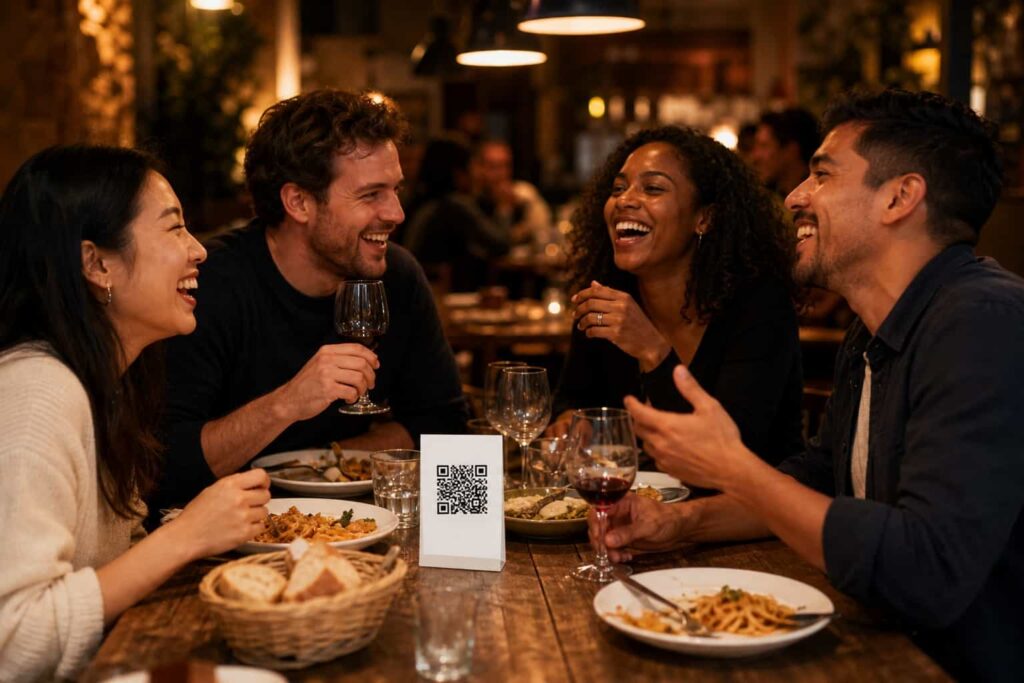
Most restaurants run marketing like a leaky bucket. They pay for ads on Instagram, they pay for Google placements, they pay for delivery app promotions. The ads bring customers in, the customers eat, and then the bucket empties. Nobody collected a name, nobody captured a phone, nobody has a way to message the customer next week to bring them back. So next month, the owner pays for the same ads to bring in different customers, and the cycle repeats. The bucket never fills, because the marketing channel ends the moment the customer walks out the door.
The point of VISU for restaurants is to fix the leak. Every table, every counter, every receipt becomes a small surface that captures the customer, gives them a reason to come back, and produces data the owner can act on. The technology is just QR codes and dynamic destinations, which restaurants already understand from the menu QR years. What changes is the intent. The same printed surface that used to serve a PDF menu now serves a loyalty signup, a recovery offer, a returning-customer reward, or a review prompt, depending on what the business needs that week.
This is not a pitch deck. It is a working explanation of how a restaurant can take the QR infrastructure it already has and turn it into a channel that actually brings customers back. The mechanics, the placements, the staff side, the data, and the rhythm. Everything in this guide can be implemented next week with no new equipment, just a different way of using the printed surfaces already in the room.
Turn Every Table Into a Channel That Brings Customers Back
VISU QR Ads gives restaurants dynamic codes, capture flows, and per-table tracking so the marketing keeps working after the meal ends.
Why Restaurant Marketing Leaks
The structural problem with restaurant marketing is that the moment of highest customer satisfaction (after a good meal, before walking out) is also the moment when the relationship ends. The customer is delighted, the food was good, the service was warm, and then they pay and leave. No name, no phone, no follow-up. The next time the owner wants to talk to that customer, they have to pay an ad platform to find them again, and there is no guarantee the platform even shows the right person.
Delivery apps amplify the leak. A customer who orders through a third-party app belongs to the app, not the restaurant. The restaurant prepares the food, takes the margin hit on the platform fee, and never sees the customer's name, phone, or address. From a marketing standpoint, those orders are invisible. The restaurant cannot send them a follow-up offer, cannot invite them to the loyalty program, cannot bring them back without paying the platform again.
The fix is to capture the relationship inside the restaurant's own surfaces, before the customer leaves or while they are mid-order. The table tent, the receipt, the counter sign, the exit door. Each of those surfaces can hold a QR code that converts the anonymous customer into a known one, with permission to message them, without paying any platform anything. For a complementary view on bringing in new customers in the first place, see our guide on get more customers.
The Table as a Marketing Channel
The table is the single most valuable marketing surface in any restaurant, and most restaurants treat it like a piece of furniture. The customer spends 30 to 90 minutes at the table in a state of growing satisfaction, with their phone within arm's reach, in a moment where they are open to engaging with the business in a way they will never be open again. That moment is worth more than any Instagram ad slot the restaurant could buy, and it is happening already, multiple times a day, for free.
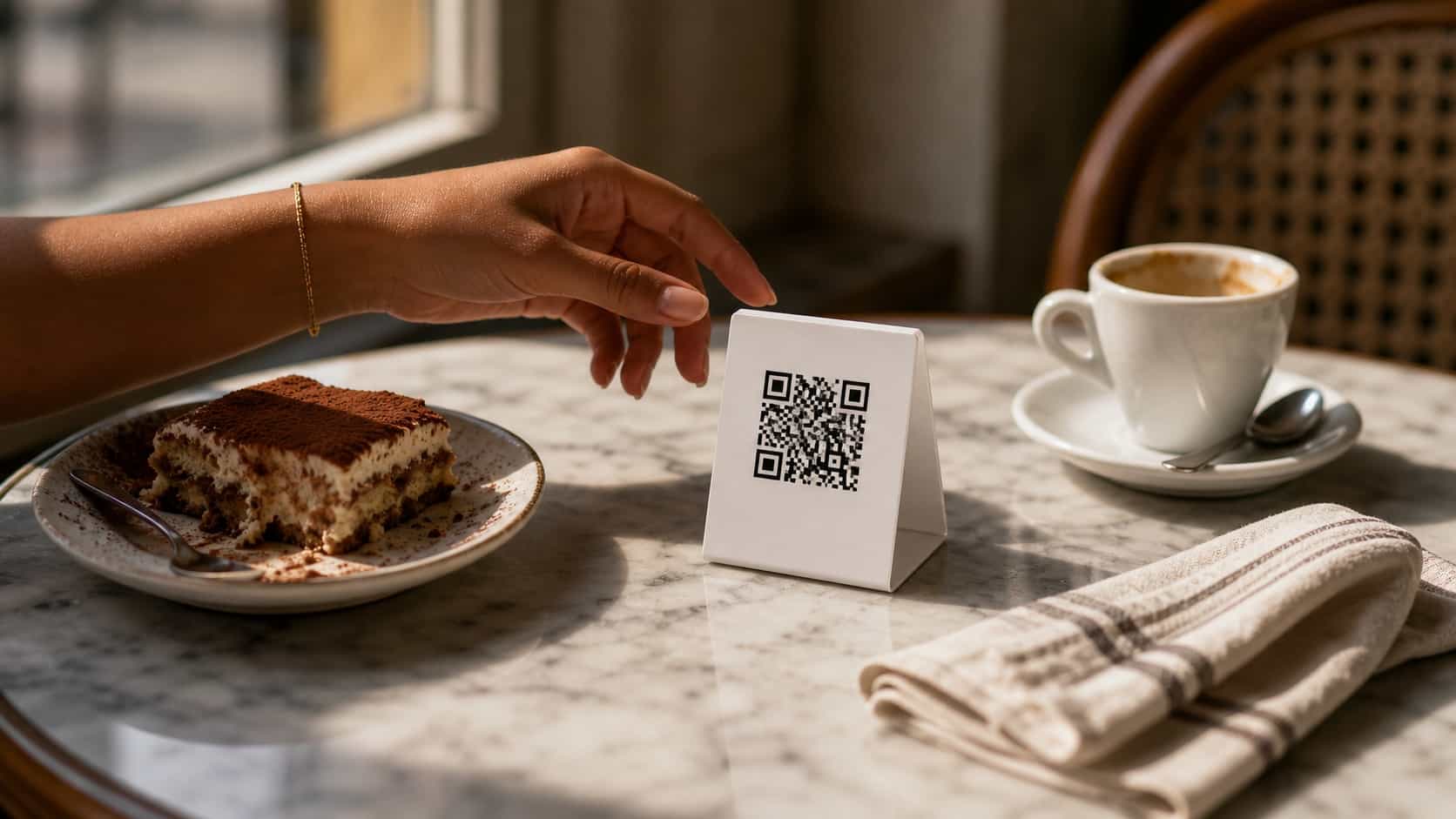
The mechanic to use the table is small. A clean acrylic table tent in the center of the table, with a QR code at customer eye level, paired with a one-line reason to scan. "Scan to leave a review and get 10 percent off your next visit." "Scan to join our loyalty program, your first stamp is on us." "Scan for next month's events." The line changes based on what the restaurant is trying to do that week, but the placement stays constant. Same code, same surface, rotating destinations.
The peak scan window at the table is the lull between the meal ending and the bill arriving. Customers are leaning back, satisfied, looking around for something to do for the next 60 to 90 seconds. The table tent at that moment is the most interesting thing on the table, and a high percentage of customers will scan if the offer is clear and the friction is low. Restaurants that get this placement right typically see scan rates of 15 to 25 percent of table parties, which is dramatically higher than any other surface in the restaurant and higher than most other businesses can produce at any surface.
Counter, Receipt, and Exit: The Three Other Surfaces
Beyond the table, three other surfaces in a restaurant produce reliable scan volume when used with the same dynamic QR approach. Each captures the customer at a different moment with a different mindset, and together with the table they form the full coverage of the customer's journey through the space.
The counter or POS area. Customers paying at the counter or at a register have phone and wallet both in hand, which is the highest "phone already out" moment in the visit. A small QR code on a stand at the counter, with a clear short headline, captures customers who would not have scanned at the table but will scan during the natural pause while their card is being processed. This is especially strong for quick-service and takeout restaurants where there is no table tent opportunity.
The receipt. A QR code printed on the receipt is the cheapest scan opportunity in the entire business because every transaction reproduces it for free. Scan rates on receipt codes are lower than table or counter codes, but the volume is so high that even a low scan rate produces meaningful return traffic. The receipt code is especially valuable for capturing customers after they have already left, who might think about leaving a review or signing up for loyalty hours later from home.
The exit area. A small sign near the door at customer eye level, with a single clear ask. Customers passing through the exit are in the highest emotional state of the entire visit (about to leave, fresh memory of the experience), and a single focused exit code catches that emotion before it dissipates. The exit code is particularly effective for review prompts, because the customer is literally one click away from sharing their experience publicly while the experience is still vivid in their mind. For a deeper view of QR code placement strategy specifically, see our guide on QR code marketing for restaurants.
Cover the Whole Restaurant With One Platform
VISU QR Ads lets you run different campaigns on table, counter, receipt, and exit codes, all tracked separately, so you see which surface drives which kind of returning customer.
Loyalty That Works for Restaurants Specifically
Restaurants have a loyalty problem that other small businesses do not have to the same degree. Customers eat at many restaurants. A loyal regular at a coffee shop visits two or three coffee shops total. A regular at a restaurant visits 15 to 30 different restaurants over the course of a year, depending on the city. Restaurant loyalty has to compete with a much wider field of alternatives, which means the program has to give the customer a real reason to choose this restaurant over the others, not just collect points passively.
The loyalty mechanics that work best for restaurants are the ones tied directly to the experience, not abstract points. Free dessert after five visits. Free appetizer after three. Birthday treat with a personalized note. Reserved table for regulars on their preferred night. None of these require expensive technology. What they require is the ability to recognize a returning customer and trigger a small gesture, which is exactly what a QR loyalty program enables. The customer scans, the system recognizes them, the staff sees the flag, and the gesture happens warmly at the table.
The visit count for restaurant loyalty also has to be calibrated differently. A coffee shop running "buy 10, get 1 free" is reasonable because customers visit weekly or daily. A restaurant running the same structure asks for 10 visits which might take 6 to 12 months for an occasional diner, which is too long to motivate. Five visits is usually the right anchor for casual restaurants, three for higher-end places where customers visit less often. The reward feels reachable, which is what drives the second and third visit pattern. For a parallel breakdown of loyalty options specifically for restaurants, see our guide on restaurant loyalty programs.
The Review Flywheel and Why Restaurants Need It
Google reviews drive restaurant discovery more than any single marketing channel a restaurant can buy. A restaurant with 4.6 stars and 350 reviews gets multiples more clicks from local search than a restaurant with 4.6 stars and 30 reviews, even when the food and the experience are identical. The review count is itself a marketing asset, and the rate at which a restaurant accumulates new reviews directly affects how it ranks against competitors over time.
The structural problem is that satisfied customers do not naturally leave reviews. Disappointed customers do. So a restaurant that does not actively prompt reviews from happy customers ends up with a review profile that overrepresents complaints relative to the actual experience. The fix is a small, low-friction prompt at the moment of peak satisfaction, which is the same table or exit moment that powers the rest of the QR marketing. The same code that captures loyalty can rotate to a review prompt when the restaurant needs more reviews that week.
The review flywheel works because each new positive review increases the chance of future customers choosing the restaurant, which produces more diners, which produces more opportunities to prompt reviews, which produces more positive reviews. The system compounds. The QR code is the small piece of infrastructure that makes the flywheel actually spin instead of staying theoretical. For the full mechanic specifically for restaurants, see our guide on Google review QR code for restaurants.
The Staff Side: Making It Work in a Real Shift
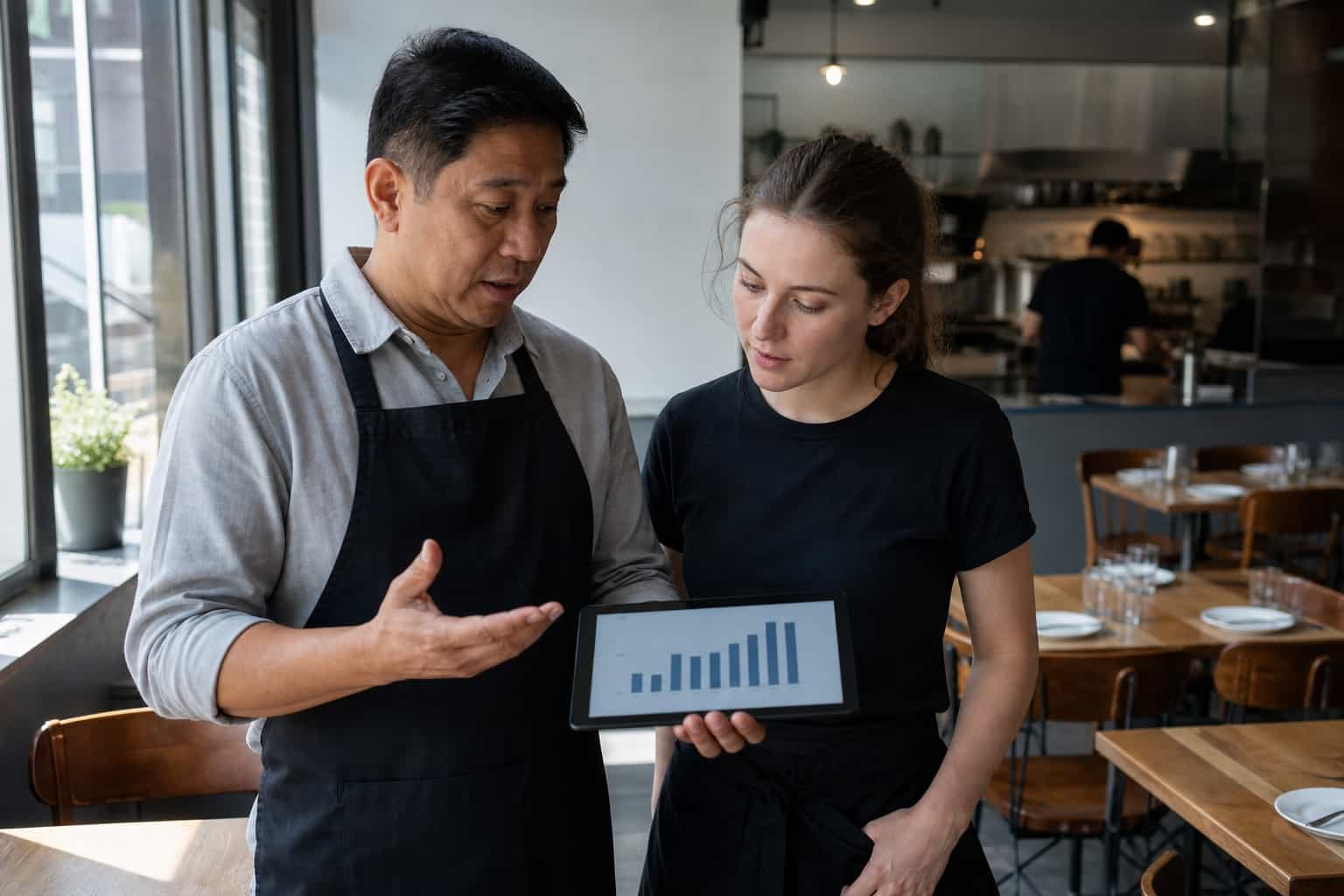
The most expensive part of a restaurant QR program is not the platform fee. It is the consistency of staff prompting. A table tent that no server mentions gets scanned by maybe 3 to 5 percent of tables. The same table tent with a one-line server prompt at the end of the meal gets scanned by 20 to 35 percent. The platform does not produce the difference. The staff does.
The script for servers has to be short, natural, and the same every shift. Something like "before you go, if you scan our code we will throw you 10 percent off next time." Ten to twelve words, casual delivery, no upsell pressure. The server can deliver it while clearing dessert plates or while bringing the check. It costs no extra time, fits into the existing flow of the meal, and produces the scan volume that makes the entire program work. Owners who train this script see scan rates climb in the first week and stabilize at a strong baseline within a month.
The training is also about the redemption moment. When a returning customer arrives with a loyalty reward unlocked on their phone, the server has to acknowledge it warmly, not treat it like a transaction issue. The reward moment is the emotional payoff of the entire loyalty program, and a flat redemption breaks the customer's relationship with the program even when they technically got what was promised. A 10-minute walkthrough at hire is enough to cover both the prompt and the redemption, and the dividend on that training shows up in the scan and return-visit numbers within weeks.
The Data Restaurants Actually Get
Once the QR codes are running across table, counter, receipt, and exit, the data the restaurant accumulates is the asset that compounds for years. Each scan is timestamped, each surface is tracked separately, each customer who provides a contact becomes part of a known list. After 60 days of running, the owner has a dataset that no other small marketing tool produces: a clear picture of who comes in, how often, which surface captures them, and what they redeem.
The most useful single layer of data is visit frequency by customer. The dashboard shows which diners come twice a week, which ones come once a month, which ones came twice and never returned. That distribution is invisible in any other system the restaurant has. Knowing which customers are weekly regulars versus monthly drifters changes how the owner thinks about staffing, menu, and even marketing budget allocation.
The second useful layer is surface comparison. The same customer can be tracked across table, counter, and receipt codes, and the data shows which surface they actually scan. Some customers scan only the table. Some only the receipt later from home. Some scan multiple. The pattern tells the owner where the marketing budget should go, and the answer is almost always different from what the owner would have guessed before seeing the data.
The third layer is dormancy. Customers who used to scan weekly and then stopped scanning are at risk of churn before any other signal shows up. The dashboard flags these dormant accounts, and a simple win-back message ("we miss you, here is a small reward to come back") at the right moment recovers a meaningful percentage of silently drifting customers. None of that recovery is possible without the data layer the QR codes produce.
The Weekly Rhythm That Runs the Channel
The restaurant QR channel becomes a real channel through a small weekly habit, not through any single launch. The recommended rhythm is a 15 to 20 minute block on Sunday morning, before service starts, dedicated to running the dashboard. During that block, the owner does three things. Update the destinations behind each QR code for the week's campaigns. Review the previous week's scan and redemption data. Send a recovery message to dormant customers identified during the week.
The campaigns that rotate through the codes follow a simple monthly pattern. Week one features the loyalty signup push. Week two runs a review prompt focus. Week three runs a slow-day or theme campaign tied to the calendar. Week four runs a recovery push for dormant customers. After four weeks, the cycle restarts with fresh creative on the same structure. The customer experiences variety because each campaign is fresh, but the owner operates from a stable template that fits easily into the Sunday morning block.
For owners running campaigns on multiple surfaces (table, counter, receipt, exit), the rotation can be staggered so each surface runs a different campaign at any given week. The table runs loyalty signup, the counter runs review prompt, the receipt runs recovery, the exit runs the seasonal campaign. The customer encounters a different message at each surface, the data segments cleanly, and the owner gets four campaigns running in parallel for the same total operational time. For a tactical breakdown of one specific campaign style, see our piece on scan and win campaigns.
Mistakes Restaurants Make With QR Marketing
Treating the menu QR as the only code. Restaurants got used to having one QR code that linked to a PDF menu. That single code is a missed opportunity because it occupies the table real estate without doing any of the loyalty, review, or capture work that the same surface could produce. The menu QR should either be replaced or supplemented by a separate dynamic code for marketing.
Static codes that cannot be updated. Many restaurants printed QR codes during the pandemic that point to a fixed URL hardcoded into the image. When the URL changes (a promotion ends, a menu version updates, a marketing campaign rotates), the printed code is useless. Dynamic codes are essential for any code that will live in the restaurant for more than a single campaign.
Ignoring the redemption moment. The customer who arrives ready to redeem a loyalty reward is the emotional core of the program. A staff member who fumbles the redemption or treats it like an inconvenience breaks the relationship the program built. Training staff to recognize and celebrate redemptions is as important as training them to prompt scans.
Running campaigns without rotation. A single campaign behind a QR code decays within a month as regulars stop seeing anything new. The infrastructure of dynamic codes is wasted if the destination never changes. Weekly or biweekly rotation is the minimum to keep returning scans alive.
Not capturing contact at signup. A scan that does not result in a captured phone or email is a missed opportunity, because the restaurant cannot follow up. The destination should ask for a single piece of contact info as part of the scan flow, in exchange for an immediate small value (a stamp, a discount, an offer). Without the capture, the program degrades into a one-shot promotional channel instead of a relationship.
No staff training. The single biggest variable in restaurant QR program performance is whether servers prompt scans verbally. Owners who skip this step see scan rates of 3 to 5 percent. Owners who train the prompt see 20 to 35 percent. Same code, same offer, dramatically different outcomes. For more on bringing customers back through the broader retention strategy, our piece on make customers come back to your restaurant covers the surrounding tactics.
Stop Renting Customers From Apps. Start Owning the Relationship.
VISU QR Ads turns every table, counter, and receipt into a tracked channel with dynamic destinations, loyalty mechanics, and a list of returning customers you can message whenever you need to fill a slow Tuesday.
Frequently Asked Questions
Do customers really scan QR codes in restaurants in 2026?
Yes, and the post-pandemic familiarity with menu QR codes means customers in 2026 scan QR codes more reliably than they did before 2020. The behavior is no longer novel and no longer requires explanation. The challenge for restaurants is not getting customers to scan, it is giving them a reason to scan beyond the menu, which is what the loyalty, review, and capture mechanics in this guide provide.
How long until VISU for restaurants produces measurable repeat visits?
Most restaurants see early signals within four to six weeks (scan volume stabilizing, first repeat scans from the same customers) and clearer patterns by month three as the data accumulates. By month six, the dashboard shows clear segments of regulars, drifters, and at-risk customers, and the weekly rhythm produces measurable lift in return visits relative to the baseline before the program started.
What if my restaurant only does takeout or delivery?
Receipt codes and bag inserts become the primary surfaces. Both reach the customer after the order is in hand, which is the right moment to ask for a review or a loyalty signup. The mechanics are the same as in-restaurant placement, just adapted to the takeout flow. A small printed card with a QR code in every bag, plus a code on the receipt, covers the captures that table tents would have covered in a dine-in restaurant.
Do I need different QR codes for different campaigns?
No. The whole advantage of dynamic QR codes is that one printed code can run unlimited campaigns by changing the destination behind it. The customer always scans the same physical code, while the content refreshes on whatever rotation you set. This is also why static QR codes do not work well for restaurant marketing beyond a single campaign.
How does this work with delivery apps?
Delivery app orders are difficult to capture because the platform owns the customer relationship. The way restaurants get around this is by including a small printed card with a QR code in every delivery bag, which gives the customer a direct path to the restaurant's own loyalty or review channel outside the platform. A portion of delivery customers convert through that card to direct relationships, recovering some of the customer relationship that the app would otherwise keep.