

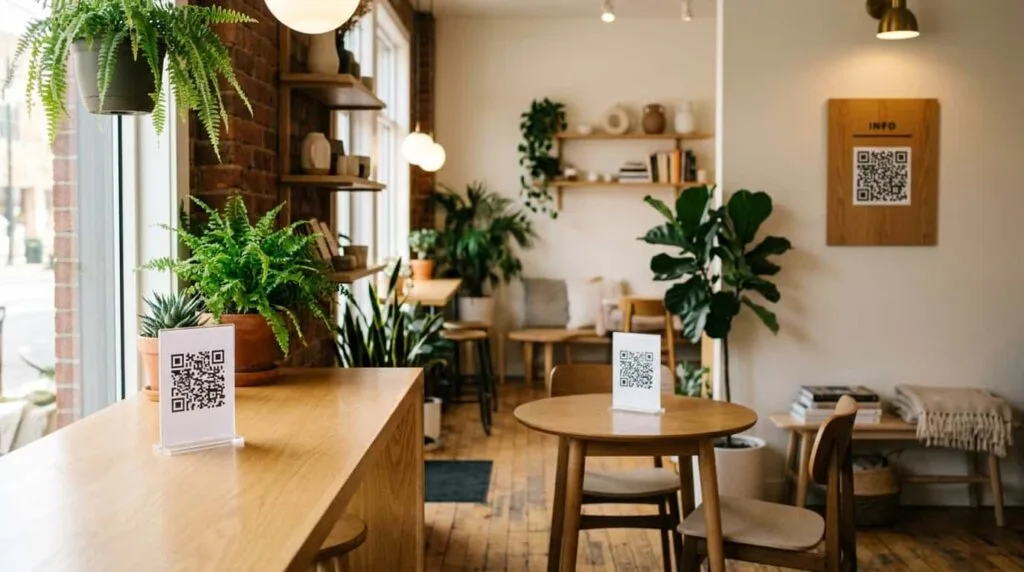
A QR code on the wrong surface is worse than no QR code at all. It looks like effort, occupies real estate in your space, and produces nothing. The painful part is that the difference between a code that gets ignored and a code that gets scanned forty times a day is almost never the design or the offer. It is the placement. Specifically, where it sits relative to the customer's natural line of sight, the moment in their experience when it shows up, and whether their phone is already in their hand when they notice it. Get those three things right and ordinary placements outperform clever ones every time.
Most owners think about placement the way they think about decoration. Find an empty spot, stick the code there, hope someone looks. That is not placement. That is decoration. Real placement starts from the customer, not the wall. You stand where they stand, sit where they sit, walk the path they walk, and ask one question at every step. Where would a phone naturally come out of a pocket here, and what would the person be thinking about at that moment? Wherever the answer is "they are already holding their phone and they are happy," that is where the code goes.
This guide walks through the surfaces in your business that produce the most scans for the least effort, and the surfaces that look obvious but quietly waste your time. Counter, table, signage, mirror, exit, receipt, and a few others. None of these are theory. They are placements that real businesses have measured and seen lift from, and you can copy any of them tomorrow without redesigning a single piece of artwork.
Test Placements With Real Data
VISU QR Ads gives every placement its own scan count, in real time. Compare table tents to counter codes, wall signs to receipts, and let the numbers tell you which surface deserves your investment.
The Three Rules of Placement That Beat Any Design Trick
Before any specific placement, three rules. If a placement violates any of them, no design or offer is going to save it. If a placement satisfies all three, even an ugly code in a boring spot will outperform a beautiful one in the wrong place.
Eye level beats every other altitude. A code mounted at the customer's natural sight line gets noticed. A code on the floor of the counter, behind the register, or above their head does not. The exact altitude depends on whether the customer is sitting, standing, or walking, but the principle is constant. Eyes do not search. They register what is in front of them. Anything outside that narrow horizontal band is decoration nobody looks at.
Idle time beats movement. A scan requires three to ten seconds of attention and a free hand. Customers in motion will not give you that. Customers waiting will. The placements that produce the most scans are the ones where customers are already pausing, already looking around, already mentally between things. The line at the register, the table after the meal, the mirror during a haircut. Movement kills scans. Stillness creates them.
Phone-already-out beats phone-in-pocket. The single biggest predictor of a scan is whether the customer has already taken their phone out for some other reason. If they are texting, paying, looking up directions, or scrolling at a table, your code is one tap away. If their phone is in a pocket or bag, you are asking for a multi-step action that most people will skip. Place codes where phones are already in the air.
That is the entire framework. Eye level, idle time, phone already out. A placement that hits all three converts at four to ten times the rate of a placement that misses any of them, regardless of design. For more on which specific surfaces work for review-style codes specifically, see our piece on where to place a review QR code.
Countertop Placements That Actually Get Scanned
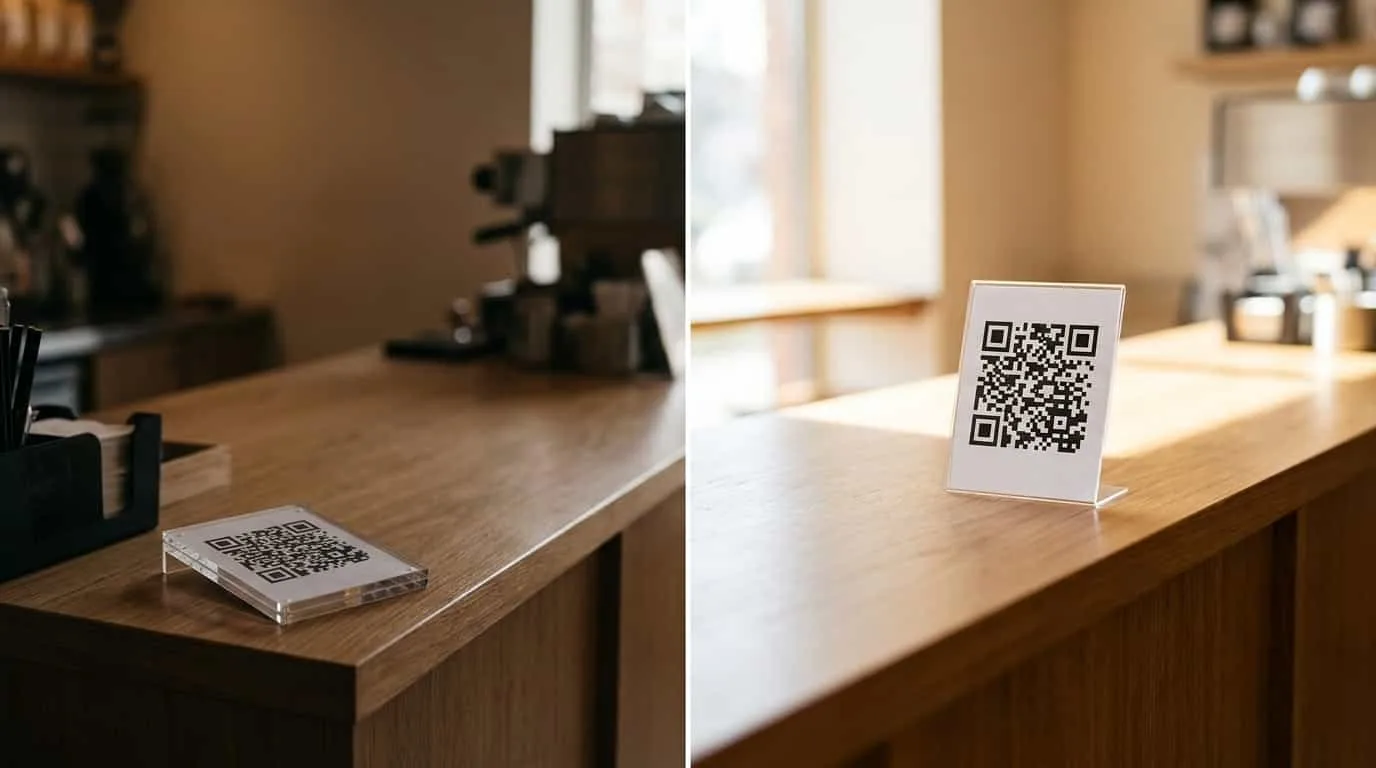
The counter is the obvious placement and the most-botched one. Owners stick a flat code on the counter surface and wonder why nobody scans. The problem is angle. A code lying flat is at a steep angle from the customer's eye, partially obscured by their own hand, glasses, wallet, and whatever else is on the counter. From their perspective, that code looks like part of the counter pattern, not a thing to interact with.
The fix is a small angled stand. Acrylic, wood, or even folded card stock works. The stand tilts the code toward the customer's line of sight, which puts it in their peripheral vision while they are standing at the counter, and that peripheral catch is what triggers the scan. Same code, same destination, same artwork, but rotated thirty degrees toward the customer turns it from invisible into obvious. This single change typically doubles or triples scans on counter placements.
The other counter placement that consistently outperforms is the side of the counter, not the top. Customers waiting at a counter spend a surprising amount of time looking down and slightly to the side, especially while their card is being processed. A code on the customer-facing vertical edge of the counter, at hip height, catches that gaze. Counterintuitive but measured to work in retail and cafes. For a full breakdown of placement strategies in retail spaces specifically, see our guide to QR codes in retail.
Table Placements: The Highest Conversion Surface in Most Businesses
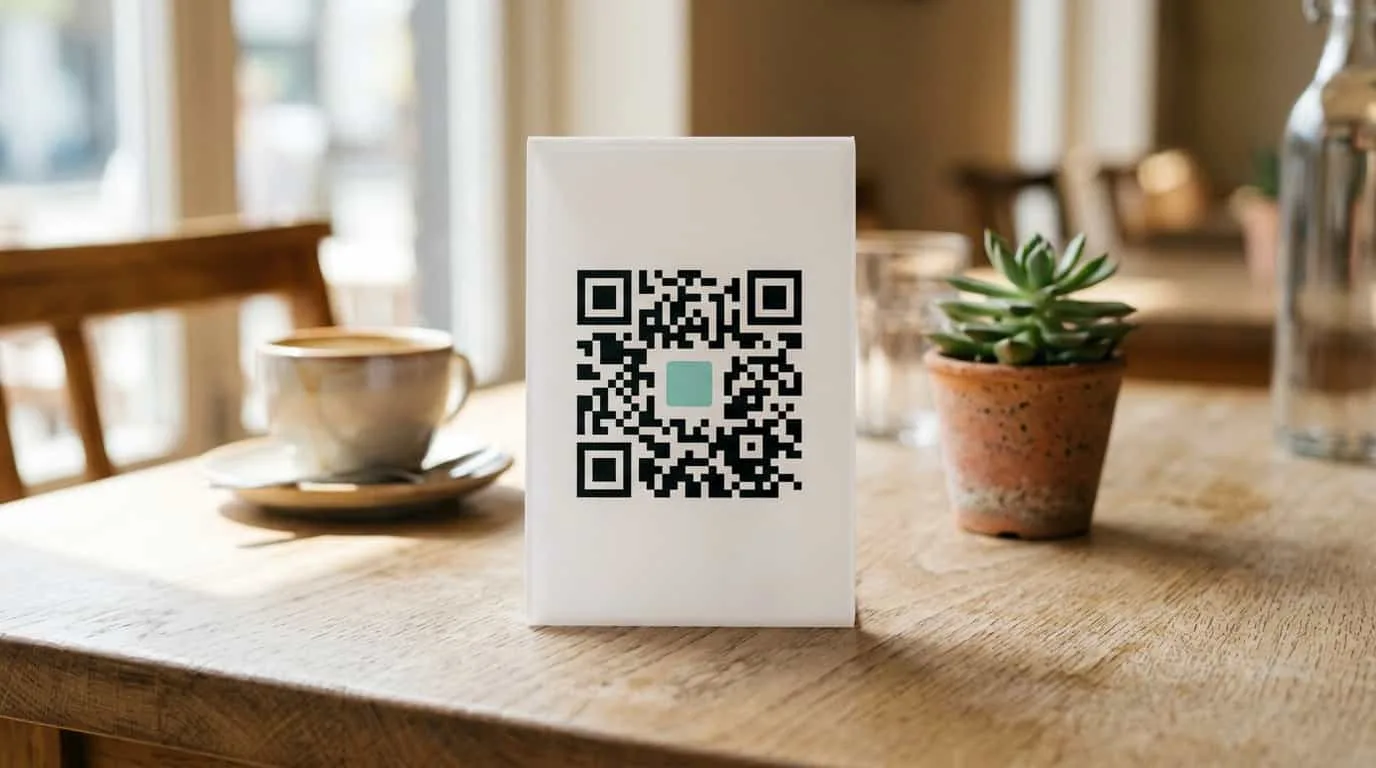
If your business has tables, this is your highest-leverage placement. A customer at a table is sitting still, has their phone within reach, has time to act, and is in a moment of genuine satisfaction (or about to be, if you are doing your job). That combination is rare in any other placement. The conversion rate on table-tent codes typically runs two to three times higher than counter codes, even when total scan volume is similar.
The most effective table placement is a small acrylic table tent, centered on the table or slightly toward the customer's preferred side. Acrylic resists food spills, looks clean, and is rigid enough that it does not tip over when bumped. Avoid paper or cardstock for permanent tents because they curl, stain, and start to feel like litter after a week. The table tent should be small enough that it does not crowd the table, big enough that the QR code is at least 2 cm wide so phone cameras lock onto it instantly.
The timing of when the scan happens matters as much as the placement. The peak window for table-tent scans is the moment between the meal ending and the bill arriving, which is when customers are leaning back, satisfied, and looking around for something to do. If your code is competing with active dining (food on the table, conversation in flow), it will lose. If it is the most interesting thing on the table during the natural lull, it will win. Design the placement and the destination to match that moment specifically. For ideas on adding a game element that increases scan rates further, our piece on scan and win campaigns walks through what works.
Different Tables, Different Results. See Both.
VISU QR Ads tracks each placement separately. Find the table position, code size, and angle that actually performs in your space.
Signage and Wall Mounts: Visibility Without Friction
Wall placements are the most visible and the most underutilized surface in most businesses. A wall sign at eye level, in the natural sight line as a customer walks in, gets passive impressions every single visit. Even when they do not scan, repeated exposure builds familiarity, and customers who see a wall code three or four times across visits are statistically more likely to scan on visit five than a customer encountering it for the first time.
The placement principles for wall signs are simple. Eye level for the average adult, which is roughly 1.5 to 1.7 meters off the ground. Near the line of sight as customers enter, pay, or wait, not in dead corners or above doorways nobody looks at. Backed by enough surrounding context (a small headline, a single sentence of value) that the customer understands what they are about to scan. A naked QR code on a wall is mysterious, and mystery is friction.
The bathroom is an underrated wall placement. Customers spend 30 to 90 seconds in the same physical position with nothing else to do, often with their phone already in hand. A small framed sign at hand-washing eye level, with a clean QR code and a one-sentence value prop ("scan for our loyalty program" or "scan for next month's specials"), produces scan rates that surprise most owners. Restaurants, cafes, and gyms see particularly strong performance from bathroom placements because the customer's phone is more likely to be out than at the counter.
Window signage facing inward is another quiet winner. Customers seated near windows in a cafe or restaurant naturally look at window decals while waiting for food or after eating, and a small QR code embedded in window-mounted artwork captures attention during natural daydream moments. The placement works because it is in the customer's natural visual rest zone, not because anyone goes looking for it.
Mirror Stations and Service Chairs
If you run a salon, barbershop, dental office, or any business where customers sit in a chair facing a mirror or service station for an extended period, this is the highest-conversion placement available to any business. Customers sit there for 20 to 60 minutes with their phone in their hand or close by, often scrolling, and the mirror or counter in front of them is in their direct line of sight the entire time.
The mirror placement is so strong because it stacks every placement principle at once. Eye level: yes. Idle time: yes, the customer is sitting still. Phone already out: usually, since most clients scroll during service. The mirror code is also the only placement where customers see it for half an hour straight, which means even a passive code without a verbal prompt produces meaningful scan rates. Add a brief verbal mention from the staff member during the appointment and scan rates climb dramatically.
The execution is small. A vinyl decal, an acrylic plate, or a small framed sign mounted on the lower corner of the mirror, large enough that the QR code is at least 2.5 cm wide. The corner placement is intentional. It avoids interfering with the customer's view of themselves (which is the point of the mirror) while staying in their peripheral vision the whole time. Center placements feel intrusive. Corner placements feel like context.
The same logic applies to service stations in dental, medical, or beauty contexts where the customer is reclined or seated facing a fixed surface. The headrest area in a dental chair, the wall opposite a treatment chair, the small surface next to a manicure station. Anywhere a customer's gaze rests for more than ten minutes while they wait or are being serviced, a code in that gaze converts above average.
Exit and Receipt: The Last-Mile Placements
The final two placements are timing-based rather than location-based. They both happen at the moment the customer is leaving, which is a specific psychological window where the customer has the most complete picture of their experience and the highest emotional charge to act on it. Done well, these placements catch customers who would never have scanned during the visit but will scan from the parking lot or on the bus home.
Exit signage. A small sign near the door at eye level, hit by the customer on the way out, with a single clear ask. Review request, loyalty signup, social follow. The customer sees it as they leave, and either acts immediately while standing there, or remembers it later in the day and acts from outside your space. Either way, you captured a customer who would have walked out invisible. Best practice is to keep the exit sign single-purpose. One ask, one code, one benefit. Multiple asks at the exit dilute every one of them.
Receipt placement. A QR code printed on the bottom of the receipt is the cheapest, most scalable placement available, because every transaction reproduces it for free. The catch is that receipts get folded, stuffed in pockets, and forgotten. Scan rates on receipt codes are typically lower than counter or table codes, but the volume is so high that even a low scan rate produces meaningful traffic. The receipt code is most valuable for customers who already left and want to take action from elsewhere, like requesting a follow-up service or leaving a review at home. For maximum value, the receipt code should point to a destination that includes the same call-to-action verbally given at checkout, so the customer who scans hours later still understands what to do.
How to Test Placements Against Each Other
The best part of dynamic QR codes is that you do not have to guess about any of this for your specific business. You can run a real test in seven days, with two placements you are curious about, and let the data settle the argument.
Pick two placements you are debating. Generate two dynamic codes with identical artwork and identical destinations. Name them clearly in your dashboard, like "Counter eye-level stand" and "Counter side mount" or "Table tent center" and "Table tent edge." Place them and walk away for a week. Do not adjust, do not ask staff to push one over the other, do not tinker. The point is to measure normal behavior, not optimized behavior.
After seven days, compare the scan counts. The result is almost always lopsided, sometimes by 3x to 5x. The winning placement is your default for that surface type. Move resources to the winner. Then pick the next placement question and run the next test. Most businesses run six to eight placement tests in their first six months and gather more actionable insight than any consultant could give them, because the data is from their own customers in their own space.
The same code structure also lets you treat placement testing as ongoing infrastructure. Once you have the winning placement, the same code can run multiple campaigns on it across the year, which is the point we covered in our piece on one QR code for multiple campaigns. Placement testing finds the right surface. Campaign rotation makes that surface valuable for years.
Placement Mistakes That Quietly Kill Scan Rates
Codes hidden behind objects. A code on the back wall of the counter, partially obscured by a card reader, a tip jar, or a display rack, is functionally invisible. Walk through your space and check every code from where the customer actually stands or sits. If anything is in front of the code at the customer's natural angle, the code is broken in practice.
Codes too small to lock. Phone cameras need a minimum size to lock onto a QR code reliably, usually around 2 cm at scanning distance. Codes smaller than this require customers to bring the phone unnaturally close, which most people will not bother to do. Print codes at the actual scan distance, not at random sizes that look good on the artwork.
Codes on glossy or reflective surfaces. Glass, polished metal, or shiny laminate produces glare that breaks the camera's ability to read the pattern. Matte finishes scan reliably. If you must place a code on a reflective surface, angle it so room lighting does not reflect directly back at the customer's typical scanning position.
Codes with no context. A naked QR code on a wall asks the customer to scan something with no idea what they will get. Add a short headline ("Leave us a review", "Join our loyalty program", "Scan for today's menu") so the value is clear before the scan. The headline is doing more work than the code.
Multiple codes competing on one surface. Some businesses stack three or four QR codes on the same counter, each with a different ask, hoping more codes equals more scans. The opposite happens. Customers freeze, do not know which to scan, and scan none. One surface, one code, one ask. If you need multiple destinations, use one code and rotate or split the destination, which is what dynamic platforms are for. For broader best practices, see our guide on QR code best practices.
Stop Decorating. Start Placing.
VISU QR Ads turns every printed surface into a measurable channel. Test placements against each other, find the winners, and let the data run your physical marketing.
Frequently Asked Questions
What is the best placement for a QR code in a small business?
It depends on the business type, but in general, the highest-converting placement is wherever customers are sitting still with their phone in hand. For restaurants, table tents win. For salons and barbershops, mirror placements dominate. For retail, counter eye-level stands and exit signs both perform well. The rule of thumb is to find the moment when the customer has idle time and a phone already out, then put the code in their direct sight line at that moment.
How big should a printed QR code be?
Minimum 2 cm wide for handheld scanning at arm's length, larger for codes seen from a distance. A general rule is that the code should be at least 1/10th of the scanning distance. So a code scanned from 50 cm needs to be at least 5 cm wide. Larger is almost always better for scan rate, smaller risks customers giving up because the camera does not lock.
Should I use multiple codes or one code for everything?
Use one code per surface, with each code tracked separately in your dashboard. This lets you compare placements and see which ones actually work. Within each code, you can run multiple campaigns by changing the destination over time. The goal is to keep placement-level data clean while still having flexibility on the destination.
Where should I avoid placing QR codes?
Anywhere customers are in motion (walking through a doorway, climbing stairs), behind transparent surfaces with glare (glass display cases under spotlights), at heights above eye level (above doorways or on ceilings), or on disposable surfaces that customers throw away before scanning (tear-off paper menus). Also avoid placements where the customer's hand will block the code while they are interacting with the surface.
Can I place a QR code on the bathroom wall? Is that weird?
Not weird, often very effective. Bathroom placements work because customers have idle time and their phone is often already out. The placement should be at hand-washing eye level, framed cleanly so it looks intentional rather than like clutter, and paired with a simple value proposition. Loyalty programs, review requests, and event signups all perform well in bathroom placements in cafes, restaurants, and gyms.