

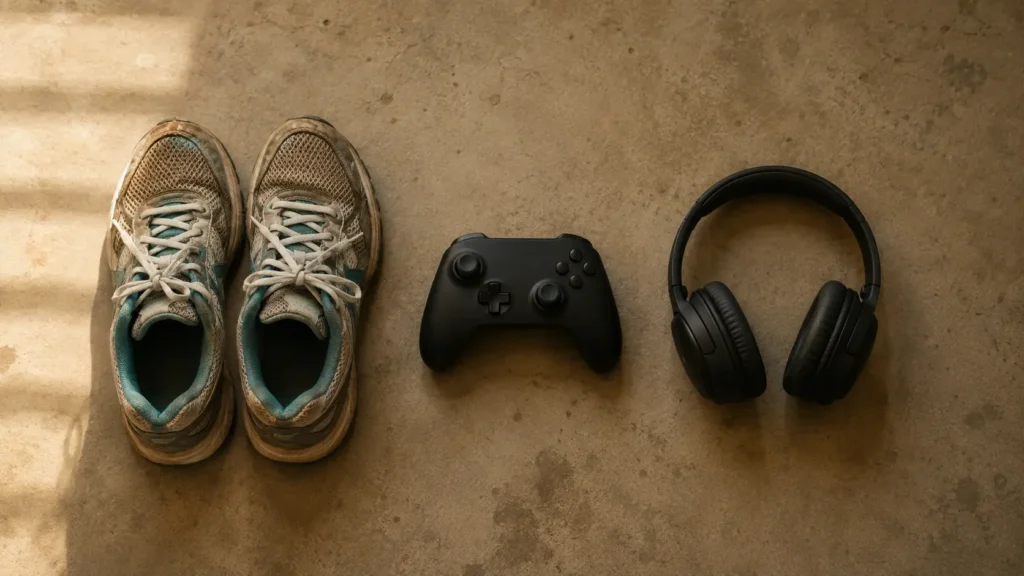
Walking apps pay the least per hour and cost you nothing. Gaming apps pay the most per hour and cost you the most time. Music apps sit in between and cost you almost nothing. That single sentence settles most of the argument, but it hides the number that actually matters: what each category pays for time you were going to spend anyway. Once you measure that way, the ranking flips.
Every comparison of these three categories makes the same mistake. It ranks them by raw payout, declares gaming the winner, and stops there. But raw payout ignores the cost side entirely. An app that pays double while demanding four times the attention is not the better deal, and treating it as one is how people end up grinding mobile games for less than a dollar an hour without noticing.
The Category None of These Three Cover
Walking pays for movement. Gaming pays for hours. Music pays for background noise. VISU pays for short verified actions tied to real campaigns, which is the only one of the four where the value per minute is the point rather than an accident.
How to Compare Three Different Categories
These three categories do not compete on the same axis, which is why most rankings of them are useless. A walking app and a gaming app are not two versions of the same product. One monetises a thing you already do, the other monetises hours you hand over.
So there are two numbers, not one. Raw pay per hour is what the app credits you for sixty minutes of the activity. Attention cost is how much of that hour you actually had to surrender. A walking app takes essentially zero attention, so its effective rate is close to infinite on time you were spending regardless. A gaming app takes the full hour, so its raw rate is also its real rate.
Judge every category on both numbers and the picture stops being confusing. We use the same framework across the whole cluster, including the wider ranking in the best reward apps comparison, and it is why our conclusions often disagree with lists that only count payout.
Walking Apps: Lowest Pay, Zero Cost
Raw pay: the lowest of the three. Walking apps credit small amounts for step milestones, and the balance climbs slowly enough that most people forget they installed one. Nothing in this category makes anyone meaningful money on payout alone.
Attention cost: effectively zero. This is the entire case for the category and it is a strong one. The app counts steps in the background while you commute, shop or walk the dog. You are not giving it minutes, you are giving it permission. Any reward at all is pure upside on time already spent, which is why the effective rate beats the raw rate by a wide margin.
The catch is redemption, not earning. The most common complaint across the category is not that the app fails to credit steps but that converting the balance into something you want is slow and offer-heavy. The gap between a rising number and an actual payout is where most people quit. The category breakdown lives in apps that pay you to walk, and if you want the version filtered to speed, the highest paying walking app covers which ones close that gap fastest.
Worth it if you already walk several thousand steps a day and treat the reward as a bonus rather than income. Not worth it if you plan to walk more because of the app. Walking for the payout is one of the worst hourly rates in this entire space.

Gaming Apps: Highest Pay, Highest Cost
Raw pay: the highest of the three, and it is not close. Gaming apps are funded by game studios paying for installs and retained players, which is a genuinely large advertising budget. That money is real, and it is why the per-hour numbers in this category beat walking and music comfortably.
Attention cost: the full hour. Here is the whole problem. These apps only pay while you are actively playing, and the reward usually scales with how deep you get into a specific title. That is not passive income, it is a low-wage job with a leaderboard. If you would not have played that game for fun, you are working, and the hourly rate you are working for is one you would refuse anywhere else.
The rate collapses on second inspection. The advertised figures usually describe the best case: a high-paying title, played efficiently, with the bonus tiers hit. The realistic average across a normal week is far lower, and it drops further once the initial-install bonuses are used up. We ran the honest numbers in games that pay real money instantly, and the no-deposit corner of the category is covered in games that pay real money with no deposit.
Worth it if you already play mobile games in the evening and would rather your existing habit paid something. Not worth it if you are starting a game you do not enjoy in order to earn. That is the single most expensive mistake in this comparison, and it is the one the category's own marketing encourages.
Where the Money in All Three Comes From
Walking apps are funded by advertisers, gaming apps by studios buying installs, music apps by streaming and survey budgets. Every one of them works because a business is paying for attention. VISU does that same thing directly, without routing the value through steps, grinding or background playlists.
Music Apps: The Quiet Middle
Raw pay: between the other two, closer to walking. Music apps pay for streaming time, song ratings or short listening tasks. The rates are modest but more consistent than walking rewards, because the underlying budget is tied to a specific measurable action rather than a step count.
Attention cost: low, but not zero. This is where the category splits in half. Passive streaming in the background costs you almost nothing and behaves like a walking app. Rating songs or completing listening tasks demands real focus and behaves like a gaming app. The two get marketed as one thing, and the difference is enormous. We separated them in the best music earning apps and tested the payout claims in get paid to listen to music.
The category has a scam problem the other two do not. Because "get paid to listen to music" is an easy promise to make and a hard one to verify, the space attracts apps that pay nothing at all. The legitimate ones are identifiable, but the filtering step is not optional here. Real vs fake music earning apps covers what to check before installing anything in this category.
Worth it if you already stream music for hours while working or commuting. Not worth it if the app asks you to keep the screen on, disables your normal player, or requires an active session to count listening time.
The Three Categories Side by Side
Read this table on both axes at once. The category that looks strongest in the pay column is the weakest in the cost column, and that inversion is the actual finding.
| Criterion | Walking | Gaming | Music |
|---|---|---|---|
| Raw pay per hour | Lowest | Highest | Low to moderate |
| Attention cost | None | The full hour | Low, unless rating songs |
| Effective rate on time you already spend | Best of the three | Worst of the three | Strong |
| Funded by | Advertisers and offers | Studios buying installs | Streaming and survey budgets |
| Main weakness | Slow redemption | Rate collapses after bonuses | Scam apps in the category |
| Runs in the background | Yes | No | Usually |
| Best for | People already on their feet | People already gaming | People already streaming |
The Hybrid Stack
Picking one category is the wrong instinct, because the three do not compete for the same part of your day. Walking uses your commute. Music uses your working hours. Gaming uses your evening. Running all three costs you nothing extra beyond the setup, and it is the only way the individually small numbers add up to something you would notice.
The practical version is simple. Install one walking app and forget it exists. Add one passive music app that runs while you work, not one that demands song ratings. Only add a gaming app if you already play mobile games, and skip the category entirely if you do not. Three apps, one of which you actively use, is the shape that works. The full stacking method is in the micro income stack, and the honest expectation-setting is in are reward apps worth it.
The gap that stacking does not close is the same in all three: none of these categories pays well for your actual attention. Walking pays you for not paying attention, gaming pays you badly for all of it, music pays you for half of it. That is where a fourth option fits rather than replaces. VISU pays for short verified actions funded by real campaigns, so the value per minute is the design rather than a side effect. Stack it alongside the other three and the attentive minutes stop being the unpaid ones. What VISU Network is explains where that budget comes from.
Which One Should You Pick?
There is no universal winner, and any ranking that declares one is measuring only half the equation. Match the category to the day you already have.
You walk a lot: start with walking. It is the only category that costs you literally nothing, and on your existing step count it has the best effective rate of the three.
You already play mobile games: gaming, and only under that condition. The raw rate is the highest available, and if the hours were already spent, that rate is real rather than theoretical.
You stream music for hours while working: music, on the passive side of the category. Avoid anything that requires active rating unless you enjoy the rating itself.
You do all three: stack all three. This is the case where the totals become genuinely worth the setup.
You do none of them: do not start any. Walking, gaming or streaming because an app pays for it means accepting an hourly rate far below anything reasonable. Pick something that pays for short deliberate actions instead, which is the reasoning behind apps that pay for attention. If videos are more your speed, get paid to watch videos covers a fourth category with a different cost profile entirely.
Stop Leaving the Attentive Minutes Unpaid
Walking pays you for ignoring it. Gaming pays you badly for everything you give it. Music pays you for background noise. VISU pays real value for short verified actions tied to real campaigns, with no step target, no grind and no playlist requirement. Run it alongside the rest of the stack.
FAQ: Walking, Gaming and Music Apps
Which pays more, walking apps or gaming apps?
Gaming apps pay more per hour in raw terms, and it is not close, because they are funded by game studios buying installs. But gaming demands the entire hour while walking demands none of it. On time you were going to spend anyway, walking apps have the better effective rate.
Do music apps really pay you to listen?
The legitimate ones do, at modest rates, for streaming time or short listening tasks. The category also attracts apps that pay nothing at all, because the promise is easy to make and hard to verify. Checking payout records before installing matters more in this category than in the other two.
Can you use walking, gaming and music apps at the same time?
Yes, and it is the best approach if all three fit your routine. They draw on different parts of your day, so they do not conflict. Walking runs during your commute, music during work, gaming in the evening, and the small individual amounts only become noticeable when combined.
Which category is best if I only want one app?
Choose the one matching what you already do most. Heavy walkers should pick walking, existing mobile gamers should pick gaming, and people who stream music all day should pick a passive music app. Choosing a category you have no existing habit in is how the hourly rate turns bad.
How much can you realistically earn from these apps?
Modest amounts in every category, and far less than the marketing implies. Walking and music produce small background totals, gaming produces more but consumes real hours. Treating any of them as income rather than a bonus on existing habits leads to disappointment.
Is there a category that pays better than all three?
For value per minute of actual attention, yes. Platforms paying for short verified actions funded by real campaigns pay a better rate than step counts, game grinding or background streaming, because the payment is tied to a deliberate action rather than to passive time. The strongest setup stacks one of those alongside whichever of the three fits your routine.