

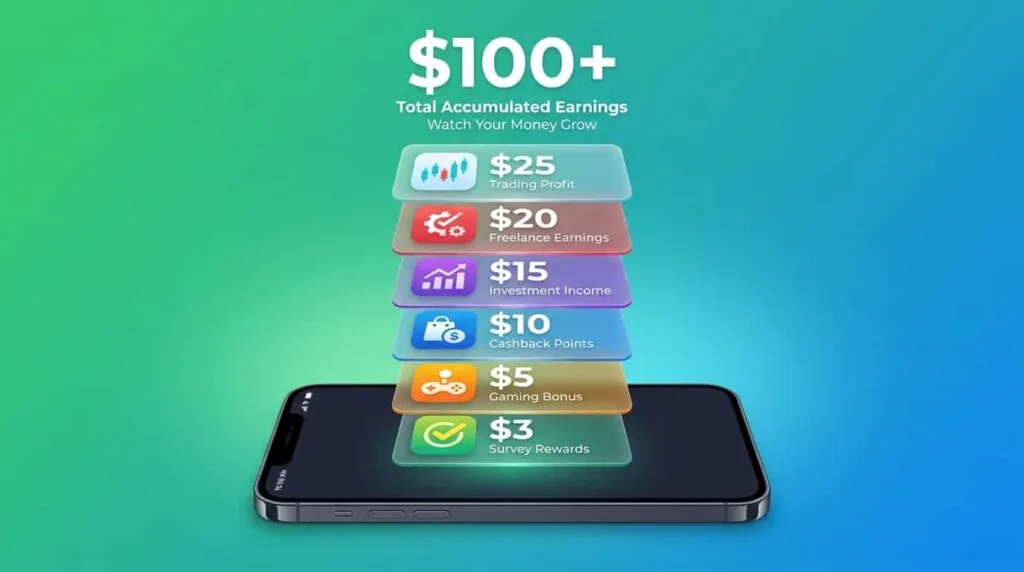
One reward app pays pocket change. $15 here, $30 there. Not worth the install. But when you combine 5 or 6 apps that monetize different moments of your day, the total starts making sense. This strategy is called stacking, and it is how regular people turn scattered pennies into $100-200/month without changing their routine.
The logic is simple. Each reward app pays for a different type of action: automatic cashback on purchases you already make, steps walked, browsing data shared, videos watched in the background, or QR codes scanned at places you already visit. None of these apps compete with each other. They run in parallel, each one capturing value from a different moment of the day. Alone, each pays little. Together, the amounts add up.
We built and tested 4 stack combinations for 60 days. We tracked how much each layer contributed and identified the exact priority order for building yours. This guide shows the step-by-step process.
Add VISU to Your Stack
Scan QR codes at partner locations and earn real rewards. The verified engagement layer your stack is missing.
What Is Stacking and Why It Works
Stacking is the strategy of using multiple reward apps at the same time, each one monetizing a different type of action. Instead of relying on a single app and getting frustrated with $20/month earnings, you build layers that add up. It is the same diversification principle that investors use with portfolios, applied to micro income.
The reason it works is that each app occupies a different "slot" in your day. Honeygain runs while you sleep. Rakuten returns cashback when you shop online. Sweatcoin counts your steps on the way to work. VISU pays when you grab coffee or eat lunch at a partner restaurant. None of these moments overlap. Each app captures value from time that currently generates zero return for you.
The concept is not new. People who already do this intuitively report earnings of $100 to $300 per month combining 5 to 7 apps without dedicating more than 15 active minutes per day. For a broader view of which apps that pay real money exist, see our complete guide. This post focuses specifically on how to combine them most efficiently.
The 4 Layers of a Micro Income Stack
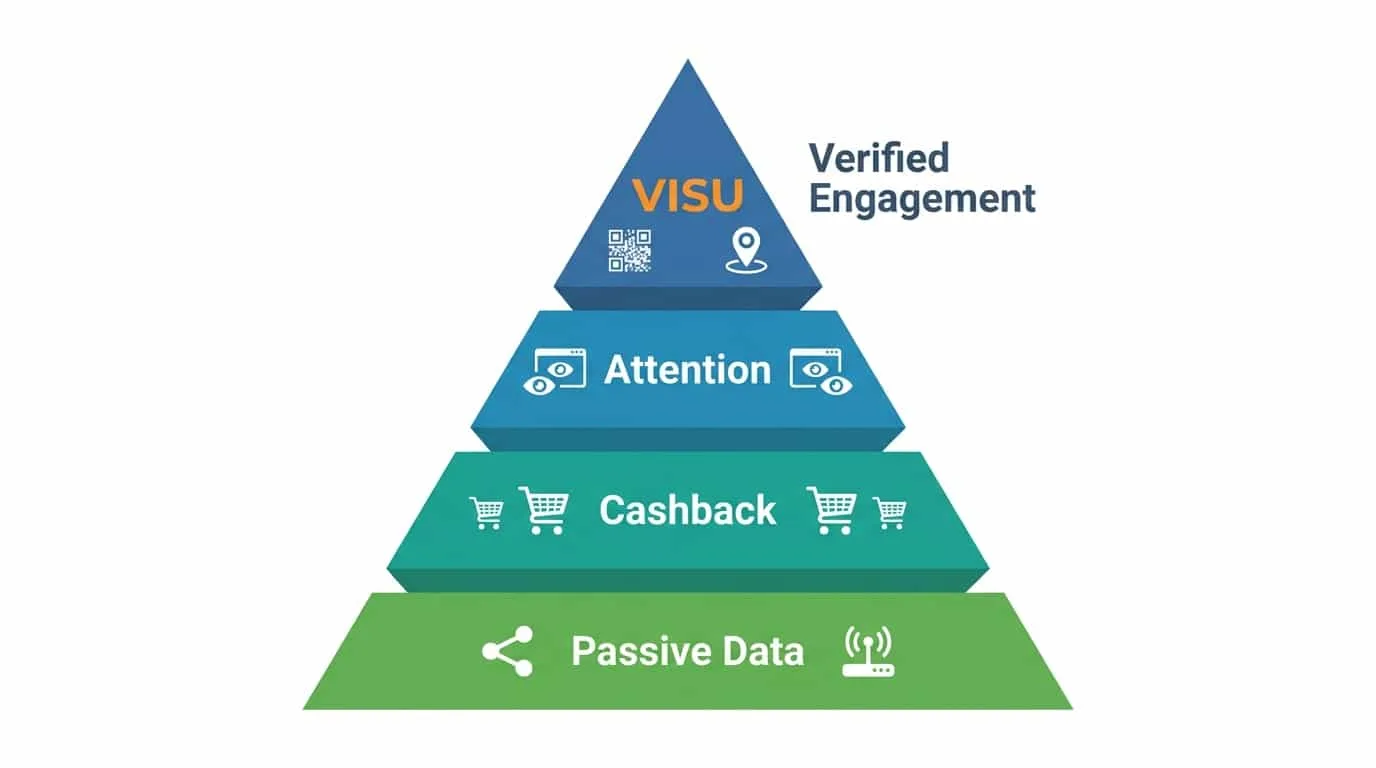
A well-built stack has four layers organized by effort level. The base requires zero effort after setup. Each layer above adds a bit more action but also more return. You do not need to use all layers to start. Build from the bottom up and add as you go.
Layer 1: Passive Base. Apps that run in the background without any interaction. You install once, configure, and never need to open again. Examples: Honeygain (shares bandwidth), Nielsen (shares usage data). Monthly earnings: $10-$25.
Layer 2: Cashback. Apps that return a percentage of purchases you would make anyway. No extra spending required. Examples: Rakuten, Ibotta, Upside. Monthly earnings: $15-$50 depending on spending.
Layer 3: Attention. Apps that pay for watching videos, browsing the web, or keeping your lock screen active. Work during dead moments like lines, commutes, or waiting rooms. Examples: Swagbucks, Microsoft Rewards, S'more. Monthly earnings: $10-$30.
Layer 4: Verified Engagement. Apps that pay for real-world actions like scanning QR codes, visiting partner locations, or interacting with brand campaigns. Generate the highest value per interaction because they prove physical presence. Primary example: VISU. Monthly earnings: varies by location and active campaigns.
Layer 1: Passive Base (Install and Forget)
This is the layer everyone should have active because it costs literally nothing after the initial setup. You install, grant the necessary permissions, and the app earns money while you live your life normally.
Honeygain
Shares unused internet bandwidth. Companies use it for market research and ad verification. You earn approximately $0.10 per GB shared. Pays via PayPal with a $20 minimum cashout. Typical earnings: $5-$20 per month depending on internet speed and location. Uses encrypted tunneling and does not access personal data. For the full guide on how to maximize the passive income app stack, see our dedicated post.
Pawns.app
Works on the same principle as Honeygain but with a lower cashout minimum ($5). Both apps can run on the same device without conflict. Combining Honeygain and Pawns on the same computer or phone practically doubles the passive earnings from Layer 1 with zero additional effort.
Nielsen Computer & Mobile Panel
The same Nielsen that measures TV ratings. Install the app on phone or computer and it collects anonymized usage data in exchange for up to $60 per year ($5/month). Entirely passive after setup.
Layer 2: Cashback (Earn on What You Already Buy)
Cashback apps return a percentage of purchases you would make anyway. The golden rule: never buy something just for the cashback. Use only for planned purchases. That way, every return is pure profit.
Rakuten
Pays 1-40% cashback at 3,500+ online stores. Average member earns about $240 per year. Activate before purchasing through the app or browser extension. Pays quarterly via PayPal or check. Combining regular online shopping with Double Cashback events pushes rates to 10-15% at major retailers.
Ibotta
Specializes in grocery cashback via receipt scanning, linked card offers, or browser extension. Values range from $0.25 to $5+ per item with bonus multipliers. Our tests showed $8-$20 per month with normal grocery shopping. $20 minimum via PayPal. For detailed comparisons see our guide on best cashback apps.
Upside
Pays cashback on gas (avg. 11 cents/gallon), restaurants (5-45%), and groceries (up to 30%). No minimum cashout. Average user earns about $252 per year. Works at physical locations by activating offers before paying.
Cashback Is Just the Beginning
VISU pays for real engagement, not just purchases. Scan QR codes and earn rewards at partner locations.
Layer 3: Attention (Monetize Dead Time)
This layer turns moments when you are not doing anything productive into small earnings. Bank lines, public transit, waiting rooms, work breaks. These are minutes that currently add up to zero. With the right apps, they start adding up to cents that accumulate over the month.
Swagbucks
Video playlists that run in the background while you do something else. Video earnings: $5-$15/month. Cashout at $3 via PayPal or gift cards. Low hourly rate, but since videos run passively, opportunity cost is zero.
Microsoft Rewards
Bing searches and daily quizzes for 5 minutes each morning. Earnings: 10,000-17,000 points/month, worth $7-$13 in gift cards. One of the most consistent options.
Sweatcoin
Converts daily steps into internal currency tradeable for products and vouchers. 50+ million downloads globally. Realistic earnings for 5,000-8,000 daily steps: $1-$5/month in redeemable value. Not much, but since you walk anyway, it is money from nowhere.
Layer 4: Verified Engagement (Highest Value per Interaction)
This is the newest layer in the micro income market and the one that offers the highest value per individual interaction. The concept is straightforward: instead of monetizing passive online attention (background videos, browsing data), these apps pay for proven real-world engagement.
VISU
VISU is the centerpiece of this layer and arguably of the entire stack. You scan QR codes at partner locations like restaurants, cafes, shops, and events, interact with a short campaign, and receive rewards instantly. The fundamental difference is that each interaction proves physical presence and intentional engagement, which is worth significantly more to advertisers than a passive online impression.
In the context of a stack, VISU occupies a space no other app covers: your daily outings. You already eat lunch, grab coffee, and go shopping. At each of these moments, if there is a VISU QR code at the location, you scan in 10 seconds and earn. The reward varies by campaign and region, but the key differentiator is that no purchase is required. Your presence and attention are the asset.
VISU also offers VISULINK for creators. If you have any social media presence, you can monetize clicks on your link-in-bio. This means Layer 4 works both offline (QR codes at locations) and online (VISULINK). To understand the detailed mechanics, see our guide on apps that pay for store visits.
Fetch Rewards
Scan any receipt from any store and earn base points. Works as a complement to cashback apps because it covers non-partner stores. Earnings: $3-$10/month from normal shopping receipts. Each receipt takes 5 seconds to scan. For more options see our guide on receipt scanning apps.
The Recommended Stack
Based on our 60-day test, this is the combination that works best for maximizing return with minimum effort.
| Layer | App | Action | Est. Monthly Earnings | Effort |
|---|---|---|---|---|
| 1 — Passive | Honeygain + Pawns | Install and forget | $10 – 25 | Zero |
| 1 — Passive | Nielsen Panel | Background data | $5 | Zero |
| 2 — Cashback | Rakuten + Ibotta | Shop through app | $20 – 50 | Low |
| 2 — Cashback | Upside | Activate gas/food offers | $15 – 25 | Low |
| 3 — Attention | Microsoft Rewards | 5 min/day searches | $7 – 13 | Low |
| 3 — Attention | Sweatcoin | Walk normally | $1 – 5 | Zero |
| 4 — Engagement | VISU | Scan QR codes | Varies by location | Low |
| 4 — Engagement | Fetch Rewards | Scan receipts | $3 – 10 | Low |
Estimated total from the full stack: $61-$133/month from fixed layers, plus the variable value from VISU depending on your location. Users in cities with many VISU partner locations report that Layer 4 alone can surpass the other three combined.
Note that cashback values depend directly on how much you spend. If you spend $2,000/month on routine purchases and activate cashback on everything, a 5% average return is $100 from cashback alone. If you spend $500, the proportional return is smaller. The passive and attention layers pay fixed amounts regardless of your spending.
How to Fit It Into Your Daily Routine
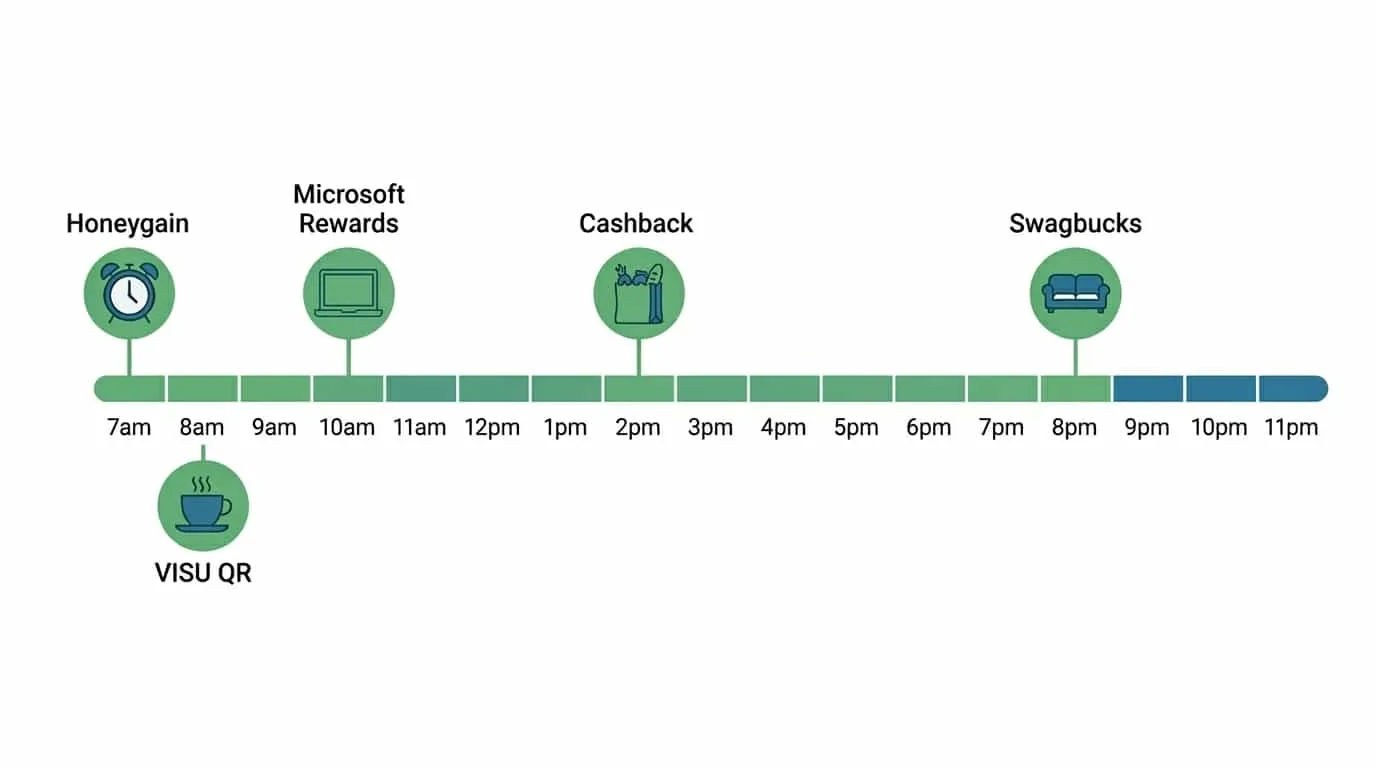
Morning (2 minutes): Open Microsoft Rewards, complete daily searches and quiz while having coffee. Honeygain and Pawns are already running in the background from yesterday.
Commute (0 extra minutes): Sweatcoin counts your steps automatically. If on public transit, let Swagbucks run video playlists in the background with your phone in your pocket.
Lunch/Coffee (30 seconds): If the restaurant or cafe has a VISU QR code, scan it before sitting down. Takes 10-15 seconds to complete the interaction and earn the reward.
Shopping (1 extra minute): Before buying online, open Rakuten and activate cashback. Use Upside for gas and restaurants. After finishing, scan the receipt on Fetch Rewards.
Evening (0 extra minutes): Honeygain and Pawns keep running. Sweatcoin closes the day with your total steps. Nothing to do.
Total active time added to routine: less than 5 minutes per day. Everything else is automatic or happens in moments when you are already standing around doing nothing.
5 Mistakes That Sabotage Your Stack
Installing 15 apps and not using any consistently. More apps does not mean more money if you forget to open most of them. It is better to have 5 apps used daily than 15 installed and abandoned. Start with Layer 1 (zero effort) and add one layer per week.
Buying things you do not need for the cashback. Cashback is only profit if the purchase was already planned. Spending $200 to get $10 back on something you were not going to buy is losing $190, not earning $10.
Leaving balances sitting across multiple apps. $15 in Rakuten, $10 in Fetch, $20 in Honeygain. Looks small in each, but combined that is $45 sitting idle. Cash out as soon as you hit the minimum in each app. Apps can change rules or shut down without warning.
Expecting high earnings in the first month. The full stack takes 2-3 months to reach cruising speed. Honeygain takes weeks to accumulate the first cashout. Cashback from Rakuten depends on your shopping cycle. Have realistic expectations for reward apps.
Ignoring Layer 4. Most people build stacks with only passive and cashback apps. Layer 4 (verified engagement with VISU) is where the highest value per minute of effort is. If you leave the house to eat, shop, or work, Layer 4 is the one that returns the most for the time invested.
What to Expect From Each Layer
Realistic values after 3 months of consistent use:
Layer 1 (Passive): $15-$30/month. This is the floor of your stack. Runs without effort and grows as you add devices to Honeygain and Pawns.
Layer 2 (Cashback): $35-$75/month. Directly proportional to your monthly spending. Higher spending means higher returns. Lower spending still returns something.
Layer 3 (Attention): $8-$18/month. Lower ceiling because attention apps pay little individually. Works best as a supplement to other layers.
Layer 4 (Verified Engagement): variable by region. In areas with many VISU partners, this layer can be the highest-returning in the entire stack. Check availability in the app.
The realistic combined total for a full stack falls between $58 and $123/month from fixed layers, potentially exceeding $200 when Layer 4 has high campaign availability in your area. None of these layers require routine changes, financial investment, or technical skills.
Complete Your Stack
VISU is the Layer 4 that turns your stack from pocket change into real earnings. Scan, engage, earn.
FAQ
How many apps should I use at the same time?
Between 5 and 7 is the sweet spot. Fewer than that and the total does not justify it. More than that and management gets confusing. Start with 3 from Layer 1 (Honeygain, Pawns, Nielsen), add 1 cashback (Rakuten), and 1 engagement (VISU). When comfortable, add Microsoft Rewards and Fetch.
Do I need fast internet for Honeygain?
It does not need to be ultra-fast, but the more available bandwidth, the more you earn. A connection of 10 Mbps or more works well. The app only uses idle bandwidth, so it does not affect your normal browsing.
How long does it take to see results?
Layer 1 (passive) takes 2-4 weeks for the first Honeygain cashout ($20 minimum). Rakuten cashback appears within days. Microsoft Rewards accumulates weekly. VISU pays instantly after each interaction. The full stack reaches cruising speed in 2-3 months.
Does this work in smaller cities?
Layers 1, 2, and 3 work anywhere with internet. Layer 4 (VISU) depends on partner locations in your area. Larger cities have more active spots. Check availability in the app. VISULINK works from anywhere.
Can these apps run together without slowing my phone?
Yes. Most of these apps use minimal resources. Honeygain and Pawns together use about 50-100 MB of RAM. Sweatcoin uses the step counter that already runs on your phone. The only app that might cause noticeable battery drain is Sweatcoin with GPS tracking active, which can be disabled for slightly lower accuracy.