

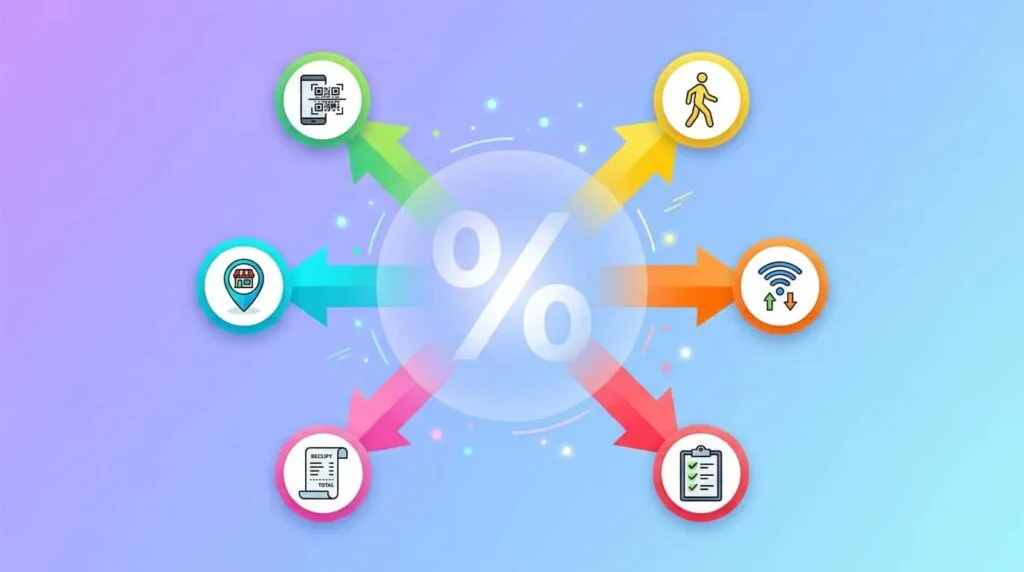
Cashback apps have a fundamental problem: you must spend money to earn money. That model works if you were already planning the purchase. But for millions of users who download these apps hoping for free income, the reality is disappointing. Cashback rates are dropping, partner offers are shrinking, and the data you trade for a few percent back is worth more than what you receive. There are better ways to earn.
A LinkedIn analysis from a former rewards industry executive put it bluntly: big cashback apps are struggling more than people realize. Partners are giving fewer offers, cashback percentages are dropping, and user engagement is falling. The PYMNTS Intelligence report found a $42 billion gap between promotional dollars spent and consumer value delivered in the offers economy. 50% of restaurant diners and nearly half of retail shoppers noticed no offer during their most recent visit. The system is failing to connect the right deal to the right person at the right time.
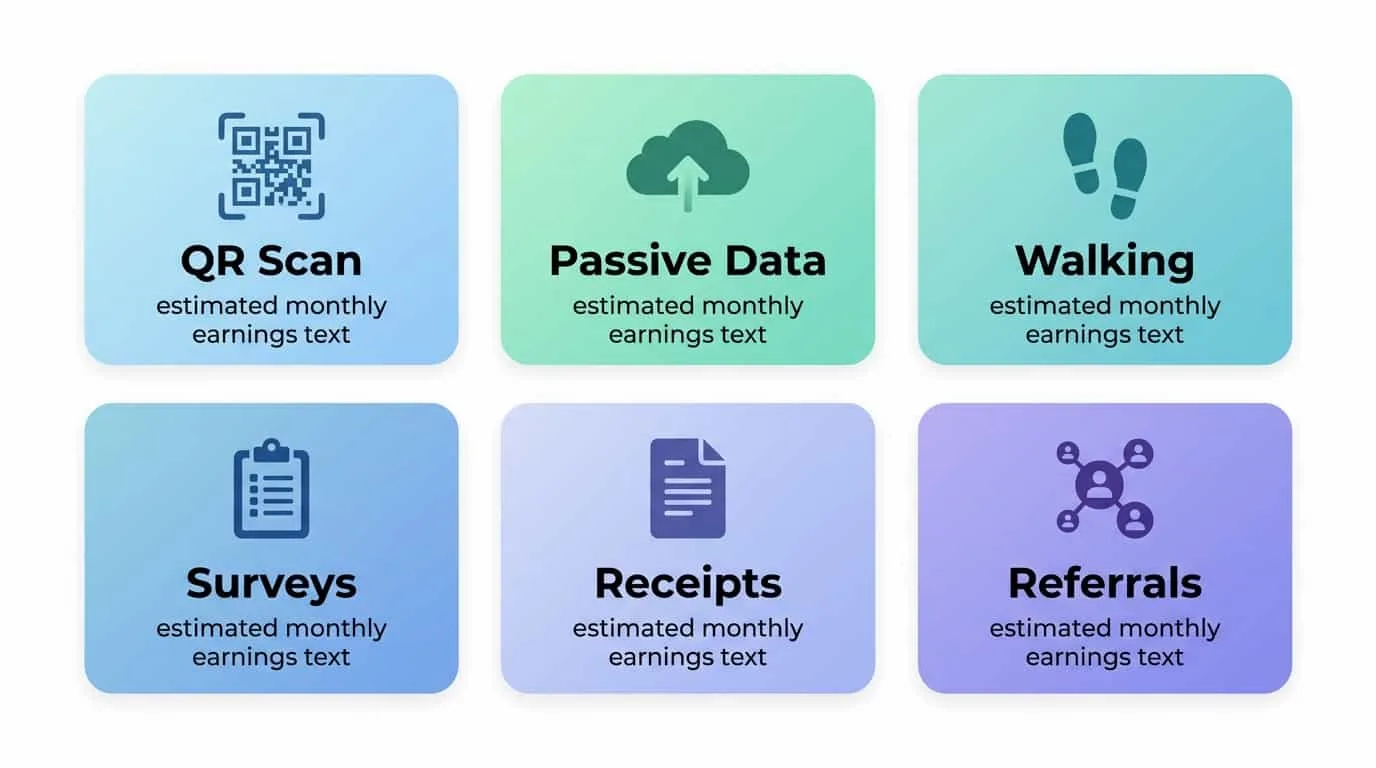
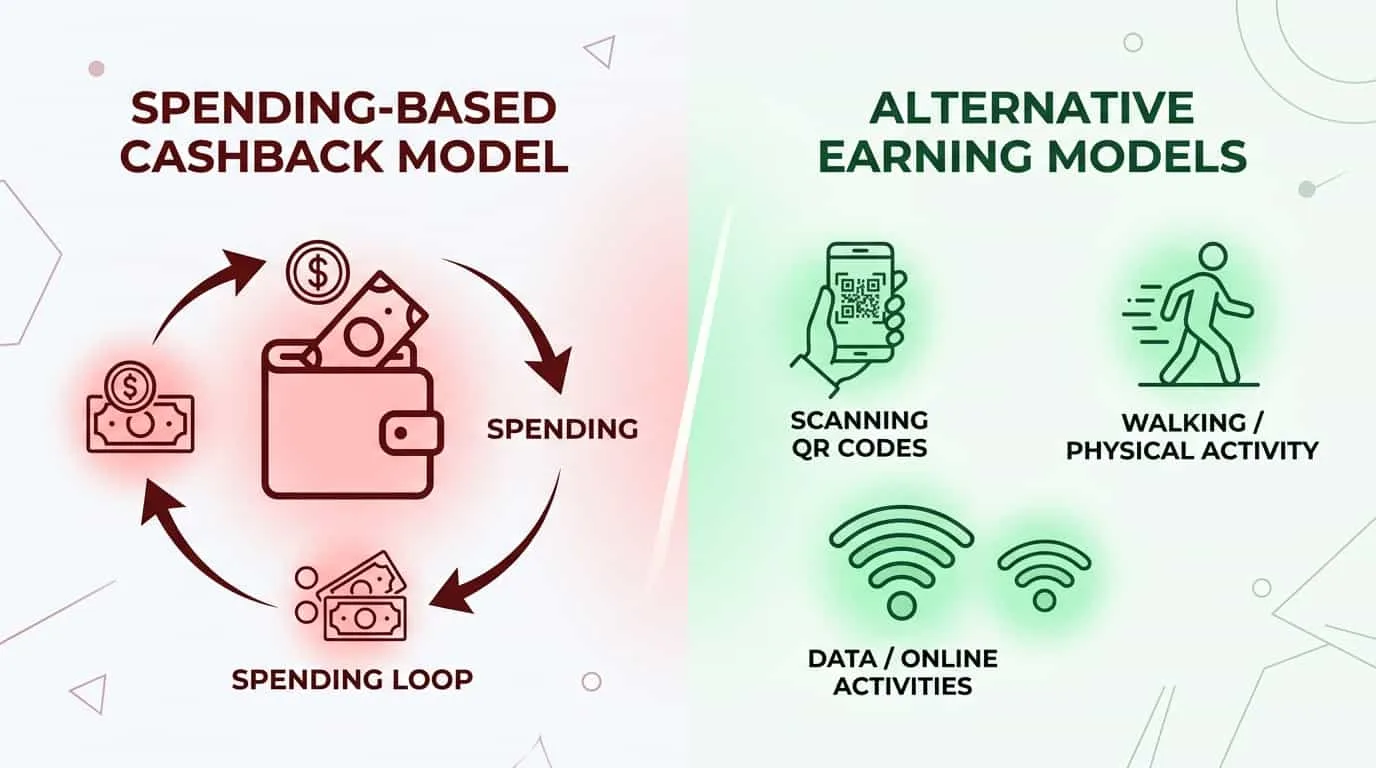
Meanwhile, a new generation of apps pays you without requiring any purchase at all. They monetize your idle internet bandwidth, your daily steps, your physical presence at locations, or 10 seconds of attention at a QR code. This post covers six categories of alternatives that let you earn without opening your wallet, with realistic numbers for each.
Earn Without Spending a Dollar
VISU pays for verified engagement at partner locations. No purchase required. Scan a QR code, interact with a campaign, earn a reward.
Why Cashback Apps Are Losing Their Edge
The core business model of cashback apps depends on retailers paying a commission for driving sales. The app takes a cut and passes the rest to you as cashback. This model worked well when it was novel and cashback rates of 5% to 15% were common. But as the market matured, several forces pushed rates down and made the economics less attractive for users.
First, retailer margins have thinned. Inflation, supply chain costs and increased competition have squeezed the commissions retailers are willing to pay. Cashback rates that were once 8% on electronics are now 2% to 3% at many stores. Second, user acquisition costs for cashback platforms have risen, forcing them to keep a larger share of each commission for themselves. Third, 38% of users now switch to apps offering multi-category rewards rather than sticking with a single cashback platform, according to market research data. The loyalty that cashback apps once commanded is fragmenting.
The deeper structural problem is that cashback apps are dying in their current form because the model requires you to spend. If you have a tight budget or simply want to earn without increasing your expenses, cashback apps offer you nothing. Every dollar of "earnings" is preceded by $10 to $100 of spending. For a full look at the current landscape, see our ranking of the best cashback apps and which ones still hold up.
The privacy cost adds another layer. Research published in The Conversation found that cashback apps collect extensive data about shopping history, browsing behavior and personal details. ShopBack was fined over its 2020 data breach that affected more than 1.4 million users. Your data has value, and trading it for 3% cashback on purchases you were already making may not be the deal it appears to be.
What Makes a Good Alternative
A true alternative to cashback apps must meet one critical condition: it should not require you to spend money to earn. Beyond that threshold, the best alternatives share three traits. They pay for time or attention you are already using. They have a transparent value exchange where you know exactly what you are giving and getting. And they generate income that is independent of your purchasing power, so a student with no discretionary budget can earn the same as a professional with a large one.
The six alternatives below are ranked by the independence of their earning model. The first requires only your physical presence. The last requires only a network of friends. None of them require you to open your wallet.
Alternative 1: QR Code Engagement Apps (VISU)
How it works: You scan a QR code at a partner location such as a restaurant, cafe, retail store or event. You interact with a short brand campaign on your phone. You receive a reward. The entire interaction takes 10 to 15 seconds. No purchase is required.
Why it pays more: Brands pay significantly more for verified foot traffic and intentional engagement than they pay for an online impression or a survey response. PYMNTS Intelligence data shows that 7 in 10 consumers change what or how much they buy when an offer actually reaches them. A QR code scan proves a real person was physically present and chose to engage. That proof is commercially valuable, which is why the reward per interaction can exceed what traditional reward apps offer.
VISU is the leading app in this category. It places QR codes at partner locations and rewards users for scanning and engaging. The rewards vary by campaign and region, but the model solves the biggest problem with cashback: you earn from your presence, not your spending. For a deeper look at this model, see our guide to scan-to-earn apps.
VISU also offers VISULINK, a link-in-bio tool for creators that monetizes clicks from your social media profiles. This means you can earn both offline (QR scans at locations) and online (VISULINK traffic). The combination covers earning opportunities whether you are out and about or at home. For more on how QR code rewards work, see our guide to QR code cashback rewards.
Best for: Anyone who regularly eats out, visits stores, attends events or has a social media presence. The more you are out in the world, the more earning opportunities appear.
Alternative 2: Passive Data Sharing Apps
How it works: You install an app that shares your idle internet bandwidth or anonymized usage data. The app runs in the background 24/7 without any interaction from you. Companies use this bandwidth for market research, ad verification and price comparison.
Apps in this category: Honeygain and Pawns.app share bandwidth and pay approximately $0.10 per GB. Nielsen Mobile Panel pays a flat monthly amount for installing a monitoring app. Combined, these apps generate $10 to $25 per month with zero active time after setup.
The advantage over cashback is absolute: there is no spending required, no active time required, and the income is completely independent of your purchasing power. The disadvantage is the low ceiling. Even running multiple passive apps on multiple devices, the total rarely exceeds $30 per month. These apps work best as the foundation layer of a larger earning stack, not as a standalone income source.
Best for: Anyone with a stable internet connection who wants guaranteed background income with zero daily effort. Ideal as a complement to active earning methods.
Alternative 3: Walking and Fitness Apps
How it works: Your phone's pedometer counts your daily steps. The app converts those steps into an internal currency that can be redeemed for gift cards, products or occasionally cash.
Apps in this category: Sweatcoin has more than 50 million downloads and converts steps into redeemable coins. Other options include Evidation and Winwalk. Realistic earnings for someone walking 5,000 to 8,000 steps per day sit between $5 and $25 per month in redeemable value.
The value proposition is clear: you already walk. The app does not ask you to walk more (though it provides a nudge). It simply captures value from movement that was already happening. The limitation is that payout options are often restricted to gift cards or internal marketplace items rather than direct cash. The effective cash value per step is very low, but the time investment is truly zero.
Best for: People who walk regularly as part of their commute, exercise routine or daily life. Pairs well with QR scan rewards from VISU since both monetize your physical movement through the world.
Walk, Scan, Earn
Combine walking app earnings with VISU QR scans at your daily stops. Two layers that monetize what you already do.
Alternative 4: Receipt Scanning Apps
How it works: You photograph any receipt from any store after any purchase. The app extracts product data and rewards you with base points. Some receipts unlock bonus offers for specific brands or products.
Apps in this category: Fetch Rewards is the leader with a frictionless scan-anything approach. Ibotta combines receipt scanning with pre-selected offers. Typical earnings from receipt scanning alone sit between $10 and $30 per month for someone making regular purchases.
You might argue that receipt scanning still requires spending, since you need a receipt. That is technically true, but the difference from cashback is important. Cashback apps require you to activate the offer before purchasing, often through their specific link or partner store. Receipt apps reward you for purchases you already made at any store, without needing to plan around the app. They capture value after the fact rather than trying to redirect your behavior before the fact.
The main limitation is speed. Earning enough points for a meaningful cash-out takes weeks of consistent scanning. Many users abandon these apps before reaching their first redemption because the individual receipts feel worthless (5 to 25 points per receipt when you need 3,000 for a $3 gift card).
Best for: People who shop frequently and are willing to spend 5 seconds per receipt. Works as a complementary layer alongside other earning methods.
Alternative 5: Store Visit and Check-In Apps
How it works: You earn rewards simply for walking into a store or being physically present at a partner location. Some apps use GPS verification, others use Bluetooth beacons, and newer models use QR codes for more precise verification.
Apps in this category: Shopkick pioneered this model by paying "kicks" for walking into retail stores. VISU takes it further by combining location verification with brand engagement for higher-value rewards. For a full breakdown, see our guide to apps that pay for store visits.
The advantage is that no purchase is necessary. Walking into a store is enough. The challenge is partner availability. These apps only pay at locations that participate in their network. In major cities the coverage is good. In smaller towns it can be thin. The newer QR code based approach that VISU uses addresses this partially by requiring less technical infrastructure at each location.
Best for: People who regularly visit shopping areas, malls, or neighborhoods with concentrations of partner locations. Check your area's coverage before committing to any single app.
Alternative 6: Referral-First Apps
How it works: You invite friends or followers to download an app. When they sign up and complete an initial action, both of you receive a bonus. Some platforms pay $5 to $50 per successful referral.
Why it belongs on this list: Referral bonuses require zero spending. They convert social capital into actual income. For users with even a modest social media following or a large friend group, referral income can exceed all other earning methods during the first few months of using a new app.
The limitation is that it is a one-time event per person. You cannot refer the same friend twice. Once your network is tapped, referral income drops to near zero. But as a launch strategy for building your initial earning stack, it is highly effective. VISU, Honeygain, Méliuz and most major reward apps all offer referral programs.
Best for: Content creators, social media users, college students with large social circles, and anyone who can share a referral link to a receptive audience.
Cashback vs. Alternatives: The Full Comparison
| Criteria | Cashback Apps | QR Engagement (VISU) | Passive Data | Walking Apps | Receipt Scanning |
|---|---|---|---|---|---|
| Requires Spending | Yes | No | No | No | Indirectly |
| Active Time/Day | 2-5 min | Under 1 min | 0 min | 0 min | 1-2 min |
| Monthly Earnings | $15-100 | Varies by region | $10-25 | $5-25 | $10-30 |
| Data Shared | Purchase history | Location at scan | Bandwidth | Step count | Receipt data |
| Payout Method | Cash/Gift cards | Cash/Pix/Rewards | PayPal | Gift cards | Gift cards/Cash |
| Works Without Budget | No | Yes | Yes | Yes | Partially |
The comparison reveals a clear pattern. Cashback apps are the only category that requires you to spend money before earning anything. Every alternative generates income from assets you already have: bandwidth, steps, presence, attention or a network of friends. For users on a tight budget, the alternatives are not just preferable. They are the only viable options.
The Best Combination for 2026
The most effective approach is not choosing one alternative. It is layering several that cover different moments of your day without adding effort. Based on our testing, the optimal combination for someone looking to replace cashback income entirely is three layers.
Layer one is passive data sharing. Install Honeygain and Pawns.app on your phone and computer. They run in the background and generate $10 to $25 per month with zero interaction. This is your guaranteed base.
Layer two is physical engagement. Install VISU and a walking app like Sweatcoin. Every time you leave the house, both apps are earning. Sweatcoin counts your steps passively. VISU rewards you when you scan a QR code at a partner location during your normal routine. Together, they monetize your movement through the world.
Layer three is receipt capture. Install Fetch Rewards and scan every receipt from every purchase. This takes 5 seconds per receipt and generates $10 to $30 per month. It works alongside the other layers without conflict.
Total estimated monthly income from this three-layer stack: $35 to $80 from the fixed layers, plus variable income from VISU depending on your location and campaign availability. Users in cities with high VISU partner density report that the QR engagement layer alone can match or exceed what cashback apps used to deliver. The complete strategy for building this stack is in our micro income stack guide.
The Best Cashback Alternative Starts Here
VISU pays for your presence and attention, not your purchases. Scan QR codes at partner locations and earn rewards with zero spending.
Frequently Asked Questions
Can alternatives fully replace cashback apps?
For users who spend a lot on shopping, cashback apps still make sense as one layer. But for users looking for income that does not depend on spending, the alternatives covered here can match or exceed typical cashback earnings of $15 to $50 per month, especially when layered together.
Which single alternative pays the most?
No single alternative consistently outearns all others because each monetizes a different asset. For active users in areas with good coverage, QR engagement apps like VISU tend to offer the highest value per minute of effort. For completely passive income, Honeygain plus Pawns.app require zero time and generate a reliable base.
Are these alternatives safe for my data?
Each category trades a different type of data. Passive apps share bandwidth, not personal information. Walking apps track step counts. VISU records location only at the moment of a QR scan, not continuously. Receipt apps extract product data from photos. None of these require bank login credentials or financial details. Compare this to cashback apps that track your full purchase history across linked cards.
Do I need to delete my cashback apps?
No. Cashback apps still work fine for purchases you were already planning. The point is to stop relying on cashback as your only earning method. Add the alternatives above so your earning potential is not limited by your spending power.
How long before I see real earnings?
Passive apps take 2 to 4 weeks to reach their first payout threshold. Walking apps accumulate slowly over weeks. VISU rewards are typically available after each interaction. Receipt scanning takes 2 to 3 weeks of consistent use. A full stack reaches cruising speed within 6 to 8 weeks.