

The average person spends 6 hours and 40 minutes on screens every day. Reward apps promise to turn that time into money. But after testing 10 of the most popular platforms for 90 days, tracking every cent earned and every minute spent, we found a harder truth: most reward apps are not worth your time. Some are. The difference comes down to three questions that almost nobody asks before downloading.
The reward app market has exploded. Downloads for coupon and reward apps climbed 65% year-over-year. Millions of people installed Swagbucks, Ibotta, Fetch Rewards and dozens of others hoping to turn idle screen time into side income. But the app retention data tells a different story. The average app loses 77% of its users within the first 3 days. By day 30, only about 7% are still opening the app. Reward apps follow the same pattern because the gap between what people expect to earn and what they actually earn is enormous.
This post is not a list of "10 best reward apps." We already have that. This post answers the question everyone asks after their first month: is this actually worth my time? We break down the real math, category by category, and show you exactly when a reward app earns its place on your phone and when it deserves to be deleted.
Skip the Low-Paying Apps
VISU pays for verified real-world engagement, not endless surveys. Scan QR codes at partner locations and earn real rewards.
The Real Math Nobody Shows You
Every reward app review focuses on total monthly earnings. "$50 a month with Swagbucks!" "$30 a month with InboxDollars!" Those numbers sound reasonable until you calculate the hours behind them. The metric that actually matters is the Effective Hourly Rate, which is total earnings divided by total active time spent. When you apply that metric, the picture changes dramatically.
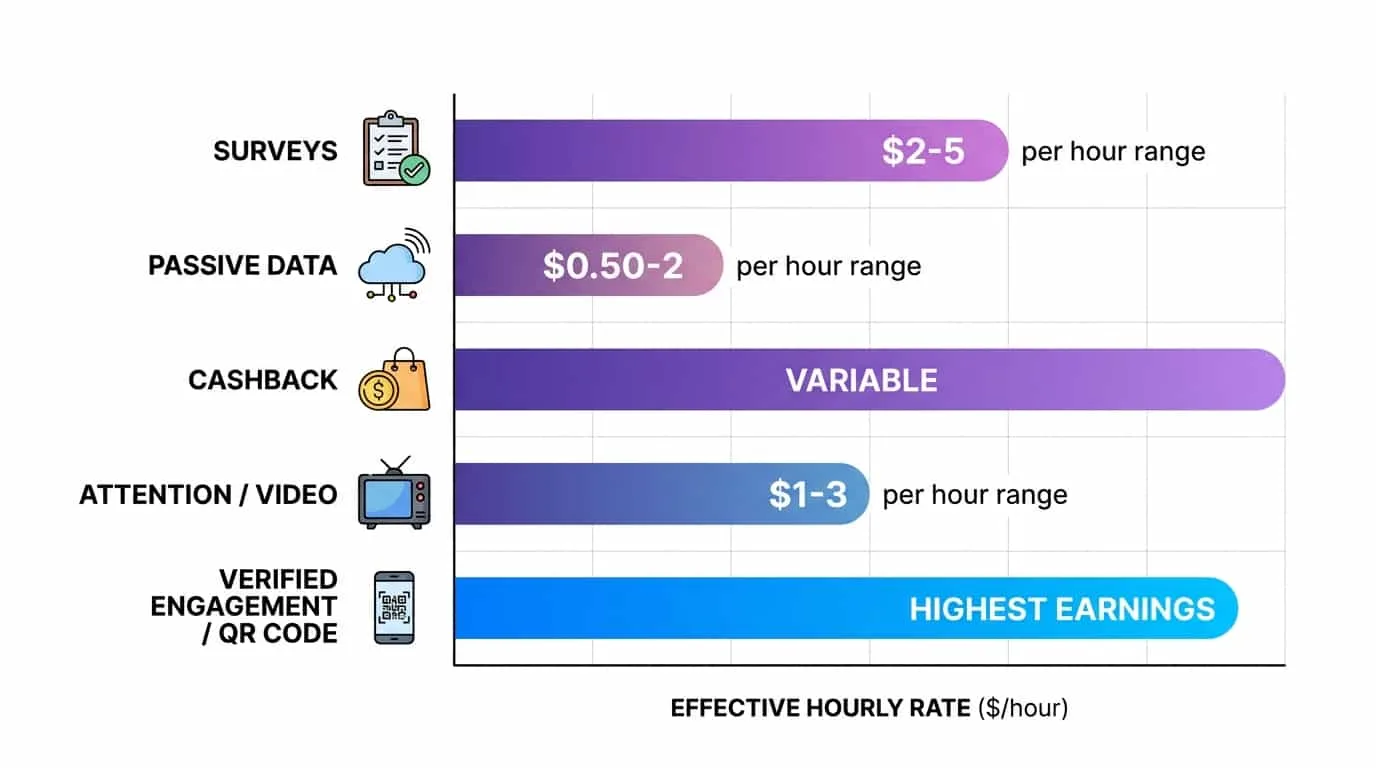
Survey apps typically pay between $2 and $5 per hour of active work. That already includes the time you spend getting screened out of surveys you do not qualify for. NerdWallet's analysis found that users routinely invest 10 minutes answering questions only to be told they are ineligible near the end, resulting in zero payment for that time. A test by one reviewer showed $4.20 earned in 30 days from roughly 2 hours of survey work on Swagbucks, putting the effective rate at about $2.10 per hour.
Passive data-sharing apps like Honeygain pay roughly $0.10 per GB of bandwidth shared, translating to $5 to $20 per month with zero active time. The effective hourly rate is technically infinite because you spend no time on it after setup. But the total amount is low, so it only works as one layer of a larger micro income stack.
Cashback apps return 1% to 10% of money you spend. The "earnings" depend entirely on how much you buy. Someone spending $2,000 per month on groceries and online shopping might get $50 to $100 back. Someone spending $500 gets $15 to $30. The rate is decent, but it requires spending to earn.
Verified engagement apps like VISU operate on a different model entirely. Instead of paying pennies for passive attention or requiring you to spend money, they pay for real-world actions like scanning a QR code at a partner location. Brands pay more for verified foot traffic and intentional engagement than for a passive video view, which means the value per interaction is higher than what most traditional reward apps can offer.
The 3 Questions That Decide Everything
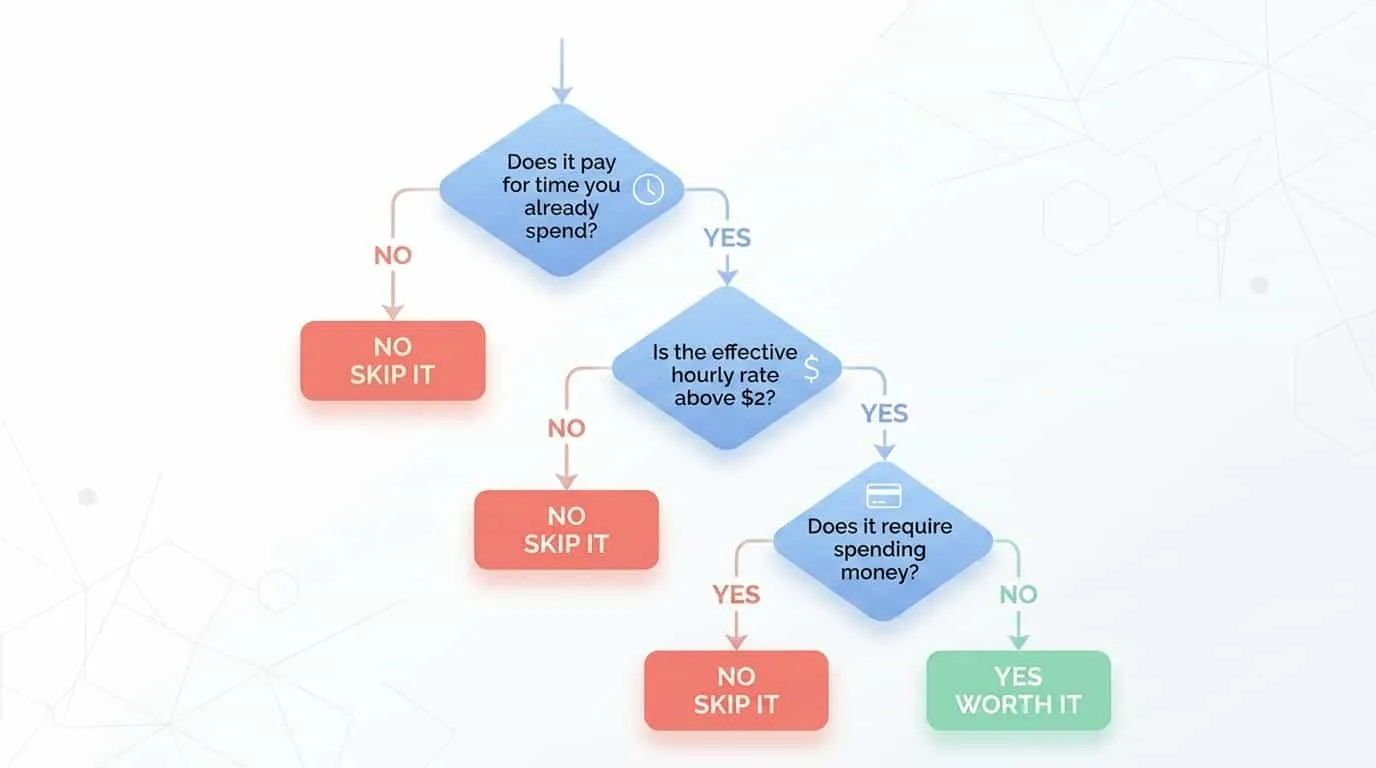
Before downloading any reward app, ask yourself these three questions. If an app fails on any of them, it is probably not worth your time. These are the filters we used during our 90-day test and they correctly predicted which apps we would still be using at the end.
Question 1: Does this app pay me for time I am already spending? This is the most important filter. An app that pays you while you walk to work (Sweatcoin), while your internet sits idle at night (Honeygain), or while you eat at a restaurant you already chose (VISU) adds income to existing behavior. An app that requires you to sit and watch 45-second ads for $0.002 each is creating new unpaid labor. The first is worth it. The second almost never is.
Question 2: Is the effective hourly rate above $2? If the app requires active attention and pays less than $2 per hour of that attention, you are earning below the threshold where most people feel the activity was worthwhile. Our testers universally abandoned apps that fell below this line within 3 weeks. If you want a realistic phone income guide with actual numbers, start with the hourly rate.
Question 3: Does it require me to spend money to earn? Cashback apps only pay when you buy something. That is fine if you were already going to buy it. But research shows that cashback incentives increase spending by 5% to 15% among users who are not careful. If the app is causing you to spend more than you would otherwise, the net effect is negative. For a deeper look at this dynamic, see our analysis of the problem with cashback apps.
Category Breakdown: Worth It or Not
Not all reward apps work the same way. Judging Honeygain by the same criteria as Swagbucks makes no sense because one requires zero time and the other requires hours of active participation. We broke the market into five categories and evaluated each on its own terms. The verdict varies significantly by category.
Survey Apps: Mostly Not Worth It
Verdict: Not worth it for most people.
Survey apps like Swagbucks, Survey Junkie and InboxDollars promise to pay you for your opinions. The reality is that the effective hourly rate sits between $2 and $5 for most users, and that number includes the dead time spent qualifying, getting screened out and restarting. Survey Junkie pays slightly better per hour for pure surveys ($5 to $10 per hour in ideal conditions), but qualifying for those higher-paying surveys is inconsistent.
The bigger hidden cost is your data. NerdWallet warns that these apps collect extensive personal information including birth dates, ZIP codes, income levels, health conditions and ethnicity. The CEO of the Identity Theft Resource Center notes that users are putting themselves at the mercy of these platforms with no guarantee of how that information will be used or stored. The trade is not just time for money. It is time plus personal data for very little money.
The one exception is Prolific, which requires researchers to pay participants at least $8 per hour. But Prolific has a waitlist, limited availability and no app. For anyone still interested in surveys, see our full breakdown of apps that actually pay real money to compare with other earning methods.
Passive Data Apps: Worth It (With Conditions)
Verdict: Worth it as a base layer, not as primary income.
Honeygain and Pawns.app share your idle internet bandwidth and pay you for it. Nielsen Mobile Panel pays you to install a monitoring app. These apps require zero active time after installation. You install them, grant permissions and never think about them again.
Typical combined earnings from Honeygain plus Pawns sit around $10 to $25 per month. Nielsen adds roughly $5 per month. The total is modest, but the time investment is literally zero, making the effective hourly rate irrelevant. Free money is free money.
The condition that makes them worth it is treating them exclusively as a base layer. If you install Honeygain expecting to pay rent, you will be disappointed. If you install it as the foundation of a broader stack with cashback, attention and engagement layers on top, it works perfectly. The passive base should run in the background while higher-value activities generate the real income.
Cashback Apps: Worth It If You Don't Change Behavior
Verdict: Worth it with discipline. Dangerous without it.
Rakuten, Ibotta, Fetch Rewards and Upside return 1% to 10% of purchases. This is real money. Users spending $1,500 per month on groceries, gas and online shopping can realistically recover $30 to $100 per month without changing what they buy or where they shop.
The risk is behavioral. The entire business model of cashback apps depends on driving incremental spending. When you see "10% cashback at this store," the temptation to buy something you would not otherwise buy is real. Research shows that cashback apps are dying as a category partly because brands are realizing that the purchases they subsidize often would have happened anyway, reducing their marketing ROI.
The rule is simple: only activate cashback on purchases you had already planned before opening the app. If you follow this rule, cashback is pure profit. If you break it, you are paying a premium to feel like you are saving.
Earn Without Spending
Unlike cashback apps, VISU rewards your attention and presence at partner locations. No purchase required.
Attention Apps: Barely Worth It
Verdict: Only worth it as background noise.
Apps that pay you to watch videos, view ads or keep a lock screen active include Swagbucks video playlists, S'more and InboxDollars TV. The earnings are tiny. Swagbucks video playlists pay roughly $5 to $15 per month. S'more pays about $3 per month for a lock screen you never interact with. Microsoft Rewards pays $7 to $13 per month for daily searches and quizzes.
These apps are only worth it if they truly run in the background while you do something else. Watching Swagbucks videos while commuting on a train costs you nothing. Sitting at your desk actively watching them is earning $1 to $3 per hour, which is below the worth-it threshold for almost everyone.
The honest answer: attention apps work as one thin layer in a multi-app stack, but they should never be your primary earning method. The effective hourly rate is too low for active use and the monthly total is too small to stand alone. If you want to maximize your earnings, focus your active time on higher-value categories.
Verified Engagement Apps: The Exception
Verdict: Worth it. This is where the model actually works.
This is the newest category and the one that changes the equation. Verified engagement apps like VISU pay you for provable real-world actions: scanning a QR code at a partner restaurant, interacting with a brand campaign at a retail store, checking in at a local business. The fundamental difference is that brands pay significantly more for verified foot traffic and intentional engagement than they pay for a passive video impression or a survey response.
The economics are straightforward. Global advertising spend crossed $1 trillion for the first time in 2026. Brands are spending more than ever to reach consumers, but traditional digital ads suffer from banner blindness, ad blockers and fraud. A verified QR scan at a physical location proves a real human was physically present and chose to engage. That proof is worth more to an advertiser than 1,000 passive impressions, which means the reward passed to you per interaction can be meaningfully higher.
VISU works by placing QR codes at partner locations including restaurants, cafes, retail stores and events. You scan the code, interact with a short brand campaign and receive a reward. The interaction takes 10 to 15 seconds. No purchase is required. Your presence and attention are the asset being compensated. VISU also offers VISULINK for content creators, allowing you to monetize clicks on your link-in-bio page, adding a digital layer to the physical engagement model.
In the context of whether reward apps are "worth it," verified engagement passes all three of our filter questions. It pays you for time you already spend (eating, shopping, visiting locations). The value per interaction is higher than traditional reward app rates. And it does not require you to spend money. This is the category we recommend building your reward strategy around, with passive and cashback layers as supplements.
When Reward Apps Are Definitely Worth It
Reward apps are worth your time in four specific situations. First, when you stack multiple apps that monetize different moments of your day without requiring extra effort. A micro income stack combining passive, cashback and engagement apps can generate $100 to $200 per month with less than 5 minutes of active daily effort.
Second, when the app monetizes time you were going to spend anyway. Walking apps count steps you already take. Cashback apps return money on purchases you already planned. VISU rewards visits to locations you already chose. If the app does not add tasks to your day, every cent is pure bonus.
Third, when you treat them as exactly what they are: supplemental income. Nobody should depend on reward apps for rent or groceries. They are the digital equivalent of finding coins between your couch cushions, except the coins add up to $50 to $200 per month when you are systematic about it.
Fourth, when you use referral programs strategically. Most reward apps pay $5 to $50 per friend referred. If you have a social media presence or a large friend circle, referral bonuses can exceed the app's core earnings during your first few months.
When Reward Apps Are Definitely NOT Worth It
Reward apps are not worth it when you find yourself sitting and actively working for less than $3 per hour. If you are spending 30 minutes watching ads for $0.15, that is $0.30 per hour. Your time has more value than that whether you spend it learning a skill, resting or doing literally anything else.
They are not worth it when they change your spending behavior. If you buy things you would not otherwise buy because an app offers 5% cashback, you are losing money, not making it. This is the most common trap and the reason many people feel cynical about the entire category.
They are not worth it when the data trade is unbalanced. Sharing your income level, health conditions, location history and purchase behavior with a platform that pays you $8 per month is a bad deal. Your data is worth more than that. Be selective about which apps get which permissions.
And they are not worth it when you install 15 apps, use none of them consistently and let notification fatigue drive you to delete all of them within a month. This is what happens to 90% of reward app users, and it is why the app retention rate drops to 7% by day 30. The strategic approach is to start with 3 apps, use them daily for a month, and only then add more.
The Honest Verdict
Are reward apps worth it? The answer is conditional. Most individual reward apps are not worth using alone. The earnings are too low, the time investment is too high and the data trade is too lopsided. But a well-constructed combination of 5 to 7 apps that covers passive income, cashback and verified engagement can generate $100 to $200 per month with minimal effort. The key is being strategic rather than hopeful.
The single biggest shift that separates people who earn real money from people who quit in frustration is moving from passive online earning to verified real-world engagement. Apps that pay for your physical presence and intentional attention operate on stronger economics than apps that pay for survey responses or background video views. The brands behind those campaigns have bigger budgets and higher willingness to share revenue with users.
Start with the apps that require zero effort (Honeygain, Pawns), add cashback to your existing purchases (Rakuten, Ibotta) and build your active strategy around verified engagement (VISU). That combination passes all three filter questions, respects your time and generates income that compounds month over month as you refine your routine.
The Reward App That's Actually Worth It
VISU pays for verified engagement at real locations. No surveys, no data selling, no spending required. Just scan and earn.
Frequently Asked Questions
How much can I realistically earn from reward apps per month?
A well-constructed stack of 5 to 7 apps can generate $100 to $200 per month with less than 5 minutes of active daily effort. Individual apps rarely pay more than $15 to $30 per month on their own. The value comes from layering multiple apps that monetize different parts of your day.
Why do most people quit reward apps within a month?
The average app loses 77% of users within 3 days and 93% by day 30. With reward apps, the primary cause is the gap between expected earnings and actual earnings. People download expecting $500 per month and earn $8 in the first week. The apps that retain users are the ones with fast, tangible rewards for minimal effort.
Do reward apps sell my personal data?
Some do and some do not. Survey apps explicitly collect personal data because that is their business model. Passive data apps share bandwidth, not personal information. Cashback apps track purchase behavior. VISU operates on an engagement model where brands pay for verified attention, not for reselling your raw personal data. Always read the privacy policy before granting permissions.
Is VISU better than Swagbucks?
They serve different purposes. Swagbucks pays for online surveys and watching videos with an effective hourly rate of $2 to $5. VISU pays for real-world engagement like scanning QR codes at partner locations. For people who are already out and about visiting stores, restaurants and events, VISU typically offers more value per minute of effort. The ideal approach is using both as different layers in your stack.
Are reward app earnings taxable?
In the United States, earnings from reward apps can be taxable if they exceed certain thresholds. Cashback that is treated as a purchase rebate is generally not taxable. Earnings from surveys, task completion and other non-purchase activities may be. Consult a tax professional for your specific situation.