

Static QR codes feel free. You generate one online, slap it on a poster, print a thousand copies, and move on. Then the URL changes, or the campaign ends, or somebody finds a typo, and suddenly that thousand-piece print run is firewood. The code that cost you nothing just cost you everything. This is the part nobody tells you when they hand you a free QR generator.
Here is what most business owners do not realize. A static QR code is not really a QR code in the modern sense. It is a printed URL in disguise. The link is baked into the pattern itself, locked in forever, and the only way to change where it points is to print a new code and replace every single copy you ever distributed. Every flyer, every menu, every sticker, every receipt template. If you printed it, you own the cost of fixing it.
Dynamic QR codes solve this with one small architectural difference, and that difference changes the entire economics of using QR codes in a business. Once you understand it, you stop seeing static codes as free and start seeing them for what they actually are. A short-term shortcut that quietly transfers risk from the platform onto your printer bill.
Stop Reprinting. Start Editing.
VISU QR Ads gives you dynamic codes you can update anytime, track in real time, and route to wherever the campaign needs to go. One code, infinite destinations.
What a Static QR Code Actually Is
The pattern of squares on a QR code is not a random design. It is data, encoded directly into the visual itself. When you scan it, the camera reads the squares, decodes the data, and follows whatever URL was written into them at the moment of generation. That moment is permanent. Once printed, the link inside that pattern is locked forever, and the only way to "change" it is to print a different pattern and physically replace the old one.
This is why static codes feel free. There is no platform between you and the code. You generate it, you own it, you print it, end of story. No subscription, no account, no recurring cost. From a budget line perspective, it looks like the smartest move in the room. The catch is that what you saved on the platform fee, you will eventually pay back ten times over the first time anything about your business changes. And in a small business, things change constantly.
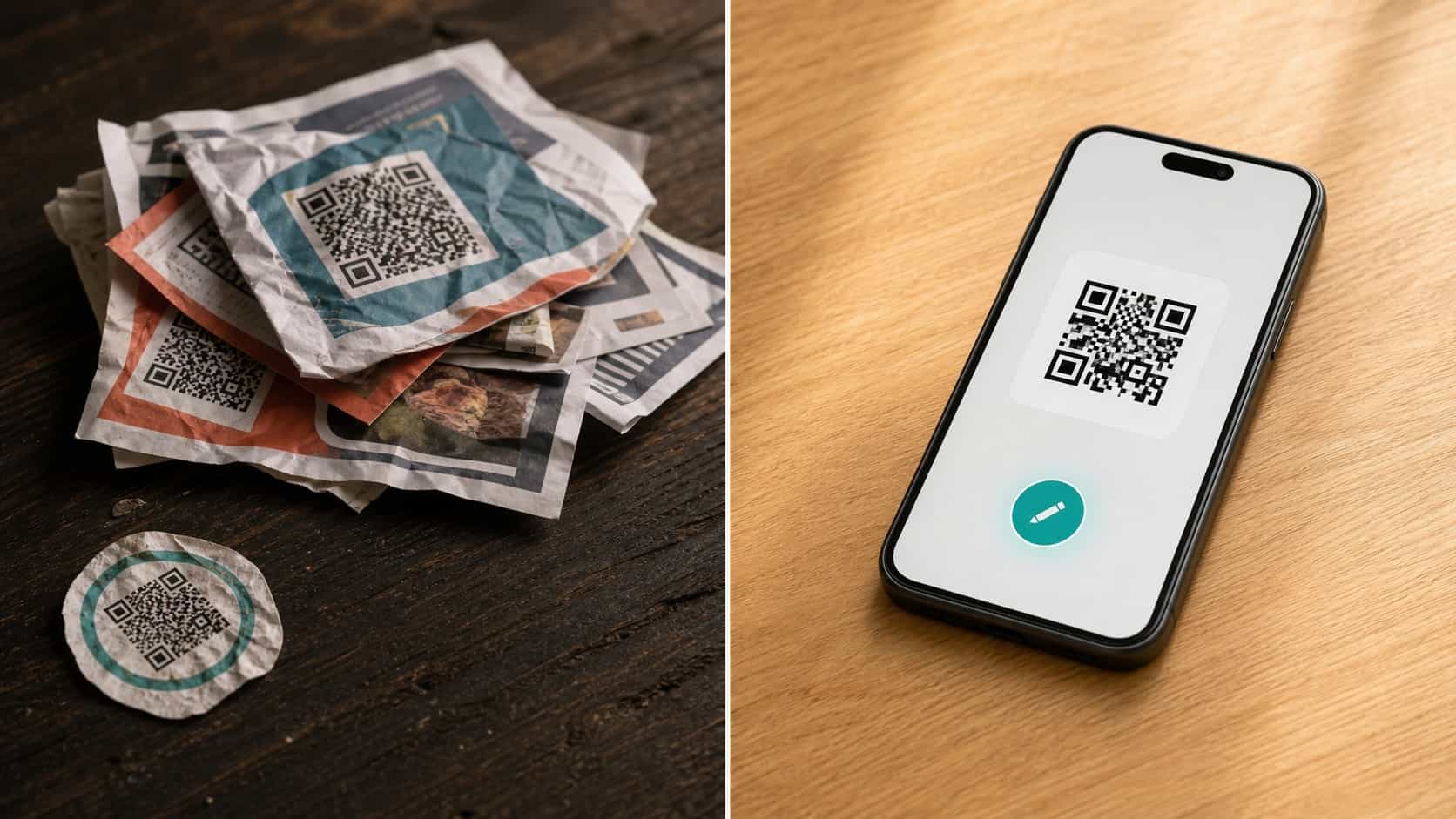
Compare that with how a dynamic code works. The pattern still encodes a URL, but that URL is not your final destination. It is a short link owned by the platform, which then redirects to wherever you tell it. Change where it points and every copy of the code already in the wild updates in seconds, because the printed pattern never had to change. The link is software, not paper. For a side-by-side breakdown, see our explainer on dynamic vs static QR codes.
Five Scenarios Where Static Codes Quietly Fail
The failure modes of static codes do not announce themselves. They show up as missed scans you never see, customers who quietly bounce, and growth opportunities you cannot act on. Here are five real situations where owners realize too late that they picked the wrong format.
The URL changed and nothing tells you. Maybe your booking platform got acquired and rebranded its links. Maybe your old domain expired. Maybe somebody on the team rebuilt the website and the slug shifted from /book-now to /booking. Whatever the reason, the static code on the wall now leads to a 404 page or a redirect chain. Customers scan, see an error, blame the business, and walk away. You only find out when reviews start mentioning it.
The campaign ended but the code is still everywhere. You ran a holiday promotion, printed 1,000 flyers, distributed them to nearby cafes and partners. The promo wraps in January. The code is still pointing to a page that says "promotion ended." Anyone scanning it now is having a worse first impression of your brand than if they had never found you at all. Static cannot redirect that anywhere useful. Dynamic flips it to your homepage in five seconds.
The destination needs to change by location or device. You expand to a second location. Now the same printed code on a flyer cannot route iPhone users to the App Store and Android users to Play Store, or send people in São Paulo to one menu and people in Rio to another. Static codes have one destination. Period. Dynamic platforms can route based on device, time of day, or location, which turns one piece of printed material into a smart distribution system.
You need to know if it is working at all. A static code gives you zero data. None. You do not know how many people scanned, when, where, or what device they used. You do not know if the placement on the counter is outperforming the one on the menu. You are flying blind, optimizing nothing, and reordering the same printed material year after year on faith. QR code tracking is impossible without dynamic.
You made a typo or design mistake. The code prints fine but you spelled the company name wrong on the surrounding artwork. Or the URL had an extra character no one caught. Or legal asked you to change a disclaimer. With static, every printed copy is a write-off. With dynamic, you fix the destination behind the scenes and the artwork fix can wait for the next print cycle. The cost of human error drops to almost zero.
One Mistake Should Not Cost a Print Run
VISU QR Ads lets you fix the destination after printing, anytime, in seconds. The artwork stays. The link adapts.
Flying Blind: The Data You Are Throwing Away

Here is the cost that owners almost never calculate, because you cannot see what you do not measure. Every time someone scans a static code, an interaction with your business just happened, and you got nothing out of it. No timestamp, no location, no device, no follow-up, no record. The customer raised their hand and you never saw it. A dynamic code captures that signal and turns it into something you can act on.
What does that signal actually tell you? At minimum, a dynamic code records the scan time, the rough geographic location, the device type, and whether the destination loaded. From there you can see which placement is producing scans, which days of the week are strongest, whether scans translate into actions on the destination page, and which physical materials are pulling weight versus dead weight. None of this is theoretical. It is real-time data that lets you stop printing things that do not work and double down on the ones that do.
For a small business, the value of this data compounds. After thirty days of tracking, you know your peak hours. After ninety, you know your best placements. After six months, you know which of your physical assets are essentially free advertising and which ones are decorative. Static codes never give you that picture, and the cost of that ignorance is not a line item. It is opportunity, every week, forever.
What Dynamic Actually Changes
The architectural difference is small but the practical difference is huge. A dynamic code points to a short link that the platform controls, and that short link redirects to wherever you currently want it to go. The user experience is identical. They scan, the page opens, no extra steps, no slower load. From their side, nothing changed. From your side, everything did.
You can update a printed QR code without reprinting. You can pause a campaign and resend traffic somewhere else. You can run two destinations in parallel and split traffic between them to test which lands better. You can route by device, language, or country. You can lock the code with a password during a launch window and open it at a specific time. You can suspend it the moment something goes wrong, which is something static can literally never do.
And every one of those scans feeds back into a dashboard that tells you what is happening. Not in a sample, not in a report you have to request. In real time, on your phone, while you are standing in your business watching customers walk past the code on the wall. That feedback loop is what turns a printed code from passive decoration into a managed channel that gets better month over month.
When Static Codes Are Genuinely Fine
Static codes are not always wrong. They are wrong as a default for a business, but there are real situations where the static format makes total sense. Recognizing those keeps the conversation honest and helps you spend on dynamic where it actually pays off.
One-time personal use. Sharing your wifi password with houseguests, putting a link to your wedding photos on a thank-you card, encoding a vCard for a quick contact share. These are scenarios where the destination will never change, the code will not be reprinted, and tracking does not matter. Static is perfect.
Permanent technical destinations. A code on a piece of equipment pointing to a manufacturer's manual that has not changed in ten years and will not change in the next ten. A code on a museum plaque pointing to a fixed encyclopedia entry. A code on a tombstone. The destination is stable across time horizons longer than any reprint cycle, so flexibility has no value.
Throwaway prototypes. Mocking up a flyer to test a layout, building an internal demo, showing a client what the artwork will look like. Static is the right call because the goal is not durability, it is speed. As soon as the design moves to production, the code should switch to dynamic.
If your use case does not match one of those, you almost certainly want dynamic. The question is not "do I need analytics," it is "can I afford to be wrong and pay for the reprint." For most businesses, the honest answer is no, and the math gets clearer the second time you have to redo a print run.
How to Migrate Without Reprinting Everything
The good news is that migrating off static codes does not have to mean throwing away every printed asset you currently have. The strategy is to triage. Start with the highest-traffic surfaces and the materials you reorder most often, then let the rest age out naturally as you reprint them in normal cycles.
First pass, replace anything you reprint monthly or more often. Receipt templates, daily menus, reorder-on-demand stickers. These get new codes immediately, dynamic from the next print cycle, no extra cost because you were going to reprint anyway. This single move covers most of your scan volume in most businesses.
Second pass, identify high-stakes surfaces with long shelf lives. Table tents, mirror decals, business cards, lobby signs. For these, generate a dynamic code now and produce a small bridge run of replacement materials. The unit cost is real but small, and you are converting your most-scanned surfaces into trackable, editable assets that pay back over the next year.
Third pass, leave the rest. Old flyers in partner locations, legacy brochures in waiting rooms, anything you would have replaced eventually anyway. As natural reorder cycles come around, the static codes get replaced organically. Within six to twelve months, your entire physical footprint is dynamic, and the migration cost is mostly absorbed into reprints you would have done regardless. For tools to actually generate the new codes, our overview of QR code generators for business covers what to look for, and our breakdown of VISU vs static QR generators walks through the practical differences.
The Code Should Adapt to Your Business, Not the Other Way Around
VISU QR Ads turns every printed surface into an editable, trackable asset. Update the destination anytime. Track every scan. Reprint nothing.
Frequently Asked Questions
Are static QR codes really worse, or is this just marketing for paid platforms?
Static codes are objectively more limited. The pattern is locked at generation, the destination cannot change, and there is no scan data captured. Those are technical facts, not marketing. The honest framing is that static is fine for permanent, untracked, one-time use cases. For anything that might change or that you want to measure, static is a long-term liability disguised as a free option.
Do dynamic QR codes scan slower or look different?
No. The user experience is identical. Same scan motion, same speed, same look. The only visual difference is that dynamic codes can be shorter and cleaner because they encode a short tracking link instead of a long destination URL. Customers cannot tell the difference, but you can update the destination anytime and see the analytics.
What happens if I stop paying for the dynamic QR platform?
This is the real question to ask before signing up. Some platforms break the code if you cancel, which is a hard lock-in. Better platforms either let you export your codes to static format or keep them functional during a grace period. Always read the cancellation policy before committing, and prefer platforms that give you ownership of your codes rather than holding them hostage.
How much do dynamic QR codes typically cost?
Pricing varies, but most business plans land between fifteen and fifty dollars per month for unlimited codes with full tracking. For most businesses, that is dramatically cheaper than a single avoidable reprint. The math becomes obvious the first time you avoid throwing away a print run because of a typo or platform change.
Can I tell from looking if a QR code is static or dynamic?
Not visually with certainty, but you can usually guess. Static codes tend to be denser because they encode the full destination URL. Dynamic codes tend to be cleaner and simpler because they encode a short tracking link. If you scan a code and it goes through a redirect domain (like vsu.li or similar) before landing, it is dynamic. If it goes straight to the destination URL, it is static.